
Exhibitions · Los Angeles
Reading time: 8 minThe California poppy blazes across the hills after rain and is gone within weeks. Roger Herman has painted them at scale and hung a skull in the same room. At eighty, half a century into his life in Los Angeles, the German painter who taught a generation of Californians is having his first solo show at Carpenters Workshop Gallery. It is open until 20 September.
Carpenters Workshop Gallery Los Angeles is currently staging California Poppies, its first solo exhibition devoted to Roger Herman, and it runs until 20 September 2026, which means you still have time.
I should declare an interest in Herman’s work. I first came across it at Art Basel Miami Beach in 2024, where Carpenters Workshop showed him among a stand of artists working at the border of art and design. It is the kind of encounter that stays with you and sends you looking for the rest. A full solo show is exactly that, and this one is worth making time for.
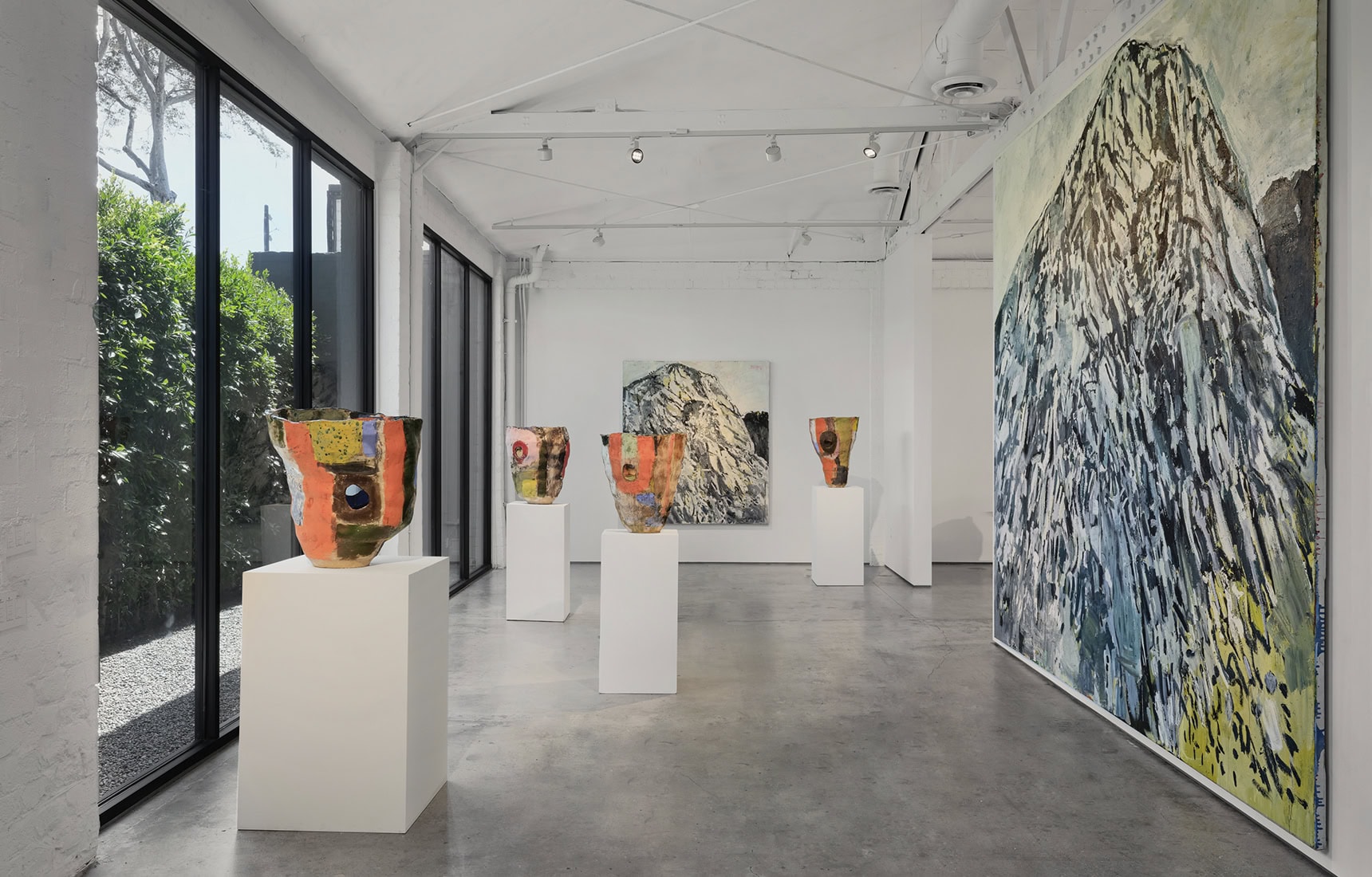
The exhibition brings together large-scale canvases, wheel-thrown ceramic vessels, two tables surfaced in ceramic panels, and a series of small cups. It is a survey of a practice that has spent fifty years refusing to decide whether it is painting or pottery, and has been considerably better for it.

The poppy, and the skull
Start with the title, because it is doing more work than it appears to.
The California poppy — Eschscholzia californica — has been the state flower since 1903, and every Californian knows what it does. After a wet winter, the hills turn orange, in sheets, in a superbloom. And then, within a matter of weeks, it is over. The poppy is the flower of the brief, spectacular arrival.
It is also, across most of Western art, the flower of sleep and forgetting and death.
Now consider what is hanging in the room with the poppy paintings. Among the large canvases, the Poppies works, multi-hued, densely layered scenes of leaves and flowers; Mountain, a landscape swept out in broad strokes of blue, turquoise and white; and there is a painting of a human skull.
The skull is a recurring motif in Herman’s work, and the gallery is explicit that it evokes the inevitability of death. Which means the show is built on the oldest arrangement in Western still life: flowers and a skull. Vanitas. Look how beautiful; look how briefly.
Herman has not imported that idea. He has found it growing on a Californian hillside, where the most beautiful thing the state produces is also the most fleeting. The superbloom is a vanitas. He simply painted it.


Untitled 44 – Courtesy of Carpenters Workshop Gallery
Who Roger Herman is
Herman was born in 1947 in Saarbrücken, a Franco-German border town that has changed nationality more than once and knows something about instability.
He began by studying law and philosophy at Saarland University. Painting won. He left for the Academy of Fine Arts in Karlsruhe, and in 1977 he moved to Los Angeles, where he has lived ever since.
The timing is the thing. Herman left Germany at precisely the moment German painting was becoming the loudest voice in the world, the moment of Baselitz, Kiefer, Immendorff and A.R. Penck, and arrived in California instead. In the 1980s, he was shown by Gagosian and positioned as the West Coast parallel to Neo-Expressionism: the same gestural force, the same freedom of attack, transplanted into Californian light.
In the late 1980s, he joined the faculty of UCLA’s School of the Arts and Architecture, alongside Chris Burden and Charles Ray; a combination that turned the department into one of the most consequential art schools in America and shaped a generation of Los Angeles artists.
And in 1998, with the Austrian painter Hubert Schmalix and the German filmmaker Chris Sievernich, he opened Black Dragon Society in LA’s Chinatown, an artist-run gallery named after the kung fu studio that had occupied the space, and which became the place to find people before anyone else had.
His work is held by LACMA, SFMOMA, the Hammer, MOCA Los Angeles, MoMA in New York, the Nasher Museum of Art in Durham, and the Walker Art Center in Minneapolis.
He is, in other words, not a painter who took up ceramics. He is one of the central figures of Los Angeles art, who happens to have spent thirty years making pots.

The pots, and where they came from
Here is the detail that explains the ceramics, and it is a good one: Herman learned to make pots at UCLA, while he was teaching there.
He did not train as a ceramicist. He was a painter in an art school who wandered into the clay and stayed. And it shows in everything he makes, because he brings a painter’s freedom to what a pot can be.
The vessels in California Poppies are wheel-thrown; the most disciplined, most classical way to begin, and then thoroughly interfered with. They arrive irregularly, with spontaneous voids and protrusions, shapes that come straight from a painter’s instinct. And then they are glazed like paintings: Herman is candid that what draws him to clay is the transformation colour undergoes in the kiln, and he treats the surface of a vessel exactly as he treats a canvas.
Look at Untitled 120 (2021) — a great yellow vessel with a flower drawn across it in black, lilac and pale green, the glaze pooling and running. It is a pot with a painting on it and it is neither, comfortably.
Two tables, one dining, one coffee, carry tops made of square ceramic panels bearing the same painterly attack, which is where Carpenters Workshop’s interest in functional art meets Herman’s indifference to categories. You can eat off it. That does not make it less of a painting.

The Mescal cups
The quietest works in the show are among its most affecting, and they are tiny.
The Mescal series is a collection of small ceramic cups modelled on the jícara, the traditional Mexican vessel made from a halved, dried gourd, used for drinking mezcal. It is one of the oldest and most ordinary drinking vessels in the Americas: a fruit, cut in half, hollowed, dried.
Herman remakes it in clay, glazed with the same restless textures as the vessels and the canvases. Mescal 42 (2022) is green and pink with a black beak-like protrusion; Mescal 5 (2022) is white and blue and looks as though it has been rescued from a fire.
And think about what that means in a show called California Poppies. A jícara is a vessel that was once a plant. Herman has made a ceramic copy of a fruit, and set it in a room full of paintings of flowers. The same subject, entering from a different door: the natural world made into an object you can hold, and drink from, and break.

California, Pink, Green, Yellow Drawing, Courtesy of Carpenters Workshop Gallery
Carpenters Workshop Gallery
The gallery is a good match, and its own history is worth a line.
Carpenters Workshop Gallery was founded by Julien Lombrail and Loïc Le Gaillard, childhood friends, in a former carpenter’s workshop in London’s Mayfair — hence the name. It now operates four galleries: London, Paris, New York and Los Angeles, at 7070 Santa Monica Boulevard. Its London home is now within Ladbroke Hall, the Notting Hill arts complex.
It also runs The Workshop at Mitry-Mory outside Paris — an 8,000 square metre research and production complex where its artists work alongside master artisans. That is an unusual amount of infrastructure for a gallery to own, and it explains why the work it shows so often sits exactly on the line between sculpture and furniture. In the same year Herman’s Los Angeles show opened, his work also appeared in the gallery’s Paris group exhibition, Radical Making, alongside historic and contemporary makers spanning six decades.


Mescal 5, Courtesy of Carpenters Workshop Gallery
“In the many years we have been working with Roger Herman, we have always admired the way he transforms imperfection and spontaneity into an expressive, evocative artistic form. His unpredictable and experimental way of depicting nature’s materiality pushes the boundaries of both ceramic art and painting. We are particularly delighted to share some of his finest creations with audiences in the city that holds such significance for the artist and where he holds an exemplary role in the creative community.”
Le Gaillard
That last phrase is the accurate one. Herman has taught at UCLA, run a gallery for other artists, and spent nearly fifty years in the same city. He is not visiting Los Angeles. He is one of the things Los Angeles is made of.
Visiting
Roger Herman: California Poppies Carpenters Workshop Gallery, 7070 Santa Monica Boulevard, Los Angeles, CA 90038 11 June – 20 September 2026

Frequently asked questions
What is California Poppies?
Carpenters Workshop Gallery Los Angeles’s first solo exhibition devoted to Roger Herman, running 11 June to 20 September 2026. It brings together large-scale paintings, wheel-thrown ceramic vessels, two ceramic-topped tables and the small Mescal cups.
Who is Roger Herman?
A German-born painter and ceramicist, born in Saarbrücken in 1947, resident in Los Angeles since 1977. In the 1980s he was shown by Gagosian and regarded as the West Coast parallel to Neo-Expressionism. He is a professor at UCLA, co-founded the Chinatown gallery Black Dragon Society in 1998, and his work is held by LACMA, SFMOMA, MoMA, the Hammer, MOCA, the Nasher and the Walker.
What are the Mescal cups?
Small ceramic pots modelled on the jícara — the traditional Mexican cup made from a halved, dried gourd and used for drinking mezcal — glazed in the same manner as Herman’s larger vessels and paintings.
Why a skull?
The skull recurs throughout Herman’s work as a memento mori. Placed among paintings of poppies — a flower famous for blooming spectacularly and briefly — it sets up the classic vanitas pairing of flowers and death.
Where is Carpenters Workshop Gallery in Los Angeles?
7070 Santa Monica Boulevard, CA 90038. The gallery also has spaces in London (Ladbroke Hall), Paris and New York.

Final thoughts
A young man in Saarbrücken gives up law, learns to paint, and moves to California in 1977 — leaving behind a German art scene that is about to conquer the world.
Fifty years later he is still there: teaching, running rooms for other artists, throwing pots he was never trained to make, and painting the flower that turns the hills orange and then disappears.
He has hung a skull beside them, which tells you he has understood the joke. The superbloom is the most Californian thing there is, and what it is really about is how short the good part lasts.
A must-visit before 20 September.


Untitled 120, Courtesy of Carpenters Workshop Gallery


Leave a Reply