
ART & CULTURE · LONDON
Reading time: 9 minCharles Burnand has taken a new Mayfair address on a mews built for horses and drivers, and filled it with work nobody can see yet. Under Wraps holds eighteen makers beneath semi-translucent sheeting and uncovers them on a schedule that runs until January. The device sounds like theatre. It turns out to be an argument about how collectible design is actually looked at.
A gallery opening usually asks a room to take in everything at once. Under Wraps, the inaugural exhibition at Charles Burnand Gallery’s new home at 20 Bruton Place, does the opposite. The work arrives wrapped in semi-translucent architectural sheeting, and comes out from under it through a choreographed sequence of automated unveilings spread across the run, which opened on 12 September 2026 and closes on 9 January 2027.

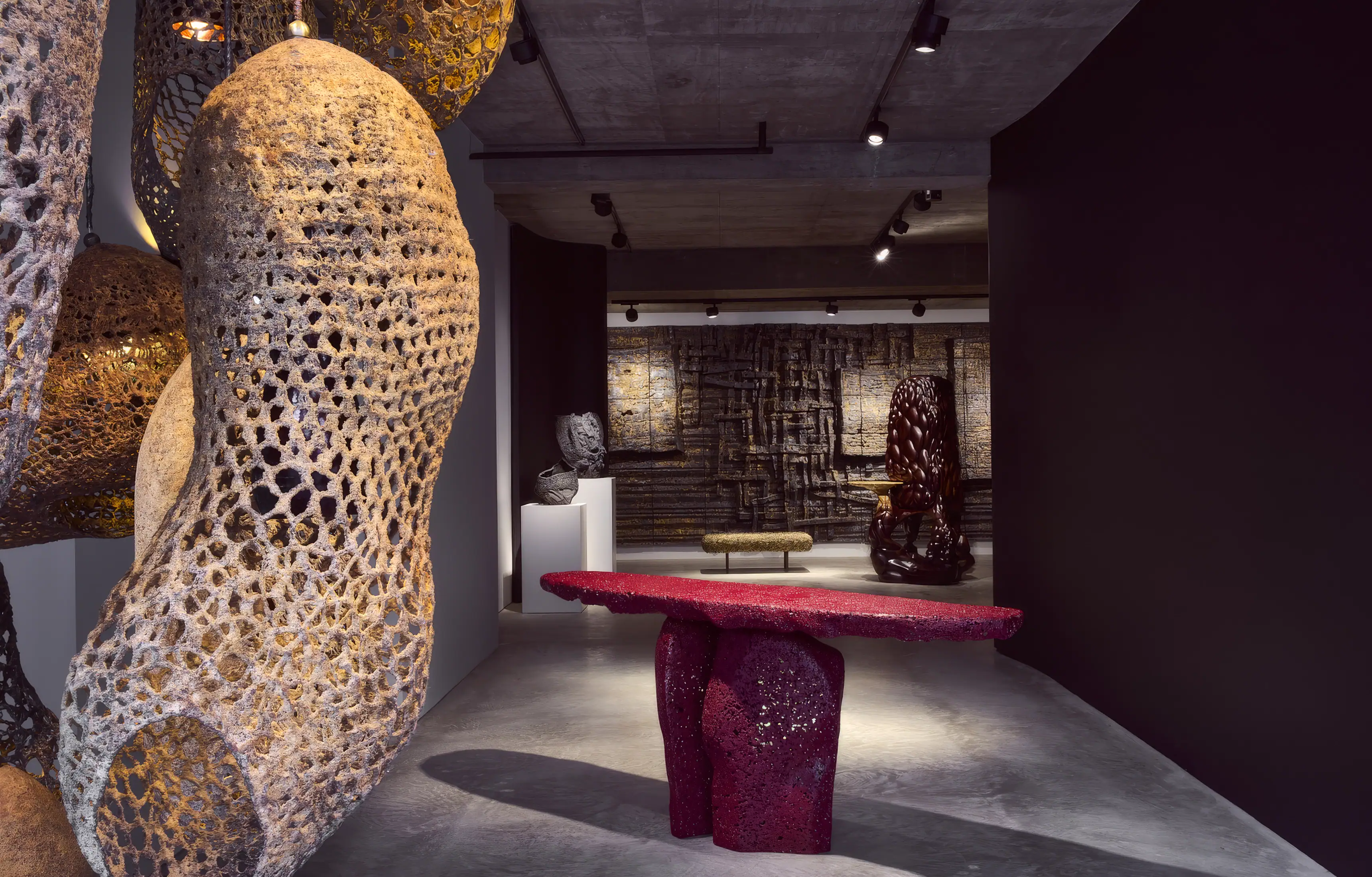
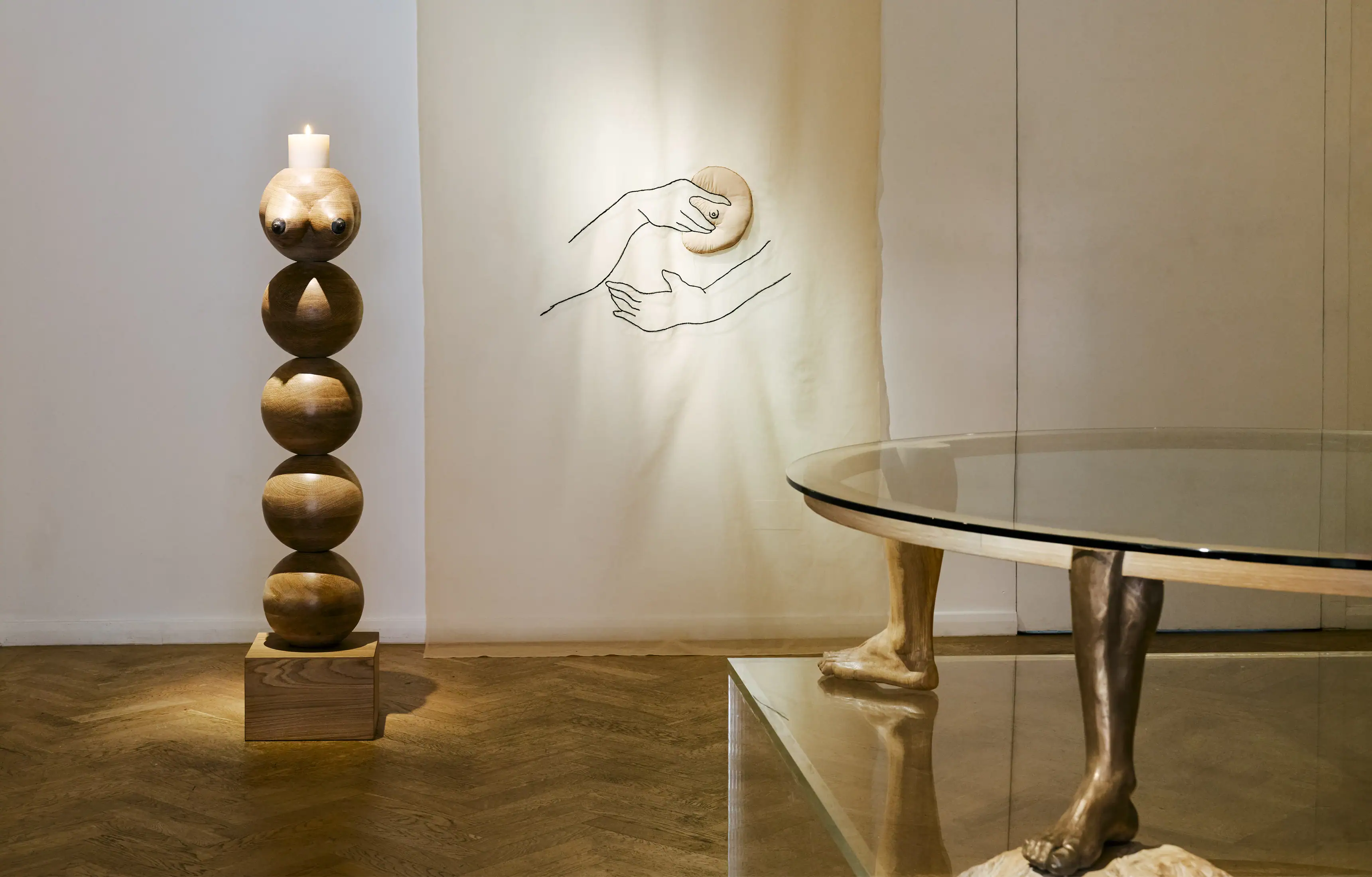
Eighteen makers are in the show: Niamh Barry, Peter Lane, Studio Furthermore, Kyeok Kim, Myungtaek Jung, Marc Fish, Deglan, Yanxiong Lin, Jan Waterston, Robyn Neild, Simon Stewart, Mia Jung, Jeske Haak, Inhye Ji, Jungin Lee, Heechan Kim, Ian Milnes and Dawn Bendick. Nearly everything has been made for this exhibition or is being shown in London for the first time. The material list runs to mirror-polished bronze, glazed ceramic stoneware, recycled aluminium, cast glass and precious metal leaf.
The reason the device works is not that it builds suspense, although it does. It is that almost every maker in the room already works by putting something out of sight, and the sheeting simply enlarges that idea to the size of the building.


A street built for the trades
Bruton Place is a service mews. It runs off Berkeley Square, crosses Bruton Street and dog-legs into Barlow Place, and it exists because the mansions on Bruton Street needed somewhere to keep their horses, their carriages and the people who drove them. The stables are still legible. Numbers 36 to 40 are Grade II listed, described in the record as a group of three stables with accommodation above, late nineteenth century, red brick with gauged brick dressings and a glazed brown brick dado, two storeys with gabled attics. The wide double doors are still there at ground level.

Over the following century the street took in garages and the back rooms of the fashion houses on the main road, and more recently an unusually dense run of restaurants for somewhere so short: The Guinea Grill at number 30, UMU, Bellamy’s, The Cocochine, SiLVA.
For a gallery that runs its own workshop, this is a coherent address. Charles Burnand does not only sell objects, it makes them: the gallery operates an in-house design and production studio realising bespoke commissions in bronze, cast glass and silver, produced in the United Kingdom. Putting that operation’s front door on a street of converted workshops, with the stable doors still in the elevation opposite, is the kind of decision that reads as luck and is usually judgement.


What the sheeting is actually doing
Collectible design is bought on first encounter. A collector walks in, sees a thing and wants it, and everything that follows is a negotiation with a feeling that already happened. That moment is the most valuable thing a gallery has, and it is also the thing an opening is worst equipped to protect, because an opening serves it to everyone simultaneously, in a crowded room, with a drink in hand.

Under Wraps takes that moment seriously enough to put it on a timetable. Rather than handing a visitor eighteen first encounters in a single evening, the exhibition parcels them out across sixteen weeks. Each automated reveal gives one piece a room to itself, in the attentional sense if not the architectural one. A visitor in November sees a different show from a visitor on the opening night, and the gallery gets sixteen weeks of reasons to be visited rather than one.
The sheeting itself matters as much as the schedule. Semi-translucent is a precise choice: the work is not hidden, it is deferred. Silhouette, scale and the general behaviour of light through the material are all available from the first day. What is withheld is surface, and surface is where most of these makers do their work.

The makers are working on the same idea
This is the part that turns a device into an argument. Take the five whose processes are best documented.
Studio Furthermore, founded in London in 2015 by Marina Dragomirova and Iain Howlett, who met on the Design Products MA at the Royal College of Art, make objects out of what is left when something is burned away. Their Tektites collection began by impregnating porous foams and sponges with Parian slip and firing them to 1,200 degrees. The sponge disappears; a ceramic skeleton in its exact shape remains, hard and stone-like and close to weightless. Moon Rock moved the same lost-foam logic into metal, cast in aluminium recycled entirely from car wheels, each piece carrying a pattern of voids that cannot be repeated. Their work is a record of an absence. Their holdings include the Vitra Design Museum, MAK in Vienna and CID Grand-Hornu.


Marc Fish works from Robinson House Studio in Newhaven, East Sussex, a working port town, where he also runs a furniture school. He pares veneers to no more than 0.6 millimetres, thin enough to bend like paper without steaming, then stacks them in sequence and suspends them in resin. Getting there took four years of trialling five resin formulations and a further three years solving the exothermic curing reaction that can draw air out of the wood and leave bubbles in the resin. His Nautilus table took 4,000 veneers and 1,000 hours. The finished object is a stack of things you look through to see other things.

Niamh Barry works from a studio in County Dublin she founded in 2001, with a team of around ten. She trained in ceramics at the National College of Art and Design and is self-taught in bronze, which is worth knowing when you look at the work, because the forms behave more like thrown volumes than fabricated ones. The National Museum of Ireland, which gave her a solo exhibition from 2018 to 2020 and acquired the prototype of her Fouette series, describes her pieces as interlocking bronze or stainless steel forms with tiny hand-cut strips of LED embedded in them. The light source is inside the sculpture. You never see it.
Peter Lane works from a 10,000 square foot studio on Scholes Street in Bushwick, Brooklyn. He came to clay from painting, having mixed sand into canvases for texture, after an encounter with mid-century pottery in Miami Beach in 1994. For wall installations he rolls slabs several inches thick, sculpts them by hand, marks a laser grid, cuts the slab into modules, then glazes and fires every module separately before composing the whole thing on site. He mixes his glazes from scratch and works the behaviour of cobalt, manganese and copper in the kiln, a process he calls fast geology. His pool walls at the Hôtel de Crillon run close to a hundred feet.

Dawn Bendick, born in New Jersey in 1977 and working from Kent, uses dichroic and what she calls multitone glass, and states her subject with unusual precision: the human instinct for temporal reckoning, the way we read the time of day and the turn of the season from light. She came to it through colour theory at the Maryland Institute College of Art and a Material Futures MA at Central Saint Martins, and before that through fashion, at Calvin Klein, Prada and the forecaster WGSN. Her work is in the National Museum of Norway. The whole point of a Bendick piece is that it does not look the same twice.
Set those five side by side and the exhibition’s device stops looking like staging. A show about concealment, gradual revelation and the passage of time has been built out of makers whose work is already about concealment, gradual revelation and the passage of time. The sheeting is not a wrapper around the idea. It is the idea, at room scale.


A grandfather, and a workshop
The gallery was founded in 2009 by Simon Stewart, and it is named after his grandfather, Charles Burnand. Stewart is also on the roster, and appears in the Under Wraps line-up alongside the makers he represents.
That in-house studio is the quiet structural point. A gallery with a workshop can say yes to things a gallery without one cannot: a designer arrives with an idea that needs a compound curve bent in a difficult material, and the answer is worked out in the building rather than outsourced or declined. It also runs the other way, out towards the trade. “If someone says they’re working on a hotel lobby and want something in cast bronze,” Stewart has said of the studio’s commission work, “I’ll pair them up and facilitate the collaboration.”

It is also what makes the provenance claim stand up. Ask who made these objects and the answer is a list of named people in named places, from Dublin to Bushwick to a port town in East Sussex.
The Mayfair space is the first of two moves. A large-scale space in the Cotswolds is planned for 2027, which would give the programme somewhere to show work at a scale Mayfair cannot hold, and would put it within reach of the workshops it already depends on.

The programme this arrives from
Under Wraps does not land from nowhere. The gallery shows at Design Miami, PAD London, Salon Art + Design and Collect, and its most recent Miami presentation, Monuments of Ether, ran from 2 to 7 December 2025 at the fair’s twentieth-anniversary edition, curated by Glenn Adamson around the theme Make. Believe. The premise there was monumentality read as atmosphere and memory rather than as mass, and the material range ran from charred iroko and carbon-lacquered surfaces to dichroic metals and layered hanji paper.

Several of the names carry straight across. Studio Furthermore showed the Hydra cabinet, Jan Waterston the Strata cabinet and table, Deglan the Boulder floor lamps and Marc Fish the Relics chandelier, alongside Myungtaek Jung, Kyeok Kim, Peter Lane, Jungin Lee and Yanxiong Lin. That continuity is the point worth noticing: this is a gallery building a roster over years rather than assembling a line-up for an opening, which is also why an exhibition that withholds the work can afford to. The names are already known to the people it is withholding them from.
Among the makers in Mayfair who were not in Miami, Mia Jung works in poured glass with precious metal inclusions, and Robyn Neild, Jeske Haak, Inhye Ji, Heechan Kim and Ian Milnes complete the eighteen.


Frequently asked questions
Where is Charles Burnand Gallery’s new space?
At 20 Bruton Place, London W1J 6LY, a mews street running off Berkeley Square and across Bruton Street, in the heart of Mayfair.
When is Under Wraps on?
From 12 September 2026 to 9 January 2027. It opened during London Design Festival and forms part of the Mayfair Design District programme.
Is it free to visit?
Yes. Admission is free and no booking is required.
What does the exhibition actually do?
Selected works are held beneath semi-translucent architectural sheeting and uncovered through a choreographed sequence of automated unveilings staged across the run, so the exhibition changes between visits.
Who is showing?
Niamh Barry, Peter Lane, Studio Furthermore, Kyeok Kim, Myungtaek Jung, Marc Fish, Deglan, Yanxiong Lin, Jan Waterston, Robyn Neild, Simon Stewart, Mia Jung, Jeske Haak, Inhye Ji, Jungin Lee, Heechan Kim, Ian Milnes and Dawn Bendick.
Is it worth going more than once?
That is the design of it. A visit in September and a visit in December are different exhibitions, because different work will have been uncovered by then.
Final thoughts
The easiest thing to say about Under Wraps is that it is a clever way to open a gallery, and it is. The more interesting thing is that the idea holds all the way down. A sheet of semi-translucent plastic withholds surface and gives you silhouette. Marc Fish gives you 0.6 millimetres at a time. Studio Furthermore give you the shape of something that has burned away. Niamh Barry puts the light inside the bronze. Dawn Bendick gives you a different object depending on when you stand in front of it.
Sixteen weeks is a long time to keep an audience interested in a single room. Charles Burnand has found a way to make the room change instead.
Under Wraps runs at Charles Burnand Gallery, 20 Bruton Place, London W1J 6LY, from 12 September 2026 to 9 January 2027. Admission is free, and the show forms part of London Design Festival.

Project Credits
More from Mayfair Design District
This article is part of continuing coverage of Mayfair Design District, the year-round programme of exhibitions, installations, talks and late nights staged across Mayfair and Marylebone. The 2026 season runs under the theme What Matters Now.
Read every Mayfair Design District story, or begin with Anne-Laure Pingreoun on the season she curates.
Martyn White is an official media partner of Mayfair Design District.

Leave a Reply