
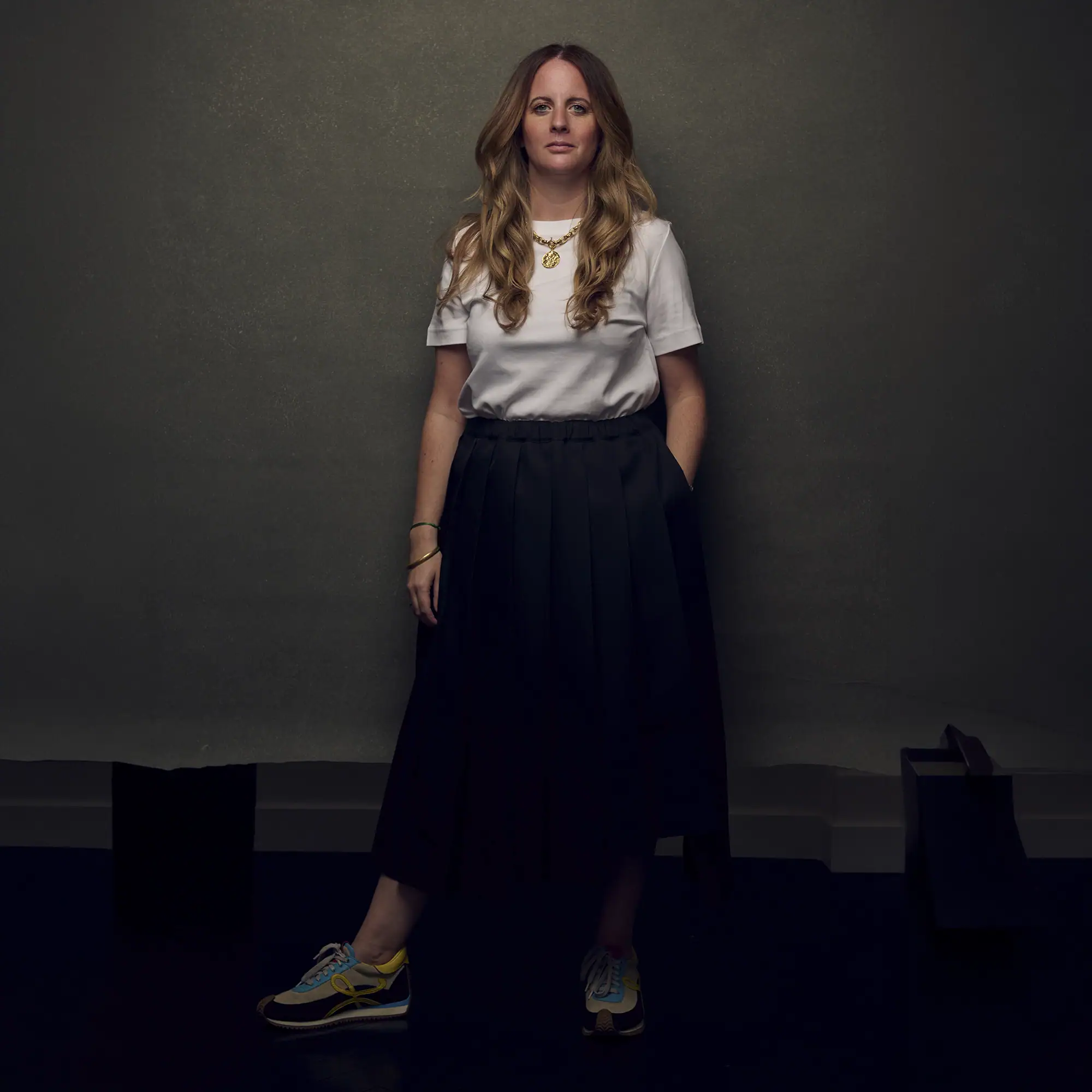
Mayfair, London SEPTEMBER 2026
Anne-Laure Pingreoun co-founded the Mayfair Design District in 2017, building on a curatorial practice she had already established through Alter Projects, a platform connecting brands with emerging artists and designers on collaborations, from a Glenmorangie campaign with Bompas & Parr to public murals with Camille Walala, conceived as culture rather than advertising. What began as a London Design Festival fixture has grown into a year-round programme of exhibitions, talks and cultural placemaking across Mayfair’s galleries, showrooms, auction houses and hotels, and now ranks among the festival’s largest design districts. Pingreoun continues to curate within it directly: this September and October she brings established names and emerging voices together for Reflections at Mandarin Oriental Mayfair, exploring reflection through glass, metal and mirrored surfaces, alongside a wider programme spanning Monologue, Romani Home, V-ZUG, Stoneline, HOLLY HUNT and MINT Gallery’s Curated Connections exchange with Polish designers.
In this interview, Anne-Laure talks about the concentration and contrast that sets Mayfair apart from other design destinations, why collaboration only works when there is a genuine reason for it, and how curiosity, connection and discovery, her own three words for the district, continue to define a neighbourhood built as much on relationships as on real estate.

Mayfair has always had an extraordinary creative community, but when we started Mayfair Design District in 2017, much of it existed behind closed doors. You had exceptional galleries, designers, makers, architects and brands all within a few streets of one another, yet there wasn’t necessarily a platform connecting them or telling that collective story.
The original idea was quite simple: to bring this community together and make its creativity more visible. London Design Festival gave us the initial moment, but the ambition was always bigger than a festival. We wanted to create connections between businesses, disciplines and audiences, and encourage people to experience Mayfair differently, through design, art, craft, making and ideas.
Over time, it has become as much about community and cultural placemaking as it is about design.

It is the concentration and the contrasts. Within a ten-minute walk, you can encounter a historic auction house, an emerging designer, a contemporary art gallery, an exceptional craftsperson, a global design brand and one of London’s great hotels.
Mayfair also has this fascinating tension between heritage and experimentation. There is an extraordinary history here, but there is also a constant appetite for what is new.
What we try to do through MDD is create unexpected connections between those worlds. Some of our most interesting projects happen when people who might not naturally work together find themselves in conversation.
 Hail, Lee Broom’s site-specific lighting installation in the stair void at Mandarin Oriental Mayfair, curated and delivered by Mayfair Design District. Photography courtesy of Mayfair Design District.
Because a community cannot really be built once a year.
London Design Festival remains an incredibly important moment for us, but we realised quite quickly that the relationships being created through the district had much greater potential. Mayfair has these extraordinary cultural moments throughout the year, from PAD, Frieze and Craft Week to exhibitions, auctions, launches and gallery programmes, so it felt natural for MDD to evolve alongside them.
Today, we think much more about creating a cultural rhythm throughout the year. Sometimes that might be an exhibition, sometimes a dinner for ten people, a talk, a private tour or an unexpected installation in a hotel. The scale can change, but the intention is always the same: bringing people together through creativity.
 From Casa al Mare, Gallery FUMI’s third-edition summer exhibition at Hay Hill. Photography courtesy of Gallery FUMI.
We don’t try to make everyone look or behave the same. In fact, the opposite is true. The richness of the district comes from everyone having such a distinct identity.
Our role is often that of a connector or curator: understanding what each partner is trying to achieve and finding the right conversations around them. A gallery might collaborate with a hotel, a designer with a chef, a craftsperson with a luxury brand, or several neighbours might come together around a talk or an exhibition.
The best collaborations happen when there is a genuine reason for people to work together, rather than collaboration for its own sake.
The conversation has definitely become more sophisticated. When we launched, sustainability was often discussed primarily in terms of materials or production. Today, people are thinking much more broadly about longevity, provenance, repair, local production, craftsmanship and ultimately why we need to make something in the first place.
There is also a renewed appreciation for objects that carry human knowledge and skill. Craft is particularly interesting in that respect because it naturally encourages us to understand where something came from, who made it and how it was made.
I think audiences increasingly want that depth. They are not only asking, “Is this beautiful?” but also, “What is the story behind it, and why does it deserve to exist?”
 Kobina Adusah at work in his Kumasi studio, ahead of Inherited Beings, his debut solo exhibition at Gallery FUMI. Photography by David Nana Opoku Ansah, courtesy of Gallery FUMI.
September and October are going to be particularly exciting because the programme stretches across London Design Festival, PAD and Frieze, with an incredible mix of exhibitions, installations, talks and more intimate moments happening throughout the district.
At Mandarin Oriental Mayfair, I am curating Reflections, an exhibition exploring reflection both literally, through material, glass, metal and mirrored surfaces, and more conceptually, as a moment of introspection. It will bring together established contemporary artists alongside designers, makers and emerging voices.
Elsewhere, there is so much to discover. Monologue will present Afterimage, bringing together collectible design and experimental material practices, while Romani Home will present a poetic new installation exploring femininity, birth and transformation through material, scent and storytelling. V-ZUG will explore food, design and ritual through The Fifth Taste: Table Rituals, and Stoneline will open up conversations around materiality and craftsmanship in luxury interiors. HOLLY HUNT will also be part of the programme, bringing its distinctive perspective on contemporary design and craftsmanship to the district.
MINT Gallery are also continuing Curated Connections, an international creative exchange bringing Polish designers and artists into dialogue with the British creative community. I particularly love this part of the programme because it introduces new voices into Mayfair and creates connections between different cultures, disciplines and generations of designers.
What excites me is that none of these projects exists in isolation. You can move from art to collectible design, from food to materials, from an emerging designer to an internationally established name, often within a few streets. I want someone to come to Mayfair for one exhibition and unexpectedly discover five other things along the way. That sense of discovery is really what the district is about.
 A Frances Priest ceramic vessel, part of The Art of Welcoming, Mayfair Design District’s exhibition of twelve QEST-funded British makers at Mandarin Oriental Mayfair. Photography by Mark Cocksedge.
Walk it.
One of the most important things about Mayfair Design District is that it isn’t contained within one building. The district itself is the experience.
Take the map, start somewhere that interests you and then allow yourself to wander. Go into the galleries and showrooms you might normally walk past. Speak to people. Look behind the doors.
And if possible, join one of our curated tours. We deliberately keep them intimate because they are about access and conversation rather than simply seeing as many places as possible. They allow us to introduce people not only to objects and spaces, but to the people behind them.
 Hail’s cascade of brushed aluminium and reeded glass, falling through the stair void beside the ming green marble staircase at Mandarin Oriental Mayfair. Photography courtesy of Mayfair Design District.
It is difficult to choose one because the projects that stay with me tend to be the ones where several worlds collide.
Our work with Mandarin Oriental Mayfair has been a particularly good example. We have been able to bring contemporary art, design and craft into a hospitality environment and allow people to encounter work almost unexpectedly, rather than within the traditional context of a gallery.
I love that idea of discovery. Someone might arrive for dinner or to meet a friend and suddenly find themselves standing in front of a remarkable piece of contemporary craft, wanting to know who made it and how.
For me, that captures something essential about MDD: creating encounters with creativity where you might not necessarily expect them.
 Max Lamb’s Crockery chairs for 1882 Ltd, shown at Gallery FUMI. Photography by Tom Hartford, courtesy of Gallery FUMI.
Curiosity. Connection. Discovery.
Curiosity because we want people to look beyond what they already know.
Connection because everything we do ultimately comes back to people, bringing designers, makers, galleries, brands, collectors and audiences into conversation.
And discovery because Mayfair still has an extraordinary ability to surprise you. There is always another door to open.
 A textured glass vessel by Michèle Oberdieck, from The Art of Welcoming at Mandarin Oriental Mayfair. Photography by Mark Cocksedge.
I would like to thank Anne-Laure Pingreoun for such a considered conversation about the thinking that holds the Mayfair Design District together, from the concentrated mix of galleries, ateliers and hotels that gives the neighbourhood its unusual creative density to the curatorial instinct that keeps finding new conversations between them. Her own contribution this autumn, Reflections at Mandarin Oriental Mayfair, is a fitting extension of that thinking: proof that discovery, as she puts it herself, is still what the district is about.
Martyn White is the year-long media partner of Mayfair Design District, following its full programme of exhibitions, collaborations and cultural placemaking across Mayfair.
Explore Mayfair Design District
Leave a Reply