
ART & CULTURE · LONDON
Reading time: 9 minSomerset House’s nineteenth Collect gathered close to 40 galleries and more than 400 makers across ceramics, glass, lacquer, jewellery, textiles, wood and paper. The work that outlasted the week came from someone who had never made an object before: a former underwater photographer who spent twelve days growing a sculpture instead of shaping one. Collect 2023 made its case for craft more plainly than the editions either side of it, by putting the process itself on display.
Collect returned to Somerset House for its nineteenth edition from 3 to 5 March 2023, with preview days on 1 and 2 March. The fair belongs to the Crafts Council, which has run it since 2004 as a platform for galleries showing work by living makers rather than a general antiques or design trade event, and that distinction shapes everything about how it is hung: close to 40 specialist galleries, from London and Seoul to Seattle and beyond, presenting more than 400 artist-makers. Almost everything on the walls and plinths had been made within the previous five years, and a large share of it had been made specifically for the week.


Collect Open
The range of material was the fair’s usual breadth: ceramics, glass, lacquer, art jewellery, precious metalwork, textiles and fibre, wood and paper, alongside a growing showing of reused and repurposed material. Running alongside the main halls, Collect Open gave over its floor to fourteen craft installations by artists from the United States, Poland and the United Kingdom, the fair’s platform for work that does not fit neatly into a gallery booth.
What set 2023 apart was not scale but subject. Across several stands, independently of one another, makers were exhibiting work where the technique was not in service of the finished object. It was the point of it.
What filled Somerset House in March 2023
Walk the fair’s three wings and the material list read like an inventory of everything a hand can shape: kiln-formed and cold-worked glass, wheel-thrown and slab-built porcelain, steam-bent wood, hand-engraved surfaces, marbled slip, laminated colour cut into solid blocks. Most galleries showed six to a dozen makers each, and the strongest booths used that range deliberately, setting a glassblower’s decades of technical control against a first-time maker’s more improvised approach to the same material.
That range is what makes Collect different from a retail craft fair. Nothing in its halls is made to a catalogue. Everything is a one-off or a small edition, priced and sold as it would be in a commercial gallery, and the Crafts Council’s role is to vet the galleries rather than the objects, which is why the fair’s identity depends on which 40 galleries it selects each year rather than on a themed brief.
Glass that keeps a record of its own making
Traver Gallery, travelling from Seattle, built its stand around three makers whose techniques could not be more different while sharing a single material.
John Kiley showed work from his Fractographs series: blocks of optic glass that he deliberately breaks, then reassembles piece by piece into their original form. The word is borrowed from materials science, where a fractograph is the study of how and why something failed. Kiley’s blocks read as both records and reversals of that failure: the glass looks shattered, but every internal plane still meets its neighbour, and light moving through the block picks out each fracture line as a separate, articulated surface rather than a single flaw.


Mel Douglas, the Canberra-based glass artist who trained at the Australian National University’s glass workshop, worked in the opposite direction. Her sculptures begin as hand-blown vessels, which she then cold-works for hours until the surface turns matte and velvet-like, before hand-engraving fine linear marks across it. She has described the engraving as rhythmic and meditative, and the three processes, kiln-forming to establish the volume, cold-working to prepare the surface, engraving to draw on it, are distinct stages rather than one technique with three names. The result sits closer to drawing in three dimensions than to conventional glass sculpture.
Jun Kaneko, the Omaha-based ceramicist whose glazed forms have shown at institutions including the Corning Museum of Glass, contributed pieces built around brushstroke: broad, gestural marks laid into the glaze so that the surface reads as a painting wrapped around a volume rather than a decorated pot.
Porcelain, wood and the language each one speaks
Ruup & Form’s stand made a similar argument in a different register, putting three makers together whose shared material, where they shared one, was doing very different work.
Clare Palmer came to ceramics in her mid-forties, leaving a corporate career to complete a two-year diploma at London’s City Lit before building the slab-built stoneware and porcelain practice she now runs from north-west London. She fires to cone 9, and her sculptures begin as writing: a phrase or a feeling that gives a piece its working title before she touches clay. The results sit deliberately between softness and rawness, what she calls a quiet tension between an outward form and whatever is happening underneath it.


Erum Aamir trained as a physicist before turning to ceramics, and it shows. Working from microscope slides in Manchester Museum’s herbarium, some of them prepared by botanists working three centuries ago, she builds thin, hand-formed porcelain structures without sketching first, letting each piece find its pattern as she works. She describes her aim as smudging the line between art and science, and the porcelain stays deliberately unglazed and translucent, so the forms read as much like magnified cell structures as like vessels.
Naomi Mcintosh, working from the Cairngorms in Scotland, builds her sculptures from beech and ash sourced locally, combining steam-bent and laser-cut elements with drawing as the starting point for every piece. Her forms translate the rhythms she observes in the Highland landscape, water, birdsong, seasonal growth, into structures that are mathematically intricate but read as organic rather than engineered.
Korea’s only gallery built for glass, and the prize that keeps finding its artists
Gallery Sklo, founded in Seoul in 2003, is the first and still the only Korean gallery specialising in contemporary glass, built with the explicit aim of moving the material out of the craft category and into contemporary art. At Collect 2023 it showed seven artists, including Sunghoon Park, whose Seed series presents blown and cold-worked glass spheres across a spread of colour, and Jiyong Lee, whose Foreigner series builds abstract, colour-laminated forms by fusing sheets of coloured glass and then carving and grinding the block until the internal layers read as a gradient rather than a stack.


The stand carried a second layer of significance. Two of its artists, metalworker Jaiik Lee and metalworker Yongjin Chung, were finalists for the Loewe Foundation Craft Prize in 2023 and 2022 respectively, and Jiyong Lee had previously reached the same shortlist. Elsewhere in the fair, ceramicists Healim Shin and Keeryong Choi carried the same connection. The Loewe prize does not sponsor Collect, and none of these makers were shown as a themed group. But the overlap between the two, a fair built on gallery selection and a prize built on jury selection, arriving independently at several of the same names, is a reasonable measure of who the wider craft world had already noticed by 2023.
One material, two heritages: Thrown Contemporary’s stand
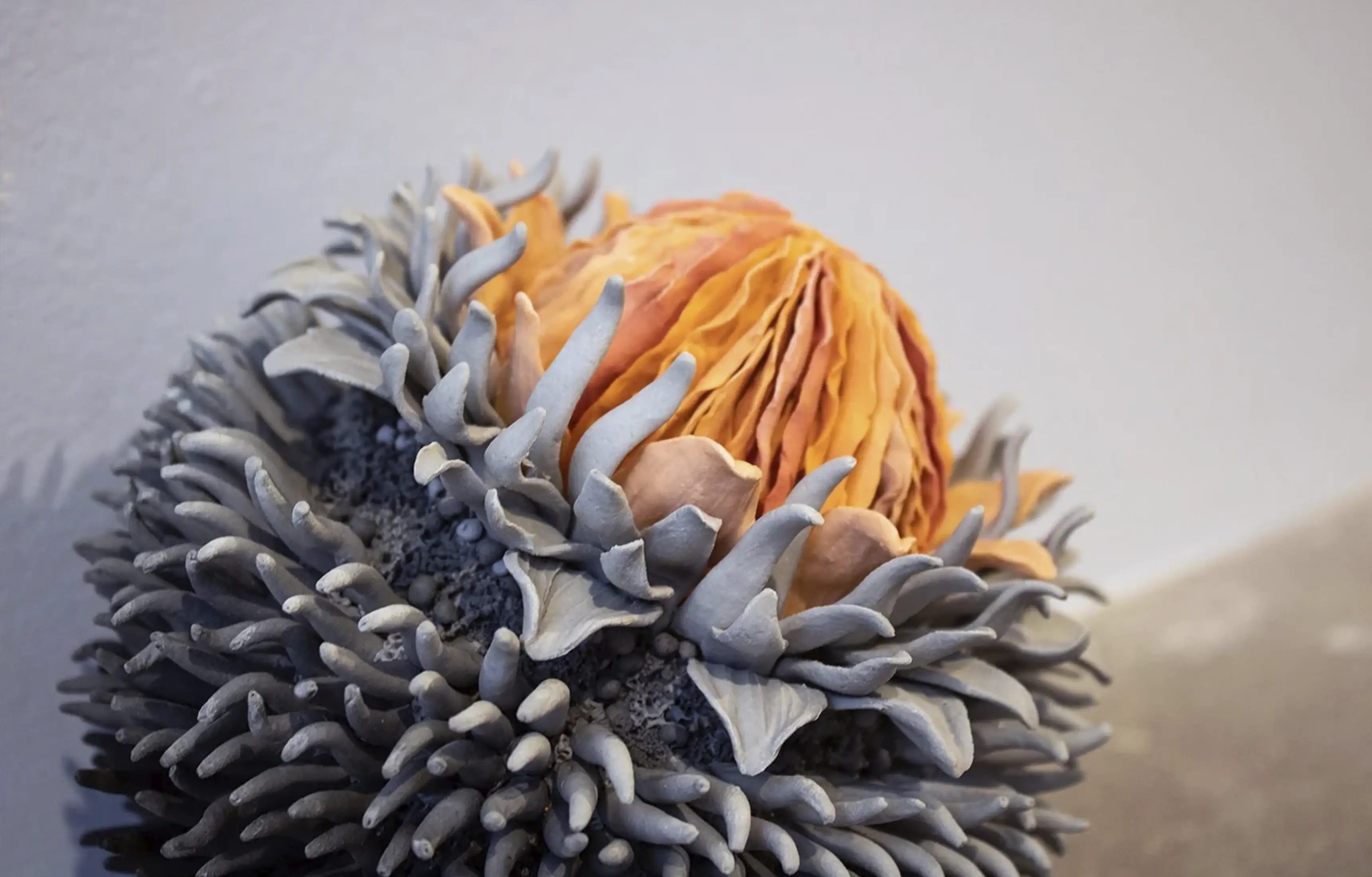
Zuleika Melluish builds porcelain floral sculptures that started as something closer to printmaking: pressing dried and fresh plants from her own garden into slabs of clay before she began, later, modelling their forms by hand instead. Her recent work is built directly from dissected specimens, each stem and petal reconstructed in porcelain thin enough to move with changing light, and left unglazed so nothing sits between the surface and the room’s light. Wired stems and tissue-thin petals carry the pieces’ central contradiction, a material this fragile behaving as though it could survive being touched.


Bisila Noha, who grew up between Zaragoza in Spain and Baney in Equatorial Guinea before training herself in ceramics after a career in advertising, showed wheel-thrown pieces finished with marbled slip alongside sculptural work that combines throwing, coiling and carving in a single piece. Her Baney Clay Project, begun in 2020 using clay sourced from her father’s ancestral village, runs through much of what she showed: mixed glaze colours used as a direct metaphor for mixed heritage, and Spanish decorative traditions worked into forms that also carry the volcanic clays of Bioko island. Where Melluish’s pieces record a single plant, Noha’s record a specific place, twice over.
The photographer who started growing her sculptures
The work in Collect Open that drew the most attention in 2023 did not come from a ceramics or glass background at all. Zena Holloway spent twenty-five years as an underwater photographer, shooting for National Geographic and GQ and directing campaigns for Nike, Pepsi and Greenpeace, after teaching herself the craft as a diving instructor in what she has called an ultra-niche profession. It was that underwater work, and a growing awareness of how much plastic she was photographing in oceans and rivers, that pushed her toward material science. A chance observation of a willow tree’s root system gave her the question that reoriented her practice: what if a textile could be grown rather than made.


Collect Open
Her installation at Collect 2023 showed the answer. Holloway carves a template from beeswax, presses it with a repeated pattern, and germinates wheatgrass seed across it in a controlled, light-filled room. Over ten to fourteen days the shoots reach around 20 centimetres while the roots below grow into the wax template, weaving themselves into a dense, structured mat that lifts away as a finished textile once it is cut and dried. Different grains behave differently under the same process, she has noted: rye grass roots crinkle like wool, while wheatgrass grows long, straight and strong, which is why it is the grain she builds with. The cut grass itself does not go to waste either, and is fed to livestock. The finished root textiles can be sealed with natural waxes and oils, or coloured with traditional dye sources such as logwood, gallnut and cochineal, and Holloway has described the durability of a finished piece as comparable to a well-made straw hat, built to be handled and to last rather than to be admired once.
Collect 2023 was the year Holloway founded Rootfull, the studio built around this process, which makes the fair the earliest point at which the work existed as more than an experiment. The forms she built for the installation echoed coral branches and sea fans, the shapes she had spent two decades photographing from the other side of a diving mask, now grown rather than shot.
Why 2023 was the year process became the argument
None of these makers were grouped as a theme by the fair itself. Kiley documenting a controlled fracture, Douglas engraving a surface she had spent hours preparing by hand, Aamir working from a microscope slide, Holloway growing a textile from a seed: each arrived at Somerset House independently, selected by a different gallery for different reasons. What connects them is that in every case, the visible surface of the finished piece is a record of how it was made, not a disguise for it.


Collect Open
That is a harder thing for a fair to hang than a single unifying material or a single national showcase, because it depends on the individual pieces carrying the argument rather than the wall text. Collect 2023 managed it anyway, largely because its jury of galleries kept finding makers, across glass, porcelain, wood and grown fibre, who were already working that way before the fair ever asked them to.
Final thoughts
It would be easy to describe Collect 2023 as a showcase, a week when Somerset House filled its rooms with expensive, well-made objects from galleries around the world. That much is true of every edition and explains nothing about why this one stood apart.
What actually happened in March 2023 was more specific. A group of makers who had never met, working in glass, porcelain, wood and grown fibre, arrived independently at the same conclusion: that the most interesting thing a craft object can do is show its own making rather than conceal it. Kiley’s broken glass, Douglas’s engraved surfaces, Holloway’s roots grown around a beeswax template, all of them let the process stay visible in the finished piece.
Rootfull did not exist before Collect 2023. It exists now because a fair built to show finished objects gave a photographer turning material scientist the room to show one still becoming itself. That is not a small thing for a fair to do, and it is the reason 2023 is worth returning to rather than filing as one more edition among many. The fair kept testing that same idea at Collect 2025, and carried it further still at Collect 2026.
What is Collect, and who organises it?
Collect is an annual fair for contemporary craft and design, run by the Crafts Council and held at Somerset House in London. It shows work exclusively through invited galleries rather than direct-from-maker stands.
When did Collect 2023 take place?
Collect 2023 ran from 3 to 5 March 2023, with preview days on 1 and 2 March, at Somerset House.
How many galleries and makers were involved in Collect 2023?
Close to 40 specialist galleries took part, representing more than 400 living artist-makers, with the majority of work made within the previous five years.
What materials were shown at Collect 2023?
Ceramics, glass, lacquer, art jewellery, precious metalwork, textiles and fibre, wood, paper, and reused or repurposed materials.
What was Collect Open in 2023?
Collect Open is the fair’s platform for experimental, non-gallery installations. In 2023 it featured 14 projects by artists from the United States, Poland and the United Kingdom.
Who is Zena Holloway, and what did she show at Collect 2023?
Zena Holloway is a photographer and bio-designer who spent 25 years working underwater before founding the studio Rootfull in 2023. Her Collect installation grew wheatgrass root sculptures inside beeswax moulds over 10 to 14 days.
What is Gallery Sklo?
Gallery Sklo is a Seoul gallery founded in 2003, the first in Korea to specialise in contemporary glass. It showed seven artists at Collect 2023, including Sunghoon Park and Jiyong Lee.
Does Collect happen every year?
Yes. Collect returns to Somerset House annually each spring, and its later editions have continued to bring new galleries and makers to the same rooms.

Leave a Reply