

ART & CULTURE · LONDON
Reading time: 6 minCollect 2025, the Crafts Council’s international fair for contemporary craft, filled Somerset House from 26 February to 2 March 2025 with 40 galleries and more than 400 living makers. It is the twenty-first edition of a fair that has quietly changed address twice, and it now sits inside a building that was purpose-built to separate fine art from exactly the kind of work it fills the courtyard with every year.
Somerset House was designed, from 1776 onward, to give the Georgian state’s most established institutions a single address. The Royal Academy, the Royal Society, the Society of Antiquaries and the Navy Board all moved in under one roof, under a 1775 Act of Parliament that formally set the building aside for government offices and learned societies. Craft, in the hierarchy those institutions spent the following century enforcing, sat below fine art, useful rather than admired, made rather than created. Collect 2025, the Crafts Council’s twenty-first edition of its flagship fair, filled that same building’s central courtyard from 26 February to 2 March 2025 with forty galleries and more than four hundred living makers working in ceramics, glass, textiles, metal and wood. The fair does not argue with the building’s history. It simply fills the space with exactly what that history once ranked as secondary, and lets the work make its own case.


First of March
What Collect 2025 actually was
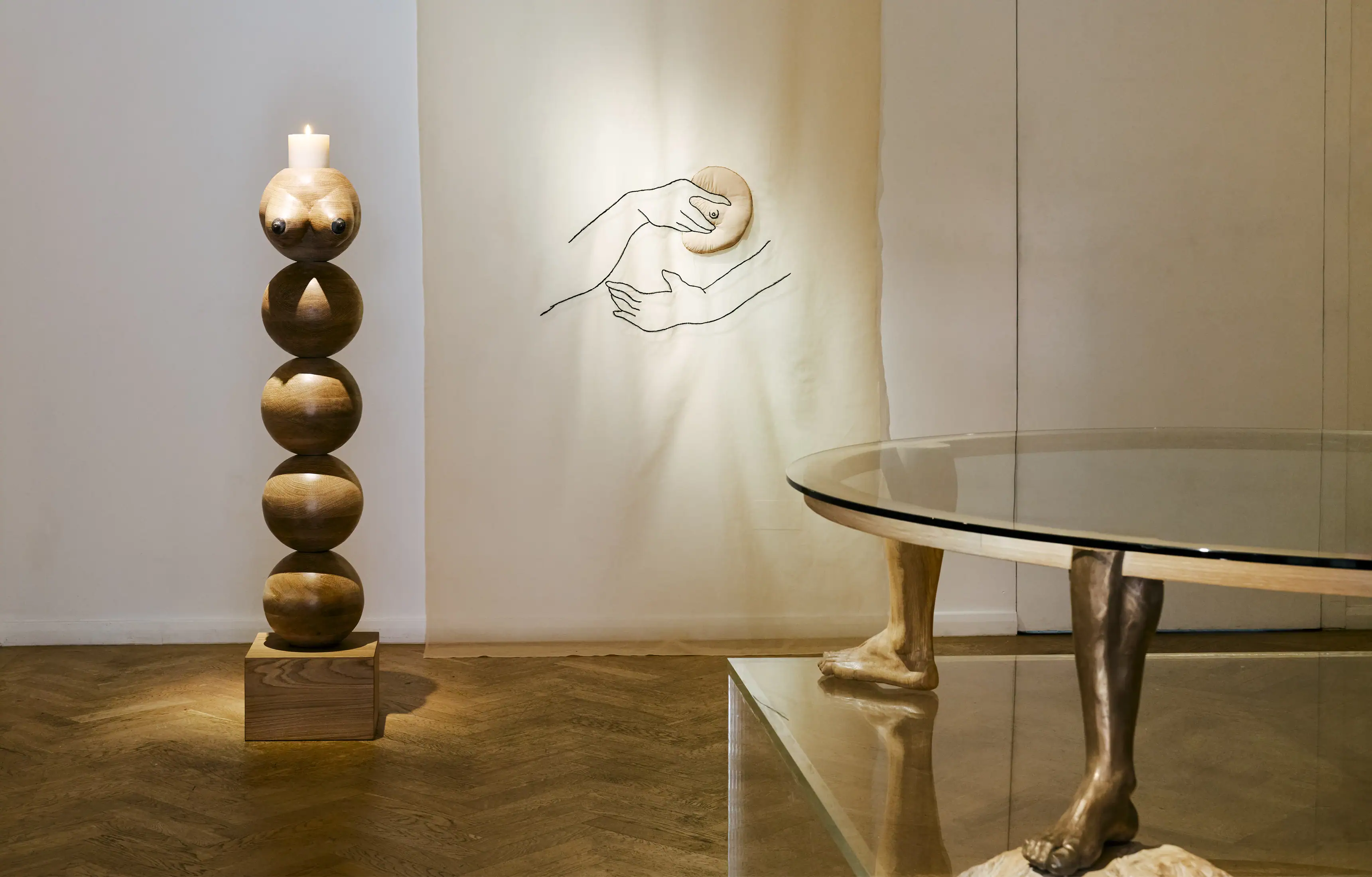
Forty specialist galleries and arts organisations took part in the 2025 edition, showing work by more than 400 living artists drawn from over 30 countries, including South Korea, Japan, Ukraine, South Africa, Greece and Canada. Eight new galleries joined for 2025, arriving from Taiwan, Switzerland, Cyprus and across the UK, alongside returning exhibitors with longer histories at the fair. Collect Open, the fair’s platform for experimental and research-led projects by individual makers and collectives, presented ten separate projects in 2025, and a new wall installation was commissioned specifically to showcase British ring makers, a discipline that rarely gets dedicated display space of its own inside a general fair. LOEWE FOUNDATION returned as fair partner for an eighth consecutive year in 2025, a run stretching back to 2018, and the Brookfield Properties Craft Award marked its sixth year of collaboration with the fair, with the winner announced during the run itself.


1882 LTD
A courtyard built to keep craft in its place
The building itself is worth understanding before any individual maker, because it changes what the fair’s presence there actually means. Somerset House replaced a Tudor-era palace on the same site, and the neoclassical structure visitors walk through today was designed by Sir William Chambers, with construction beginning in 1776 under the 1775 Crown Lands Act. Its central courtyard, the space Collect now fills every year, measures roughly 300 feet by 200 feet, flanked by a pair of terraces, and originally opened directly onto the Thames before the Victoria Embankment was built in the late 1860s and pushed the river back from the building’s front door. Victorian wings extended the complex eastward in 1831 and westward in 1856, growing the site outward as the institutions inside it grew.


PIK’D
For nearly two centuries, that courtyard belonged to government offices, tax and revenue departments, and the era’s most established cultural bodies, none of which had any use for what would now be called contemporary craft. The turn came only in 1984, when the Somerset House Act permitted cultural redevelopment of the site. The Courtauld Institute of Art moved into the North Wing in 1989, and it was not until 2013, once HM Revenue and Customs finally vacated the building, that the Somerset House Trust took full charitable oversight and converted the complex into the arts venue it is today, with studios, galleries and exhibition space replacing government desks. Collect arrived at Somerset House in 2020, meaning the fair has occupied this specific courtyard for a shorter span than most visitors would assume, even as it now feels like the space’s natural use.


Alison J Clark
The makers proving the point
First of March, a Welsh gallery representing makers living and working across Wales, brought a group including the silversmith Rauni Higson, who works from a studio in the Nantlle Valley in Snowdonia, alongside Beate Gegenwart and Michelle Griffiths. Higson’s practice sits at the more sculptural end of silversmithing, treating hammered metal as a material for movement and form rather than only for domestic tableware, and her inclusion gave the fair a direct line back to a landscape and a making tradition well outside London.


NM Art & Design
1882 Ltd. brought a different kind of case study in what contemporary craft can do inside an industrial setting. The company was founded in 2011 by Emily Johnson and her father Christopher, the fourth and fifth generations of the Johnson Brothers pottery family, and now works out of part of the historic Wedgwood factory in Barlaston, Stoke-on-Trent, having grown from four potters and four kilns to twenty-three potters and eleven kilns since moving into the site in 2021. Its collaboration with the designer Max Lamb, whose Crockery collection for the brand is held in the Louvre’s permanent collection, is the company’s clearest statement of intent: fine bone china made by hand, at industrial scale, without treating either half of that description as a compromise on the other. Beirut-based PIK’D Gallery brought a different geography again, showing Tessa Eastman, Toni Losey and Andrea Nassar, extending the fair’s reach into a part of the contemporary craft world that rarely gets equal billing at London fairs.


Cavaliero Finn
The techniques being revived rather than repeated
Two makers at Collect 2025 were doing something more specific than showing finished objects: reviving techniques that had genuinely fallen out of use. Uriel Caspi, born in northern Israel and trained at the Bezalel Academy in Jerusalem before completing a master’s degree in ceramic art at Alfred University in New York, spent more than nine years researching and reviving the Arabian lustre-glaze technique, a method that fires precious metals into a glaze under a controlled reduction atmosphere to produce a reflective, iridescent surface. His large-scale ceramic fragments, shaped using the ancient jarre à la corde technique of wrapping clay around a wooden armature and rope before removing the armature once the clay has hardened, draw on his training and on the years since his mother’s death, when working with clay became, in his own account, a genuinely therapeutic practice rather than only a professional one.


Uriel Caspi
Huimin Zhang, a Beijing-born jeweller now working from a studio in London’s Hatton Garden, is doing comparable work with a different material and a different tradition. She practises traditional Chinese filigree, twisting gold wire as fine as 0.08 millimetres, roughly a third the width of a human hair, into brooches that take around a month each to complete. Her Collect Open 2025 project extended a body of work that includes a series inspired by a friend’s experience of breast cancer, brooches shaped as blooming flowers, using a centuries-old technique to make work about a distinctly contemporary subject. “The way I combine different techniques shows how filigree can be very modern,” Zhang has said of the approach, “and I hope that my work can inspire people to take up these traditional skills.” Her pieces are now held in the Victoria and Albert Museum’s Chinese department, a museum with its own long history of ranking decorative art below painting and sculpture, now holding her filigree work as part of its permanent collection.


Charles Burnand Gallery
Twenty-one years of moving the fair itself
Collect is run by the Crafts Council, a body with its own history of establishment recognition arriving later than it might have. It began life in 1971 as the Crafts Advisory Committee, was renamed the Crafts Council in 1979, and was granted a Royal Charter in 1982, the same kind of formal state recognition that Somerset House’s original occupants had held since the building’s construction two centuries earlier. Collect itself launched in 2004, and has changed venue twice since: first at the Victoria and Albert Museum from 2004 to 2009, then at the Saatchi Gallery from 2009 to 2019, before moving to Somerset House for the 2020 edition, where it has remained since. Twenty-one years after its first edition, the fair has spent roughly equal time at each of its three homes, and its current one carries by far the longest and most loaded institutional history of the three.


Joanna Bird Contemporary Collections
Final thoughts
None of this history changes what a visitor to Collect 2025 actually saw: forty galleries’ worth of contemporary ceramics, glass, metalwork and textiles, made by living practitioners working across more than thirty countries, filling a Georgian courtyard for five days in late February and early March. What the building’s history adds is context for why that filling matters as more than scheduling. A courtyard designed to house the institutions that decided what counted as fine art, for a state that had no equivalent institution for craft, now hosts the fair that gives contemporary craft its most concentrated annual moment in London. Collect does not need to say anything about that history for it to be worth knowing. It followed the same pattern set by Collect 2023, and it will be back again for a twenty-second edition in 2026, in the same courtyard, making the same quiet point all over again.


&Gallery
What was Collect 2025?
The twenty-first edition of Collect, the Crafts Council’s international fair for contemporary craft and design, held at Somerset House, London, from 26 February to 2 March 2025, with forty galleries and more than 400 living makers.
Where is Collect held, and has it always been at Somerset House?
Collect has been held at Somerset House since 2020. Before that, it ran at the Saatchi Gallery from 2009 to 2019, and at the Victoria and Albert Museum from its 2004 launch until 2009.
Who organises Collect?
The Crafts Council, a UK charity founded in 1971 as the Crafts Advisory Committee, renamed the Crafts Council in 1979 and granted a Royal Charter in 1982.
What is Collect Open?
Collect Open is the fair’s platform for experimental, research-led projects by individual makers and collectives, shown alongside the main gallery presentations. It featured ten projects at Collect 2025.
Who partners with Collect?
LOEWE FOUNDATION has been Collect’s fair partner since 2018, marking its eighth consecutive year at the 2025 edition. The Brookfield Properties Craft Award marked its sixth year of collaboration with the fair in 2025.


Gallery Sklo

Leave a Reply