
ART & CULTURE · MILAN
Reading time: 10 minIn April 2018, the Californian light artist Phillip K. Smith III took the sky above a Renaissance courtyard in Milan and gave it a floor. ‘Open Sky’, built for the fashion brand COS at Palazzo Isimbardi, used a faceted ring of mirror-polished stainless steel to fold cloud, colour and passing crowds into a single reflective surface. It was the seventh instalment of one of Milan Design Week’s longest-running annual commissions, and a direct descendant of the desert experiments Smith had been running in California for the previous four years.
For six days in April 2018, the inner courtyard of Palazzo Isimbardi in Milan held a piece of the sky that had never actually touched the ground. Phillip K. Smith III, an artist and trained architect based in California’s Coachella Valley, built Open Sky for the fashion brand COS, using a ring of angled, mirror-polished steel to gather the Milanese sky, the palazzo’s baroque façade and every visitor who walked through it into one continuously shifting reflection.
The installation ran from 17 to 22 April 2018, timed to Milan Design Week and the Salone del Mobile trade fair, and marked COS’s seventh consecutive year commissioning a new work for the city. It followed collaborations with the architect Sou Fujimoto in 2016 and the design studio Studio Swine in 2017, and it took place in the same courtyard and garden at Palazzo Isimbardi, seat of the Metropolitan City of Milan, that would host COS’s commission the following spring.
What makes Open Sky worth returning to, beyond its scale, is what it reveals about how Smith works. This was not a one-off experiment dreamed up for a fashion brand. It was the most public version yet of a technique he had spent the previous four years refining in the desert, on land he owns two hours outside Los Angeles, brought for the first time to a European city and a 16th-century stone courtyard.

What Open Sky actually was
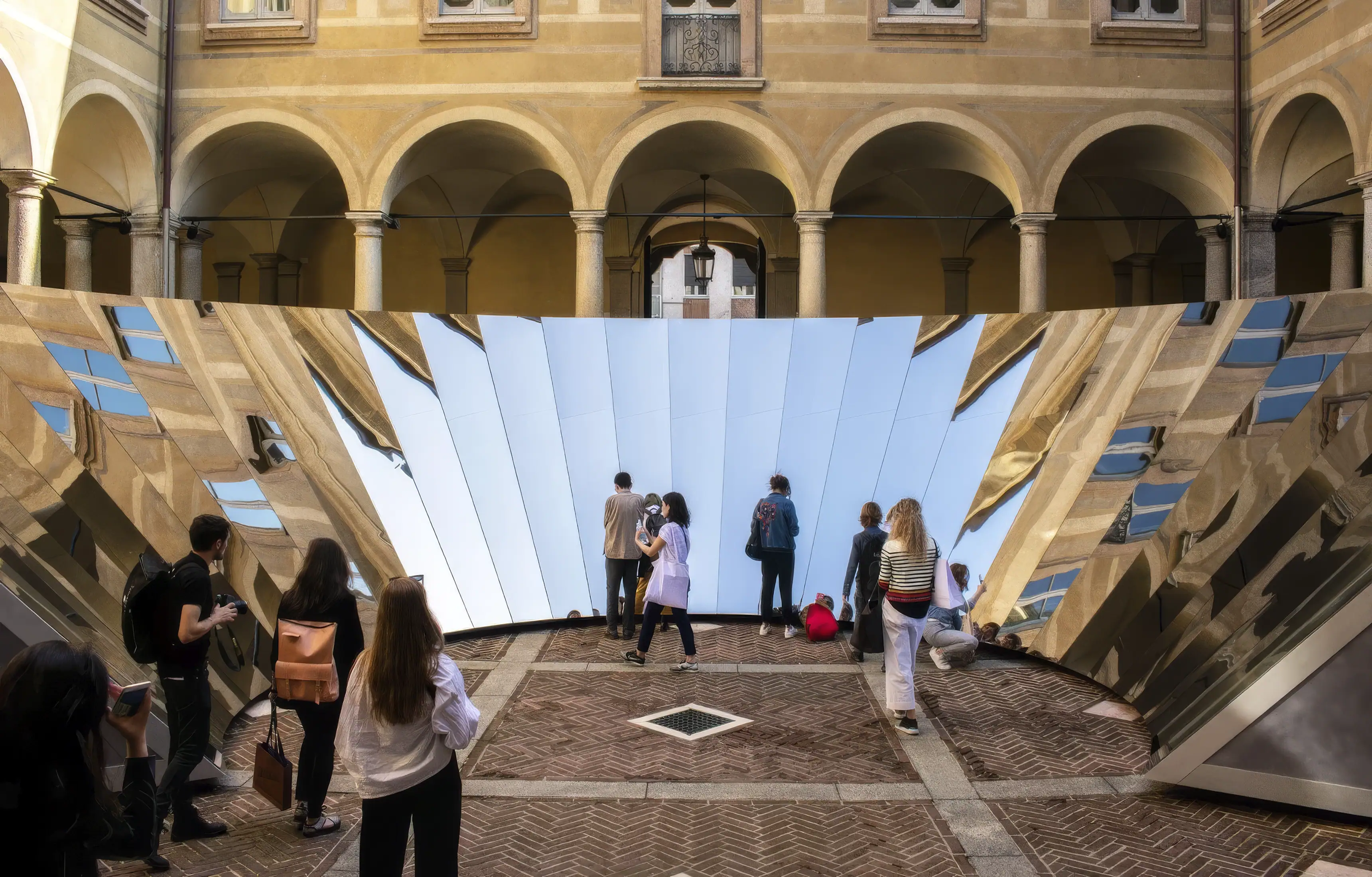
At the centre of the palazzo’s courtyard, Smith built a faceted, roughly circular structure some 14 metres across, formed from mirror-polished stainless steel plates set at carefully calculated angles. Rather than a single curved mirror, the surface was broken into dozens of flat facets, each one catching and redirecting a slightly different slice of sky, stone and sunlight, so that the work behaved less like a mirror and more like a compound eye turned on the courtyard around it.
Smith has described his intention in direct terms: “I wanted to pull the sky down to the ground and wrap it together with the architecture so while the piece is static, everything else, the clouds, the light, the people, is constantly changing.” The geometry did the work of that idea literally. Where the courtyard offered a square of sky framed by four storeys of Renaissance stonework, the faceted ring gathered that same sky and reassembled it as a low, semicircular band of reflection at eye level, close enough to walk into.
Beyond the main structure, five smaller freestanding sculptures stood in the palazzo’s adjoining English garden, each built from horizontally and vertically folded reflective panels. Positioned among trees and hedging, they caught foliage, branches and passing visitors rather than open sky, offering what Smith called quieter, more private moments within a piece that was, in the courtyard, a fully shared experience. COS extended the same visual language into a handful of its retail windows during the week, carrying the reflective idea from the palazzo out onto the street.

The artist behind the mirrors
Phillip K. Smith III was born in Los Angeles in 1972 and grew up in California’s Coachella Valley, the desert region that would later become both his home and his primary material. He left for the East Coast to study, earning dual degrees in fine art and architecture from the Rhode Island School of Design, a combination that shows up directly in his work: pieces built with a sculptor’s instinct for light and colour but engineered with an architect’s understanding of structure, load and tolerance.
After periods in Providence, Boston and New York, Smith returned to the Palm Springs area in 2000 and, in 2004, bought a plot of desert land that has functioned as his studio and testing ground ever since. He served as artist-in-residence at the Palm Springs Art Museum in 2010, and by the time COS approached him for Milan, he had built a body of work almost entirely concerned with one question: what happens when you place a precisely engineered reflective or luminous surface directly into an open landscape and let the sky do the rest of the work.
Lucid Stead (2013) answered that question with an abandoned homestead in Joshua Tree, sliced with strips of mirror and lit internally so that the cabin itself seemed to dissolve into the desert at dusk. Reflection Field (2014), built for the Coachella Festival, used a grid of mirrored forms that read as a conventional reflective surface by day and a field of shifting colour by night. Portals (2016), an 85 foot circular pavilion built around a mesquite tree, added eight concentric rings of LED light to the same underlying idea. Each piece pushed the desert version of the same trick a little further before Milan gave him a European courtyard to try it on.

Building a ring of reflected sky
Open Sky began roughly seven months before it opened, with Smith’s first meeting on the project in September 2017. The structure was fabricated from mirror-polished stainless steel in 14 gauge, a thickness Smith chose deliberately: thinner steel risked denting during handling and installation, while anything thicker would have been too rigid to bend into the precise curves the piece needed. That single material decision, balancing flexibility against durability, is the kind of detail that never makes it into a press photograph but decided whether the piece could be built at all.
Underneath the reflective surface sat a hidden skeleton of 34 structural ribs, arranged in a repeating triangular pattern that gave the faceted skin its shape without ever being visible to a visitor standing in the courtyard. Smith has spoken about that internal structure with something close to affection: “There’s a whole structural logic on the inside of the piece that you don’t see. It’s like looking at a skeletal structure; it’s gorgeous.” More than a hundred people worked on getting that structure into the courtyard, including Smith’s own studio, the fabricator Urban Art Projects, additional workshops in Brooklyn and Milan, COS’s team, the palazzo itself and a Milan-based production company coordinating the install. A single artist’s idea, in other words, arrived in Milan only after passing through a genuinely international supply chain of specialist fabrication.

A courtyard built to be walked through
Smith designed Open Sky as a sequence rather than a single view. Visitors entering the courtyard first encountered the immense circular form as a tactile, abstract presence, a wall of angled steel rather than a legible reflection. Moving along the palazzo’s colonnade toward the far side of the courtyard, the 16th-century architecture began to reappear in the mirrored surface, angularly reconfigured and slightly unfamiliar. Only on approaching the work’s centre did the effect resolve: the reflected architecture appeared to draw back like a curtain, opening onto a full, encircling view of the sky itself.
That staged reveal meant no two visitors experienced quite the same piece. Time of day, weather, the position of the sun and the route a person chose through the courtyard all changed what was reflected back, a point Smith returns to often when discussing his work generally: “I think my work, both my earlier pieces and my newer installations, is united by a single goal, which is to get people to slow down and take stock of their time and their environment.” Open Sky asked that question of visitors moving through a working seat of government in the middle of a European city, rather than across open desert, which changed what the piece was actually testing.

Renaissance grandeur and government business
Palazzo Isimbardi is not a gallery or a fair pavilion built for the purpose. It is a genuine Milanese palazzo with a documented history reaching back to at least the late 15th century, when its earliest core is thought to have served as a residence connected to Cicco Simonetta, a councillor under the Sforza dukes. The building passed through the Pallavicini family before the Taverna family took it on in the mid-16th century and rebuilt it substantially as a suburban retreat, giving it the layered character it still has today: a street façade regarded as one of the finest examples of Lombard baroque in the city, paired with a garden front in a later, more restrained neoclassical style.
At its centre sits a four-sided Doric portico in granite, round-arched and colonnaded, framing the same courtyard Smith filled with mirrored steel. Inside, the palazzo holds Renaissance frescoes and paintings by Giambattista Tiepolo and Francesco Hayez in its council chamber. The Province of Milan took the building as its administrative headquarters in 1935, and it now serves as the seat of the Metropolitan City of Milan, meaning Open Sky was staged inside a functioning government building rather than a venue built or rented purely for the fair. That gave the piece a genuine historic weight to work against: a courtyard designed for civic business and Renaissance display, momentarily given over to an artist testing what a mirror could do to a sky.

COS and seven years of building something new in Milan
Open Sky was the seventh consecutive year COS commissioned a new work for Milan Design Week, a run that began in 2012 and has brought in a different architect, artist or studio each year, including Nendo, Snarkitecture, Sou Fujimoto and Studio Swine before Smith’s turn in 2018. Read against that run, Open Sky sits at a hinge point: the year the series turned toward pure optical effect after several years of more literal sensory and architectural experiments, and the year before it turned toward material science entirely. COS returned to Palazzo Isimbardi the following spring for its eighth commission, working with the architect Arthur Mamou-Mani on Conifera, a 700-piece bioplastic lattice grown, rather than built, through the same colonnade and courtyard Smith’s mirrors had occupied twelve months earlier. Seen together, the two installations make an unusually direct pair: one folding the sky itself into a historic courtyard, the next threading a compostable structure through the same stones, each testing a completely different idea of what a temporary building could be. The installation immediately before Open Sky, Studio Swine’s New Spring in 2017, is covered in full on this site too, tracing the same annual commission back to its sixth year.

The desert connection nobody drew in Milan
The detail that gets lost in most coverage of Open Sky is how recently, and how directly, Smith had rehearsed this exact technique before COS ever approached him. In 2017, the year before Milan, Smith completed The Circle of Land and Sky in the California desert: 300 polished stainless steel reflectors, each angled at ten degrees, arranged in a large circle to catch the desert horizon and the sky above it. The mechanism, angled steel plates redirecting an open sky into a walkable, human-scale ring, is essentially the same mechanism that appeared in Palazzo Isimbardi’s courtyard a matter of months later.
That is not a coincidence so much as a working method. Smith builds and rebuilds the same small number of ideas, in different landscapes and at different scales, refining the angle, the material gauge and the visitor’s path each time. Open Sky was not a new departure invented for a European fashion brand. It was the desert idea, tested and proven in California, transplanted into a Renaissance courtyard to see whether the same trick still worked when the open horizon was replaced by four storeys of baroque stonework. It did, which is arguably the more interesting story than the installation’s scale or its material list.

Final thoughts
It would be easy to describe Open Sky as a striking photo opportunity built for a fashion brand’s design week calendar, the kind of installation that circulates for a season on social media and is then filed away as another Milan spectacle. What actually happened at Palazzo Isimbardi in April 2018 was more considered than that description allows.
Phillip K. Smith III took a technique he had spent four years testing against open desert horizons, in increasingly ambitious form through Lucid Stead, Reflection Field, Portals and The Circle of Land and Sky, and asked whether it still worked when the horizon was replaced by a Renaissance courtyard, a Doric portico and four storeys of baroque stone. Fourteen gauge steel, 34 hidden ribs and more than a hundred fabricators later, it did. The sky above Palazzo Isimbardi came down to eye level, folded itself around Tiepolo’s ceiling and a working seat of government, and gave several thousand visitors a genuinely different way to look up.
COS’s seven years of Milan commissions had, by 2018, already covered light, scent and mist. Open Sky gave the series its clearest optical argument yet, and set up the courtyard for the very different, very material experiment that would follow it a year later. Taken together, the two installations are a reminder that the same historic stones can support two entirely opposed ideas of what temporary architecture is for, provided the artist behind each one is specific enough about the mechanism.
What was Open Sky?
Open Sky was a mirrored art installation created by the artist Phillip K. Smith III for the fashion brand COS, shown at Palazzo Isimbardi in Milan during Milan Design Week 2018.
Where and when was Open Sky shown?
It was installed in the courtyard and garden of Palazzo Isimbardi, on Corso Monforte in Milan, from 17 to 22 April 2018.
Who is Phillip K. Smith III?
Phillip K. Smith III is a California-based artist and trained architect, known for large-scale light and mirror installations built into open landscapes, particularly in the Coachella Valley desert. He holds dual degrees in fine art and architecture from the Rhode Island School of Design.
What was Open Sky made from?
The main structure was built from mirror-polished stainless steel, 14 gauge thick, supported by an internal frame of 34 structural ribs arranged in a repeating triangular pattern, with five smaller mirrored sculptures in the adjoining garden.
How big was the main structure?
The faceted mirrored ring at the centre of the courtyard measured roughly 14 metres across.
Which edition of COS’s Milan series was Open Sky?
It was the seventh consecutive year COS commissioned a new installation for Milan Design Week, following collaborations with, among others, Sou Fujimoto in 2016 and Studio Swine in 2017.
What came after Open Sky in the same courtyard?
COS returned to Palazzo Isimbardi the following year, 2019, for its eighth commission, working with the architect Arthur Mamou-Mani on the bioplastic installation Conifera.
Can Open Sky still be seen?
No. It was a temporary installation, shown only for the six days of Milan Design Week 2018, and was dismantled afterwards.


Leave a Reply