

ART & CULTURE · MILAN
Reading time: 10 minA six metre aluminium tree, a darkened former cinema, and bubbles engineered to survive contact with fabric but not with skin. In April 2017, the London based duo Studio Swine built COS an installation whose real subject was not the tree at all but the few seconds each bubble lasted before it released its scent and vanished. It was the sixth instalment of a Milan Design Week collaboration that has since run for years longer, and it set the terms that Studio Swine’s design principles would demonstrate at scale.
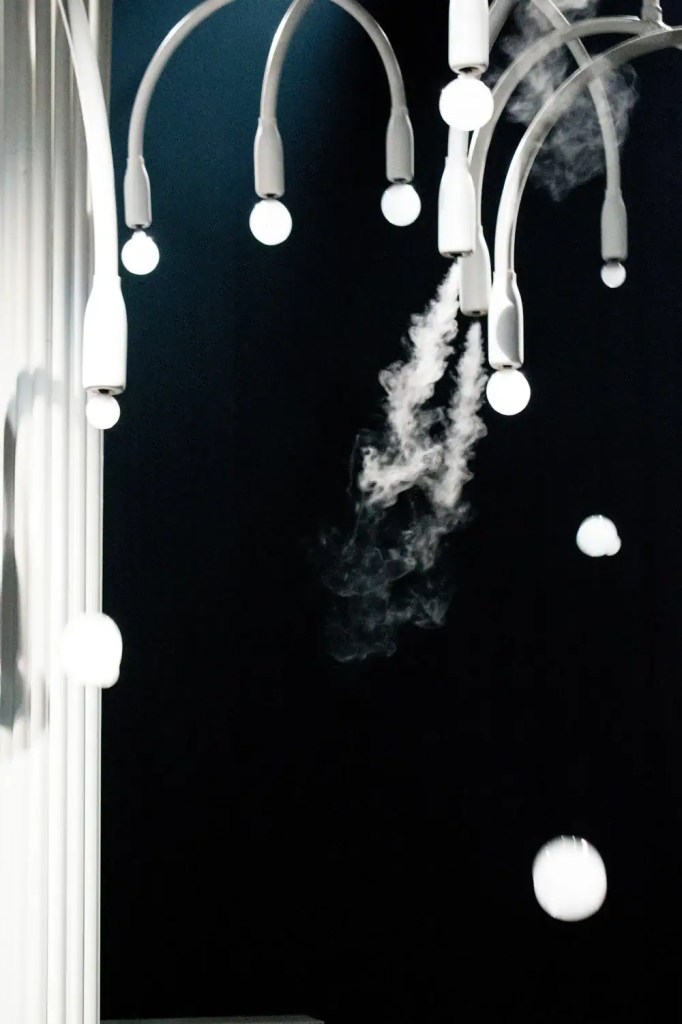
For six days in April 2017, visitors to Milan Design Week were led through black curtains into a darkened former cinema on Via Pietro Mascagni, where a six metre tree stood alone in the gloom. Its branches, tubes of recycled aluminium fixed to a frame of repurposed scaffolding, released mist filled bubbles that drifted down toward the floor. Visitors wearing thin fabric gloves could catch and hold them, feeling the bubble hold its shape against the glove’s texture in a way it never would against bare skin. Eventually each one broke, releasing a fine, scented mist, and was gone.
The installation was called New Spring, and it was built by the design duo Studio Swine, Alexander Groves and Azusa Murakami, for the fashion brand COS. It ran from 4 to 9 April 2017 inside Cinema Arti, a disused 1930s cinema at Via Pietro Mascagni 8, and it was the sixth consecutive year COS had commissioned a new installation for Milan Design Week, a run that had begun in 2012 and would go on to bring in a different architect, artist or studio every spring for years afterwards.
What makes New Spring worth returning to is not simply its scale, though a bubble large enough to hold and a tree tall enough to fill a former cinema auditorium is arresting enough on its own. It is the way the installation’s central engineering problem, keeping a bubble intact for slightly longer than physics would prefer, doubled as the entire argument the piece was making. Studio Swine builds objects around waste, industrial process and overlooked material by habit. Here, working for a fashion brand rather than with a landfill’s worth of ocean plastic, they applied exactly the same instinct to something that had no material value at all: air, water, a little soap, and roughly ten seconds of held shape.

What New Spring actually was
At the centre of Cinema Arti’s stripped interior stood a tree structure standing close to six metres tall, built almost entirely from recycled aluminium tubing mounted on a frame of powder coated scaffolding, itself made from parts the studio had already had to hand rather than commissioned new. The branch ends were fitted with custom bubble making mechanisms, engineered from roughly 3,000 individually 3D printed components, because, as Murakami has explained, the bubble machines that already existed on the market simply were not built for what the installation needed them to do.
Those mechanisms released large, translucent bubbles, each filled with a fine mist rather than plain air, which drifted from the branches toward the floor of the darkened room. The solution itself was close to the simplest bubble mixture there is: water, air and a little soap, in Groves’s own description, though he has been careful to note that a great deal of quiet engineering sat behind that simplicity. The bubbles were formulated to hold together on contact with certain textured fabrics for a few moments rather than bursting instantly, which is why every visitor was handed a pair of gloves on entry. Touch one with bare skin and it burst at once. Touch it through the glove and it would sit, intact, in the palm of a hand for a short while before finally giving way and releasing its scent into the room.
Visitors entered through black curtains into near total darkness, a staging choice that did real work: with almost nothing else to look at, the tree, the drifting bubbles and the mist they released became the entire field of attention. It was a deliberately minimal set of ingredients, a tree, some bubbles, three scents and very little light, asked to carry an entire installation on their own.

The studio that turns waste into wonder
Studio Swine was founded in London in 2011 by Alexander Groves and Azusa Murakami, who met while both were studying for a Masters in Product Design at the Royal College of Art. Groves, British, had come to the RCA with an undergraduate degree in fine art from Oxford; Murakami, Japanese, had trained as an architect at the Bartlett School of Architecture before making the same move into product design. The studio’s name is itself a piece of design thinking: SWINE stands for Super Wide Interdisciplinary New Explorers, a description that has turned out to be a fairly accurate summary of how the practice actually works.
Rather than settling on a signature material or form, Studio Swine has built its reputation on a repeatable method: arrive somewhere, research what that place produces or discards in quantity, and turn it into something considered. In São Paulo, that meant Can City in 2013, a mobile foundry that smelted waste aluminium drinks cans, gathered by the city’s own network of informal recyclers, using recovered vegetable oil as fuel, and cast the metal into stools on the street where the cans had been collected. In 2014, it meant Hair Highway, a series of lacquered objects made from human hair sourced through China’s hair trading industry, shown at Design Miami/Basel. In 2015, it meant Gyrecraft, objects turned from plastic debris gathered across all five of the world’s ocean gyres during an expedition the studio undertook by boat, examining what a genuinely global waste stream looks like when it washes up as raw material rather than as a statistic.
The studio describes its own working method as Ephemeral Tech, a term that captures the pattern running through all of this work: sophisticated engineering and fabrication put in service of something that is deliberately not permanent, whether that is a stool cast on a street corner and left behind, or a bubble built to last ten seconds. New Spring was the first time that instinct was applied to a substance with genuinely no material value at all, which is arguably a harder brief than turning ocean plastic into furniture, because there was no waste stream to redeem and no material story to fall back on. The entire argument had to be carried by engineering and timing alone.

An installation with the same rule Studio Swine applies to waste
Groves has described the studio’s guiding principle for New Spring directly: the aim was to achieve maximum effect with minimal resources, using low voltage lighting throughout and building the tree’s frame from scaffolding components the studio already had rather than fabricating a new structure for a single week’s use. That is precisely the discipline Studio Swine applies to a pile of ocean plastic or a heap of drinks cans, just turned toward a fashion brand’s design week budget instead of a waste stream. The constraint was chosen, not imposed.
The scent mechanism carried its own quiet engineering problem. Each bubble, on bursting, released one of three custom fragrance blends, built around flower, fruit and wood, standing in for what Groves called the three basic elements of a tree. Formulating a scent that could survive being carried inside a soap bubble turned out to be genuinely difficult, because, in Murakami’s own description, perfume depends on oils, and oil is the enemy of a bubble’s surface tension. Getting the fragrance to emulsify properly, rather than separate and clog the delivery tubes feeding each branch, took the kind of unglamorous, iterative testing that never shows up in a finished installation but decided whether the piece worked at all.

Why a cherry blossom festival, and not simply a tree
Studio Swine has been specific about where the concept for New Spring came from. Murakami has said the studio wanted to build something closer in spirit to Japan’s Sakura, or cherry blossom, festival: contemplative, tied to a particular season, and built around bringing people together rather than around any single object. The timing was deliberate. New Spring opened during Milan Design Week’s own seasonal moment, early April, echoing the short, closely watched window in which Japan’s cherry trees bloom each year.
That reference explains a design decision that might otherwise look arbitrary: why build an installation around something that lasts only a few seconds, rather than a tree sculpture that simply stays in bloom for the whole week. Cherry blossom is affecting precisely because it does not last. Hanami, the Japanese custom of gathering to view the blossom, is built on watching something beautiful and temporary in the company of other people, and Murakami has pointed to scent as a genuinely underused part of that experience, the specific fragrance of a cherry blossom season being as much a part of the memory as the colour of the petals. New Spring borrowed that whole structure rather than only its visual cue: a communal, time limited gathering, organised around a fragrance that exists for only a few seconds before it disperses, deliberately staged during the one week of the year when Milan is full of people who have travelled specifically to look at design.

A cinema built for one century, borrowed for one week
Cinema Arti, the venue COS and Studio Swine chose for New Spring, was built in the 1930s to the designs of the architect Mario Cereghini, on Via Pietro Mascagni in Milan, and originally operated as a working cinema rather than an exhibition space. By 2017 it stood disused, one of several former industrial and civic buildings that Milan Design Week regularly reopens for a single week each April before they return to standing empty. Its stripped interior, no seating, no screen, simply a dark, enclosed volume, gave Studio Swine exactly the blank, light controlled space the installation needed: a room where a visitor’s eyes would have nothing to adjust to except the tree, the bubbles and the mist drifting between them.
Working inside a disused cinema rather than a purpose built pavilion also meant New Spring inherited a certain history without having to explain it. A room built for collective viewing in the 1930s was, for one week in 2017, put back to work as a room for collective experience of a different kind, gathering strangers in the dark around something transient rather than around a screen.

The sixth of a run that has kept going
New Spring did not appear in isolation. COS began commissioning a new Milan Design Week installation every year from 2012, and by the time Studio Swine’s turn came round in 2017 the brand was, by its own account, marking its sixth participation in the fair. The Japanese architect Sou Fujimoto had built a light based installation for COS the year before, in 2016, and Studio Swine followed him with an installation built almost entirely around scent and mist rather than light or mirror.
The run did not stop there. COS returned to Milan the following spring for its seventh commission, working with the Californian artist Phillip K. Smith III on Open Sky, a faceted ring of mirror polished steel built inside the courtyard of Palazzo Isimbardi. The year after that, for an eighth commission, the French architect Arthur Mamou-Mani built Conifera in the same courtyard, a 700 piece lattice of compostable bioplastic bricks designed to be composted once the show came down. Seen together, the three installations trace a clear line: mist and scent in a disused cinema in 2017, reflected sky in a Renaissance courtyard in 2018, and a growing, compostable structure in the same courtyard in 2019, each one testing a completely different idea of what a week long installation could be built from and what it should leave behind.
Final thoughts
It would be easy to describe New Spring as a pretty piece of design week theatre, the kind of installation built for a season of photographs and then filed away once the bubbles are gone. That description misses what the piece was actually testing.
Studio Swine’s entire practice is built on taking something with no obvious value, ocean plastic, waste aluminium cans, human hair swept from a barbershop floor, and proving that considered engineering can turn it into something worth keeping. New Spring pushed that same instinct to its limit by working with a substance that could not be kept at all. A soap bubble filled with scented mist has no material worth, no second life, no possible archive. What Studio Swine built instead was ten seconds of held shape, achieved with low voltage lighting, reused scaffolding and roughly 3,000 custom printed parts, all in service of a moment that was designed, from the outset, to disappear.
That is precisely the lesson Murakami drew from Japan’s cherry blossom festivals in the first place: the beauty is in the fact that it does not last, and it is worth gathering with other people to watch it go. COS’s Milan Design Week series was, by 2017, already six years old, and it has since gone on to reflect the sky and grow a compostable forest in the same city. New Spring remains the year the series proved that a design argument about restraint and impermanence could be made with nothing more than air, water and a little soap.

What was New Spring?
New Spring was an interactive installation by the design duo Studio Swine, built for the fashion brand COS and shown at Milan Design Week 2017. Its centrepiece was a six metre tree that released mist filled bubbles carrying scent.
Where and when was New Spring shown?
It was installed inside Cinema Arti, a disused 1930s cinema at Via Pietro Mascagni 8 in Milan, and ran from 4 to 9 April 2017, timed to Milan Design Week and the Salone del Mobile.
Who is Studio Swine?
Studio Swine is a design duo founded in London in 2011 by the British artist Alexander Groves and the Japanese architect Azusa Murakami, who met while studying for a Masters in Product Design at the Royal College of Art. The studio’s name stands for Super Wide Interdisciplinary New Explorers.
What was the tree sculpture made from?
The tree stood close to six metres tall and was built almost entirely from recycled aluminium tubing, mounted on a frame of powder coated scaffolding that the studio already had to hand.
How did the bubbles work?
Each bubble was filled with mist rather than plain air, from a solution close to water, air and a little soap. The mixture was engineered to hold its shape briefly against textured fabric, which is why visitors wore gloves, while bursting immediately on contact with bare skin.
What scents did the bubbles release?
On bursting, the bubbles released one of three custom fragrance blends, built around flower, fruit and wood notes, intended by Studio Swine to represent the three basic elements of a tree.
Which edition of COS’s Milan Design Week series was New Spring?
It was the sixth consecutive year COS commissioned a new installation for Milan Design Week, following the architect Sou Fujimoto’s light based installation in 2016 and preceding Open Sky in 2018 and Conifera in 2019.
Can New Spring still be seen?
No. It was a temporary installation shown only for the six days of Milan Design Week 2017, and it was dismantled afterwards.


Leave a Reply