
ART & CULTURE · VENICE
Reading time: 8 minDaniel Arsham’s fictional archaeology has toured enough cities that the device risks becoming a formula: cast an object, bury it in crystal, call it the future. Venice 3024 works because the artist stopped inventing the apparatus of that fiction and borrowed a real one, a French national workshop that has been casting masterpieces since 1794. The result is a show that argues fictional archaeology is a material practice before it is an idea.
Daniel Arsham opened his first solo exhibition in Venice on 17 April 2024, timed to coincide with the opening days of the 60th International Art Exhibition, La Biennale di Venezia, and running until 15 September 2024. The show, titled Venice 3024, was staged inside the Chiesa di Santa Caterina, a deconsecrated church in the Cannaregio district, and presented by the gallery Perrotin in collaboration with curator Ronald Harrar.
It brought together new bronze and stainless steel sculpture, a suite of works recreated from historic museum moulds, a new mosaic collaboration with the Italian glassmaker Bisazza, and a fully functional, crystal-encrusted motorcycle. All of it sits inside Arsham’s long-running device of imagining the present as it might be excavated a thousand years from now, in the year 3024.
The premise is simple enough to state in a sentence and easy to mistake for a gimmick, because Arsham has now staged versions of it in several cities. What distinguishes Venice is not the concept but the apparatus behind it: a genuine 230-year-old French casting workshop, a genuinely damaged and rebuilt Venetian church, and a regional glassmaking tradition, all put to work on the same fiction. That is the design argument worth making about this show, and it is the one most coverage of the opening skipped past.


What Venice 3024 actually is
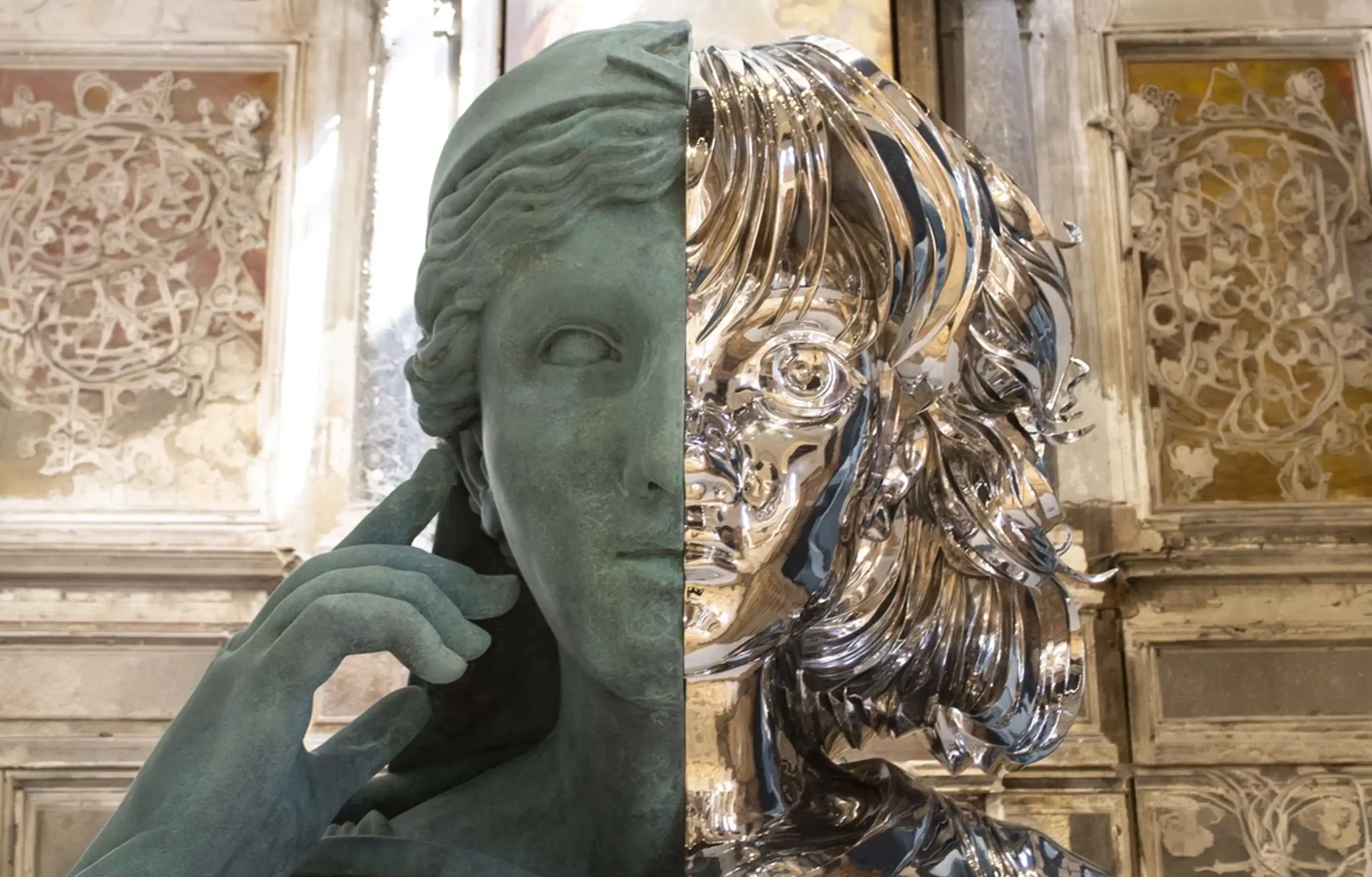
The centrepiece is a large-scale bronze and stainless steel sculpture installed in the church’s apse, the raised recess behind where the altar once stood. It belongs to Arsham’s Fractured Idols series, which fuses recognisable faces, drawn from anime, cartoons and classical antiquity, into single fictionalised portraits. Arsham builds these composites by running source imagery through artificial intelligence to generate the hybrid forms, then sculpts and casts the results in metal.
Around it, the nave holds Arsham’s Fictional Archaeology pieces: figures cast from classical statuary and rendered in geological materials, so they read as objects excavated rather than made. New for Venice were two glass mosaic works produced with Bisazza, the mosaic manufacturer based in Montecchio Maggiore in the Veneto, the same region as Venice itself. Also on show was the Eroded Blue Calcite Superveloce 800, a fully roadworthy MV Agusta motorcycle that Arsham had already debuted at Art Basel Miami Beach in December 2023, its bodywork carrying the same crystalline erosion as his gallery sculpture.
The effect, moving through a 15th-century nave lined with objects that look freshly dug from the ground, is disorientating in the way Arsham intends. A viewer becomes, for the length of the visit, the archaeologist his premise requires.


The architect who became a fictional archaeologist
Daniel Arsham was born in Cleveland, Ohio, in 1980 and raised in Miami. At twelve, Hurricane Andrew destroyed his family’s home, an event he has cited repeatedly as the origin of his interest in ruin and reconstruction. He trained not as a sculptor but as an architect, attending the Design and Architecture Senior High School in Miami before winning a scholarship to study architecture and design at The Cooper Union in New York.
That training shows in the work. In 2004, back in Miami, Arsham co-founded an artist-run exhibition space called The House, where he met the dealer Emmanuel Perrotin, beginning a representation that continues at Venice 3024 two decades later. In 2007 he co-founded Snarkitecture with the architect Alex Mustonen, a studio built on the idea that existing materials and spaces can be manipulated into something unexpected: a museum floor rippled like sand, a shopfront that appears to be crumbling into powder. Snarkitecture’s language of controlled collapse is the direct ancestor of the eroded objects now filling the Chiesa di Santa Caterina.
The same instinct has taken Arsham into fashion and product design at a scale most artists never reach. He designed runway sets for Dior under Kim Jones from 2018, produced an eroded suitcase and pilot case with Rimowa, cast a Porsche 911 Turbo in blue calcite, and worked with Tiffany & Co. and Adidas. Each project applies the same logic as the Venice sculptures: take an object that is instantly recognisable, and show it as if time, or the future, had already got to it. For a design publication, this is the more useful way to read Arsham than as simply an artist showing at the Biennale. He is an architect who never stopped designing, and who found that erosion, applied carefully, is a design language in its own right.


How an eroded sculpture is actually made
The word “eroded” undersells the process, which is closer to geology managed on a schedule. Arsham begins with a mould, either taken directly from an object or generated from a 3D scan, and casts a hollow shell from it in plaster or resin. Into that shell he introduces geological materials, principally volcanic ash, selenite, quartz, pyrite and hydrostone, along with pigments such as blue calcite and rose quartz for colour. Crystals are seeded to grow within the cast over weeks, so that when a section of the shell is later removed, the interior appears to be genuine mineral formation breaking through a familiar surface, exactly as it would if the object had spent centuries underground.
Nothing about the process is quick. A motorcycle-scale work like the Eroded Blue Calcite Superveloce 800 requires the vehicle to remain fully functional beneath its crystallised skin, which means Arsham’s studio is working simultaneously as a foundry, a mineralogy lab and, in that case, a garage. It is the same patience Snarkitecture brought to architecture, redirected into geology.


The 1794 workshop behind the future’s ruins
The detail that separates Venice 3024 from a generic touring version of the same concept is the sourcing of its Fictional Archaeology pieces. For this exhibition, Arsham worked with the Réunion des Musées Nationaux, Grand Palais (RMN-GP), drawing on moulds and scans of works held in the Louvre, the Acropolis Museum and the Kunsthistorisches Museum in Vienna.
What is worth knowing, and what almost none of the coverage of the opening mentioned, is what that partnership actually is. The RMN-GP’s casting workshop, the atelier de moulage, was established in Paris in 1794, in the middle of the French Revolution, to supply museums and the fine art schools with precise plaster reproductions of antique masterpieces that most institutions could never own an original of. Over two centuries the workshop has grown into an archive in its own right: it holds casts of works that have since been damaged, altered or lost entirely, which means some of its plaster copies are now the only accurate surviving record of an original form.
That is the mechanism Arsham borrowed. A workshop built to preserve the past with total fidelity became the tool he used to imagine the future’s decay. His “future relics” are not sculpted from imagination; they are cast from the same moulds a French institution has used since the eighteenth century to keep antiquity legible. Fictional archaeology, staged this way, turns out to depend on genuinely functioning archaeological infrastructure, not an invented version of it. That is the argument the show is actually making, whether or not it says so on the wall text.


Why Santa Caterina, and not somewhere grander
The Chiesa di Santa Caterina has its own layered history, and it happens to mirror the show inside it. Construction began in the early 13th century under the Order of Penitence of Jesus Christ, stalled after the order was suppressed in 1274, and was eventually completed by Augustinian monks who dedicated the church to Catherine of Alexandria. It once held paintings by Veronese, Tintoretto and Palma il Giovane. In the 1970s, a fire during restoration work severely damaged the building and much of what it contained. Deconsecrated and repaired, it now forms part of the Liceo Marco Foscarini, a Venetian school, and its nave is used for exhibitions during periods when the Biennale draws visitors to the city’s less obvious corners.
A church that has already been built, burned and rebuilt is a genuinely fitting setting for an artist whose entire practice is about objects surviving damage and re-emerging changed. It is also a useful corrective to the idea that a Biennale-season show needs a grand pavilion to matter: Venice 3024 was one of roughly ten collateral exhibitions recommended to visitors moving beyond the Biennale’s own Giardini and Arsenale sites that year, alongside the main exhibition, Stranieri Ovunque, Foreigners Everywhere, curated by Adriano Pedrosa, which ran from 20 April to 24 November 2024.


What makes Venice’s 3024 different
Arsham has staged versions of “3024” in more than one city, and the device travels well because it is simple: cast the present, bury it, imagine it dug up. What keeps the Venice edition from feeling interchangeable with those other stagings is how specifically it is anchored to the place. The RMN-GP partnership ties the work to the Louvre, the Acropolis Museum and Vienna’s Kunsthistorisches Museum, all institutions built on precisely the kind of classical antiquity that Venice, as a Biennale city steeped in its own antique and Byzantine inheritance, has spent centuries collecting, copying and displaying. The Bisazza collaboration ties it to the Veneto’s own glassmaking tradition, a few kilometres and a few centuries removed from Murano. And the church itself, rather than a neutral white box shipped in for the season, carries five centuries of the same story the sculptures are telling: something built, damaged, and made legible again.
None of that is guaranteed by the concept. It is the result of who Arsham partnered with and where he chose to show the work, and it is the reason Venice 3024 reads as a considered exhibition rather than a stop on a schedule.

Final thoughts
It would be easy to read Venice 3024 as another stop for a well-travelled concept, a crystal-encrusted motorcycle and a set of familiar eroded figures moved into a picturesque church for Biennale season. That reading misses what actually happened. Arsham did not just imagine a future in which the present has become archaeology. He borrowed the real machinery of archaeology to do it, a French national workshop that has spent 230 years casting masterpieces so precisely that some of its copies now outlast the originals they were taken from.
That is the design argument underneath the show. Fictional archaeology only works as a concept if the objects it produces carry the weight of genuine technique, and in Venice, Arsham made sure they did: real moulds from real collections, a real glassmaking region, a real building that has already survived its own disaster and repair. The premise travels between cities. In Venice, for once, the substance travelled with it. The same premise had already found a very different setting two years earlier, when six bronze relics from the same practice stood in the Formal Garden at Yorkshire Sculpture Park, Arsham’s first UK museum exhibition, proving that fictional archaeology reads just as clearly in an eighteenth-century English garden as inside a deconsecrated Venetian church.
What was Venice 3024?
Venice 3024 was Daniel Arsham’s first solo exhibition in Venice, staged at the Chiesa di Santa Caterina from 17 April to 15 September 2024, presented by the gallery Perrotin with curator Ronald Harrar, timed to the 60th Venice Biennale.
What is Daniel Arsham’s “fictional archaeology”?
It is Arsham’s long-running practice of casting recognisable objects, from technology to classical statuary, in geological materials such as volcanic ash, selenite and quartz, so they appear to have been excavated centuries in the future rather than made in the present.
What materials does Arsham use in his eroded sculptures?
Principally volcanic ash, selenite, quartz, pyrite and hydrostone, with pigmented minerals such as blue calcite and rose quartz used for colour, cast into a mould taken from or scanned off the original object.
Where were the classical sculptures in Venice 3024 sourced from?
Arsham worked with the Réunion des Musées Nationaux, Grand Palais, using moulds and scans of works held in the Louvre, the Acropolis Museum and Vienna’s Kunsthistorisches Museum, produced by the RMN’s casting workshop, which has operated since 1794.
Is Daniel Arsham an architect?
He trained in architecture and design at The Cooper Union in New York and co-founded the studio Snarkitecture with Alex Mustonen in 2007, alongside his sculpture practice and collaborations with brands including Dior, Porsche, Rimowa and Tiffany & Co.
What was the venue’s history before the exhibition?
The Chiesa di Santa Caterina is a deconsecrated church in Venice’s Cannaregio district, begun in the early 13th century and completed under Augustinian monks. It was badly damaged by fire during restoration in the 1970s and now sits within the Liceo Marco Foscarini school.

Leave a Reply