
ART & CULTURE · BASEL
Reading time: 10 minA five metre wood sculpture built for a Dublin office atrium, a Dead Sea armature left to crystallise into furniture, and a ceramic tribe grown from an accident with green flocking fibre. Design Miami/Basel’s 2019 Design at Large programme put nine large-scale works inside a Herzog & de Meuron hall and asked what design does once it stops being decoration. Five of those presentations carry the argument furthest.
Design Miami/Basel ran from 11 to 16 June 2019 at Messe Basel, timed as always to coincide with Art Basel next door. It was the fourteenth edition of the fair, and the second under Aric Chen as curatorial director, and Chen used his platform, Design at Large, to ask a specific question: what happens to design once the distinction between raw material and waste, natural and artificial, stops holding. He called the theme Elements: Earth.
Nine large-scale installations answered the brief, each occupying a 2,000 square metre hall that Herzog & de Meuron, the Basel practice behind Tate Modern and the Elbphilharmonie, built as the entrance to their home city’s own exhibition halls. Five of the presentations are worth going back to: Joseph Walsh Studio’s Magnus V, Mercado Moderno’s staging of Mameluca Studio’s Manimal, Jason Jacques Gallery’s Moss Tower by Kim Simonsson, Etage Projects’ pairing of FOS and Guillermo Santomá, and Friedman Benda’s Bleached II by Erez Nevi Pana. Between them they cover wood, ceramic, foam, salt and reclaimed fibre, and each one answers Chen’s question differently.


Joseph Walsh Studio presents Magnus V
The hall Herzog & de Meuron built for the argument
Design at Large was not a sideshow to the main fair. It sat inside the New Hall at Messe Basel, the elliptical steel and glass structure Herzog & de Meuron completed in 2013 and which forms the building’s entrance, so every visitor to the fair passed through Chen’s nine commissions before reaching a single gallery booth. That placement mattered: Chen was using the architecture the city is best known for to frame a set of works about what gets built and what gets discarded, in the same city that built it.

Joseph Walsh Studio presents Magnus V
The other four installations in the hall answered the same brief from different angles. Andrea Branzi showed the largest grouping yet assembled of his Territories series with Friedman Benda, Shahar Livne used heated plastic composite to simulate geological formation for Galerie VIVID, Formafantasma built office furniture from recycled electronic waste for Giustini/Stagetti under the title Ore Streams, and Odile Decq presented a glass Black Pavilion with Galerie Philippe Gravier, lit by projected light collages from the artist Patrick Rimoux. Nine studios, one theme, and almost no overlap in material between any two of them.
Design Miami/Basel’s June date makes it the calendar counterpart to Design Miami’s flagship fair in Miami Beach each December. The two editions rarely repeat material or galleries in the same year, but both have used large-scale programming, Design at Large in Basel and its equivalent strand in Miami, to push exhibitors toward work that a standard booth could not hold.


Mercado Moderno presents Manimal by Mameluca Studio
Joseph Walsh Studio: an atrium piece finds its way to Basel
Joseph Walsh built Magnus V from layered olive ash, finished white and oiled, and it was, at five by five by six metres, the largest work in his Magnus series to that point. The piece reads as a single ribbon of wood pulled into a continuous, banking curve, engineered rather than merely carved, using a method Walsh describes as combining craft, research and structural engineering to find forms the material would not otherwise hold at that scale.

Mercado Moderno presents Manimal by Mameluca Studio
What is not obvious from the fair listing is that Magnus V began as an architectural commission. It was made for the atrium of IPUT’s Dublin headquarters, a permanent piece of corporate real estate before it was ever a fair exhibit, and Walsh has spoken about wanting it to provoke “calm, reassurance and discovery” in people who pass through that lobby every working day. Design at Large borrowed a building element, in effect, and put it inside another one for a week.
Walsh, who is self-taught and established his studio in County Cork in 1999, also showed Eximon, a bench cut from Kilkenny limestone with fossils still visible in the stone. His pieces since have gone into the Metropolitan Museum of Art, the Centre Pompidou, the Cooper Hewitt and Chatsworth House, where the Duke of Devonshire has said the two Enignum chairs he commissioned bring the family more daily pleasure than almost anything else in the collection.


Jason Jacques Gallery presents Moss Tower by Kim Simonsson
Mercado Moderno: Mameluca Studio’s Manimal
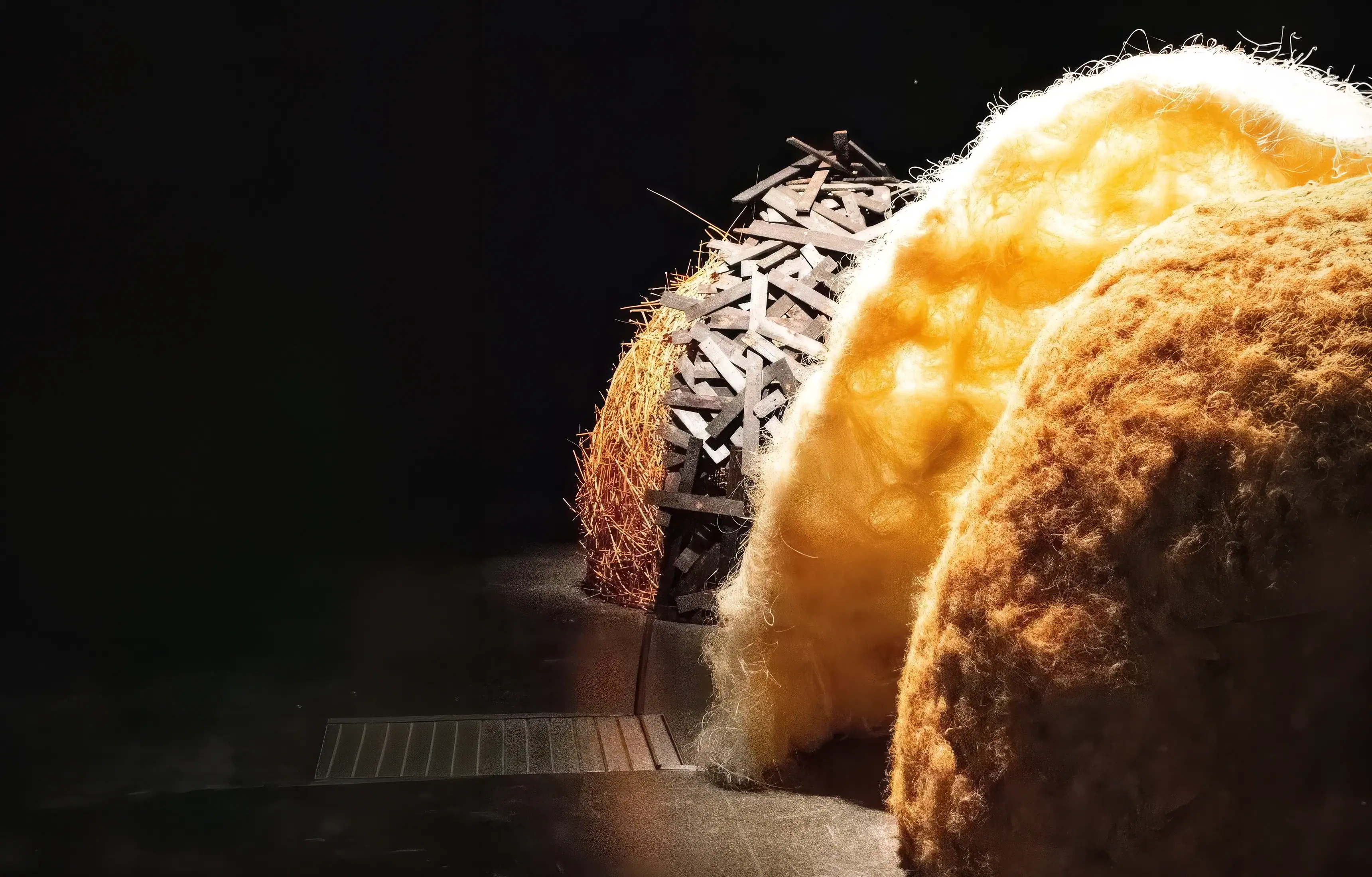
Mameluca Studio was founded in Rio de Janeiro in 2012 by Alessandra Clark, a Brazilian designer whose grandmother was connected to the Lygia Clark Foundation, and Nuno Franco de Sousa, whose training spans biology and engineering. Manimal, staged by the Rio gallery Mercado Moderno, comprised three nest-like forms built from reclaimed wood, bulrush fibres, cardboard pulp and discarded fishing nets, modelled on the nests city-dwelling weaver birds construct from whatever scrap material is closest to hand.

Jason Jacques Gallery presents Moss Tower by Kim Simonsson
The pairing was the point. Where a bird’s nest of cardboard and netting reads as resourcefulness, the same materials in a landfill read as waste, and Mameluca built Manimal to sit exactly on that line. The three structures were scaled and lit to be walked around rather than viewed from a single angle, closer to habitats than sculptures, with the reclaimed timber left rough enough to show its previous life as something else. The studio has described the work as proposing new hierarchies around the idea of waste altogether, rather than simply illustrating the problem.
Clark and Franco de Sousa built the studio around exactly that kind of cross-disciplinary reading, her background in product design and marketing set against his training in biology and engineering, and Manimal was an early, fully-realised statement of it: a piece of natural history observation translated directly into gallery-scale design, with no metaphor required to make the connection land.

Mercado Moderno presents Manimal by Mameluca Studio
Jason Jacques Gallery: Kim Simonsson’s Moss Tower
Kim Simonsson, a Finnish ceramicist, builds his Moss People from handmade stoneware and then coats them in a technique called flocking, in which fine nylon fibre is applied over paint to give the surface a velvety, mossy texture. The colour itself was an accident: Simonsson discovered it by layering yellow flocking over an existing black base and getting an unexpected green, and that green has defined the series since.

Friedman Benda presents Bleached II by Erez Nevi Pana
For Jason Jacques Gallery, the New York dealer that represents him, Simonsson built Moss Tower, a set of the figures arranged across tiers of industrial metal scaffolding rather than plinths, so that visitors looked up through the structure rather than down onto a display case. The characters draw on Nordic fable rather than any single story, and each one carries something, a book, a radio, a plush toy, that suggests a journey already in progress rather than a fixed pose. The scaffolding itself did real work in the staging: it read as construction hoarding as much as gallery furniture, putting a folkloric subject inside an industrial frame that matched the hall’s wider argument about earth, extraction and what gets built.
Simonsson has kept building on the series since Basel, taking it to a solo show titled Moss Cabbage People at Galerie NeC in Paris and, in 2022, installing fibreglass versions of the figures along the thoroughfares of the Utopia Festival in Lille, where they lined the route among the pedestrians rather than standing apart from them. What began as a workshop accident with two tins of flocking fibre has become one of the more recognisable bodies of work to come out of contemporary Finnish ceramics.

Etage Projects presents A Million Times and Leaking Fountain by FOS and Piano by Guillermo Santomá
Etage Projects: FOS and Guillermo Santomá read the Anthropocene
Etage Projects, the Copenhagen gallery, paired two artists whose work rarely shares a wall. FOS is the professional name of the Danish artist Thomas Poulsen, who has worked under that mononym since the mid 1990s specifically to separate the work from his own identity, and who describes his practice as social design, positioned deliberately between architecture and art. His contribution was a film, A Million Times, following an Arctic explorer’s journey, shown alongside Leaking Fountain, a neon installation staged to look like plumbing that has failed at the point water is supposed to begin.

Etage Projects presents A Million Times and Leaking Fountain by FOS and Piano by Guillermo Santomá
Guillermo Santomá, based in Barcelona, works from the material outward rather than the concept in, a habit visible in furniture that has previously combined Tibetan sheep fur with foam and industrial hardware. For Design at Large he built Piano, a functional instrument carved from roughhewn foam with speakers embedded directly in its body, a post-industrial object standing in for a pre-industrial one. Together the two works treated the Anthropocene as something to be felt through material and sound rather than argued in a wall text.

Etage Projects presents A Million Times and Leaking Fountain by FOS and Piano by Guillermo Santomá
Friedman Benda: Erez Nevi Pana’s Bleached II
Erez Nevi Pana trained at the Holon Institute of Technology and completed a masters at Design Academy Eindhoven, and has spent much of the years since building a practice around vegan, animal-free materials. Bleached II is part of a body of work in which he builds wooden armatures, wraps them in loofah, and submerges them in the industrial evaporation ponds of the Dead Sea for months at a time. The loofah draws minerals from the water the way it would draw water from a plant, and the salt crystallises across the surface in formations closer to coral than to furniture, until the object is finished by the sea rather than by Nevi Pana’s hands.

Friedman Benda presents Bleached II by Erez Nevi Pana
The project is a direct response to potash extraction in the Dead Sea, which Nevi Pana connects to a wider chain running through agriculture and methane emissions to the climate consequences of both. The Bleached series won PETA’s Vegan Homeware Award in 2018 and was a Beazley Designs of the Year nominee, and individual pieces are now held by the Design Museum Holon and FRAC Grand Large. Friedman Benda, the New York gallery that gave Nevi Pana his first solo show, has continued to work with him since, including a later exhibition built from architectural-scale blocks of the same crystallised salt.

Friedman Benda presents Bleached II by Erez Nevi Pana
Final thoughts
It would be easy to read Design at Large as a sustainability showcase, five studios given a stage to say the right things about materials and waste. What the works actually did was more specific than that. Walsh brought an architectural commission into a fair setting and let its scale do the arguing. Mameluca built the comparison between bird and human waste into the object itself rather than a caption beside it. Simonsson turned an accident in a workshop into a decade of green figures. Santomá and FOS gave the Anthropocene a sound and a body rather than a slogan. Nevi Pana handed the final stage of the work to the Dead Sea itself.
That range, wood to ceramic to foam to salt, is what Chen’s theme was actually testing: not whether design could look sustainable, but whether five different studios, working in five different materials, would arrive at the same underlying question without being told to. They did. Herzog & de Meuron’s hall gave that argument the scale to be seen, and Design Miami/Basel gave it a week to be looked at properly.
When did Design Miami/Basel 2019 take place?
The fair ran from 11 to 16 June 2019 at Messe Basel, Switzerland, alongside Art Basel.
What was Design at Large?
Design at Large was Design Miami/Basel’s platform for large-scale installations, curated in 2019 by Aric Chen around the theme Elements: Earth. It occupied a 2,000 square metre hall inside Messe Basel’s New Hall, designed by Herzog & de Meuron.
What is Joseph Walsh’s Magnus V made from?
Magnus V is built from layered olive ash with a white oiled finish, measuring roughly five by five by six metres. It was originally commissioned for the atrium of IPUT’s Dublin headquarters before it travelled to Basel.
What is Kim Simonsson’s flocking technique?
Flocking is the process of applying fine nylon fibre over paint on a stoneware surface to give it a soft, textured finish. Simonsson’s signature green was discovered when a layer of yellow flocking was applied over an existing black base.
How is Erez Nevi Pana’s Bleached series made?
Wooden armatures wrapped in loofah are submerged in the Dead Sea’s industrial evaporation ponds for months, allowing salt to crystallise across the surface naturally rather than being applied by hand.
Who is Mameluca Studio?
Mameluca Studio was founded in Rio de Janeiro in 2012 by Alessandra Clark and Nuno Franco de Sousa. Manimal, shown by Mercado Moderno at Design at Large, was built from reclaimed wood, bulrush fibres, cardboard pulp and fishing nets.
Is Design Miami/Basel connected to Design Miami in Miami Beach?
Yes. Design Miami/Basel is the same organisation’s June fair, running alongside Art Basel, while Design Miami’s flagship edition takes place in Miami Beach each December alongside Art Basel Miami Beach.
Who curated Design at Large in 2019?
Aric Chen, then Design Miami’s curatorial director, curated the 2019 edition around the theme Elements: Earth.


Leave a Reply