
Art & Culture · Miami
Reading time: 8 minFrom FENDI’s centenary salotto and Charles Burnand’s Best-in-Show sculptures to Lasvit’s frozen splashes of glass, a personal edit of the moments that defined Design Miami‘s ‘Make. Believe.’ anniversary edition.
Every December, Design Miami reasserts its position as one of the most influential events on the global design calendar, gathering leading galleries, designers, collectors and curators at the intersection of contemporary design and art. The 2025 edition — a milestone twentieth anniversary, staged at Pride Park in Miami Beach from 3 to 7 December — once again turned the city into a vibrant forum for collectable design, where material experimentation, craftsmanship and conceptual thinking took centre stage. Curated around the theme “Make. Believe.”, it brought together more than seventy exhibitors and a raft of debut presentations.
This year’s fair reflected a continued shift towards narrative-driven design, with exhibitors presenting work that explored sustainability, cultural heritage and the evolving relationship between technology and the handmade. From museum-quality installations to highly sought-after limited editions, Design Miami 2025 offered a compelling snapshot of where contemporary design is headed, both aesthetically and ideologically. What continues to set the fair apart is its ability to balance the commercial with the curatorial, championing emerging voices alongside established names. Against the backdrop of Miami Art Week, it proved once again why it remains a vital platform for innovation. What follows is a personal edit of the standout presentations, designers and moments that captured the spirit of this year’s fair.
FENDI: Fonderia Fendi


A long-standing presence at Design Miami, FENDI returned for 2025 with a powerful and poetic presentation by the Milan-based Argentinian designer Constanza (Conie) Vallese, marking both the fair’s milestone year and the fashion house’s centenary. FENDI’s history at the fair reaches back further still, to December 2018, when the house marked ten years at Design Miami with The Shapes of Water, ten resin fountains by Sabine Marcelis set on travertine plinths that echoed FENDI’s own Rome headquarters. Titled Fonderia Fendi, the installation is conceived as an homage to the Fendi sisters — whom Vallese describes as “a collective energy of creative women who embodied elegance and also strength” — and recreates an intimate salotto furnished with one-of-a-kind pieces in bronze, ceramic, glass, carpet and leather, each fabricated with a different Italian atelier. Invited to take part by curator Dan Thawley, Vallese brings her multidisciplinary sensibility — art, design, jewellery and craft, threaded with recurring floral motifs — to bear on a hundred years of the house. It was one of the fair’s most thoughtful and emotionally charged moments.
Lasvit: Fragment of Time


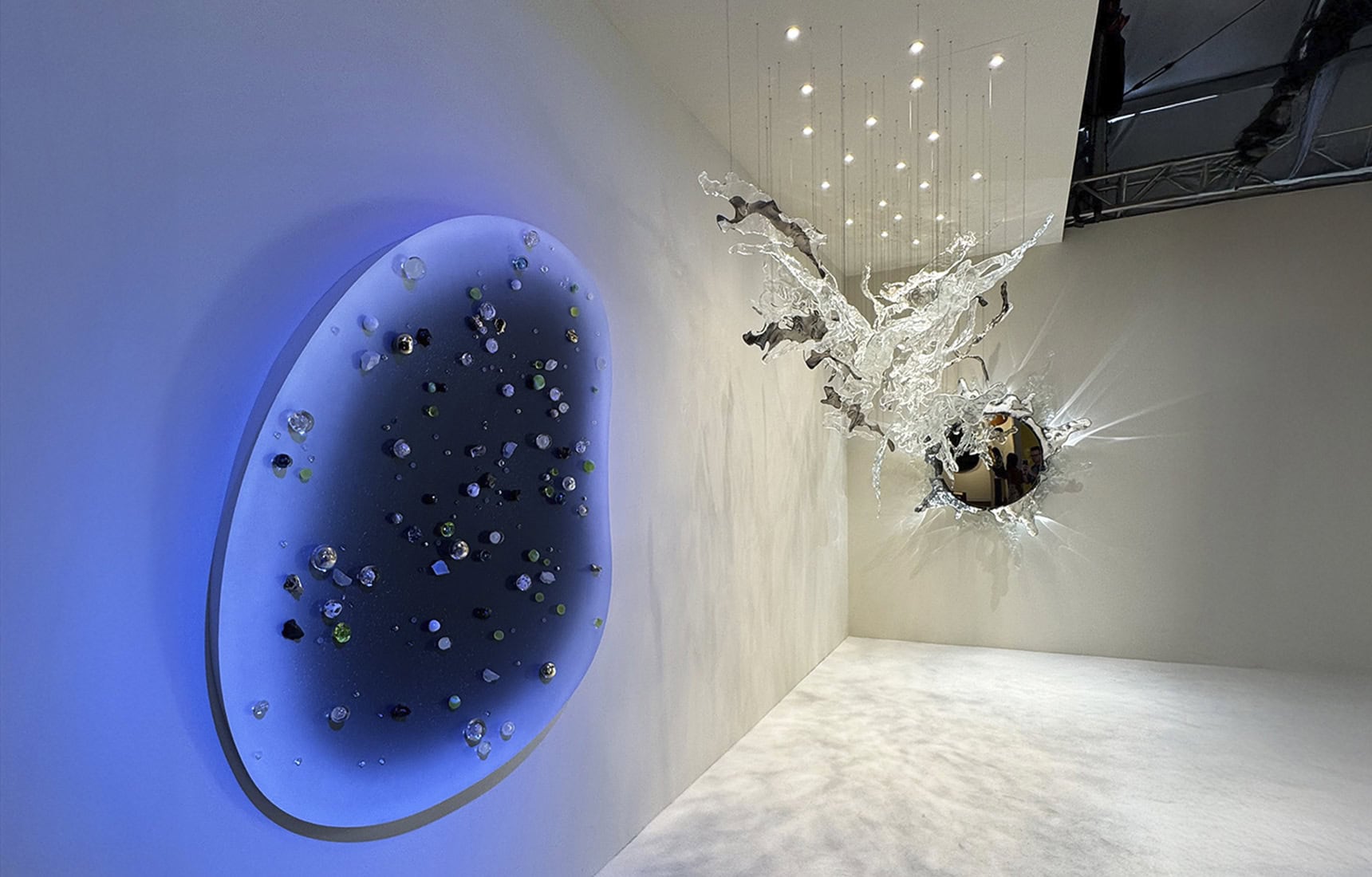
Having followed Lasvit across fairs and exhibitions around the world — from landmark installations to recent showings at Dubai Design Week — it remains a studio that never fails to impress, and its mastery of glass as both material and medium was again on full display. Through the exhibition Fragment of Time, light, form and molten glass were transformed into poetic expressions of craft, capturing the studio’s singular ability to hold the ephemeral. Among the standout pieces was Splash, a mirror that freezes the instant before water breaks its surface, reflecting both its surroundings and the viewer; and Stargazer, which drew the vastness of the night sky into an intimate frame. Where tradition meets experimentation and technical virtuosity gives form to memory and movement, Lasvit is a presence to return to with anticipation.
Bea Interiors: Make Believe


Chiming neatly with the fair’s own theme, Bea Interiors presented Make Believe, a sensorial sanctuary that invited visitors into a world of texture, materiality and quiet contemplation. Founded by Bea Pernia, the studio is defined by an intuitive, artistic approach that bridges interior and product design, and a deep-rooted material curiosity — natural woods, lush textiles, leather, metal and reflective surfaces composed into a harmonious whole. At Design Miami the result was an installation where clean, contemporary lines were softened by rich texture, a space that felt at once modern and grounded. It offered a genuine moment of pause within the fair — a reminder of design’s ability to evoke emotion, nurture the senses and create environments that resonate beyond the purely visual.
Friends Artspace: Quartersawn


One of the fair’s most intellectually resonant presentations, Friends Artspace showed Quartersawn, a thoughtful group exhibition rooted in material intelligence and historical awareness. Across the stand, tradition was not preserved but transformed. Aspen Golann reimagined eighteenth- and nineteenth-century broom-making, elevating domestic tools into sculptural tributes to overlooked histories; Kawabi drew on Japanese joinery in wood and paper lighting; and Trey Jones’s Nerikomi-patterned woodworks seemed to exist outside of time. Materiality functioned as memory throughout — Nour Hage’s hand-dyed textiles as acts of matrilineal remembrance, Meg Callahan’s quilts of reclaimed bedsheets and deadstock, Theju Nimmagadda’s mosaics of mass-produced cedar, Joanna Bloom’s quietly mystical ceramics. By elevating the accessible, the imperfect and the overlooked, Quartersawn dissolved the line between past and future.
Hicham Ghandour Designs


Hicham Ghandour presented a dedicated space for his Mediterranean Collection, an intimate encounter with work deeply rooted in craftsmanship, cultural memory and material refinement. Born in Beirut in 1958, Ghandour’s creative journey bridges continents — the elegance of Europe, the energy of New York and the enduring heritage of Lebanon, where he returned in 2011. His practice is grounded in rigorous training: furniture restoration at New York’s Fashion Institute of Technology, then gilding restoration at Palazzo Spinelli in Florence, experience that led to work with the gilding conservation department at The Metropolitan Museum of Art and prototypes for Ralph Lauren Home. Since 2016 he has made one-of-a-kind pieces for Milan’s Nilufar Gallery. At Design Miami, the collection distilled all of this into objects that felt timeless, tactile and quietly powerful.
Tokio.


A compelling fusion of tradition and futurism, Tokio. presented an immersive installation that distilled the essence of Tokyo’s nocturnal landscape into a Miami setting. Its Uebu lighting sculptures, arranged in precise, rhythmic lines, evoked the ordered serenity of a bamboo grove — architectural, minimal and quietly powerful — while large-format photography of Tokyo’s streets at night set up a dialogue between light, structure and urban atmosphere. Founded in 2011 by Gorazd Malačič, Tokio. approaches design as a considered contemporary expression, valuing simplicity, precision and advanced technology brought to life by skilled craftspeople. The effect was both cinematic and restrained: forward-looking design that sits comfortably in the present while resonating with earlier eras, an elegant synthesis of heritage, innovation and architectural clarity.
The Future Perfect


A gallery this publication has admired across its New York and Los Angeles spaces, The Future Perfect, once again reaffirmed its reputation for pushing boundaries and championing a cross-disciplinary approach. Its Miami curation placed material exploration and conceptual rigour at the forefront, with work that reflects an ongoing commitment to design as an evolving practice, one that thrives on risk-taking, unexpected pairings and the blurring of lines between art, design and architecture. Each piece felt considered yet exploratory, emphasising process as much as outcome. What distinguishes the gallery is its knack for presentations that are at once intellectually engaging and visually compelling, underscoring its role as a platform for ideas as much as objects. Fresh, confident and forward-looking, it remains one of the most influential voices in contemporary collectable design.
1882 Ltd


Always a highlight, 1882 Ltd consistently injects vibrancy and playfulness into ceramics, and its stand this year was no exception — a joyful composition balancing bold colour, dynamic form and impeccable craftsmanship. Founded in 2011, the design-driven studio collaborates with visionary designers and artists to create limited-edition homewares that celebrate both innovation and craft, each piece meticulously hand-finished by skilled potters. At Design Miami the installation transformed the stand into a visual feast, where every curve, glaze and texture invited close inspection. It is a reliably uplifting presence, and a persuasive demonstration of how craft, creativity and imagination can converge into work that is as technically accomplished as it is vibrant and unforgettable.
Sten Studio


Sten Studio presented a truly immersive installation that engaged the senses and transported visitors into a world of imagination and elegance. Its thoughtful handling of materials, colour, texture, lighting and subtle soundscapes created an environment that felt alive — magical, energetic and deeply refined. Founded in Mexico, the studio is known for an experiential approach to contemporary design, blending craftsmanship, narrative and innovation across furniture, lighting and decorative objects, and often transforming spaces into multi-sensory experiences. At Design Miami that ethos was on full display: every detail carefully considered, so that design became an experience rather than a display — immersive, playful and elegant, a fine reflection of the gallery’s signature ability to combine creativity, craftsmanship and storytelling.
Ateliers Courbet


The Ateliers Courbet stand was a masterclass in curation — beautifully composed, immersive and thoughtfully arranged to highlight both contemporary and archival design. Founded in 2013, the New York gallery has built its reputation championing the meticulous work of rarefied master craftsmen from around the world, bringing attention to centuries-old techniques maintained by ateliers across five continents. This year’s presentation combined rotating exhibitions of ongoing design catalogues with adjoining salons and viewing rooms drawn from the gallery’s permanent collection, contemporary collaborations sitting alongside archival treasures. The result was a display that felt both elegant and alive — a quiet celebration of craft, precision and artistic vision, curated with an artistry to rival the pieces themselves, and one that left visitors deeply appreciative of the work behind each creation.
Charles Burnand: Monuments of Ether


It came as no surprise that Charles Burnand was named Best in Show. The London gallery’s presentation, Monuments of Ether, was a masterful exploration of material pushed to its limits, where substance becomes sensation and the physical world dissolves into something almost spectral. De Glan Studios’ Boulder forms transformed geological mass into fluid sculptural language; Kyeok Kim inscribed time onto matter, layering powdered wood and natural lacquer over crocheted copper wire; and Peter Lane expanded ceramics into monumental fields of fire, texture and molten depth. Together the works revealed how materiality can transcend its own weight, becoming atmospheric, immersive and deeply poetic — a reminder of the gallery’s mastery at curating not only objects but experiences, where craftsmanship, innovation and sensory engagement converge with remarkable clarity.
Todd Merrill Studio


Todd Merrill Studio invited visitors into a realm where art, design and imagination intertwine, embodying the fair’s Make. Believe. spirit to the letter. From resin blooms and hand-carved wood to shimmering textiles, glass and clay, every piece felt alive — forms bending and twisting, surfaces rippling with light, the boundary between the real and the imagined dissolving. A defining feature was its focus on pioneering female artists and designers — Molly Hatch, Andrea Marquis, Pia-Maria Raeder, Alice Riehl, Draga Obradovic and Mindy Horn among them, alongside the gallery debut of the Jamaican artist Laura Facey — complemented by sculptural seating, tables, lighting and objects from a deep roster of makers. Rooted in the power of the handmade, it was a testament to how material, form and creativity can unite to create experiences that are sensual, fantastical and timeless.
Tuleste Factory


Tuleste Factory’s stand was a celebration of curiosity, imagination and playful experimentation — an installation where colour, material and form converged into a vivid sensory journey. True to its “Keep It Curious” ethos, the gallery presented design as a living fantasy: bold, unexpected and deeply emotive. Each piece, from sculptural works to lighting and objects, embodied joy and wonder, and the curation gathered an impressive roster of visionary names, including Marina Abramović, Pilar Zeta, Miranda Makaroff and Merve Kahraman. The effect was enchanting — forms playful yet precise, colours vibrant but harmonious, and every material, from glass and metal to textiles and ceramics, manipulated with exquisite craftsmanship. It underscored the gallery’s rare ability to merge imagination with refinement, leaving a lasting impression on all who visited.
Design Miami 2025 once again proved why it remains a vital platform for contemporary design, where craftsmanship, innovation and imagination converge — the same case Design Miami 2022 made three years earlier under its own golden-age theme. From immersive, multisensory installations to playful, vibrant ceramics and meticulously curated galleries, the fair showcased the breadth and depth of talent shaping today’s design landscape. Whether celebrating material mastery, cross-disciplinary experimentation or the enduring power of handcraft, each presentation offered a fresh perspective on what design can achieve. Twenty years in, the fair leaves a lasting impression — a reminder that, at its best, design is not only seen but felt, experienced and imagined. The same appetite for scale carries into the fair’s June counterpart, Design Miami/Basel, where the 2019 edition’s Design at Large programme staged nine large-scale installations, Joseph Walsh’s Magnus V and Erez Nevi Pana’s Bleached II among them, inside a hall built by Herzog & de Meuron.


Leave a Reply