ART & CULTURE · DUBAI
Reading time: 10 minEvery city with ambition announces that it is becoming an open-air gallery. Very few then commit a billion dirhams, hand permanent landmark commissions to their own artists, and let a sculpture park take root on a road the whole city drives down. Dubai has spent four years quietly building the machinery behind the phrase, and the results are now solid enough to walk between.
Painting a wall is easy. Almost every city that wants to look creative starts with murals, because they are cheap, quick, photogenic and reversible. The harder question, the one that separates a genuine public art culture from a marketing campaign, is what happens next: whether anything permanent gets built, whether artists are properly paid, whether the work is maintained a decade later, and whether it comes from the place it stands in.
Dubai has been answering that question since January 2022, when Sheikh Hamdan bin Mohammed bin Rashid Al Maktoum approved the emirate’s Public Art Strategy, with implementation beginning the following year. What has emerged since is not simply more murals. It is a permanent landmark sculpture by five Emirati artists in a public park, a sculpture park on Jumeirah Road with seven commissioned works in it, an annual festival that has grown into the city’s most reliable testing ground for new talent, and, as of April 2026, a one billion dirham portfolio aimed at holding the whole thing together.
The phrase Dubai keeps using is “an open-air gallery.” It has taken four years, but the phrase has finally acquired some infrastructure behind it.
The policy machine behind the paint
Public art in Dubai does not happen by accident, and understanding the scaffolding explains why the work looks the way it does.
The Public Art Strategy sits inside a stack of overlapping government plans: the Dubai Creative Economy Strategy, the D33 Dubai Economic Agenda, and the Dubai 2040 Urban Master Plan. Of those, 2040 is the one that matters most to what actually gets built, because it governs where public space exists at all. A public art programme is only as good as the public realm it has to work with.
The delivery model is the more interesting decision. Rather than appointing a single commissioning body, Dubai Culture distributed the work across Art Dubai, Tashkeel, Alserkal, Art Jameel and Akaas Visual Arts, the organisations that already had working relationships with artists. It is slower than a central agency and it produces markedly better work, because the people selecting artists have seen their studios.
The economic case is substantial. Dubai ranked first globally in 2024 for greenfield investment into cultural and creative industries, and the Creative Economy Strategy targets a 5 per cent contribution to GDP, against roughly 2.5 per cent today. The strategy is working and it is still building. What follows is the part that matters most, which is what the money has actually produced.

Chafa Ghaddar
Union of Artists: the moment it became permanent
If one work marks the shift from decoration to infrastructure, it is this one.
In 2023, Dubai Culture and Art Dubai launched an AED 2 million open call for the emirate’s first permanent landmark public commission. The result, unveiled in February 2024, is Union of Artists, standing in Al Hudaiba Public Park with views towards the Etihad Museum and Union House. The siting is not casual. This is the ground where the UAE was founded.
The work is by five Emirati artists working as one: Afra Al Dhaheri, Shaikha Al Mazrou, Asma Belhamar, Khalid Al Banna and Mohamed Ahmed Ibrahim.
Formally, it is seven pillars that lean into and cross each other, one for each emirate, resolving into a single standing structure rather than seven separate objects. The reference is the areesh, the palm-frond dwelling that is among the oldest building types in the region and which works by exactly this logic: slender elements, individually weak, braced into stability by being tied against one another. Translating that from palm frond into permanent material is the whole idea of the piece, and it is why the sculpture reads as woven rather than assembled.
The authorship is legible in the object, which is unusual for a group work. Al Banna contributed the intersecting stick structure. Al Mazrou added the bands that wrap and tension the pillars, which is recognisably her subject, since her practice is built on tension, weight and balance in steel. Ibrahim supplied the engraved surface motifs that run through his own work, so the pillars carry his mark-making at close range while reading as pure structure from a distance. Five practices are present without any of them dominating.
That resolution was the artists’ doing rather than the brief’s. Shortlisted separately, they chose to propose each other. As Al Dhaheri described the moment, “If [he] wasn’t doing this, then we were not doing it either. I then suggested that we propose each other’s projects.”
It says something about the density of the UAE art community that a competitive shortlist turned itself into a collective, and something about the commissioning process that it let them.
Huna Sculpture Park, and what private money does differently
The second development is that Dubai’s public art is no longer only a government activity.
Huna Sculpture Park, at H Residence on Jumeirah Road, opened in March 2024 and now holds permanent works by Rana Begum, Shaikha Al Mazrou, Pablo Reinoso, Khalid Al Banna, Nadim Karam, Sara Naim and Jacob Dahlgren.
That list is a curatorial position rather than a shopping trip. Begum works with light, colour and repeated industrial geometry, so her surfaces change as you move past them. Reinoso is best known for benches whose slats escape their own function and grow into the air behind them, which is about the most generous thing you can put in a public seating context. Karam makes figurative narrative sculpture with a strong silhouette. Dahlgren works in systematic colour and geometric abstraction. Set against Al Mazrou’s tensioned steel and Al Banna’s textile-derived abstraction, the collection covers optical work, narrative work, systemic work and material work rather than seven variations on the same outdoor object. On a road most of the city drives down weekly, that variety is what makes it worth stopping for twice.
The park’s commissions run through the A.R.M Holding Public Art Commission with Art Dubai. The most recent open call, themed around بنظهر أقوى, a statement of collective resilience and renewal, closed on 25 July 2026, and sought a site-specific outdoor work from UAE-based regional and international artists with a track record in permanent or large-scale installation. The winner has not yet been announced.
A.R.M Holding’s chief executive, Mohammad Saeed Al Shehhi, framed the reasoning plainly: “Culture is essential to how we build cities and communities. This commission reflects our belief that art should be woven into everyday life.”
The structural point stands on its own. When a developer commissions permanent sculpture through an established art fair rather than buying decorative pieces from a catalogue, the standard across the city rises, and Huna is the evidence of it.

Ahmed Amine Aitouche
The murals, and what they are actually for
None of which makes the murals unimportant. They do a different job: they cover far more ground, far more cheaply, and they reach people who will never set foot in a gallery.
The strongest of them are genuinely site-specific rather than generically decorative.
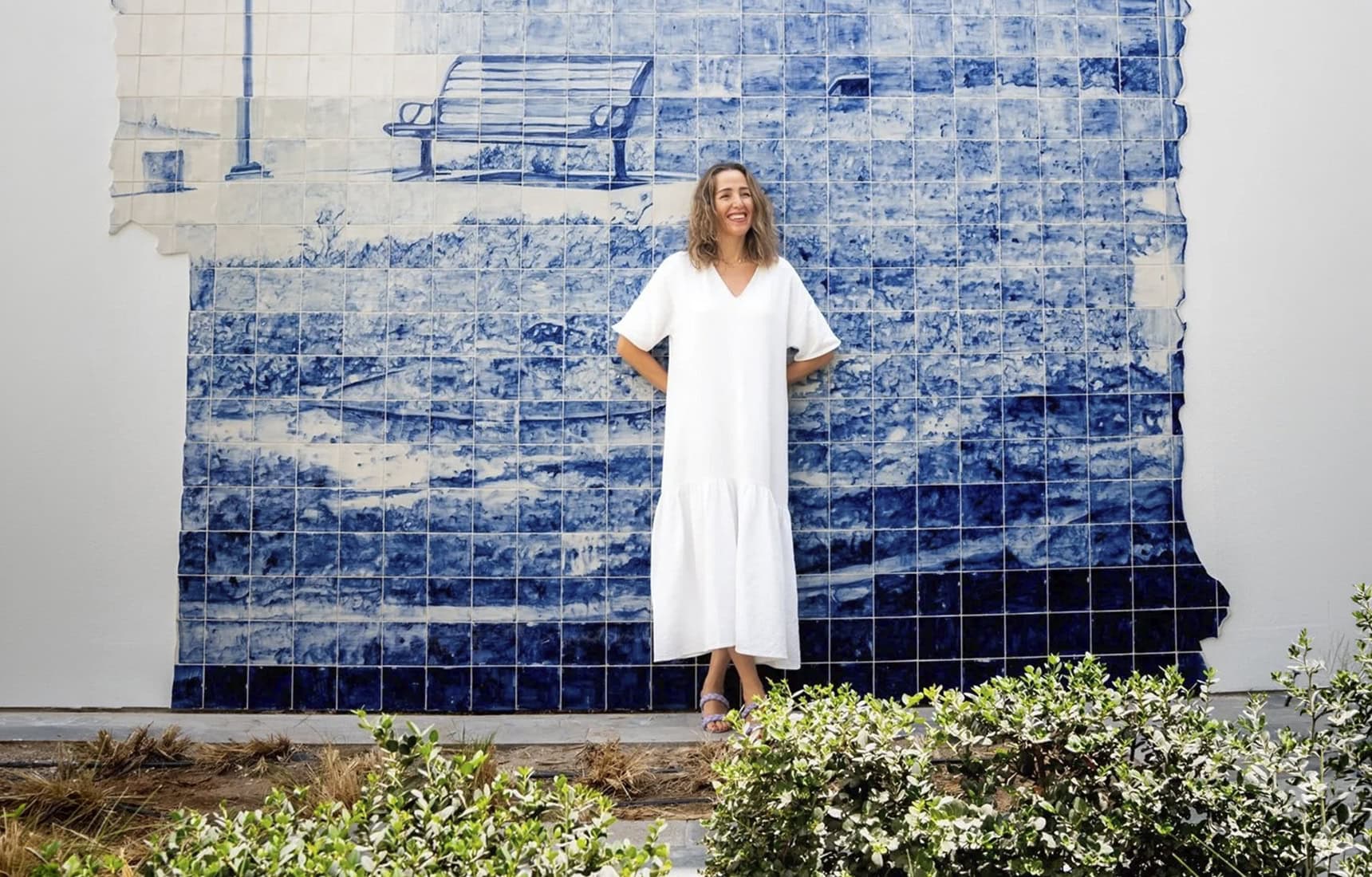
Chafa Ghaddar at the Al Safa Art and Design Library is the most accomplished. The Lebanese artist’s gypsum mural draws on Islamic ornamentation and reworks the library’s own original architectural elements, using the Azulejos ceramic tradition, itself a Portuguese form shaped by Islamic, Chinese and Spanish influence. A technique with that many inherited layers is a well-judged choice for a city built on overlapping populations.
The Tide by Yubran Gosne, the UAE-based Argentinian artist known as Sanctum, sits in Umm Suqeim Park. Four panels of blue, turquoise and green trace the meeting of water and sand, holding on to a maritime identity that most of contemporary Dubai has built over.
Ahmed Amine Aitouche, the Algerian artist working as Sneak Hotep, has two: Amalgamation in Nad Al Sheba Park, painted across three interconnected surfaces and dealing in coexistence and balance, and Epitome in Abu Hail Park, a quieter piece about personal growth.
Unified, by Tunisian calligraffiti artist Karim Jabbari and American designer Jaime Brown, is the historically significant one. Among the earliest permanent works in Al Quoz, painted around 2020, it fuses Arabic calligraphy with contemporary graphic design and marked the moment Al Quoz began its shift from industrial estate to creative district. It arrived before the policy did.
Note where these are: Umm Suqeim, Nad Al Sheba, Abu Hail, Al Safa, Al Quoz. Not the waterfront, not Downtown. The mural programme has been pointed at neighbourhood parks and residential districts, which is the correct instinct. Public art that only appears where tourists already are is not public art. It is set dressing.
Sikka: the city’s testing ground
The Sikka Art and Design Festival is where a good deal of this talent surfaces first.
Now in its 14th edition, Sikka ran from 23 January to 1 February 2026 in the Al Shindagha Historic Neighbourhood, under the theme “Imagining Dubai: Identities of the Future”. Work spread across 16 historic houses, with installations on rooftops and in the spaces overhead, alongside workshops, talks, performances, supper clubs and a market. Entry is free.
The free admission matters more than it sounds. It removes the single biggest filter on who encounters contemporary art, and it is the reason Sikka functions as a genuine public programme rather than an art-world event that happens to be outdoors.
Dubai Culture’s chief executive, Shaima Rashed Al Suwaidi, describes the distinction: “Sikka stands out for its integrated, community-led model that goes beyond the traditional exhibition format.”
Siting it in Al Shindagha is deliberate too. Putting speculative contemporary work inside restored historic courtyard houses forces a conversation between the two rather than letting heritage sit sealed off as a museum piece.

Chafa Ghaddar
What a billion dirhams is meant to buy
The most significant recent development arrived on 30 April 2026, when Sheikha Latifa bint Mohammed bin Rashid Al Maktoum, chairperson of Dubai Culture, unveiled a one billion dirham Creative Sector Resilience Portfolio.
It is organised around five pillars: cultural infrastructure, creative production, participation and audiences, talent development, and cultural impact. In practice that means free multi-purpose venues delivered with Dubai Municipality and other partners, affordable workspace for creatives, a Dubai Cultural Grant micro-grants programme with Art Jameel, a micro-commissioning initiative, exhibition grants with Art Dubai, and e-learning through LinkedIn.
The public art element sits in the cultural impact pillar, extending the open-air gallery idea onto outdoor billboards across the city.
The interesting part is not the billboards. It is the affordable workspace and the micro-grants, because the recurring problem for artists in Dubai has never been visibility. It has been the cost of staying. A commission is a one-off. A studio you can afford is a career.
What comes next
Three things show how far this now reaches.
Permanence and maintenance. Paint on an exterior wall in Gulf summer conditions asks a great deal of any programme, which is exactly why the move into permanent sculpture matters. Union of Artists at Al Hudaiba and the seven commissioned works at Huna are built to outlast a mural, and they give the 2020 to 2025 wave of painted work a durable frame to sit within.
Who gets commissioned. Union of Artists set a high bar by handing the emirate’s first permanent landmark to five Emirati artists rather than importing a marquee international name. That instinct has held as the budgets have grown, and it remains the clearest signal of what the programme values.
The growth runway. Creative industries contribute roughly 2.5 per cent of GDP against a 5 per cent target, and the billion dirham portfolio is pointed directly at that distance. It funds studios, grants and workspace, which is where durable growth in a creative economy actually comes from.
As Hala Badri, director general of Dubai Culture, puts it: “The starting point is always the place itself. Every district in Dubai has its own rhythm, its own memory.” That is the right principle, and the spread of work across Umm Suqeim, Nad Al Sheba, Abu Hail, Al Safa and Al Quoz shows it being applied consistently.

Ahmed Amine Aitouche
Frequently asked questions
What is Dubai’s Public Art Strategy?
A government strategy approved in January 2022 by Sheikh Hamdan bin Mohammed bin Rashid Al Maktoum, with implementation from 2023, aimed at turning Dubai’s streets, parks and neighbourhoods into an accessible open-air gallery through sculptures, murals and installations.
What was Dubai’s first permanent public art commission?
Union of Artists, unveiled in February 2024 at Al Hudaiba Public Park, created by Emirati artists Afra Al Dhaheri, Shaikha Al Mazrou, Asma Belhamar, Khalid Al Banna and Mohamed Ahmed Ibrahim through an AED 2 million open call with Art Dubai.
Where can you see public sculpture in Dubai?
Al Hudaiba Public Park for Union of Artists, and Huna Sculpture Park at H Residence on Jumeirah Road, which opened in March 2024 with works by Rana Begum, Shaikha Al Mazrou, Pablo Reinoso, Khalid Al Banna, Nadim Karam, Sara Naim and Jacob Dahlgren.
Where are Dubai’s best murals?
Al Safa Art and Design Library (Chafa Ghaddar), Umm Suqeim Park (The Tide by Sanctum), Nad Al Sheba Park (Amalgamation) and Abu Hail Park (Epitome), both by Ahmed Amine Aitouche, and Al Quoz for Unified by Karim Jabbari and Jaime Brown.
When is the Sikka Art and Design Festival?
The 14th edition ran from 23 January to 1 February 2026 in the Al Shindagha Historic Neighbourhood, with free entry. It is held annually in the first quarter.
Who runs public art in Dubai?
Dubai Culture and Arts Authority, working with Art Dubai, Tashkeel, Alserkal, Art Jameel and Akaas Visual Arts, alongside private commissions such as the A.R.M Holding Public Art Commission.
What is the Creative Sector Resilience Portfolio?
A one billion dirham programme unveiled on 30 April 2026 by Sheikha Latifa bint Mohammed bin Rashid Al Maktoum, covering cultural infrastructure, creative production, audiences, talent development and cultural impact.
Final thoughts
The temptation with a story like this is to describe the murals, list the parks and call the city a canvas. That version is easy to write and tells you very little, because murals are what every ambitious city produces first.
What is actually happening in Dubai is more demanding and more interesting. A strategy was approved, a partner network was built out of organisations that already knew the artists, an AED 2 million landmark commission went to five of the emirate’s own, a sculpture park took root on a public road, a free festival grew into the reliable place to see new work, and a billion dirhams was committed to the unglamorous end of the problem: studios, grants and space to work.
There is still plenty of road ahead, and that is the point. Creative industries are moving from roughly 2.5 per cent of GDP towards the 5 per cent target, the permanent commissions are multiplying, and a programme this well resourced has the means to keep producing work with genuine substance in it.
But the phrase has stopped being a slogan. In Dubai now, the open-air gallery is somewhere you can actually walk.
Project Credits
Go further from here
Add to calendar
Google CalendarApple or OutlookRead next
The Sikka Art and Design Festival, founded by Dubai Culture in 2011, showcases emerging artists in the Al Shindagha Historic Neighbourhood. The 2026 edition featured around 250 artworks across 16…
Dubai


