
PRODUCTS & OBJECTS · DUBAI
Reading time: 8 minEmirates has given Premium Economy on its Airbus A350 an electrically powered privacy screen, the first of its kind in the cabin class, alongside a headrest first proven at the back of the aircraft rather than the front. That is the more interesting decision of the two. On a jet with no First Class at all, Premium Economy is the most considered seat most passengers on board will ever sit in, and Emirates has chosen to test its newest idea on the biggest cabin before trusting it here.
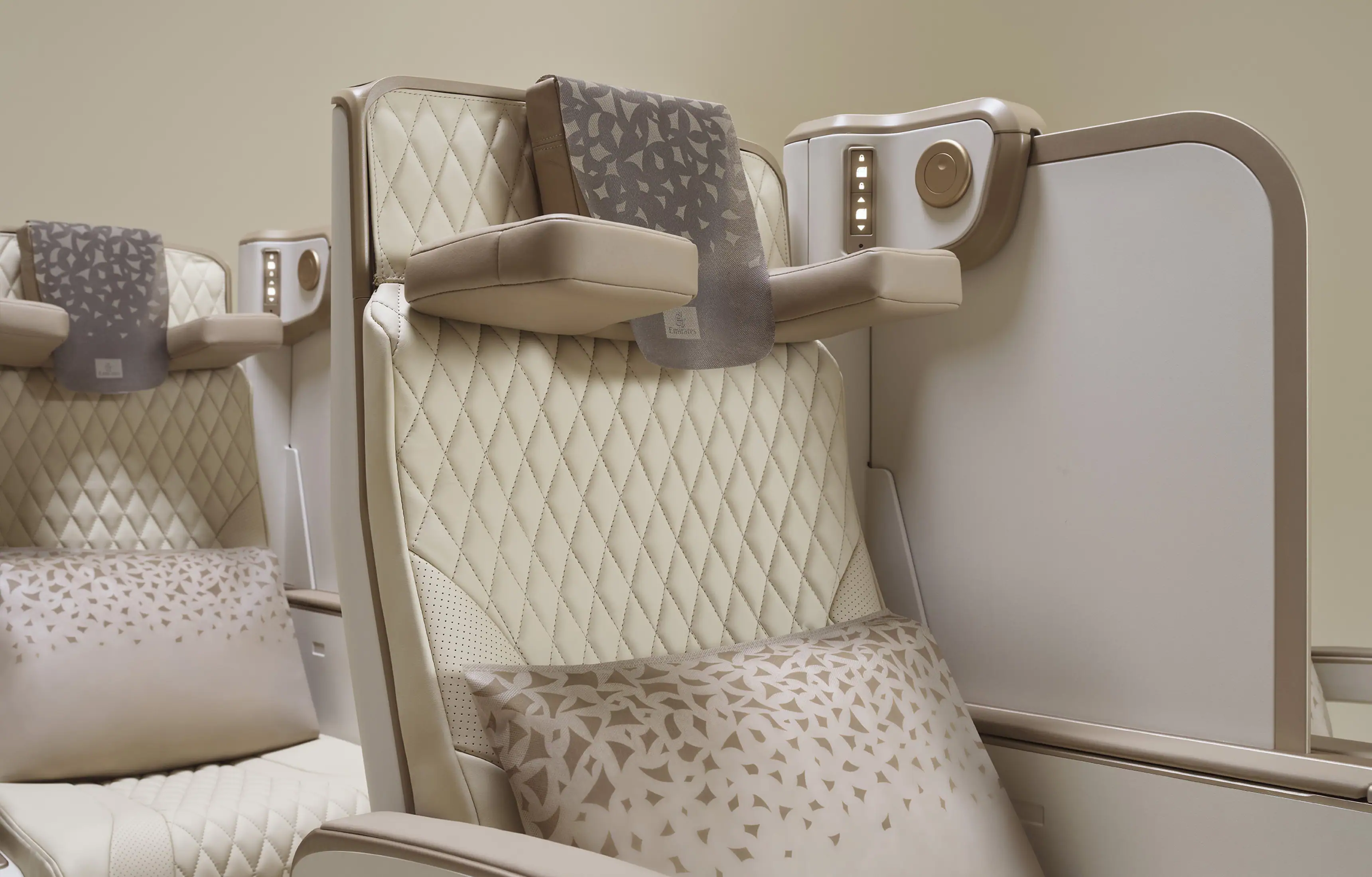
Emirates announced the new seat on 3 September 2026, fitting it to the Premium Economy cabin of its Airbus A350-900. The cabin holds 28 seats across four rows in a 2-3-2 layout, 20 inches wide with up to 39 inches of pitch, and it introduces two things at once: a full-height privacy screen that raises, lowers and locks electrically between adjacent seats, and the U-Dream headrest, a Safran Seats design with side wings that fold inward to cradle the head and neck.
Neither idea is being tried for the first time on this aircraft. The privacy screen is new to Emirates, but the headrest is not new to Emirates’ fleet: it appeared first in Economy Class, on the airline’s Safran Z400 seat, seven weeks earlier. That sequence, cheaper cabin first, is unusual enough in aviation seat design that it is worth pausing on before getting to the specification sheet.
The rest of the seat reads like a Premium Economy upgrade should: wireless charging, a first for the cabin class on Emirates, USB-C power, a 13.3-inch 4K HDR touchscreen running the airline’s ice entertainment system, a Passenger Control Unit with lounge and meal presets, a manually deployed leather footrest, and a tray table with an integrated phone or tablet holder. The recline is electric and moves the seat into what Emirates calls a cradle position, designed to stay inside the seat’s own footprint rather than pressing into the row behind. None of that is exotic on its own. What makes the seat worth writing about is the sequence it arrived in, and what the screen is actually built to do.
What the screen is built to do
A physical divider between adjacent Premium Economy seats is not, on its own, a new idea. Japan Airlines already fits a full-height screen to its own Premium Economy cabin. What Emirates has added is the mechanism: its screen is powered and lockable, raised and lowered from the seat controls rather than lifted by hand and left to hold its position, or not, on its own.
That distinction matters more than it looks like it should. A manual divider asks a passenger to physically deploy it, hold it in place and trust that it stays there through turbulence, a shifted elbow or eight hours of a long-haul sector. A motorised, lockable one removes the negotiation. It is the difference between a partition and a fitting, and it is the kind of detail that only shows up once an airline has decided privacy in Premium Economy is worth engineering properly rather than gesturing towards.
The screen sits alongside the U-Dream headrest at the top of the seatback, and the two are designed to work together: the headrest folds in to support the head and neck, and the screen closes off the seat to either side, so a passenger travelling alone effectively gets a private berth without paying for one.

The headrest that flew in Economy first
The U-Dream headrest is not new. Emirates first put it into service in Economy Class on 20 July 2026, on three Airbus A350 aircraft, built into the Safran Z400 seat. Sir Tim Clark, President of Emirates Airline, described its purpose plainly at the time: “The U-Dream changes the game if the person wants to sleep, by supporting the neck in full. No more neck pillows needed.” The headrest had already been independently tested to European Union Aviation Safety Agency standards before that debut.
Seven weeks later, the same headrest, in the same leather finish, with the same folding side wings, arrived in Premium Economy. That is the detail most coverage of the new seat has skipped past, and it is worth naming directly: aircraft seating almost always develops the other way round. A new material, mechanism or comfort feature is proven in the most expensive cabin first, where the margin absorbs the cost of getting it wrong, and it filters backwards over successive aircraft generations, if it filters back at all. Emirates has done the opposite here. The idea was tested on the cabin that carries the most passengers, in the harshest possible sample size, before it was trusted anywhere else.

Why testing it in the busiest cabin first makes sense
There is a straightforward engineering logic to that order, even if it is not the one Emirates has stated publicly. Economy Class on an Emirates A350 carries far more passengers, on far more sectors, than Premium Economy does. A mechanism that has to survive constant adjustment by unfamiliar hands, across thousands of cycles a week, generates a volume of real-world wear data that a 28-seat cabin simply cannot produce as quickly. By the time the U-Dream headrest reached Premium Economy, it had already been flying, being folded, unfolded and leaned on, for seven weeks on live commercial sectors.
It also changes what the privacy screen is allowed to be. A moving mechanical part built into a seatback carries certification and safety weight, and an airline that has already carried that weight once, in the cabin least tolerant of failure, has a stronger basis for extending the idea somewhere passengers are paying more and expecting more.

The cabin the seat sits inside
The Premium Economy seat does not exist in isolation from the rest of the A350 interior, and the aircraft’s own design language is worth naming. Emirates has dressed the cabin in cream leather and wood grain, with the airline’s signature bronze and gold worked through the trim, and it uses an illuminated motif of the ghaf tree, the UAE’s national tree, on the window blinds when they are closed. It is a specific, legible piece of Emirati identity built into the fabric of the aircraft rather than left as a logo, and it gives the cream and bronze palette of the new Premium Economy seat somewhere to sit.
The service around the seat has been built to match. Premium Economy dining uses Royal Doulton fine bone china, Robert Welch stainless steel cutlery and linen napkins, with Chandon Vintage Brut 2021 offered exclusively in the cabin. Amenity kits are produced in partnership with United for Wildlife, with skincare from Aveda. None of this is unusual for a premium cabin in isolation, but taken together with the powered screen and the shared headrest, it reads as a single decision rather than a checklist: treat Premium Economy as a cabin worth finishing properly, not as a buffer between Business and Economy.

Where this sits in Emirates’ Premium Economy story
Emirates introduced Premium Economy for the first time in January 2021, on six Airbus A380 aircraft. The cabin went on general sale on 1 June 2022, and the first commercial routes followed from 1 August 2022, to London Heathrow, Paris Charles de Gaulle and Sydney, with Christchurch added that December. A wider retrofit programme, fitting Premium Economy to 67 A380s and 53 Boeing 777s, began that November and has continued since.
The A350 is a newer part of that story. Emirates took delivery of its first A350 on 25 November 2024, and the aircraft entered commercial service in January 2025, flying first to Edinburgh. The airline’s A350 order stands at 73 aircraft, with 19 already in service as of the end of March 2026 and the rest still to arrive. Every one of those aircraft will carry this Premium Economy seat as standard, which means a cabin that started as a six-aircraft trial in 2021 is, five years on, being built into the newest and most technically ambitious part of Emirates’ widebody fleet.

Frequently asked questions

Final thoughts
The easy version of this story is a features list: a new screen, a shared headrest, wireless charging, a 4K screen. All of that is true, and none of it is really the point. The actual decision worth noticing is where Emirates chose to prove its newest piece of comfort engineering first, and it chose the cabin with no upgrade to sell and nowhere to hide a fault. That is a more confident bet than putting it straight into the cabin built to impress.
On a personal note, I have flown with Emirates more times than I can easily count, and every one of those journeys has reinforced the same impression: this is an airline still prepared to spend real engineering effort on the physical experience of flying, seat by seat, rather than treating the cabin as a finished problem. Seeing that investment land in Premium Economy, a cabin plenty of airlines treat as an afterthought, is exactly the kind of detail that keeps me paying attention to what Emirates does next.

Leave a Reply