Design · Los Angeles
Reading time: 11 minThe two most important words in this exhibition were printed on the wall and almost nobody read them. The show was called 50 Chairs at Christie’s c/o Basic.Space, and every chair in it was listed the same way: the maker, then care of whoever owns it now. For six days in Beverly Hills, custody mattered as much as authorship.
Collectible design spent six days inside an auction house in Beverly Hills this autumn, and the way it was labelled is the most interesting thing about it. 50 Chairs at Christie’s c/o Basic.Space ran from 25 to 30 September 2026 at Christie’s on North Camden Drive, by appointment, following an invitation only preview the evening before. Fifty chairs were brought together and sold by Basic.Space, spanning the twentieth century canon and work made in Los Angeles this year.
It has now closed. What it leaves behind is a line-up that reads like nothing else, and a way of writing it down that is worth borrowing.

Two words were doing all the work
The title carries a c/o, and so does almost every entry in the line-up. Not a list of fifty designers. A list of fifty pairs. Ludwig Mies van der Rohe c/o BASA. Joe Colombo c/o Eric Wareheim. Michel Ducaroy c/o Jordan Poole. Philippe Hiquily c/o Kelly Wearstler. Ray and Charles Eames c/o The Eames Office. Max Lamb c/o JF Chen. Rick Owens c/o Carpenters Workshop Gallery.
Care of is what you write on an envelope when the person you are writing to does not live at the address. The parcel reaches them through somebody else. Applied to fifty chairs it does something precise: it puts the maker and the current custodian on the same line, in the same typeface, and declines to say which one you came to see. A Mies cantilever and a Togo are design history. Who is sitting on them in 2026 is the other half of the sentence.
That is an unusual thing for an exhibition to admit out loud, and it is exactly what an auction house does for a living. Provenance is not a footnote in a saleroom, it is a large part of the value. Staging the show inside Christie’s and writing every label in the grammar of a forwarding address lines the two systems up so neatly that it reads as a thesis rather than a format.

Why fifty chairs and not fifty tables
The format works because of what a chair is. It is the most constrained object in furniture and the most free. The constraints are fixed by the body and barely move: a seat somewhere around 450 millimetres off the floor, a depth that supports the thigh without catching behind the knee, a back that meets you at the right height, and enough structure to carry a person who sits down heavily. Those numbers have not changed in a century.
Everything else is open. Within that narrow brief a designer can use bent plywood, a steel tube, blown balloons coated in epoxy, welded cutlery or a block of honed aluminium, and the result will still be read as a chair. That combination of a fixed test and an unlimited answer is why the chair became the discipline’s standard argument, and why practically every designer of consequence has made one. A show of fifty tables would be a catalogue. A show of fifty chairs is fifty answers to the same question.
It is also why the two most unusual pieces in the room were legible at all. PlayLab’s Teamwork Chair has two legs removed and only stands when two people balance it together, and the Fork Chair is built from welded vintage forks. Both break the brief in a way you can read instantly, because you know what the brief was before you walked in.

The plinth was a grandstand
The staging answered the obvious problem, which is that fifty chairs in one room will either look like a warehouse or like a shop. The solution was a continuous landscape of low white terraces running the length of the gallery, stepping up in shallow risers, with chairs set at different heights across them.
The effect is that you look across the collection rather than along it, the way you would read a crowd in a stand. Nothing is behind anything. A chair on the third riser is as visible as one on the floor, which matters when the objects range from a Mies tubular cantilever to a translucent blue armchair built out of blown balloons.
There is a quiet joke in it as well. The only continuous horizontal surface at seat height anywhere in the room is the plinth, and the plinth is the one thing you are not allowed to sit on. A room containing fifty places to sit offers the visitor none, which is the condition of every chair that crosses from furniture into collecting.

The building was designed around a chair designer
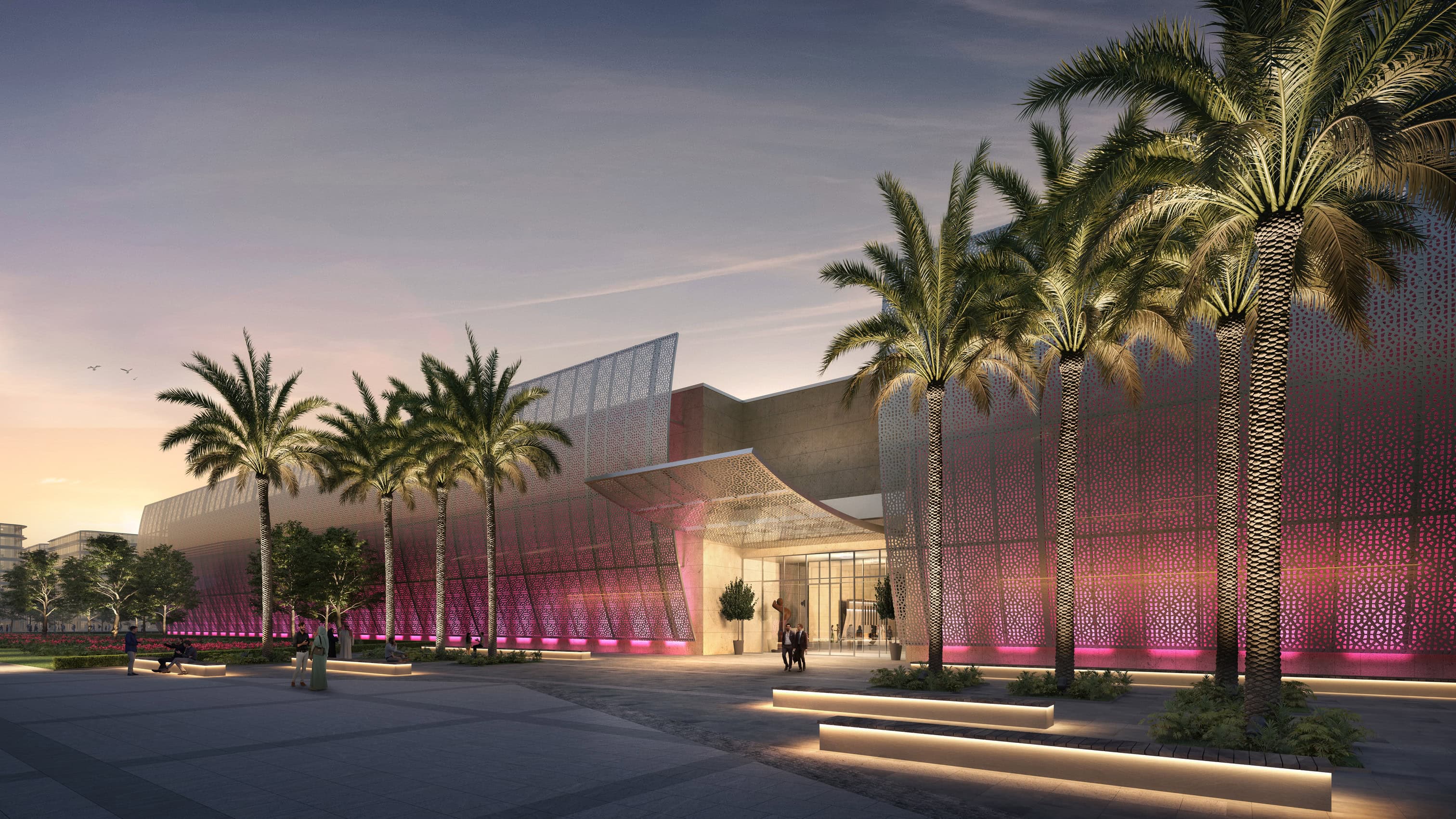
Christie’s Beverly Hills was designed by wHY, the practice founded by Kulapat Yantrasast, and completed between 2016 and 2017. It is a converted single storey commercial building holding roughly 4,500 square feet of gallery with a 1,400 square foot roof terrace above, and its signature is the undulating screen of pearlescent white aluminium across the front, generated from only three extrusion profiles arranged in varying rhythms.
The detail worth knowing is where the formal language came from. wHY has described the palette of clear cut curves and softened angles as drawn from Josef Hoffmann. Hoffmann co-founded the Wiener Werkstätte and designed the Sitzmaschine and the Fledermaus chair, which puts him among the most consequential chair designers of the twentieth century. So fifty chairs spent a week inside a building whose facade grammar was borrowed from a man who made his name on seating. Nobody planned that, and it is the best accident in the show.

The pieces that carried it
The historic anchor was the Eames LCW, designed between 1945 and 1946 and shown here in the rare calfskin edition produced in 2002 for a Christie’s auction, contributed by The Eames Office. A chair made for a Christie’s sale, returning to a Christie’s floor twenty four years later, is its own small piece of provenance.
Seoul based NICEWORKSHOP showed the stainless steel 378 chair engraved with Dr. Woo, the tattooist, who drew the initial design with a laser and let the studio finish the patterned profile by hand. PlayLab, Inc. contributed the Teamwork Chair, a conventional chair with two legs removed so that it only stands when two people balance it together. Joseph Santiago-Dieppa, via AUTOBODY, built Chair No.2 around chains of spheres that take the ball and claw foot of historic furniture and rebuild a whole chair out of it. B G Robinson showed SV_3, a lounge chair with a monolithic frame in honed aluminium, drawing on aerospace and coachbuilding.
Among the rest were Devon Turnbull’s Untitled Chair of 2020, contributed by Matt George, Vince Skelly’s carved Checkerback, SeungJin Yang’s epoxy coated balloon chair via The Future Perfect, and a limited edition beaten brass chair of around 1970 by Philippe Hiquily, hand worked with a lucite base and stamped one of forty, lent by Kelly Wearstler. Hiquily is held by MoMA, the Guggenheim and the Centre Pompidou.

The Los Angeles half of the room
Roughly half the line-up was made within driving distance of the gallery, and that is the part of the show with the longest tail. AUTOBODY platforms material led work by Los Angeles artists and designers and brought three names with it, Joseph Santiago-Dieppa, Asher Gillman and NH Depass. B G Robinson works in a vocabulary pulled from aerospace and coachbuilding, which in southern California are local industries rather than references. PlayLab, Inc. is a multidisciplinary studio whose humour is its method. Vince Skelly carves, Marquel Williams showed the Beam Chair II, and Sam Klemick, Emily Thurman and Tristan Marsh were all in the room.
Set against the imported canon, the effect is a straightforward claim: that a chair made in a Los Angeles workshop this year belongs on the same riser as a Mies cantilever, and the only honest way to find out is to put them a metre apart and see what happens. On the evidence of the installation photographs, what happens is that the contemporary work holds its own on material and the historic work holds its own on resolution, which is roughly what you would hope.

One chair in the room was designed for a museum
Merit contributed the Beaubourg chair by Michel Cadestin and Georges Laurent. It is worth separating from the rest because of what it was made for: Cadestin and Laurent designed it in 1976 specifically for the Centre Pompidou, and it was produced by Teda in wire and tubular steel to furnish the building. It is a chair that began life as museum equipment and has since become a collectible object in its own right.
Put it next to the Hiquily and the room contains both halves of that journey at once: a chair designed to be used inside the Pompidou, and an artist the Pompidou collects. The distance between furniture and artwork is the distance between those two labels, and in this show they were a few steps apart on the same white terrace.

Where collectible design sits now
Basic.Space was founded by Jesse Lee and describes itself as a curated marketplace running from physical events to the website. The fact the line-up does not mention, and which explains a good deal about the ambition here, is that Basic.Space acquired Design Miami in October 2023. The company putting fifty chairs into an auction house also owns the fair that has done more than any other to define the category.
Seen that way, the show is less a pop-up than a position statement about where collectible design is sold and to whom. The line-up puts Gaetano Pesce with Bottega Veneta, Sabine Marcelis with BD Barcelona, Apparatus, Estudio Persona and Paulin Paulin Paulin alongside the NBA guard Jordan Poole and Stefon Diggs, who showed a piece from his own furniture line Si Vis Pacem. The collector list and the designer list are presented as a single roster. We have followed this market elsewhere in Design Miami and in Gulf collectible design.

The chair made of forks
The preview on 24 September was staged by the hospitality agency CARVINGBLOCK, which built a twenty foot structure of interwoven chairs and ringed it with single place settings, calling the piece Table For One. Canapes were held at intervals within the structure itself, so guests had to approach the sculpture to eat.
The agency also worked with the artists Emory Hall and Emma Pryde on a restaurant chair built entirely from vintage forks, welded together into a recognisable chair silhouette with all the irregularity of collected cutlery. The Fork Chair stayed on view for the run of the exhibition, and it is the piece that states the show’s premise most plainly: the most familiar object in hospitality, remade until it has to be looked at. For another exhibition where the staging carried as much argument as the objects, there is Pastina at Lake Como Design Festival, and for a collector’s room assembled with the same instinct, Tola Ojuolape’s Collectors Lounge.

What happens to the chairs
The exhibition closed on 30 September 2026. The chairs were curated and sold through Basic.Space rather than through a Christie’s sale, so this was an auction house lending its floor and its vocabulary rather than running a lot list, which is a distinction worth holding on to when the two are staged this close together.
Photography of the installation is by Kayla Alise, courtesy of Basic.Space.

Frequently asked questions
What was 50 Chairs at Christie’s?
An exhibition of fifty chairs curated and sold by Basic.Space, staged at Christie’s Beverly Hills from 25 to 30 September 2026 by appointment, after an invitation only preview on 24 September. Its full title was 50 Chairs at Christie’s c/o Basic.Space.
Which designers were included?
The line-up ran from Ludwig Mies van der Rohe, Ray and Charles Eames, Joe Colombo, Olivier Mourgue, Michel Ducaroy and Norman Cherner through to Gaetano Pesce with Bottega Veneta, Max Lamb, Sabine Marcelis, Rick Owens, Tom Sachs, Chris Wolston and a large contingent of Los Angeles makers including AUTOBODY, B G Robinson, PlayLab, Inc., Vince Skelly and Marquel Williams.
What does the “c/o” in the title mean?
It is the convention used throughout the line-up, where each chair is listed as the maker followed by the person or gallery who contributed it. Care of is the phrasing used on a forwarded letter, and here it puts the designer and the current owner on the same line.
Who designed Christie’s Beverly Hills?
The practice wHY, founded by Kulapat Yantrasast, completed the building between 2016 and 2017. It holds around 4,500 square feet of gallery with a 1,400 square foot roof terrace, behind an undulating screen of pearlescent white aluminium made from three extrusion profiles.
What is Basic.Space?
A curated marketplace for collectible design founded by Jesse Lee, running physical events alongside its online platform. It acquired Design Miami in October 2023.

Final thoughts
The achievement of this exhibition is a piece of language. By writing every label as maker care of owner, and by putting the whole thing inside an auction house, it made the point that a chair’s biography does not stop when it leaves the workshop. Who kept it, who sat on it and who is letting it go are part of the object now.
The chairs have gone back to their owners or on to new ones, and the room has been cleared. What stays useful is the staging and the grammar: a stepped white terrace that lets fifty objects be seen at once without hierarchy, and two small words that give a contemporary marketplace the same vocabulary as a two hundred and sixty year old saleroom.

Project Credits
Go further from here
Read next
The first Frieze Abu Dhabi is built around a thirteenth century shrine assembled from reused Roman stone, rebuilt in the atrium out of timber and cloth by Dala Nasser.
Abu Dhabi