
Interiors · Portland
Reading time: 8 minLondon and Los Angeles studio Fettle joins Ennismore to shape The Hoxton Portland — a former 1920s theatre in the city’s historic Chinatown district, where preserved columns and raw plaster meet mid-century warmth across the lobby, bar, La Neta restaurant and ‘The Apartment’.
Some hotel brands arrive in a city and impose themselves upon it; The Hoxton has always preferred to move in quietly and get to know the neighbours. Its Portland outpost — the sixth hotel in the brand’s portfolio — is a case study in that philosophy. Designed by Fettle, the London- and Los Angeles-based design studio, in collaboration with Ennismore, the hotel occupies the site of a former 1920s theatre in the historic Chinatown district and wears its setting with evident pride.
Fettle’s brief covered the hotel’s public spaces — the restaurant, cocktail bar, lobby, café and the ‘apartment-style’ meeting rooms — and the studio drew its inspiration directly from the surrounding area, a part of Portland known for its industrial, gritty backdrop juxtaposed with pockets of natural beauty. That tension between the raw and the refined runs through every room, and it is what gives the hotel its particular charge.

A Theatre and a Tower
The fabric and history of the structure shaped the design concept from the outset. The hotel merges the old 1920s theatre with a newly constructed tower housing the guest rooms, and rather than smoothing over the join, Fettle celebrates it. In the historic section, beautifully textured timber columns, old plaster finishes and rough concrete have been preserved and restored, their scars left legible. The new addition answers with a clean, industrial aesthetic and a striking glazed façade.
This is the underpinning of the Hoxton style: modern design and traditional elements held in deliberate contrast, each sharpening the other. Walk through the ground floor and the building’s biography is everywhere — a strip of peeling paint on a century-old column, framed like an artwork between crisp new concrete blockwork; reclaimed beams running overhead against fresh acoustic panels. Few hotels let their buildings speak this candidly, and fewer still edit that speech so well.
The choice of neighbourhood matters here, too. Old Town Chinatown is Portland’s original quarter, a district whose fortunes have risen and fallen with the city’s own, and whose fabric carries more history per block than anywhere else in town. Opening a hotel of this ambition here was a statement of confidence in the area — and by preserving so much of the theatre’s fabric rather than replacing it, Fettle and Ennismore ensured the statement read as an investment rather than an erasure. It is regeneration done the patient way, from the inside of an existing building outwards.

“The best meetings happen in rooms that do not feel like meeting rooms.”

A Lobby Built for Lingering
The public spaces each exude distinct personalities while connecting stylistically through materials, fixtures and furniture, and the lobby is the heart of the operation — a social hub conceived as much for locals as for guests. The open-plan room is anchored by an expansive brick wall with an integrated central fireplace, complete with its own log store, around which colourful mid-century-inspired furnishings are arranged: a long rust-toned sofa, blush poufs, ochre armchairs, oak bookcases layered with ceramics, books and greenery.

Overhead, the details reward attention. The brass pendant lights were custom-designed by Fettle, their globe forms echoing through the space, while the ceiling is finished in Armstrong’s Tectum wood-wool panels painted a soft, inviting Bella Pink — an unexpectedly tender gesture in a room of brick and concrete, and precisely the kind of contrast that keeps the scheme from tipping into industrial cliché. A long communal table beside the steel-framed glazing serves Portland’s laptop crowd by day; by evening, the fireplace takes over.
The reception desk deserves its own mention: a faceted black volume set against reclaimed timber panelling, flanked by shelves of globes and curios. It reads less like a hotel front desk than a well-travelled study, which is, one suspects, entirely the point.

The Bar: Teal, Timber and Herringbone
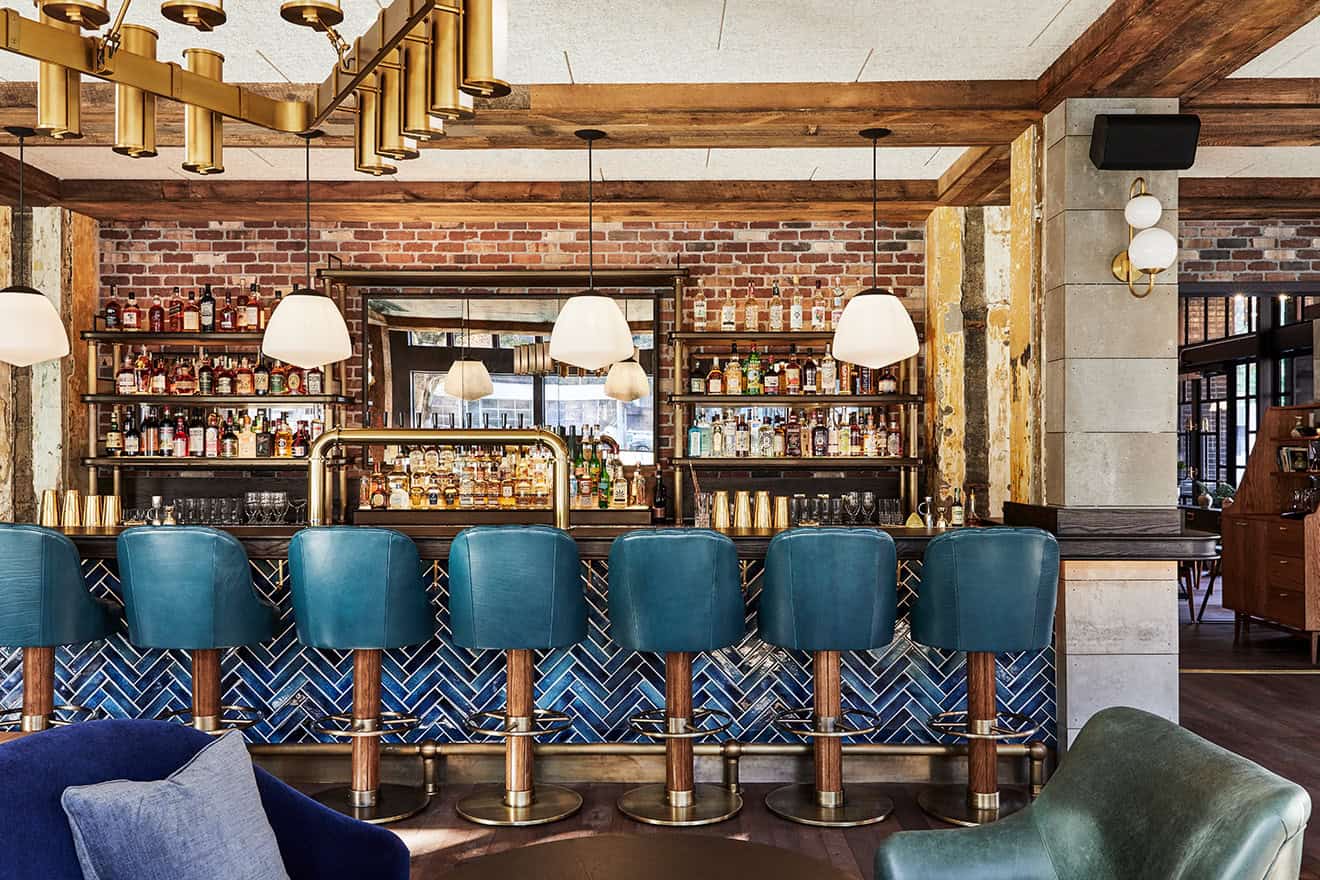
The bar and restaurant sit at the forefront of the building, flanked on two sides by the full-height glazing of the existing façade — a legacy of the theatre that now floods the rooms with street light and street life. A prominent timber-topped bar commands one side of the space, its underside faced in vibrant teal herringbone tiles, with teal leather stools drawn up along its length. Brass gantries and tubular chandeliers glow against exposed brick, while reclaimed timber flooring — sourced locally from Pioneer Millworks — extends seamlessly from the lobby, stitching the spaces together underfoot.

It is a masterclass in material layering: brick, brass, leather, tile and timber, each with its own texture and temperature, composed so that the eye keeps moving without ever feeling hurried. The distressed original columns punctuate the room like exclamation marks, reminders that this glamour is built on a working building’s bones.
The seating tells the same story in softer language. A mustard velvet sofa here, a pair of ikat-print armchairs there, blush and blue upholstery mingling with teal leather — the mix looks collected rather than specified, as though the room had been furnished over years by someone with excellent taste and a weakness for auctions. It is a Hoxton hallmark, and Fettle executes it with real fluency.

La Neta
At the opposite end of the room sits the restaurant, La Neta, and here the mood deepens. Walls clad in dark-painted timber panelling are hung with Latin-inspired artwork curated by local art consultant Upfor Gallery — a gallery wall of prints and works on paper that gives the room its character and its conversation pieces. Simple freestanding banquettes upholstered in aged green leather are paired with timber and tan leather chairs around oak dining tables, while a bespoke black, white and gold patterned floor tile marks the threshold, distinctly separating restaurant from bar.

The restraint is telling. La Neta could easily have been themed; instead, Fettle lets a handful of well-chosen elements — the green leather, the dark panelling, the curated art — do the work, producing a dining room that feels established rather than installed. The channel-stitched banquettes curving beneath the artwork are as comfortable as they look, and the brass drum chandeliers above cast exactly the right kind of evening light.

The Apartment
Catering for meetings and events, ‘The Apartment’ comprises four rooms of varying sizes arranged around a central pantry-style kitchen — The Hoxton’s signature answer to the joyless corporate meeting suite. Classic mid-century teak furniture outfits the rooms, easily rearranged to suit everything from board meetings to supper clubs, while homely touches — colourful contemporary artwork, books, greenery, vintage rugs — foster the relaxed, residential atmosphere that invites visitors to make the space their own.

The central kitchen is the heart of it all, and it may be the most quietly charming room in the hotel. A black-panelled island with a crisp white top is lined with five green velvet stools; open shelving displays neat rows of crockery; holophane pendants hang above a patterned mosaic floor; a cream retro fridge stands fully stocked in the corner. Surrounded by soft velvet lounge seating, it gives delegates somewhere to gather and socialise in the comfort of home — the difference between a coffee break and a kitchen conversation.
As a piece of workplace-adjacent design, The Apartment remains one of the smartest ideas in hospitality: it understands that the best meetings happen in rooms that do not feel like meeting rooms. Fettle’s handling of it in Portland is particularly assured — the teal-walled rooms with their oak cabinetry could pass for the study of a well-read friend, and the gallery walls of colourful prints above blue panelled wainscoting give each space a personality worth remembering. Delegates book rooms; they return for atmosphere.

Portland, Distilled
What Fettle has achieved in Portland is a hotel that feels honestly of its place. The industrial grit is real — preserved in the columns, the brick, the concrete — and so is the warmth, supplied by velvet, brass, timber and that improbable pink ceiling. The scheme never strains for Pacific Northwest signifiers; instead it absorbs the neighbourhood’s character through material honesty and local sourcing, from the Pioneer Millworks floors to the Upfor Gallery art programme.

For The Hoxton, the project confirmed the brand’s formula travels well precisely because it refuses to be a formula: each hotel begins with its building and its street. For Fettle, it stands among the studio’s most persuasive works — a demonstration that the transatlantic sensibility it first tested at The Draycott in Los Angeles can land in a city like Portland and feel, almost immediately, like a local.
A century ago, this address drew crowds with performances. It still does — only now the theatre is the room itself: the fire crackling against the brick, the brass lights glowing under a pink ceiling, and a cast of guests and locals who, given half a chance, will stay long past the final act.

Leave a Reply