
DESIGN TRAVEL · NEW YORK
Reading time: 9 minInspired by the character of Manhattan’s historic Flower District, Moxy Chelsea transforms a contemporary hotel stay into an immersive design experience. Conceived by Rockwell Group, the property blends Italian romance, botanical influences and panoramic city views to create one of New York’s most distinctive hospitality destinations.
New York is a city built on constant reinvention. Neighbourhoods evolve, skylines transform and hospitality concepts arrive with remarkable speed. Among them are projects that feel intrinsically connected to their surroundings, drawing their identity from the character of the place they occupy.
Chelsea has long been one of Manhattan’s most fascinating districts. Art galleries occupy former industrial buildings, the High Line threads its way above the streets, and creative energy seems permanently woven into the neighbourhood’s fabric. Hidden amongst this activity lies the Flower District, a small yet historic enclave where florists, growers and designers have traded blooms for generations.

It is here, surrounded by overflowing buckets of seasonal flowers and the rhythm of daily deliveries, that Moxy Chelsea finds its inspiration. Rising above West 28th Street, the hotel takes its place among the most characterful addresses in a city rich with design-led hospitality. Rockwell Group has created something memorable: a hotel that celebrates the romance of the Flower District while embracing the energy, creativity and optimism that continue to define modern New York.
Chelsea’s Flower District: One of Manhattan’s Best-Kept Secrets
To understand Moxy Chelsea, it helps to understand the neighbourhood that inspired it.
Long before Chelsea became synonymous with contemporary art galleries, luxury residential developments and the High Line, West 28th Street was establishing itself as New York’s centre for horticulture. For decades, the Flower District has supplied florists, event designers, restaurants and private buyers across the city, creating a distinctive atmosphere unlike anywhere else in Manhattan.
Even today, the district feels refreshingly authentic.

In the early morning hours, delivery trucks unload flowers sourced from around the world, while shop owners arrange displays that transform the pavements into temporary gardens. The streets hum with a different kind of energy. There is colour everywhere. Roses, hydrangeas, orchids, eucalyptus and exotic tropical plants create a constantly changing landscape that feels almost theatrical amidst the surrounding urban density.
It is this juxtaposition that makes the area so fascinating.
Here, nature and city life exist side by side. Industrial buildings coexist with living greenery. Historic storefronts sit beneath contemporary skyscrapers. The Flower District represents a version of New York that remains deeply connected to craft, commerce and community, qualities that became central to the vision for Moxy Chelsea.
Rockwell Group embraced the neighbourhood’s identity, using it as the foundation for a story that unfolds throughout the property and roots the hotel firmly in this particular corner of Manhattan.
Rockwell Group and the Art of Storytelling Through Design
Rockwell Group has been one of the defining influences on contemporary hospitality.
Founded by David Rockwell, the New York-based practice has built a global reputation for creating environments that blur the boundaries between architecture, theatre and experience. Whether designing hotels, restaurants, cultural institutions or performance venues, the studio’s work consistently centres around storytelling.
Spaces are not designed simply to be admired.

They are designed to be experienced.
This philosophy is particularly evident at Moxy Chelsea. Rockwell Group approached the project as a contemporary interpretation of a secret urban garden, drawing inspiration from both the neighbourhood below and the romantic elegance of Italian villas. The studio has described the concept as a meeting between The Secret Garden and Milan’s Villa Necchi Campiglio, combining botanical references with a sophisticated European sensibility.
The result is a hotel where every detail contributes to a larger narrative.

Guests move through a sequence of spaces that gradually reveal themselves, much like wandering through a hidden garden. There are moments of drama, intimacy and surprise. Materials shift, light changes and views open unexpectedly. The building continually encourages exploration.
This sense of discovery becomes one of the hotel’s greatest strengths.
Arrival: From City Streets to Botanical Escape
One of the most impressive aspects of Moxy Chelsea is the transition between exterior and interior.

Outside, Manhattan operates with its characteristic intensity. Pedestrians fill busy pavements, taxis move through traffic and the city carries its momentum forward at full pace. Upon entering the hotel, the atmosphere begins to soften.
The architecture itself plays a significant role in this transformation.
The building’s greenhouse-inspired design references the area’s horticultural heritage, while generous glazing allows natural light to flood interior spaces throughout the day. The design introduces botanical references gradually through texture, materiality and scale, allowing each to be discovered in turn.

This restraint is what makes the concept feel sophisticated.
Flowers are not treated as decoration. Instead, the hotel captures the feeling of a garden: moments of discovery, layered textures, seasonal colour and an underlying sense of calm amid the city’s constant movement.
The effect is subtle but remarkably successful.
Feroce: Bringing Italian Hospitality to Manhattan
At street level, Feroce serves as the social heart of the hotel.
Inspired by Italian café culture and the elegance of early twentieth-century Milan and Rome, the restaurant unfolds through a sequence of thoughtfully connected rooms that gradually lead guests towards an unexpectedly tranquil outdoor courtyard.

The design immediately establishes a sense of warmth.
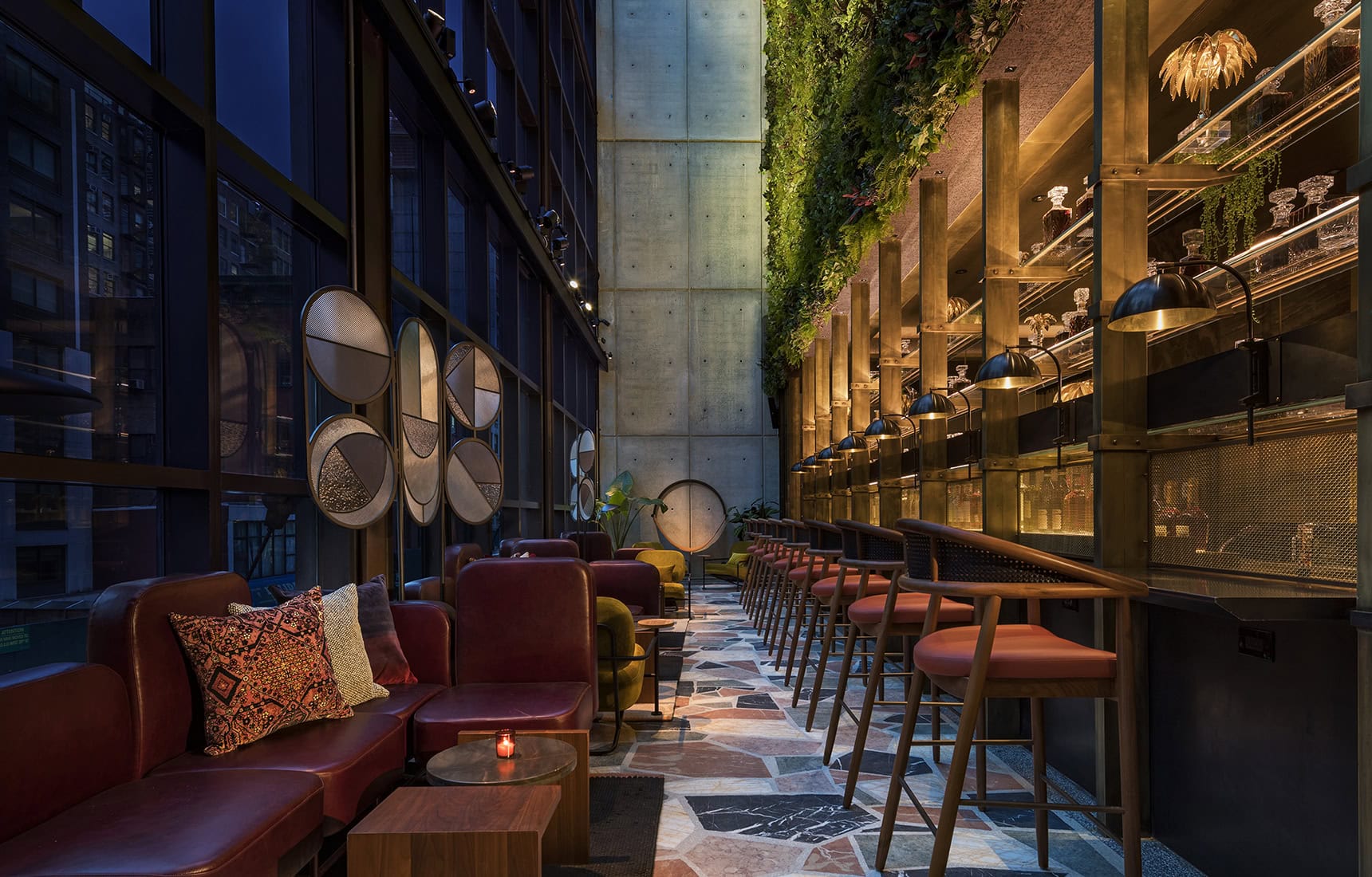
Recessed Venetian plaster walls glow beneath illuminated barrel-vaulted ceilings, while geometric lighting fixtures introduce a touch of modernity to an otherwise timeless setting. Large-format mosaic flooring provides visual rhythm throughout the restaurant, complemented by rich emerald tones, burgundy leather upholstery and dark timber detailing that bring depth and sophistication to the interior.
What elevates the space beyond aesthetics is its atmosphere.
Italian hospitality has always been less concerned with formal luxury and more focused on creating environments that encourage conversation, connection and enjoyment. Feroce captures this spirit beautifully. Colourful Italian sweets displayed in oversized apothecary jars sit alongside carefully curated collections of aperitifs and digestifs, introducing moments of personality that give the space warmth and character.

There is confidence in the design, but also a welcome sense of fun.
As guests move deeper into the restaurant, the experience becomes increasingly immersive. Arched booth seating provides views across the dining room, while darker finishes create intimacy and contrast. Bespoke details, including grappa-tasting carts and terrazzo surfaces, reinforce the sense of craftsmanship throughout.
The destination, however, lies beyond the interior itself.
The Hidden Courtyard
In a city where outdoor space is often considered a luxury, the courtyard at Feroce feels particularly special.
Sheltered behind the restaurant and enveloped by greenery, it offers a rare moment of tranquillity within one of the busiest urban environments in the world. Here, the influence of the Flower District becomes most tangible. Planting softens the architectural framework, while natural light transforms the atmosphere throughout the day.

The experience feels worlds away from the streets just beyond.
On warm evenings, diners gather beneath the open sky as Manhattan continues around them unseen. The contrast is remarkable. New York is rarely associated with stillness, yet spaces like this remind visitors that moments of quiet escape continue to exist.
These are often the memories that endure long after departure.
A Masterclass in Materials and Craftsmanship
One of the defining qualities of Moxy Chelsea is its commitment to material richness.
The interiors are grounded in lasting materials chosen for their character and longevity. Mosaic flooring, terrazzo surfaces, Venetian plaster, brass detailing and richly upholstered furnishings create an environment that feels tactile and substantial.

There is an authenticity to these choices.
Each material contributes to the hotel’s broader narrative while providing visual depth and texture. Light reflects differently across plaster and terrazzo. Brass develops character over time. Natural materials soften the building’s industrial structure and introduce warmth into contemporary spaces.
The cumulative effect is significant.
Guests may not consciously identify every design decision, but they recognise the atmosphere it creates.
That atmosphere feels curated rather than manufactured.
The Lounge and Conservatory: Hospitality for a New Generation
The second-floor lounge reveals another side of Moxy Chelsea’s personality.
Reached via a dramatic concrete staircase enclosed in glass, the space functions as a contemporary interpretation of a hotel living room. Here, the distinctions between work, leisure and socialising intentionally dissolve, reflecting the changing needs of modern travellers.

At the centre of the lounge sits a conservatory-inspired space overlooking the Flower District below. A striking living wall rises approximately twenty feet high, introducing greenery into the heart of the building and reinforcing the botanical character established elsewhere throughout the hotel.
The setting feels distinctly New York.
Raw concrete elements sit alongside rich upholstery, brass accents and mosaic flooring. Industrial and organic materials coexist effortlessly, creating a contemporary environment that feels both energetic and welcoming.
Throughout the day, the space transforms naturally.

Morning coffee meetings evolve into afternoon work sessions. Guests gather for cocktails as evening approaches. Locals and visitors mingle comfortably within the same environment. Flexible furniture arrangements and adaptable layouts ensure the lounge remains responsive to changing demands, moving naturally from one mood to the next.
This versatility reflects a wider shift within hospitality design.
Hotels are no longer simply places to sleep. Increasingly, they function as social hubs, workplaces, cultural venues and neighbourhood gathering spaces.
Moxy Chelsea embraces this evolution with remarkable clarity.
The Fleur Room and the Rise of New York’s Rooftop Culture
No visit to Moxy Chelsea feels complete without experiencing The Fleur Room.
Occupying one of the most dramatic positions within the building, the rooftop destination has become one of Manhattan’s most sought-after social spaces, offering panoramic views that stretch across the city skyline.
Yet what makes The Fleur Room memorable is not simply the view.
New York has long embraced its rooftop culture.

The Fleur Room creates a compelling atmosphere that holds its own even when the skyline disappears after dark. Rockwell Group understood this and responded by designing an environment that feels equally impressive from within.
Industrial windows frame the city beyond while bronze finishes, textured wall coverings and plush furnishings introduce warmth and sophistication. Subtle lighting creates intimacy without competing with the spectacle outside, while illuminated resin elements containing embedded floral references link the space back to the Flower District below.
The result feels distinctly New York.
There is glamour here, certainly, but also an authenticity grounded in the building’s broader narrative.
Where Interiors and Skyline Become One
Adjacent indoor-outdoor spaces continue this dialogue between architecture and city.
Retractable window systems allow the lounge to transform into an open-air veranda, creating an almost seamless relationship between interior and exterior environments. Emerald walls, floral upholstery and bold patterned flooring introduce a more playful atmosphere than the main rooftop space, particularly as evening transitions into late-night celebrations.

Design details encourage interaction with the skyline rather than distraction from it.
Large mirrored surfaces capture reflections of surrounding buildings and interior lighting, creating layers of visual depth that blur distinctions between inside and outside. Seen at sunset, when Manhattan’s towers begin to glow against the evening sky, the effect is particularly striking.
New York rewards elevated views generously.
Moxy Chelsea uses them with genuine thoughtfulness.
A Hotel That Captures the Spirit of Modern New York
The hospitality landscape in New York is remarkably rich. New hotels open constantly, each offering a fresh vision of luxury, lifestyle or urban experience.
Moxy Chelsea continues to stand out because it understands a simple truth: the most memorable destinations are rooted in authenticity.

Every aspect of the property connects back to the Flower District and the wider character of Chelsea. The architecture references greenhouses. The interiors draw inspiration from gardens and Italian villas. Public spaces encourage interaction and creativity. Rooftop experiences celebrate the surrounding city without losing sight of the neighbourhood below.
Nothing feels arbitrary.
Everything feels intentional.
Perhaps most importantly, the hotel captures the duality that makes New York so compelling. It is energetic yet intimate. Sophisticated yet approachable. Contemporary yet deeply connected to local history.

In many ways, Moxy Chelsea represents the best of modern hospitality design. It delivers beauty without pretension, luxury without excess and storytelling without gimmickry.
For travellers seeking a design-led stay in Manhattan, it remains one of the city’s most engaging addresses. Not simply because of how it looks, but because of how effectively it connects guests to a part of New York many might otherwise overlook.
And in a city built upon constant reinvention, discovering somewhere that still feels genuinely original is perhaps the greatest luxury of all.


Leave a Reply