
ART & CULTURE · LOS ANGELES
Reading time: 10 minIn February 2023, The Future Perfect gave Gaetano Pesce his first solo show in Los Angeles, filling the ground floor of the Goldwyn House with resin furniture spanning five decades. Dear Future mixed his earliest pieces with his newest, deliberately out of chronological order. The gap between 1969 and 2022 turns out to be the whole point, because there almost isn’t one.
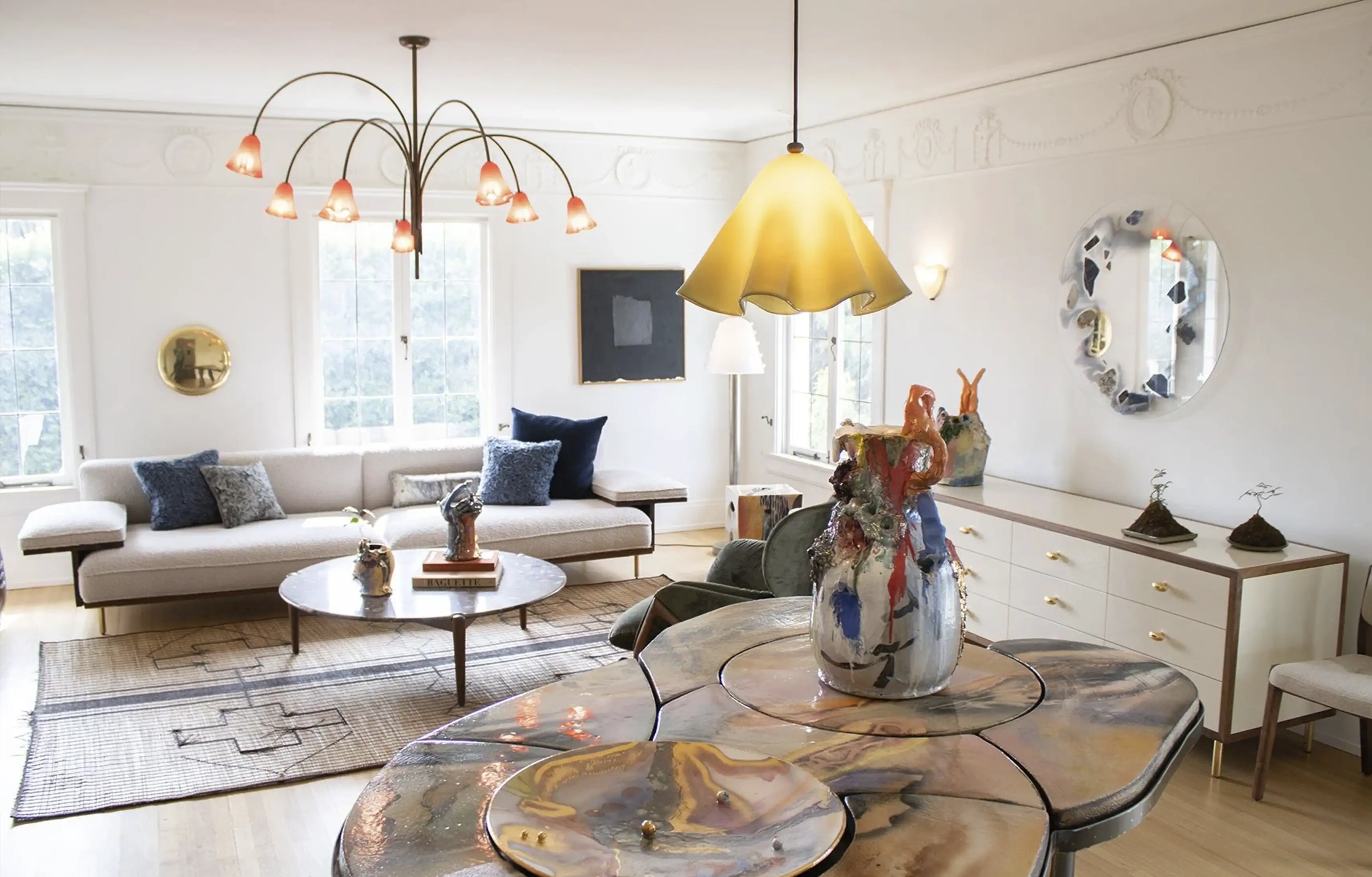
Gaetano Pesce had been making furniture since before most galleries showing it were founded, and Los Angeles had never given him a room of his own. That changed on 16 February 2023, when The Future Perfect opened Dear Future on the ground floor of the Goldwyn House, its gallery and showroom in the Hollywood Hills, timed to Frieze LA week. The show ran through 31 March 2023 and gathered work made between 1969 and 2022: chairs, tables, lamps and vessels, all cast or moulded in the resins Pesce had spent his career arguing with.

It was billed as his first solo exhibition in the city, and the claim held up. Pesce, then 83, had shown in New York, Venice and Miami for decades, but Los Angeles had only ever seen his work in other people’s group shows and other people’s living rooms.

The interesting decision was not that The Future Perfect gave him the space. It is what they did with it. Rather than laying the work out as a chronology, historic pieces at one end and new commissions at the other, the gallery mixed them in the same rooms. A chair from 1969 sat near a shelf made in 2022. That choice is the argument this piece follows, because it is not simply a curatorial flourish. It says something specific about what changed in Pesce’s work across five decades, and the honest answer, tested against the objects actually on show, is not very much.
A ground floor full of colour, cast in resin
The show occupied the ground floor of the house, a domestic sequence of rooms rather than a white cube, and it read as one because Pesce’s work has always been built to live in rooms rather than plinths. The pieces on show ranged across every register he worked in. A version of the UP5_6 armchair, the piece known as La Mamma, appeared not in its familiar stretch fabric but recast in recycled cork, one of only two ever made in that material. Nearby stood the Square Airport Lamp, a design from 1986 that Pesce revisited in 1994, its flexible rubber membrane wired with miniature bulbs and weighted at the base with lead. The Nobody’s Perfect chairs, a series he began in 2002 and kept remaking, turned up in blue and in pink, no two castings quite matching. Lamps from the One of Us and Some of Us families stood around the rooms with faces painted onto irregular resin heads, part portrait and part object. A River Table, its legs cast to look like a felled trunk, sat under a chandelier of folded resin that behaved, from a distance, like draped cloth.

Alongside these were pieces made for the show itself: the Leaf Shelf, a new 2022 series, and a run of vases with legs, some tubular, some pooled like melted candy, in colours that shifted piece to piece because the resin was never poured to match. Nothing in the room was labelled early or late. A visitor moving from one console to the next was as likely to be looking at a 2022 object as a 1969 one, and for long stretches could not have told the difference by eye alone.

From a kinetic art collective in Padua to a chair about motherhood
Pesce trained as an architect at the University of Venice, studying under Carlo Scarpa and Ernesto Rogers, and it shows in how deliberately his furniture treats structure and enclosure as the same problem. In 1959, while still in his twenties, he became one of the founding figures of Gruppo N in Padua, a collective working in programmed and kinetic art alongside international peers such as Gruppo Zero in Germany and the Groupe de Recherche d’Art Visuel in Paris. That grounding in a movement built on repetition, sequence and controlled variation is the root of nearly everything he did afterwards with resin.

The piece that made his name arrived a decade later. In 1969, working with the Italian manufacturer that would become B&B Italia, Pesce designed the UP series, a set of moulded polyurethane forms shipped flat-packed and vacuum-sealed, expanding into shape only once unwrapped. UP7 took the form of a giant foot. UP5, paired with its tethered ottoman UP6, became La Mamma: a rounded, maternal form anchored by a ball-shaped footstool attached by a cord, a piece Pesce intended as a statement about the condition of women, the seat’s shape suggesting the body, the tethered stool suggesting confinement. It was not a subtle design, and it was not meant to be. Pesce belonged to the generation of Italian designers, working alongside figures such as Ettore Sottsass in the years before Memphis formalised the same instincts, who treated furniture as a legitimate place to make a political argument rather than a decorative one.

That instinct, using an object’s form to say something rather than simply to furnish a room, runs through every piece the Goldwyn House show gathered, from the 1969 chair to the 2022 shelf.

Why no two pieces of his are ever quite the same
Resin gave Pesce a material that could carry his argument literally as well as formally. Poured rather than milled, it sets with the particular flaws of that pour: a bubble here, a colour that has bled slightly further than the batch before it, a surface that catches light differently from its neighbour on the same shelf. Pesce treated that inconsistency as the entire point, describing his method as making mass-produced originals: objects that come from a mould and a repeatable process, the way any manufactured object does, but that are finished by hand in ways that guarantee no two will match. Uniformity, in his own account of the work, is what design should fear more than almost anything else.

That is why the Nobody’s Perfect chairs are named as they are, and why the cork edition of La Mamma sits so comfortably beside vases whose legs pool into different shapes from one casting to the next. It is a workshop process closer to cooking than to manufacturing, components and a recipe rather than a fixed specification, and it means every object in the Goldwyn House show carried a small, deliberate flaw as its signature.

Fifty-three years apart, making the same case
Retrospectives usually tell a story of change: an early period, a breakthrough, a late style. What the mixed hang at the Goldwyn House actually demonstrated, whether or not it set out to, is that Pesce’s furniture does not really have one. Put the 1969 UP5_6 next to the 2022 Leaf Shelf and the shared logic is immediate: a mould that yields a repeatable form, finished by hand so that the repetition never fully holds, in colours poured rather than specified. The materials changed, resin technology in 2022 is not what it was in 1969, and the household objects he chose to reinvent changed with the decades. The argument underneath them did not move.

That is the fact this piece can offer that a listing of the works cannot: Dear Future was not structured to prove continuity, but the specific objects it borrowed happen to prove it anyway. The 1969 chair and the 2022 shelf can share a room without either one dating the other, because they were never trying to say different things.

A third exhibition inside the same house
The Goldwyn House has now hosted three distinct shows worth tracking as a single thread. Built in 1916 in the Hollywood Hills to a design by Arthur S. Heineman, later home to the film producer Samuel Goldwyn, the house has operated since as The Future Perfect’s Los Angeles base, a working residence that doubles as a gallery rather than a showroom dressed to resemble one. Dear Future is the third exhibition staged there worth reading in sequence: a general survey of the gallery’s roster across its rooms, a group exhibition called Inner Space built around the shared material language of JB Blunk, Isamu Noguchi and a younger generation of makers, and now a solo show given entirely to one designer’s fifty-three-year output.

Three separate curatorial ideas, tested in the same historic rooms within a few years of each other, is itself worth noting. It says something about how deliberately The Future Perfect uses the house: not as a static backdrop repeated for every show, but as a variable the gallery keeps resetting.

What the house gives an argument like this
A resin chair about motherhood, or a lamp with a painted face, reads differently in a domestic room than it would on a plinth. The Goldwyn House puts Pesce’s furniture back into the kind of space it was designed to occupy, which is precisely what makes the mixed hang legible. Seen among a fireplace, a staircase and a window rather than in a neutral gallery sequence, the difference between a 1969 chair and a 2022 shelf stops being a matter of period and becomes a matter of which room they happen to be standing in.

The show also landed at a moment when Pesce was still working at full pace. The same year, he designed four hundred resin-covered chairs for Bottega Veneta’s spring 2023 runway show and produced his first handbag for the brand. A further solo presentation followed in Miami that December. He died in New York on 3 April 2024, at eighty-four, a little over a year after the Los Angeles rooms closed. Dear Future stands, in that light, as one of the clearest single-room demonstrations of an argument he had been making since Padua: that an object can be repeated and still be singular, and that that is worth more than getting either quality alone.

Final thoughts
It would be easy to read Dear Future as a career survey and leave it there: a designer in his eighties, a house full of his best-known chairs, a neat five-decade span for the wall text. That version of the story is accurate and also the least interesting thing about the show.

What actually happened in those rooms was closer to a proof. Pesce’s earliest and latest work were put side by side without a chronology to protect either one, and the argument he had been making since a kinetic art collective in Padua in 1959 held up without needing a single caption to explain it. A poured resin surface still refused to repeat itself exactly, fifty-three years and one material generation later.

The Goldwyn House gave that argument the setting it needed: a real house rather than a gallery, rooms rather than a sequence, objects doing the job they were designed to do rather than performing for a plinth. Three exhibitions into the building’s life as a gallery, that is starting to look less like a coincidence of programming and more like a working method.

Gaetano Pesce spent a career insisting that uniformity was the thing worth fearing. A house built in 1916, asked to hold a chair from 1969 and a shelf from 2022 in the same room without either one looking out of place, is as good a place as any to see him proved right.
What was Dear Future?
Dear Future was Gaetano Pesce’s first solo exhibition in Los Angeles, staged by The Future Perfect at its Goldwyn House gallery from 16 February to 31 March 2023, timed to Frieze LA week.
Who is Gaetano Pesce?
Gaetano Pesce (1939 to 2024) was an Italian architect, designer and artist known for pioneering resin and polyurethane furniture, including the 1969 UP5_6 armchair, and for his role in Italy’s Radical Design movement.
Where was the exhibition held?
It was staged on the ground floor of the Goldwyn House, a 1916 Hollywood Hills residence designed by Arthur S. Heineman and formerly home to Samuel Goldwyn, which now operates as The Future Perfect’s Los Angeles gallery.
What works were on show?
The exhibition spanned 1969 to 2022, including a cork edition of the UP5_6 armchair, the Square Airport Lamp, the Nobody’s Perfect chair series, One of Us and Some of Us lamps, the River Table, a resin chandelier and the new 2022 Leaf Shelf series.
What materials did Pesce use?
Almost everything on show was cast or moulded in polyurethane resin, poured by hand so that colour, form and surface varied slightly from piece to piece, along with one rare edition of the UP5_6 chair remade in recycled cork.
Is this the only Future Perfect exhibition at the Goldwyn House?
No. Dear Future is the third exhibition staged at the house to date, alongside a general survey of the gallery’s roster and the group show Inner Space, both also covered on this site.
Can the works still be seen?
Dear Future closed on 31 March 2023, but Gaetano Pesce’s work remains part of The Future Perfect’s ongoing programme and holdings, and pieces from the UP and Nobody’s Perfect series continue to be produced.


Leave a Reply