Collectible Design · Los Angeles
Reading time: 7 minThe Future Perfect‘s Goldwyn House invites you to come close and stay a while. Tucked into the foot of the Hollywood Hills, this 1916 residence, designed by the maverick architect who would later invent the motel and once home to film mogul Samuel Goldwyn, has been reimagined as a place where collectable design is lived with rather than merely looked at. You wander from drawing room to garden, and somewhere between a balloon-blown chair and a hand-cast bronze chandelier, the line between home and exhibition quietly dissolves.
There is a particular kind of warmth that settles over the Goldwyn House, the ease of open doors, sunlit rooms and works you can walk right up to. The Future Perfect has spent more than two decades cultivating exactly that feeling. Its Los Angeles home, the Goldwyn House, is the fullest expression yet of a simple, radical idea: that design is best understood in the rooms where life actually happens.

Set against the green rise of the Hollywood Hills, the house is at once a private residence, a working gallery and a stage for some of the most inventive collectable design being made today. To cross its threshold is to step into a layered story — of early-twentieth-century Los Angeles ambition, of golden-age cinema, and of a contemporary design culture that increasingly prizes the handmade, the singular, and the quietly extraordinary. This is the story of how a century-old Hollywood residence became one of the most compelling places to encounter design anywhere in America.


The Gallery That Rewrote the Rules
Founded in 2003 by David Alhadeff, The Future Perfect has grown from a single Brooklyn storefront into one of the most influential contemporary design galleries in the world. Its reputation rests on an unusually clear point of view: a commitment to studio-made work, limited editions and one-of-a-kind pieces, championed long before “collectible design” became an art-world category of its own.


Over the years, the gallery has helped launch and elevate some of the most sought-after names in the field. It was an early and consistent champion of the lighting designer Lindsey Adelman, whose sculptural, hand-blown fixtures have become modern classics; of Jason Miller, whose Roll & Hill lighting brand reshaped American design manufacturing; and of the Dutch master Piet Hein Eek, celebrated for turning reclaimed scrap timber into objects of raw, patchwork beauty. To follow The Future Perfect’s roster is to trace the leading edge of studio design over the past twenty years.


What sets the gallery apart, though, is not simply who it represents but how it chooses to show them. Alhadeff tailors each location to its own architecture and character, city by city. In Manhattan’s West Village, in San Francisco and here in the Hollywood Hills, the programme shifts with the setting, a philosophy that reaches its most ambitious form at the Goldwyn House.


“It is not a showroom dressed to resemble a home; it is an actual home that also happens to be a gallery.”
From White Cube to Lived-In Space
The gallery’s guiding instinct has always been domestic. Alhadeff has long argued that a chair, a table or a lamp only truly reveals itself in context — beside a window, under a real ceiling, within reach of a hand. The Goldwyn House takes that conviction to its logical conclusion. This is not a showroom dressed to resemble a home; it is an actual home that also happens to be a gallery, where Alhadeff lives with his husband, the photographer Jason Duzansky, and their son. The result is a space with the intimacy of a private residence and the ambition of a museum.


A House With Cinematic Bones
The building itself is central to the experience. Completed in 1916, the Goldwyn House was designed by Arthur S. Heineman, a largely self-taught architect whose career reads like a chapter of California invention. Having moved with his family from Chicago to Pasadena, Heineman made his name — alongside his brother Alfred — as a pioneer of the bungalow court, that distinctively Southern Californian arrangement of small dwellings gathered around shared garden space. Their Bowen Court in Pasadena, begun around 1910, remains one of the oldest and largest surviving examples, now listed on the National Register of Historic Places.


Heineman’s most lasting contribution to the American landscape, however, came later. In 1925 he opened the Milestone Mo-Tel in San Luis Obispo and, in doing so, coined a word that would circle the globe: the “motel.” The term was never trademarked, and it was taken up freely by others, a measure of just how completely one architect’s idea entered the language of a nation on the move. That spirit of experimentation, of building for a Southern California being invented almost in real time, is stitched into the fabric of the Goldwyn House.


Where Goldwyn Once Lived
The residence takes its name from its most storied occupant. Samuel Goldwyn was one of the towering figures of Hollywood’s founding generation — a Polish-born glove salesman turned film pioneer who lent the “Goldwyn” to Metro-Goldwyn-Mayer and went on to build one of the most respected independent production companies in the business. Under his exacting eye came pictures such as Wuthering Heights, The Little Foxes and the multiple Oscar-winning The Best Years of Our Lives, along with later triumphs including Guys and Dolls. Goldwyn’s name became a byword for quality, ambition and a certain gruff perfectionism.
That such a figure once called this house home lends every room an undertow of narrative. You feel it in the generous proportions, the sun that pours through the windows, the sense of a place designed for gathering and display. The Future Perfect has not erased that history so much as tuned into it — treating the house as a co-author rather than a neutral container.


Design You Are Invited to Live With
Step inside and the curatorial approach becomes immediately clear. Contemporary works are placed as they might be in any beautifully considered home: a striking chair angled toward the light, a table set as if for dinner, sculptural lighting suspended over rooms still recognisably domestic. Nothing is roped off. The invitation is to move through, to look closely, to imagine.
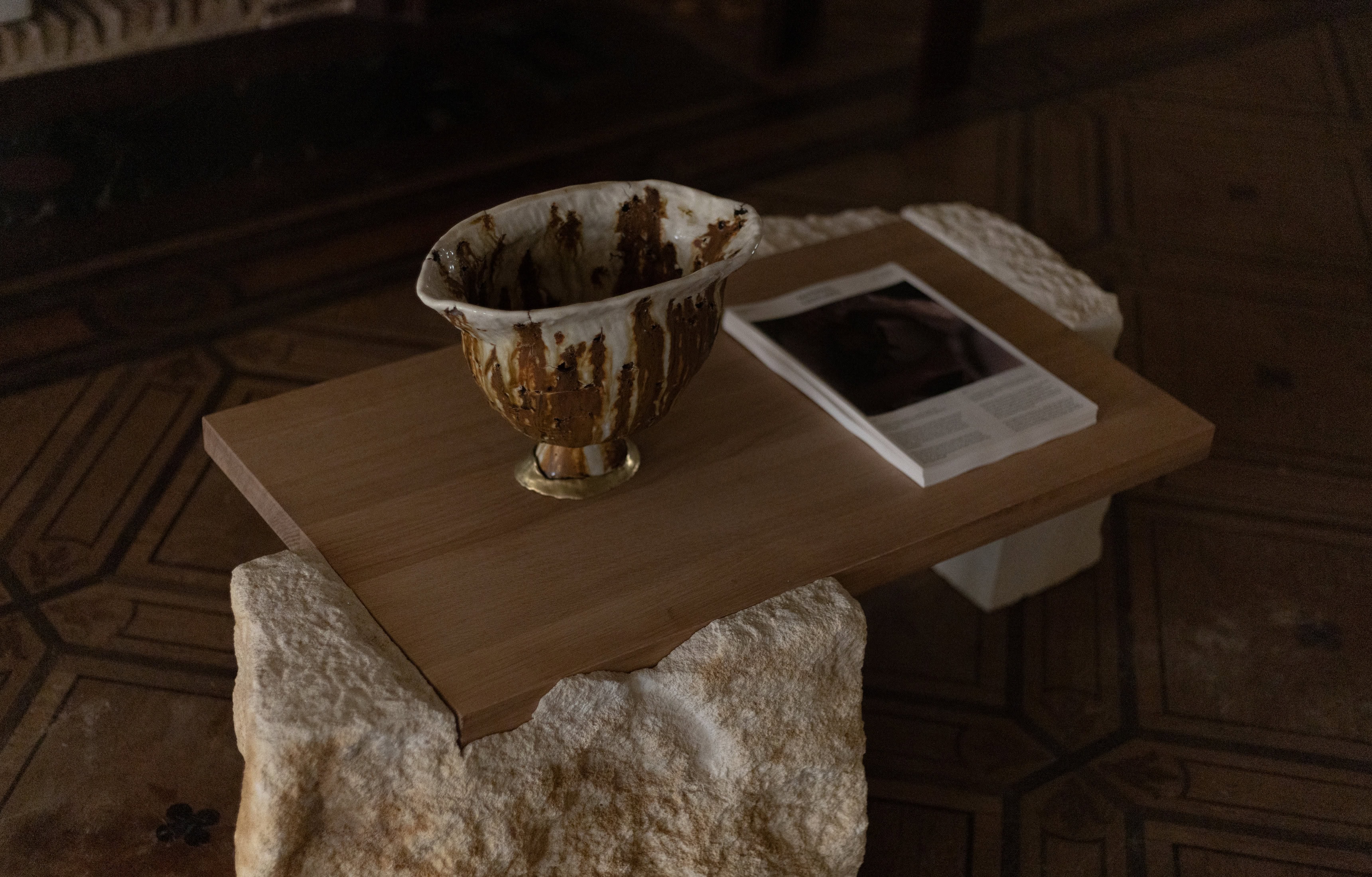
The roster on show reads like a survey of the most exciting collectible design being made now. There are the exuberant, anthropomorphic works of Chris Wolston, whose terracotta Nalgona chairs sprout limbs and toes, and whose cast Hand chandeliers reach out like something from a dream. There is the Korean designer Seungjin Yang, whose glossy, jewel-toned seating looks impossibly like inflated balloons yet is engineered to bear real weight — a magician’s trick rendered in epoxy-coated latex. Around them sit pieces by Karl Zahn, Bari Ziperstein, Eric Roinestad, Dee Clements, Ben & Aja Blanc, Ian Collings, Bradley Bowers and the Dutch experimenter Floris Wubben, among a rotating cast of international talent.


Material, Craft and the Value of the Handmade
What unites these makers is an unashamed devotion to material and process. This is design that wears its craft openly: the throw of the potter’s hand, the pour of molten bronze, the tension of blown glass caught mid-breath. The Goldwyn House makes a quiet, confident argument for objects that carry the evidence of the human hand, that take time, that are singular by nature.
That emphasis on craftsmanship also reframes how visitors read the works. Displayed in a lived-in setting, a hand-thrown ceramic lamp or a carved timber bench is understood as something with a real role to play in daily life. It is a subtle but meaningful shift, and it goes to the heart of why The Future Perfect has been so influential: it has helped a generation of collectors see functional objects as worthy of the same attention, and the same devotion, as art.


The Garden as Gallery
The experience does not stop at the walls. The surrounding gardens are treated as an extension of the exhibition, with pieces sited among the planting and the California light doing much of the curatorial work. Here, indoor and outdoor blur in the way that only really happens in Los Angeles, and the sculptural qualities of the design come into their own against foliage, shadow and sky. It is a reminder that this city has long been one of the most fertile grounds for design experimentation in the world.


Los Angeles and the New Geography of Collectible Design
The Goldwyn House did not appear in a vacuum. Over the past decade, Los Angeles has emerged as a genuine capital of collectible design, its warehouses, studios and hillside homes drawing makers and collectors who might once have gravitated only to New York or Milan. The city’s abundance of space, light and craft infrastructure — its ceramicists, metalworkers, woodshops and fabricators — has made it a natural home for the studio-made object.
By planting its most experiential space here, The Future Perfect both reflects and accelerates that shift. The Goldwyn House functions as a cultural anchor, hosting exhibitions, dinners and events throughout the year that bring together designers, collectors and the simply curious. It is less a shop than a salon — a place where the conversation around design is had in person, in three dimensions, over the course of an afternoon or an evening rather than on the scroll of a screen.


Why the Goldwyn House Matters
To visit the Goldwyn House is to be gently reminded of something easy to forget: that the objects we live with shape the texture of our days. By dissolving the boundary between gallery and home, The Future Perfect returns design to its natural habitat and, in doing so, asks us to look harder at the chairs we sit in and the light we read by.
There is a rare alchemy at work here — a century-old house built by a restless inventor, once home to a Hollywood titan, now given over to the most forward-looking design of our moment. Past and present hold each other in balance, and the result feels neither like a museum nor a store but like something more valuable: a living, breathing argument for the enduring power of things made well, by hand, with intention. Long after you leave, it is that feeling — of design as something to be lived with, not merely admired — that lingers. That same philosophy has shaped the gallery’s recent exhibitions, from Reinaldo Sanguino’s graffiti-glazed porcelain to Kristin Victoria Barron’s Plume, and most recently to Gaetano Pesce’s Dear Future.
Project Credits
Go further from here
Read next
Inside The Future Perfect's Goldwyn House in Los Angeles, where the Inner Space exhibition set JB Blunk and Isamu Noguchi alongside a new generation of makers — collectible design shown…
New York