
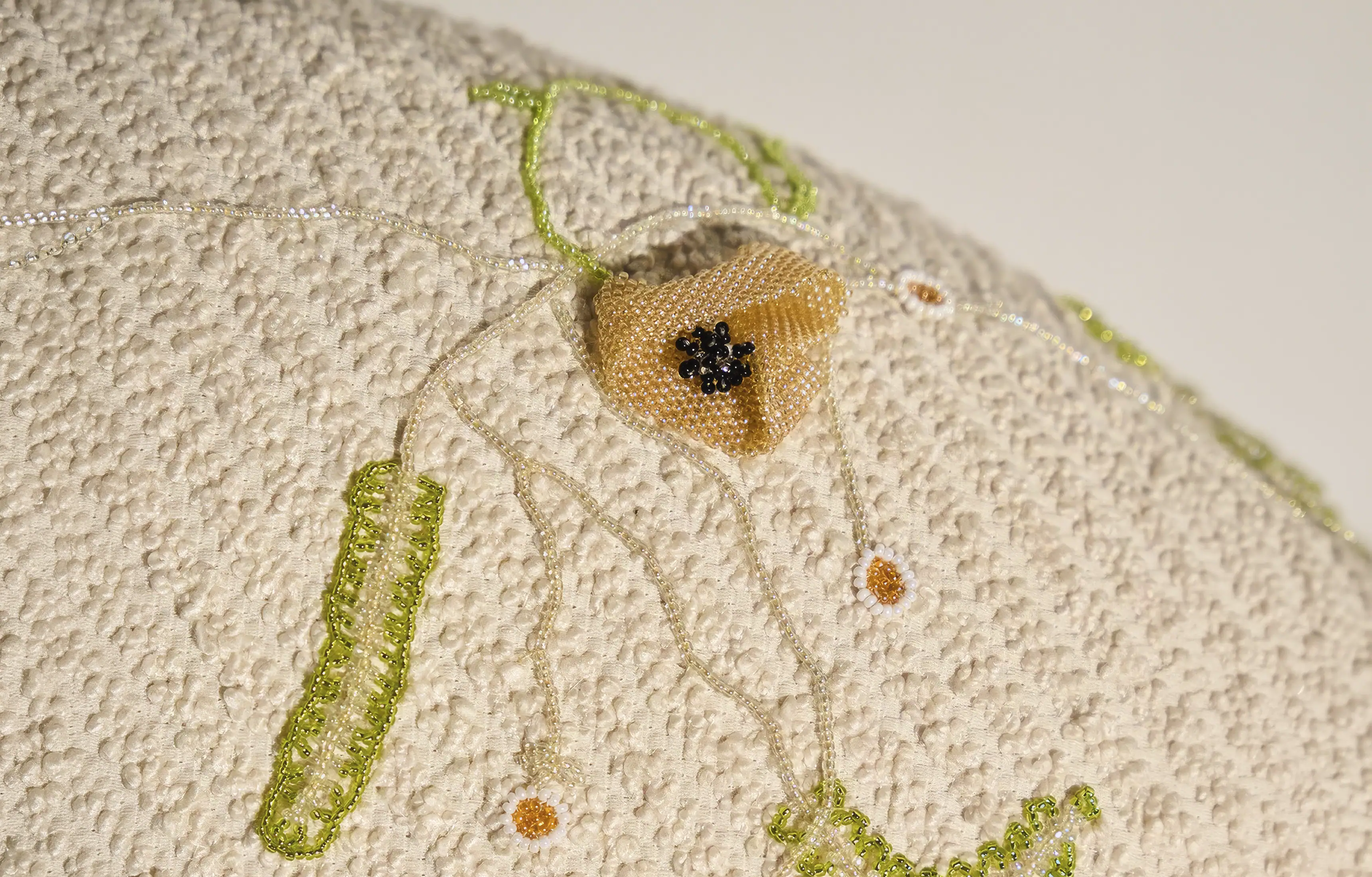
For Mother’s Day 2025, GUBI handed the same chair to two very different women-led practices and asked each to make it their own. One answer arrived in 244,000 glass beads, hand-placed over two weeks by six Guatemalan artisans. The other arrived in layers of hand-stitched silk from a Danish textile artist working alone. Both started from Pierre Paulin’s Pacha, the same 1975 design at the centre of GUBI’s own archive revival, and both ended up auctioned for UNICEF.
Introduction
GUBI launched Mother Made around Mother’s Day 2025, commissioning three one-off versions of Pierre Paulin’s Pacha chair from two women-led practices: the Guatemalan artisan collective Pura Utz, founded by Bernabela Sapalú and Anna Waller Andrés, and the Danish textile artist Nina Ferlov. All three chairs were auctioned online through Auctionet, in partnership with the Danish auction house Palsgaard Kunstauktioner, closing on 3 June 2025, with proceeds going to UNICEF Denmark to support maternal and child welfare work, including safe childbirth environments, clean water access and education in under-resourced communities.
The choice of chair was not incidental. Pacha is the Pierre Paulin design GUBI itself brought back into production first, before extending the same archive partnership with the Paulin family to the sculptural F300 Lounge Chair later that same year. Mother Made sits in between those two milestones: the same base design, handed to two outside practices as raw material rather than reproduced as a retail piece, with the results sold for a cause rather than a catalogue. That sequencing, and what each maker actually did with an identical starting point, is the part of the story the original coverage left out.


One base chair, two completely different hands
Paulin designed Pacha in 1975 as a low, generously upholstered swivel chair, built from rounded volumes rather than hard edges, the opposite in temperament to the tauter, more architectural F300 he had designed a decade earlier. That soft, continuous surface is exactly what makes it workable as a canvas: a single unbroken expanse of fabric large enough to carry sustained handwork without the piece reading as a print or a pattern swatch. GUBI supplied three identical Pacha shells, each on a Pearl Gold swivel base, and handed them to Pura Utz and Nina Ferlov as a starting material rather than a finished object to be respected as-is.
What came back could not have been more different from each other, despite starting from the same shape.


244,000 beads, six pairs of hands, two weeks
Pura Utz was founded in Santiago Atitlán, Guatemala, in 2018 by Bernabela Sapalú and Anna Waller Andrés, working initially out of Bernabela’s own house with six artisans. The name translates roughly as “pure quality, pure good,” and the model behind it is specific: artisans are paid a full third of each piece’s retail price, a transparent arrangement the founders built deliberately as an alternative to the exploitative piecework many of the women had experienced before joining. The collective has since grown to sixteen core artisans, expanding to more than fifty during peak production periods. Bernabela herself began learning embroidery and beadwork at thirteen, developing traditional Maya beading technique over decades before co-founding the collective built around it.
For Mother Made, six of those artisans spent two weeks hand-placing approximately 244,000 glass beads across the chair’s surface, working in intuitive flatwork rather than from a fixed pattern, so no single section repeats exactly. The finished piece, upholstered in Dedar’s Lupo Special Diagonal Bouclé beneath the beadwork, carries floral motifs the collective associates with fertility, birth and renewal, and the chair was named for Pachamama, an Earth Mother figure invoked across several Latin American indigenous cosmologies.
The scale of the handwork is the detail worth sitting with, and Pura Utz’s own smaller pieces make it legible. A single beaded pouch from the collective takes two artisans three working days and around 24,400 beads, a rate of roughly 4,000 beads per person per day. The Pachamama chair, at 244,000 beads across six artisans over two weeks, works out to almost exactly the same rate sustained for ten times as long. It is not a faster or more industrial process scaled up for a bigger commission. It is the same handwork, at the same pace, simply given ten times the hours. That is what separates this from a licensed print or an embroidered trim applied to a finished object: the labour is the design, not decoration added to it.


Threads passed like a lesson
Nina Ferlov, working alone rather than through a collective, contributed two further Pacha chairs, each finished in layered, hand-stitched silk embroidery over the same Dedar bouclé base. Where Pura Utz’s beadwork is dense and uniform across the whole surface, Ferlov’s chairs read as painterly, built from scraps and threads worked into flowing, non-repeating surfaces that GUBI has described as evoking the rhythm of knowledge passed between generations. Each of her two chairs is consequently unique even to the other, since neither is stitched from a template.
GUBI has described the intent behind Ferlov’s two chairs as a meditation on how knowledge moves between generations, framed as something closer to nourishment than instruction, passed on rather than taught. Whether or not a viewer reads that meaning into the surface unprompted, the physical fact underneath it is verifiable: two chairs built from an accumulation of individual stitches and fabric scraps, worked by hand over time, rather than printed, screened or machine-embroidered in a single pass.
Public biographical detail on Ferlov’s own practice is thin, which is worth naming plainly rather than papering over: this is a case where the maker deserves more space than the available sources currently allow, and it is a genuine gap for Martyn to close directly with GUBI or with Ferlov herself, rather than one this piece can fill from published material. An interview would likely be exclusive, since no other coverage of Mother Made appears to have gone further than her name and a description of the work.


Why a chair, and specifically this one, could take embroidery at all
The choice of Pacha over any other GUBI piece is also a construction decision, not only a symbolic one. Pacha is built as fully upholstered soft seating: foam over a frame, wrapped in continuous fabric, with no rigid shell interrupting the surface. That is a meaningfully different structure from the F300, whose fibreglass shell (now HiREK in GUBI’s reissue) is designed specifically to be a single hard, moulded form. A hard shell can be painted, lacquered or moulded with texture, but it cannot be embroidered or beaded across its surface the way a length of continuous fabric can. Pacha’s soft, upholstered construction is precisely what made it possible to hand this chair to two textile-based practices and ask for needlework rather than a fresh coat of finish.
That distinction also explains why Mother Made could not simply have used the F300 instead, even though the F300 was the more newsworthy reissue in GUBI’s calendar the same year. The brief needed a chair built from fabric all the way through, not a moulded shell with fabric added afterwards. Pacha was not just the sentimental or strategic choice. It was the only one of GUBI’s two major Paulin pieces that the brief could physically work on.


Why Pacha, specifically
Pacha is not an arbitrary choice of chair for a charity project. It is the Paulin design GUBI has already staked its own archive credibility on, the first of the designer’s pieces the company brought back into production, and the piece Marie Kristine Schmidt, GUBI’s chief executive, has previously pointed to as the foundation the F300 reissue was built on. Handing that specific chair to two women-led practices for a Mother’s Day fundraiser is not a random pairing of a nice object with a good cause. It puts the design GUBI is most publicly invested in directly into the hands of makers outside its usual manufacturing process, and lets the results be judged, and bid on, entirely on their own terms.


What the auction actually raised
The three chairs went to auction through Auctionet, closing on 3 June 2025. Pura Utz’s Pachamama chair sold for 3,501 US dollars after 60 bids. Nina Ferlov’s two chairs sold separately for 2,217 and 2,209 US dollars. Together, the three pieces raised just under 8,000 US dollars for UNICEF Denmark’s maternal and child welfare programmes. Those are modest figures set against a global charity’s total income, and there is no reason to inflate them: what they represent is a direct, traceable line from six named artisans and one named artist’s labour to a specific cause, sold as one-off objects rather than folded into an anonymous donation total.

Frequently asked questions
What is GUBI’s Mother Made?
A Mother’s Day 2025 initiative in which GUBI commissioned three unique versions of Pierre Paulin’s Pacha chair from the Guatemalan artisan collective Pura Utz and the Danish textile artist Nina Ferlov, then auctioned all three for charity.
Which chair did GUBI use for Mother Made?
The Pacha chair, designed by Pierre Paulin in 1975 and reissued by GUBI as part of its ongoing partnership with the Paulin family’s archive, the same partnership that later produced GUBI’s reissue of Paulin’s F300 Lounge Chair.
Who made the Pachamama chair?
Six artisans from Pura Utz, a Guatemalan collective founded in 2018 by Bernabela Sapalú and Anna Waller Andrés, who hand-placed roughly 244,000 glass beads across the chair over two weeks.
Who is Nina Ferlov?
A Danish textile artist who contributed two further one-off Pacha chairs to Mother Made, each finished in layered, hand-stitched silk embroidery, working individually rather than as part of a collective.
Where did the auction proceeds go?
To UNICEF Denmark, supporting maternal and child welfare initiatives including safe childbirth environments, clean water access and education in under-resourced communities.
How much did the Mother Made auction raise?
The three chairs sold for a combined total of just under 8,000 US dollars: 3,501 dollars for the Pachamama chair and 2,217 and 2,209 dollars for Nina Ferlov’s two chairs.
Can the Mother Made chairs be bought now?
No. Each of the three chairs was a unique, one-off piece sold once through the Auctionet and Palsgaard Kunstauktioner auction, which closed on 3 June 2025.

Final thoughts
The easy version of this story is a Mother’s Day marketing initiative: a well-known furniture brand, a good cause, three pretty chairs. What actually happened is more specific than that, and more useful to know. GUBI took the single design it has staked its own archive reputation on and handed it, unfinished, to two women-led practices with no obligation to treat it gently. Pura Utz answered with six weeks of combined hand labour and a quarter of a million beads. Nina Ferlov answered with two chairs that exist nowhere else, stitched without a template. Neither result looks anything like the Pacha chair GUBI sells in its own catalogue, and that was the point.
Mother Made is easy to miss between GUBI’s bigger reissue announcements, since it produced no new product line and generated no ongoing retail revenue. What it produced instead was proof that the company’s most important design can survive being handed to somebody else entirely, and come back better for it. The three chairs are gone now, each to a private buyer, which is its own kind of ending: no catalogue number, no repeat production run, nothing left to browse except the auction record and the photographs. That was always the arrangement. A one-off chair sold once is a stranger, more honest kind of tribute to a designer than a reissue with a shelf life, and Pacha, on this evidence, can carry both.
Leave a Reply