
Design travel
Reading time: 11 minA Georgian house in Hampshire with no known architect took nine years to bring back. What makes Heckfield Place worth studying is not the biodynamic farm everyone writes about, but the decision to commission 110 pieces of furniture from named workshops and to cast the door handles in bronze so they would go dull.
There is a particular kind of country house hotel that arrives fully formed, its references legible from the car park. Heckfield Place is not that. It opened in September 2018 after a restoration that began with planning consent in 2009, which is nine years of work on a house that most people had last seen as a corporate training centre.
The estate runs to 438 acres near Hook in Hampshire, less than an hour from London. It has a farm, a market garden, seven glasshouses, two lakes, a pinetum, a 67 seat cinema in the basement and, since 2023, a spa the size of a small office building. Almost everything written about it leads on the farming. That is understandable, because the farming is very good. It is also not where the design argument lives.
The better way in is the furniture. Somebody at Heckfield decided that the objects in the house should be commissioned rather than specified, from workshops that could be named, using materials that could be traced to a river or a woodland. That decision runs from the bulrush in the headboards to the bronze on the doors, and it is the actual design argument on this estate.

A house whose architect nobody knows
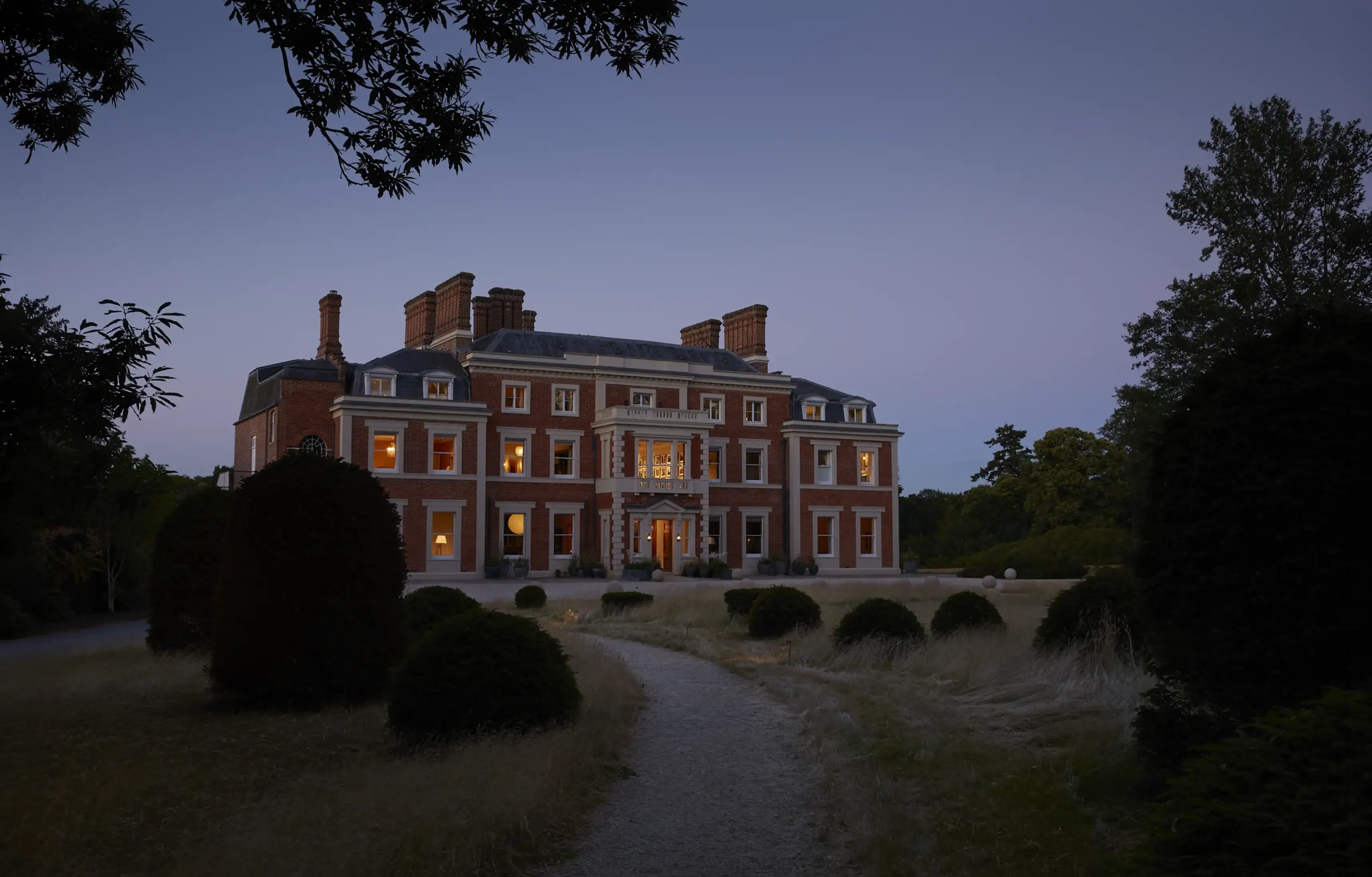
Heckfield Place was built between 1763 and 1766 for Jane Hawley, a widow who paid for it out of trust funds held for her infant son. No architect is recorded. For a house of this quality that is unusual, and it sets the tone for a building that has always been more legible through its occupants than through its authorship.
It is Grade II listed, list entry 1092255, first listed on 16 January 1981. The list description calls it “a Large mansion of classical form”: a central block of three storeys with two storey wings and attics, red brick laid in Flemish bond with stone dressings, a modillion cornice under a blocking course parapet, plain pilasters, rusticated quoins at the centre and a pierced balustrade over the entrance. The roof is hipped slate with mansards above the wings. The interiors are described as “rich Victorian restoration, in the classical manner”, which is a polite way of saying that the eighteenth century house you think you are looking at is largely a nineteenth century reading of itself.
The Huguenot merchant John Lefevre bought it in the mid 1780s. His daughter Helena married Charles Shaw, who took the name Shaw-Lefevre and grew the holding from 120 acres to several thousand. Their son, Charles Shaw-Lefevre, Viscount Eversley, was Speaker of the House of Commons from 1839 to 1857 and lived here until his death in 1888 at the age of 94. Colonel Horace Walpole bought the estate in July 1895 and put in electricity, new drainage and a water tower.
Then the twentieth century did what it did to a great many houses of this size. Heckfield became a conference and training centre in 1981 to 1982, was acquired by Racal Electronics, became the Vodafone staff training centre in 1985 after Racal’s mobile business took off, and operated as the Thales Commercial University from 2000 to 2002. Gerald Chan, the Hong Kong born co-founder of the Boston private equity firm Morningside Group, bought it in 2002.
The landscape carries its own designation: Grade II Registered Park and Garden, list entry 1001379, registered on 24 November 1997.

Spratley and Partners did the hardest part, which was the subtraction
The architect of record for the restoration and the wider estate masterplan is Spratley & Partners of Henley-on-Thames, with Sarah Tassell named as director on the project. Work covered 83,000 square feet of gross internal area.
The most consequential move was removal. The 1980s conference facilities and the bedroom block that came with them were taken out, and rooms that had been subdivided for corporate use were reinstated to their original proportions. This is the least photogenic work on any listed building project and the part that determines whether everything else can succeed. You cannot furnish your way out of a room that is the wrong shape.
What was then added is deliberately declared as new rather than blended in. A structural glass link connects the manor to the restaurant. The stair down to the 67 seat basement cinema runs past walls of Cotswold rubble stone with a bronze balustrade on stone treads. Handmade brick in Flemish bond and clay roof tiles carry the new-build fabric.
The consultant team is on the record and worth naming, because a country house restoration of this length is always a collective effort: Clegg Associates on structure, Apex Core on mechanical and electrical, Cole Easdon on civils, Lighting Design International on lighting, with Operis Construction and Goodman Hichens building it.
The masterplan work continued around the house: gate lodge and gardener’s cottage converted for guests, a spa cottage beside the walled garden, reconfigured drives and paths, an energy centre running wood pellet boilers, and the expansion of Home Farm with dairy buildings and glasshouses.

Ben Thompson’s brief was to make it behave like a house
The interiors are by Ben Thompson of BWT London, who trained at Studioilse under Ilse Crawford before setting up his own practice. That lineage is visible in the work: the same interest in how a room supports the body, the same suspicion of decoration that does no work.
Thompson has described the brief plainly. “The overriding message we heard was to sympathetically restore the Georgian building and its original character, which had been lost over the years.” His own framing of the difficulty is sharper: “The challenge was to be brave enough to treat Heckfield Place as a home, while having a hotel operation run unobtrusively in the background.”
The material decisions follow from that. Lime plaster on the walls, chosen because it takes light softly and keeps moving with the building. English oak floors picked for grain rather than uniformity. Bare brickwork left visible where the fabric warranted it. A palette of muted greys, greens and blues. Pale marble in Marle, dark brown marble in the bathrooms, polished brass at the bar, oak trusses overhead in the Long Room, panelling finished in bespoke colours through the principal rooms.
Two details tell you how the project was thought about. Electronic door locks, the great enemy of any historic bedroom, are hidden behind white linen hoops. And Thompson has said the sequence of rooms was planned around daylight: “The movement of the sun was important in leading one’s day through the building.” That is a planning principle rather than a decorating one.
Gerald Chan has been unambiguous about his own role, telling the Boston Globe: “I personally approved all the decisions. No designer did anything there without my approval.” Owners who say that out loud are rare, and it explains a good deal about the consistency of the result.

The 110 pieces, and the workshops that made them
This is the part that deserves the space, because it is where Heckfield differs from its peer group.
Special Branch Furniture developed and manufactured 110 unique pieces working directly with Thompson’s studio, in their own workshop with traditionally trained cabinet makers. The list is specific in a way that furniture schedules almost never are. A retail cabinet in limed oak with unlacquered brass and drawers lined in natural vegetable-tanned leather, fitted with Carl Auböck handles. Twenty one sets of butler’s trays in European oak, unlacquered brass and vegetable leather, with luggage racks in the same three materials. And a run of oak tiffins that combine steam-bent carrier frames, handmade plywood cut on a CNC, and oak “swill” weave from Cumbrian woodland.
That swill work was done by Owen Jones, one of very few people still practising Cumbrian oak swill basketry, a craft that involves boiling and riving oak into thin bands and weaving them green. Deller McClafferty did the metalwork and Wolfram Lohr the leather.
Felicity Irons, a master rush weaver in Bedfordshire, made the woven rugs and the bed headboards from bulrush harvested from the Great Ouse. She cuts it herself from a punt. A headboard you can name the river for is a different kind of object from one specified out of a fabric book.
The rest of the roll call: Benchmark, Terence Conran’s West Berkshire workshop, on custom oak; George Smith on upholstery, supplying the Fairhill sofas in the Panelled, Ochre, Lake and Coppice Rooms along with Signature chairs, a Gainsborough stool, a bespoke Knight stool and the Edwardian chair; Lucy Bathurst of Nest Design on hand-woven tapestries; José Carvalho and Effie Gibson on custom ceramics; The New Craftsmen on one-off pieces throughout; and local potters commissioned for restaurant dishware and lamp bases.
Then the ironmongery, which is the detail I would show anyone who wanted to understand the project. John Planck Ltd worked on Heckfield from 2009 to 2018, the full nine years, casting solid bronze door furniture to match surviving Georgian originals. Bedroom doors carry a knob on a stepped backplate outside and a lever inside, with the electric strike integrated behind. Casement fasteners and sliding stays were remade and the stays shortened from 300mm to 150mm to suit the manor’s narrow windows. The bronze was left unlacquered, on purpose, so that it would patinate under use rather than stay bright. Somebody signed off a specification whose success condition is that it looks older in ten years than it did on opening day.

The gardens have a nineteenth century celebrity and a twenty first century plan
The landscape was never the work of a single designer. Historic England records it as developing incrementally, with Charles Shaw-Lefevre laying out pleasure grounds and park in the early nineteenth century and formal terraces added around 1818, later joined by an Italianate terrace. The registered area holds two interconnected lakes with cascades, woodland including a pinetum, and the walled kitchen garden.
Its most famous gardener is the reason the skincare brand exists. William Wildsmith ran the gardens here in the second half of the nineteenth century with a staff of thirty men, made Heckfield a destination for carpet bedding, drew 2,000 visitors in five days in 1882 and kept a grape room that preserved two thousand bunches a year. Wildsmith Skin, the estate’s own skincare company, is named for him.
The modern landscape work is by Todd Longstaffe-Gowan, who reconceived the upper and lower walled gardens. He is the same landscape architect responsible for the Tudor knot garden in Chapel Court at Hampton Court Palace, and the pairing of deep historical scholarship with a working brief is his particular territory. Philip Bailey is head gardener, and put the scale of the recovery on the record: “A team of twenty-four gardeners and arborists have spent the last five years restoring the gardens, the pleasure grounds, and the trees.”
The market garden runs to eight acres with polytunnels, glasshouses and an orchard, and is run by Jane Scotter, who founded the biodynamic farm Fern Verrow in Herefordshire and is credited as head grower here.

What is certified, and what is simply true
Heckfield’s environmental claims are worth stating precisely, because the precision is to the estate’s credit and the loose version circulating online is less impressive than the real one.
The market garden holds Demeter biodynamic certification, awarded in 2020, with organic conversion having started in 2017. The wider Home Farm is organic. Those are two different standards covering two different parts of the estate, and describing the whole place as biodynamic is a simplification the estate itself does not make. Marle, the main restaurant, holds a Green Michelin Star, and Heckfield took two Michelin Keys in 2024.
Everything else in the sustainability account is the estate’s own reporting rather than third party certification: biomass boilers burning wood pellets, rainwater harvesting, a private borehole, LED lighting at around 90 per cent with motion sensing, a dairy opened in 2020 with a Guernsey herd, and arborists propagating seed from specimen trees over 150 years old. There are no published carbon figures, which is a gap worth closing given how much of the estate’s identity rests here.

The Bothy, and the kitchen as it stands now
The Bothy by Wildsmith opened in April 2023 and is the largest single addition since the hotel opened: 17,000 square feet, six treatment rooms including two doubles, two fitness rooms, a movement studio, a plant-based dining room and an oak terrace with sauna, steam room and cold plunge. The centrepiece is The Waters, a chlorine-free pool treated by mineral ionisation, lined with 29,434 hand-laid tiles.
The material palette is the interesting part. Fossilised limestone for floors, sink surrounds and the treads of a spiral staircase, and antique Hampshire brick salvaged from the exterior of the estate’s own buildings, brought inside and re-laid. The building holds a maximum of 52 guests at any time, takes over sixteens only, and bars phones and alcohol. Reka Seres-Erdei runs spa operations, with Rosamond Freeman-Attwood having built the treatment menu.
In the kitchens, the estate is in a new chapter. Skye Gyngell shaped the food at Heckfield from the opening and gave it a rare coherence, carrying her Spring approach of cooking from a named farm rather than from a supplier list. She died on 22 November 2025, aged 62. Eleanor Henson, who joined Spring in 2016 after Ballymaloe and became its head chef in 2022, had been appointed culinary director of both Heckfield Place and Spring that September. Her remit covers menus at both sites and the farming partnerships with Fern Verrow and Home Farm. “This role really reflects everything I believe in as a chef,” she has said, “the deep connection between land and plate.”

Frequently asked questions
Who designed the interiors at Heckfield Place?
Ben Thompson of BWT London, who previously worked at Studioilse under Ilse Crawford. The architect for the restoration, the new-build work and the estate masterplan is Spratley & Partners, with Sarah Tassell as project director. Owner Gerald Chan has said he personally approved every decision.
When did Heckfield Place open, and how long did the restoration take?
It opened in September 2018. Planning permission was granted by Hart District Council in 2009 and the restoration ran for nine years. Gerald Chan bought the estate in 2002.
How old is the house?
It was built between 1763 and 1766 for Jane Hawley. No architect is recorded. It is Grade II listed, and the landscape carries a separate Grade II Registered Park and Garden designation from 1997.
Is Heckfield Place biodynamic?
The market garden is certified biodynamic by Demeter, awarded in 2020 after organic conversion began in 2017. The wider Home Farm is organic. These are two different standards, so the accurate description is that part of the estate is certified biodynamic rather than all of it.
What is The Bothy by Wildsmith?
The estate’s spa, opened in April 2023 across 17,000 square feet. It has six treatment rooms, a movement studio, a plant-based dining room, an oak terrace with sauna and steam, and a chlorine-free mineral-ionised pool lined with 29,434 hand-laid tiles. It admits a maximum of 52 guests at a time, is over sixteens only, and does not allow phones or alcohol.
Who is Wildsmith named after?
William Wildsmith, head gardener at Heckfield in the second half of the nineteenth century, who ran a staff of thirty and made the gardens a national horticultural attraction.
Who cooks at Heckfield Place now?
Eleanor Henson was appointed culinary director of Heckfield Place and Spring in September 2025, succeeding Skye Gyngell, who established the food here from the 2018 opening and died in November 2025.

Final thoughts
The reason Heckfield is worth the drive is not the wellness vocabulary, which every estate of this type now has, and it is not really the farm either, good as the farm is. It is that a nine year budget was spent on things that only reveal themselves slowly. Bronze that dulls. Rush cut from a specific river. A hundred and ten pieces of furniture that exist nowhere else. A stay of two nights will not show you most of it.
That is a commercially awkward position for a hotel, and the estate has taken it anyway. Restoration projects usually reach for the visible gesture, because the visible gesture is what gets photographed and booked. Heckfield put the money into the door handles. Ten years from now, when the bronze has gone properly brown and the oak has moved, it will read better than it does today, which is the only real test a project like this can set itself.


Leave a Reply