
HOSPITALITY INTERIORS · UNITED KINGDOM
Reading time: 8 minCreated for Belmond’s iconic British Pullman, the Celia carriage by Baz Luhrmann and Catherine Martin redefines luxury train interior design through storytelling, craftsmanship and immersive hospitality. Set within a meticulously restored 1932 Pullman carriage, this richly layered private dining space transforms the traditional rail journey into a theatrical experience, where opulence, narrative and atmosphere converge to celebrate a new era of slow, design-led travel.
There are few modes of travel that evoke the same sense of romance and occasion as the railway. Long before aviation redefined global movement, trains shaped the very idea of travel as an experience; something to be savoured, not rushed. Journeys unfolded slowly across landscapes, conversations lingered, and interiors were designed not simply for functionality but for atmosphere, comfort, and elegance.

Today that sense of ritual is being rediscovered, and Belmond’s Celia carriage sits at the centre of the revival. It restores the hours between departure and arrival as the point of the trip rather than the cost of it. Rather than prioritising destination over journey, it reasserts the importance of the experience itself, reimagining train travel as something immersive, theatrical, and deeply considered.
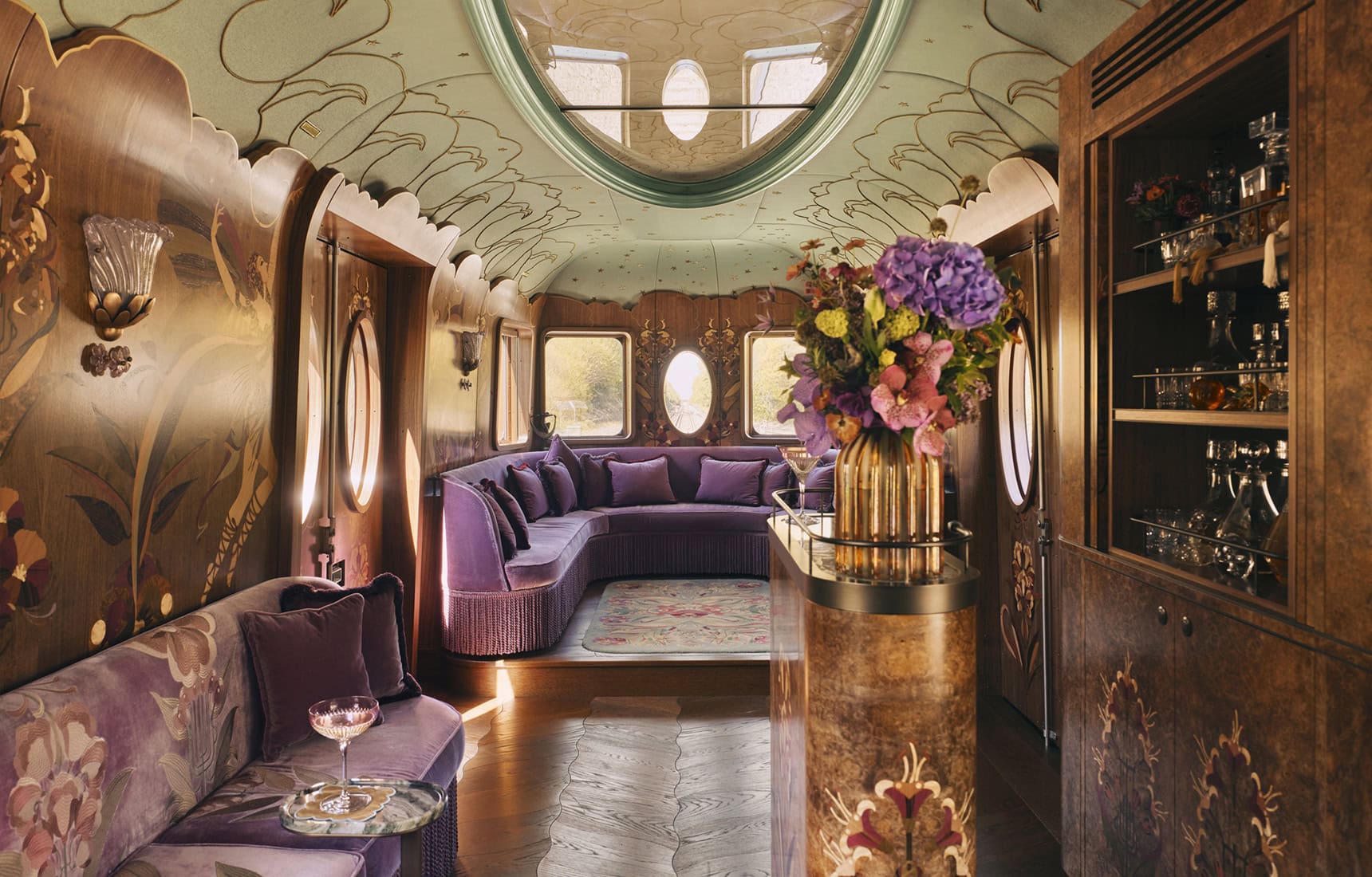
Created for the British Pullman by filmmaker Baz Luhrmann and Academy Award-winning designer Catherine Martin, Celia is not simply a luxury carriage; it is a carefully constructed world. Housed within a restored 1932 Pullman carriage, it transforms a historic piece of railway heritage into an intimate, narrative-driven environment where craftsmanship, storytelling, and hospitality converge to define a new era of luxury train interior design.
Reviving the Golden Age of Rail Travel
The British Pullman has long been synonymous with glamour. Its collection of meticulously restored carriages represents a living archive of 20th-century travel, where marquetry, polished wood, and plush upholstery recall a time when journeys were as important as arrivals. Celia builds upon this legacy, but instead of simply preserving the past, it reinterprets it through a contemporary design lens.
Accommodating just twelve guests, the carriage offers an experience defined by exclusivity and intimacy. It introduces a more private, residential approach to hospitality, where groups can gather, celebrate, and connect within a space that feels both personal and extraordinary. This shift reflects a broader evolution within luxury travel, where bespoke experiences and meaningful environments are valued over scale or spectacle.
What distinguishes Celia is its willingness to fully embrace the emotional and theatrical potential of design. It does not aim to replicate historical interiors, nor does it adopt a restrained, minimalist approach. Instead, it occupies a unique position where heritage meets imagination, resulting in a space that feels both nostalgic and entirely new.

A Narrative-Driven Interior
At the heart of the project lies a narrative; a fictional story inspired by a glamorous 1930s West End muse who once portrayed Titania, Queen of the Fairies in Shakespeare’s A Midsummer Night’s Dream. This narrative becomes the conceptual framework for the entire interior, informing everything from material choices to spatial organisation and decorative detailing.
This approach represents a departure from traditional transport design. Rather than focusing purely on ergonomics and efficiency, Celia is conceived as an immersive environment, where storytelling shapes the user experience. Every element contributes to a cohesive narrative, encouraging guests to engage not just with the physical space, but with the atmosphere it creates.
For Baz Luhrmann and Catherine Martin, this cinematic sensibility is a natural extension of their creative practice. Known for their visually rich and emotionally layered work, they bring a sense of drama and composition to the carriage, ensuring that each moment feels intentional and carefully staged. The result is an interior that blurs the line between set design and architecture. It is not simply a backdrop for the journey, but an active participant in it.

Spatial Choreography on Rails
One of the most compelling aspects of Celia is its spatial planning. Unlike traditional train carriages, which typically function as linear dining environments, this design introduces a series of interconnected spaces that unfold throughout the journey.
Guests move between a private cocktail bar, an intimate lounge, a dining area, and an entertainment space. Each zone offers a distinct atmosphere, contributing to a layered experience that evolves over time. This sense of progression is central to the design, transforming the carriage into something closer to a sequence of scenes than a single, static space.
This spatial choreography reflects principles more commonly found in residential and hospitality design than in transportation. It allows for moments of interaction, pause, and transition, creating a rhythm that mirrors the pace of the train itself.
As the landscape shifts outside, the interior experience shifts alongside it. The journey becomes multidimensional: not just a passage through geography, but through atmosphere, light, and narrative.

The Art of Opulence
In an era where minimalism continues to dominate many areas of design, Celia stands out for its unapologetic embrace of opulence. The interior is richly layered, with textures, colours, and materials combined to create a deeply immersive environment.
Yet this opulence is carefully controlled. It feels generous and assured at every turn. It is balanced with a level of refinement that ensures the space remains elegant and cohesive. This balance is what elevates the carriage from decoration to sophisticated design.
Every surface contributes to the overall composition. Fabrics, finishes, and detailing are selected not only for their visual impact but for their ability to reinforce the narrative. The result is an interior that rewards attention, revealing new details and relationships with each glance.
This commitment to decorative richness reflects a broader shift within luxury interiors, where there is a renewed appreciation for craftsmanship, materiality, and layered design. Celia embraces this direction fully, positioning itself as a counterpoint to more restrained contemporary aesthetics.

Craftsmanship and Detail
Exceptional design often reveals itself in the smallest details, and Celia is no exception. The carriage demonstrates a remarkable level of craftsmanship, with each element carefully considered and executed.
This attention to detail aligns with the broader ethos of the British Pullman, where heritage craftsmanship has long been a defining characteristic. In Celia, this legacy is both preserved and reinterpreted, resulting in an interior that feels authentic yet forward-looking.
Details are not treated as secondary to the overall design; they are integral to it. From the precision of joinery to the layering of finishes, each component contributes to the overall atmosphere. This level of care ensures that the experience feels cohesive and immersive.
For guests, it creates a sense of discovery. The interior invites exploration, encouraging a slower, more deliberate engagement with the space. In doing so, it reinforces the idea that luxury is often found not in scale, but in nuance.

Hospitality as Experience
While the design itself is central to Celia’s appeal, it is ultimately the way the space is experienced that defines its success. Hospitality design is not simply about aesthetics; it is about creating environments that facilitate connection, celebration, and memory.
Celia has been conceived as a setting for precisely these moments. Whether hosting a private lunch, a champagne reception, or a special celebration, the carriage offers an environment that feels both intimate and elevated.
The inclusion of a private chef, bespoke menus, and dedicated service enhances this experience, ensuring that every aspect of the journey is tailored to the guests. This personalised approach reinforces the carriage’s residential quality, making it feel less like a traditional hospitality venue and more like an extraordinary private space.
It is this blending of design and service that defines contemporary luxury. The experience is not just curated visually but holistically, encompassing atmosphere, interaction, and emotion.
Reframing the Journey
Perhaps the most significant achievement of Celia is its ability to reframe the concept of travel itself. In a world increasingly focused on speed and efficiency, it offers an alternative perspective; one that values time, experience, and presence.
The carriage encourages guests to slow down, to engage with their surroundings, and to appreciate the journey as an integral part of the experience. The changing landscape outside becomes part of the narrative, interacting with the interior in subtle and dynamic ways.
This relationship between interior and exterior is what gives train travel its unique character. Unlike other modes of transport, it allows for a continuous visual dialogue with the environment. Celia enhances this dialogue, framing it within an interior that is equally rich and engaging.
In doing so, it captures the qualities that make a journey memorable: a sense of anticipation, of occasion, and of enjoyment in the act of moving itself.

A New Chapter in Luxury Train Design
Celia represents more than a singular design project; it signals a broader shift in how luxury train travel can be imagined. By combining heritage with storytelling, craftsmanship with innovation, it offers a blueprint for future hospitality experiences within the rail industry.
It demonstrates that transport design can move beyond functionality to become something emotionally resonant and culturally significant. It shows that interiors can be both immersive and refined, theatrical yet grounded.
For designers and architects, it provides a compelling case study in narrative-driven design. For travellers, it offers something equally valuable: a reminder that the most memorable journeys are not always the fastest, but the ones that invite us to stop, observe, and fully engage with the experience.
Design That Transforms the Journey
Celia by Belmond is ultimately a celebration of design’s ability to transform how we experience the world. Through its layered interiors, narrative depth, and commitment to craftsmanship, it redefines what luxury train interior design can be.
It is an environment where architecture, storytelling, and hospitality intersect; where the boundaries between travel and theatre dissolve. In doing so, it creates something rare: a journey that feels as meaningful as the destination itself.
For those who believe in the power of design to elevate everyday experiences, Celia stands as a powerful reminder that luxury, at its best, is not about excess but about intention, imagination, and the creation of moments that linger long after the journey ends.


Leave a Reply