
ART & CULTURE · MILAN
Reading time: 9 minFor Milan Design Week 2021, the curatorial partnership H+O turned a third-floor apartment in Brera into a study of the mirror, as object, material and metaphor. Josephine Akvama Hoffmeyer and Elisa Ossino filled every room with custom furniture, international design and a site-specific work by the Milanese artist Roberta Savelli, then gave the whole thing the title of a Velvet Underground song about being seen clearly. The choice fits more precisely than it first appears to.
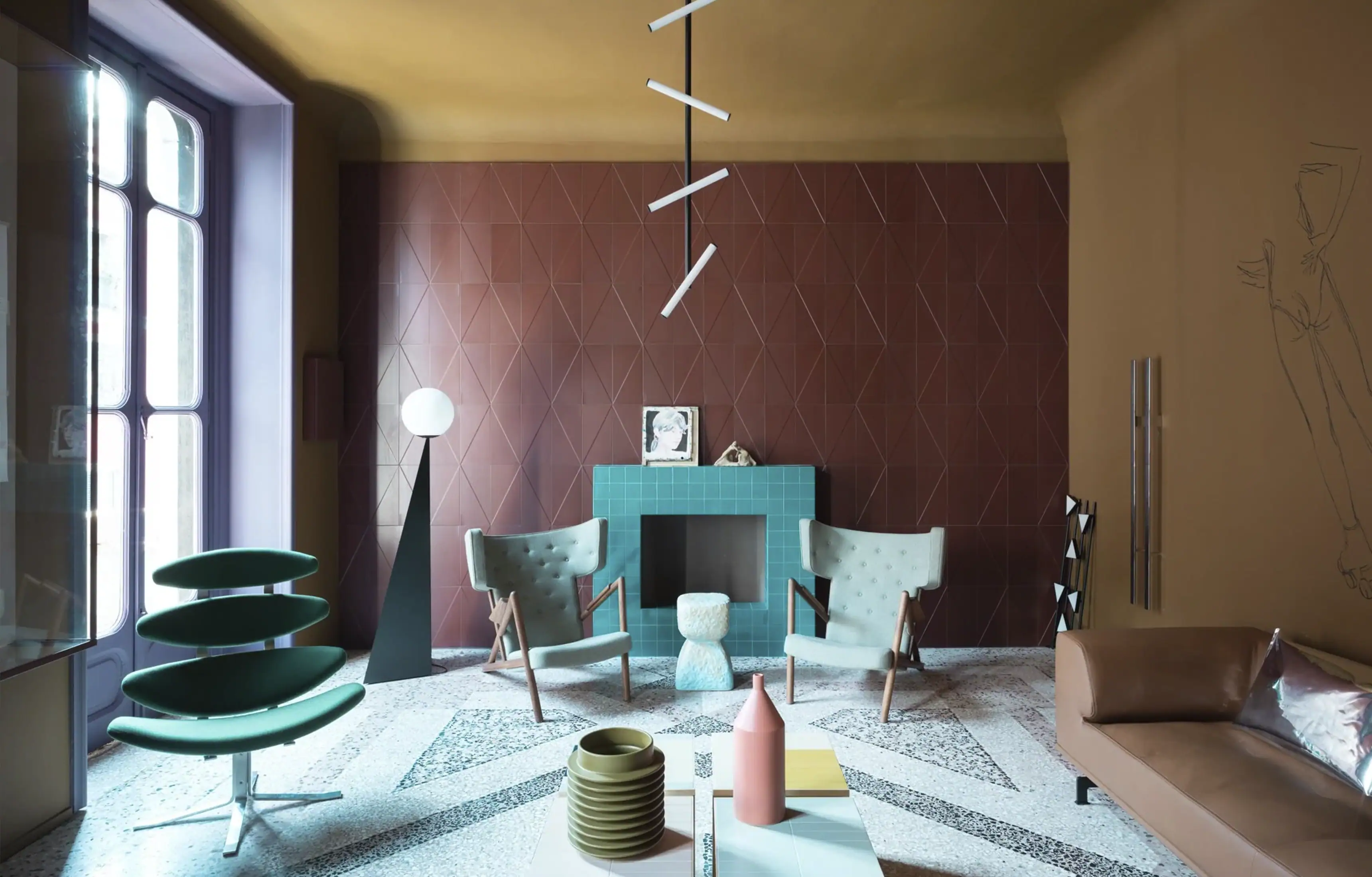
Via Solferino 11 sits three floors up in Brera, the design district that turns into Milan’s most concentrated stretch of showrooms and installations every September. Brera’s particular character during Design Week comes from its residential scale: rather than trade-fair halls, its events unfold inside actual apartments, courtyards and shopfronts across a compact grid of streets, so a visitor moves from a private home to a gallery to a workshop within a few hundred metres. In 2021, for five days between the 5th and the 10th, one of those apartments became I’LL BE YOUR MIRROR, a room-by-room installation built entirely around the mirror: as a physical object, as a surface, and as the central metaphor for how a space can make a visitor look back at themselves.
The apartment belongs to H+O, the curatorial partnership between Josephine Akvama Hoffmeyer and Elisa Ossino, and it has operated as a gallery in its own right since 2019. I’LL BE YOUR MIRROR was not a one-off booking of borrowed space. It was H+O working inside a room they had already made their own, filling it with custom furniture, lighting and ceramics from a deliberately mixed roster of Italian and Nordic design houses, and handing one room over entirely to an analogue installation by the Milanese artist Roberta Savelli. Every decision, from the tile underfoot to the title above the door, was aimed at the same question: what does it mean to be reflected accurately.

A gallery apartment, not a rented one
H+O is easy to misread as a single studio. It is better understood as a partnership between two people who each run something else. Elisa Ossino is the architect and designer behind Elisa Ossino Studio, founded in Milan in 2006, working across residential and retail interiors, product design, art direction and set design. Josephine Akvama Hoffmeyer is the founder and creative director of File Under Pop, the Copenhagen surface-design studio she started in 2015, known for clothing floors, walls and ceilings in tile and paint.
In 2019 the two of them, already established collaborators, co-founded H+O as a distinct project: a brand dedicated to surface design, exhibitions and multidisciplinary installations exploring new approaches to interiors and contemporary lifestyle. That same year they opened the apartment on Via Solferino as H+O’s permanent gallery space in Brera. I’LL BE YOUR MIRROR was staged inside that standing gallery, which is why the installation reads less like a temporary stunt and more like a considered use of a room the pair already understood in detail. It followed an earlier H+O apartment installation, Perfect Darkness, staged in the same space and built around an inverse idea: withheld light rather than reflected light.
Both women bring histories to the project that are not always visible in the finished rooms. Ossino trained at the Politecnico di Milano and has spent nearly two decades developing a design language built on geometric abstraction, monochrome surfaces and a strong sense of scenic suspension, the same qualities that shaped her Balnea bathroom collection for Salvatori, winner of Best Bathroom at the 2020 Elle Decoration International Awards, and that placed her among AD’s Top 100 Interior Designers in both 2019 and 2020. Hoffmeyer’s route to design ran through music rather than architecture. Before founding File Under Pop, she worked as a professional singer, trained in New York and performing backing vocals internationally, including for Joe Cocker and Rick Astley, before turning her ear for composition toward colour, surface and interior space.

Mirrors as furniture, not decoration
Inside the apartment, the mirror stopped being a fixture on a wall and became the organising material of every room. Elisa Ossino Studio designed the interior framework and debuted the Albalat collection within it, a line of maple wood coffee and bedside tables set with patterned ceramic tile, alongside walls and surfaces finished in clay by File Under Pop. The effect was rooms built from flat, reflective and semi-reflective planes stacked against one another, so that colour and pattern bounced between floor, table and wall rather than sitting still on any one of them.
Around that framework, H+O brought in a deliberately cross-cultural set of design houses. Fredericia Furniture supplied Danish seating including Børge Mogensen’s Spanish Dining Chairs, the Delphi Sofa and the sculptural Sequoia Pouf. House of Finn Juhl contributed pieces of Danish mid-century design including the 1941 Poet Sofa and the asymmetric Wall Sofa, their organic curves set deliberately against Ossino’s more geometric interior. Salvatori, the Tuscan stone specialist Ossino had already worked with on Balnea, showed its Omaggio a Morandi marble vases, their soft, stacked forms echoing the painter Giorgio Morandi’s own studies of reflected light on still life. Tubes Radiatori and Atelier Areti brought sculptural heating and lighting elements designed to stand as objects in their own right rather than disappear into the architecture, treating a radiator or a light fitting with the same formal attention Ossino gave to a table or a wall. Hutte, Jacobsroom and Officine Saffi filled out the roster of contributing houses across furniture and product design. The result was less a showroom than a conversation between studios that do not usually share a room, held together by Ossino’s spatial choreography and by the mirror motif running through every piece she selected.
That choreography was also a deliberate exercise in pairing opposites. Fredericia and House of Finn Juhl represent two of Denmark’s most established furniture houses, working in warm timber and organic upholstered form; Salvatori and Tubes work in stone and metal, cooler materials associated with Italian architectural interiors rather than domestic comfort. Placing a Poet Sofa’s soft curves within sightline of a stone Morandi vase, in a room already built from reflective tile, meant every material in the apartment was doing double duty: functioning as furniture, and functioning as a surface that returned the room’s colour and light back into it.

Roberta Savelli’s analogue installation
One room was given over entirely to the Milanese artist Roberta Savelli, who created a site-specific, analogue installation intended to sharpen the apartment’s atmosphere of suspense. Savelli, born in 1969 in Giussano and trained in set design at Milan’s Accademia di Brera, works primarily in painting, and her practice has long circled the idea of the constructed habitat, a space built to hold both a life and an imagination at once. That training in set design is worth noting on its own terms: it is the same discipline of building a room to carry meaning that runs through Ossino’s own interiors, and the two have collaborated with each other repeatedly beyond this installation.
Savelli’s contribution to I’LL BE YOUR MIRROR worked by deliberate contrast with the rest of the apartment. Where the furniture and surfaces around it were finished, considered and precisely specified, her installation was analogue and site-specific, made for that room and that room only, refusing to be reproduced or relocated. Set inside a sequence of rooms otherwise full of named international products, it gave visitors a moment built on presence rather than provenance, which was, in an apartment about reflection, exactly the point: a mirror only works when something real stands in front of it.
Savelli’s collaboration with Elisa Ossino Studio extends beyond this single installation, and her work as a painter, shown at auction and exhibited in Milan galleries, consistently returns to the idea of a constructed habitat rather than a single portrait or object. That recurring interest in built, inhabited space is precisely why her practice suited a project about apartments as much as it suited a project about mirrors: she builds rooms for a painting to happen inside, in the same way Ossino builds rooms for a life to happen inside.

Why a Velvet Underground song fits a mirror apartment
H+O took the exhibition’s title, and its epigraph, from The Velvet Underground and Nico, the band’s 1967 debut album. I’ll Be Your Mirror was written by Lou Reed specifically for Nico to sing, and unlike much of the record around it, the song is tender rather than confrontational: a promise from one person to reflect another’s true self back to them, “in case you don’t know”. Reed later described writing it as an act of reassurance for a singer he thought the public consistently misread. As a piece of music history, that makes it an unusually exact reference for an installation about mirrors. It is not a song about vanity or surface. It is a song about accurate reflection as an act of care, which is precisely the argument Hoffmeyer and Ossino built their rooms around.
The choice carries a further layer that the installation’s own material does not spell out but that Hoffmeyer’s biography makes clear. Before she was a designer, she was a professional vocalist, trained in New York and performing internationally as a backing singer, work that consists, at its core, of accurately reflecting someone else’s voice and intention back into a room. A curator with that history choosing a lyric about reflecting someone’s true self is not simply borrowing a mood from a famous record. It is a reference that runs directly through her own working life before design, which gives the epigraph a weight that a purely visual reading of the installation would miss.

The mirror as a design argument
Read as a whole, I’LL BE YOUR MIRROR made a specific design argument rather than a decorative one. A mirror in most interiors is treated as a fixture: hung, framed, positioned to bounce light into a corner. Here it was treated as a structural idea, applied to furniture, tile, marble and glass alike, so that reflection became a property of the whole room rather than a single object within it. Ossino’s spatial choreography, Hoffmeyer’s surfaces, the invited design houses and Savelli’s analogue counterpoint all served that single argument: that an apartment can be built to show a visitor something true about themselves, and that doing so is a matter of material choice as much as concept.
Final thoughts
I’LL BE YOUR MIRROR worked because H+O treated the mirror as a discipline rather than a decorative flourish, carrying it through furniture, tile, marble and light until it became the room’s structure rather than its ornament. Staged inside a gallery apartment the partnership had already made its own, with Roberta Savelli’s analogue installation as a deliberate counterweight to the specified pieces around it, the exhibition gave Milan Design Week 2021 one of its most exact matches between title and material. A song about reflecting someone accurately, chosen in part by a curator who once made her living doing exactly that with her voice, turned out to be the right name for a set of rooms built to do the same thing with light, glass and colour.
What was H+O’s I’LL BE YOUR MIRROR?
I’LL BE YOUR MIRROR was an apartment installation staged by the curatorial partnership H+O at Via Solferino 11 in Milan’s Brera district, running from the 5th to the 10th of September 2021 during Milan Design Week. It filled the apartment with custom furniture, international design and a site-specific artwork built around the theme of the mirror.
Who are Josephine Akvama Hoffmeyer and Elisa Ossino?
Josephine Akvama Hoffmeyer is the founder and creative director of File Under Pop, a Copenhagen surface-design studio she launched in 2015, and a former professional singer. Elisa Ossino is a Milan-based architect and designer who founded Elisa Ossino Studio in 2006. The two co-founded H+O in 2019.
What is H+O, and how does it relate to Elisa Ossino Studio?
H+O is a separate curatorial project co-founded by Josephine Akvama Hoffmeyer and Elisa Ossino in 2019, focused on surface design, exhibitions and multidisciplinary installations. It is distinct from Elisa Ossino Studio, Ossino’s own architecture and design practice, though Elisa Ossino Studio designed the interior framework for I’LL BE YOUR MIRROR. H+O also runs a standing gallery apartment in Brera, opened the same year the partnership was founded.
Which design houses featured in the installation?
The apartment brought together pieces from Fredericia Furniture and House of Finn Juhl from Denmark, and Salvatori, Tubes Radiatori, Atelier Areti, Hutte, Jacobsroom and Officine Saffi from Italy, alongside Elisa Ossino Studio’s own Albalat collection and clay surfaces by File Under Pop.
Why is the installation named after a Velvet Underground song?
The title comes from I’ll Be Your Mirror, written by Lou Reed for Nico on The Velvet Underground and Nico in 1967. The song’s promise to reflect someone’s true self back to them matches the installation’s central idea, and carries an added resonance given Josephine Akvama Hoffmeyer’s earlier career as a professional singer.


Leave a Reply