
[Section] · [Location]
Reading time: 6 minMost great museums sort the world into rooms: this civilisation here, that century there. Louvre Abu Dhabi does something braver. It places a Renaissance painting beside an Islamic artefact beside an African sculpture, and asks you to notice what they have in common rather than what separates them. Step inside, and the building’s famous dome turns out to be only the beginning of the story.
The moment the outside world goes quiet
There is a particular moment almost every visitor to Louvre Abu Dhabi has, usually without warning. You walk in from the heat and the glare of Saadiyat Island, sunlight begins to fall through the vast dome overhead in soft, shifting points, water appears where you did not expect it, and the pace of the day simply drops away. The museum does not ask you to look at art so much as invite you to slow down and feel your way through it.
I have written elsewhere about the architecture, about Jean Nouvel‘s silvered dome and the engineering behind that celebrated rain of light. This piece is about what happens once you are underneath it. Because for all the attention the building’s exterior receives, the real achievement of Louvre Abu Dhabi is on the inside: the way the galleries are arranged, the rhythm of the spaces, and a curatorial idea that quietly reframes what a museum can be.

A universal museum, and why that matters
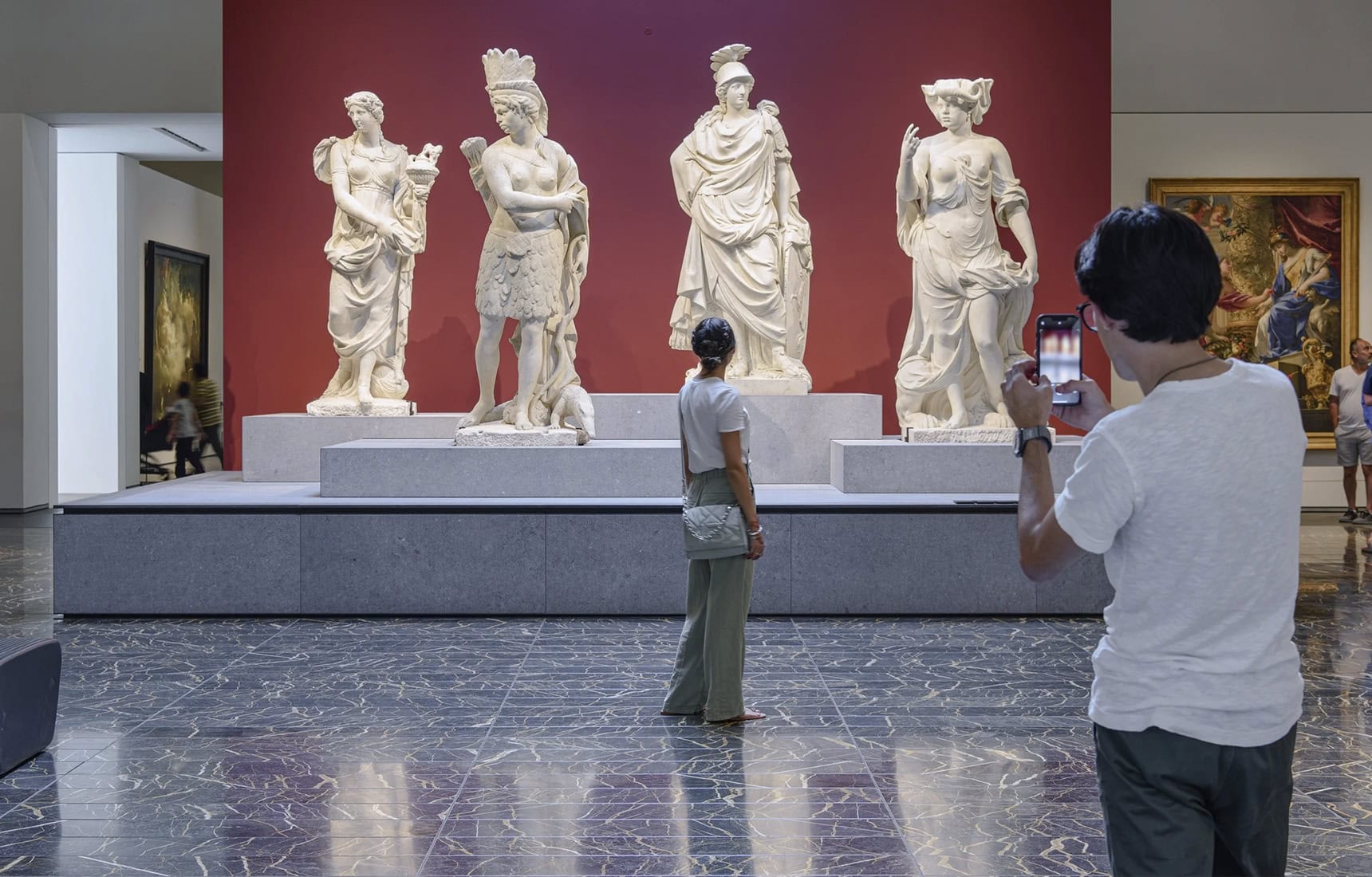
Louvre Abu Dhabi opened in November 2017 as the first universal museum in the Arab world, and that word, universal, is the key to everything that follows. Most museums organise their collections by geography or by civilisation, so you move from the Egyptian room to the Greek room to the European wing. Here, the galleries are arranged chronologically but thematically, chapter by chapter, and works from utterly different cultures are deliberately placed side by side.
The effect is startling in the best way. An ancient sculpture sits near a Renaissance painting. A page of sacred Islamic text converses with Asian ceramics and works from Africa. Rather than telling you that these worlds were separate, the museum shows you how often they were asking the same questions, about faith, power, beauty, death and the human figure, at the same moment in history. Moving through the galleries becomes less about chronology and more about recognition, a slow accumulation of the sense that creativity is one long shared conversation. It is a genuinely humane way to display a collection, and it is what distinguishes this museum from almost any other.

Interiors designed to disappear
The interior design is what makes that idea legible, and its greatest quality is restraint. The galleries are lit softly, finished in muted stone and quiet materials, and proportioned so that no room ever overwhelms you. Nothing competes with the objects. The architecture frames each piece and then gets out of the way, which is far harder to achieve than it sounds and far rarer than it should be.
What keeps the sequence from feeling austere is the constant, careful relationship between inside and outside. As you move through the galleries, openings are positioned to catch a sudden view of water, a courtyard, or a shaft of filtered sun beneath the dome. These glimpses reconnect you to the sea and the sky just often enough that the museum never feels sealed off or airless. The transitions are choreographed like a piece of music: a narrow passage opens without warning into a broad plaza, a darkened gallery leads you out into a sunlit court, water appears between two volumes and stops you in your tracks. You are not walking through a set of rooms so much as through a composed narrative that unfolds in time.

The rain of light, experienced from below
From inside, the dome stops being an object and becomes an atmosphere. Nouvel’s eight layered, star-punched screens filter the sun into thousands of moving points that the museum calls the rain of light, and they never hold still. Across a single day the pattern drifts across pale walls and stone floors, sharpening at midday, lengthening and warming toward dusk. It is the closest thing a building has to weather of its own.
For anyone who photographs, this is the great gift of the place. Every hour rewrites the light, and the contrast between the crisp white gallery volumes and the intricate metallic canopy overhead gives you endlessly changing compositions of geometry and reflection. Sunrise and sunset are the most generous, washing the whole museum-city in gold, but honestly there is no bad time to raise a camera here.

Beyond the galleries: the whole complex works
Part of what makes a visit linger is that the experience does not stop at the gallery doors. Open-air courtyards invite you to sit beside the sea. Quiet walkways give you room to think between exhibitions. Cafés and terraces let you watch the light travel across the dome while you rest. The museum is conceived as a small city of some fifty-five white buildings gathered under one canopy, and that idea of a place to wander, rather than a route to march through, is felt everywhere.
The Children’s Museum adds a genuinely thoughtful layer, giving younger visitors their own space to meet art and storytelling through play rather than instruction. And the collection itself keeps moving. Temporary exhibitions and international collaborations refresh the programme regularly, and the permanent display is continually enriched by new acquisitions and major loans. On a recent visit the museum had introduced a run of new arrivals, among them a seventeenth-century Triumph of David rendered in painted and gilded leather, a rare Kota-Obamba reliquary figure from Gabon, a Roman imperial cameo and a Mamluk mosque lamp, the last a lovely reminder of how central the symbolism of light is to Islamic art, and to this building in particular. If you have visited before, it is reason enough to return.

More than an attraction
What ultimately sets Louvre Abu Dhabi apart is its place within the UAE’s cultural ambition. It was never meant to be only a destination for visitors. It stands for a deliberate decision to put art, education and cultural dialogue at the centre of the country’s future, a place of genuine exchange that draws in global perspectives while remaining rooted in its Middle Eastern setting. You feel that seriousness of purpose without ever being lectured by it.
As night falls across Saadiyat Island and the dome begins to glow against the water, the museum changes character one more time. Reflections ripple across the Gulf, the galleries settle into stillness, and the place feels less like somewhere you have visited than something you have experienced. That, in the end, is the achievement. Louvre Abu Dhabi understands that a museum is not only a place to display objects. It is a place capable of shaping memory, curiosity and a quiet sense of connection, and it does so by insisting, in every room, on what we share.

Leave a Reply