
ARCHITECTURE · ABU DHABI
Reading time: 7 minA dome of 7,850 stars, as heavy as the Eiffel Tower, resting on four hidden piers so that it seems to float on the sea. A “rain of light” borrowed from a palm grove. And behind it, one of the boldest cultural transactions of the century. Nearly a decade on, Jean Nouvel‘s Louvre Abu Dhabi is still the most quietly astonishing building in the Gulf.
Some buildings change the rhythm of a city. Louvre Abu Dhabi changed the ambitions of a nation.
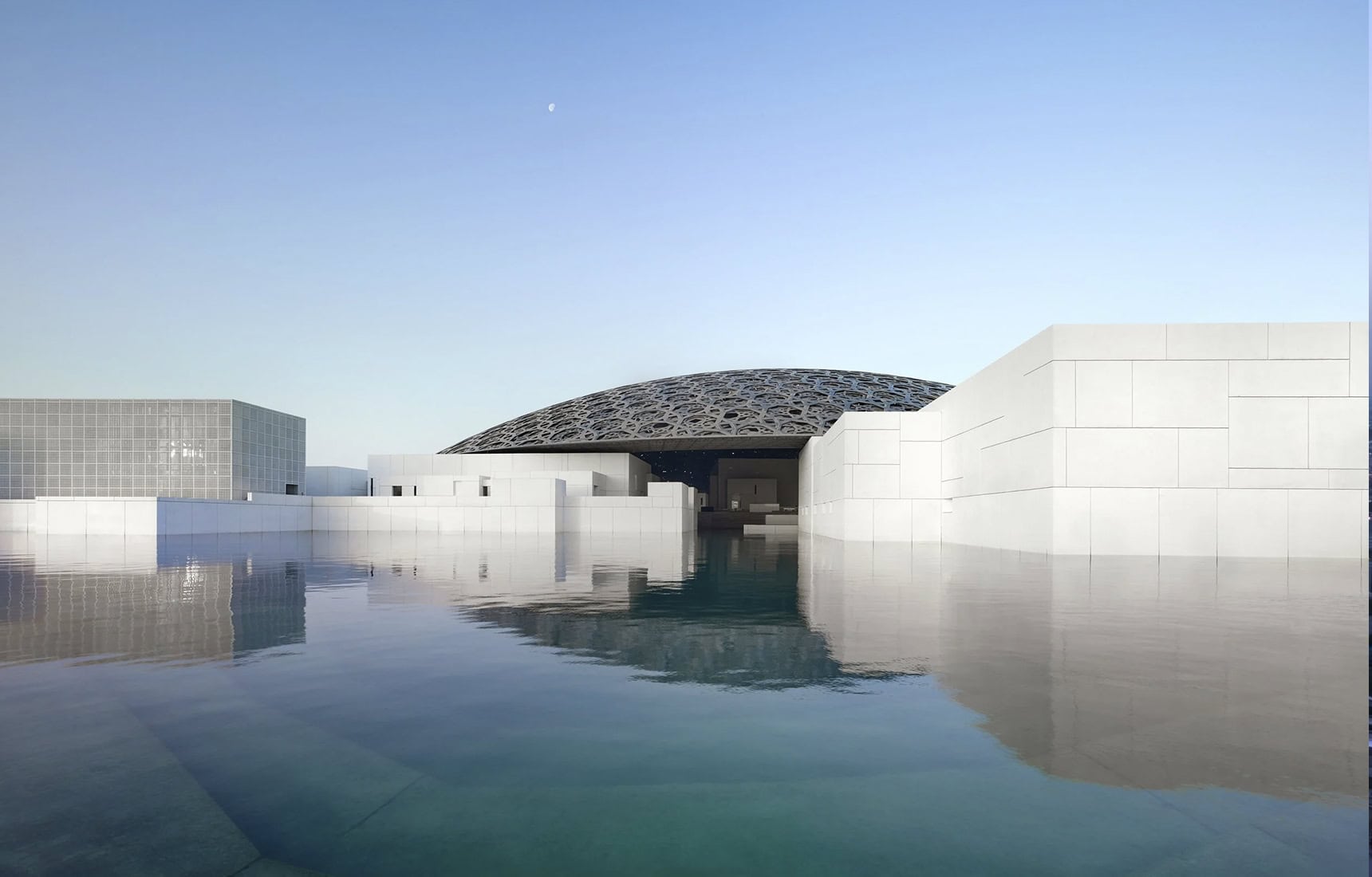
Rising from the waters of Saadiyat Island like a silver mirage, Jean Nouvel’s museum manages to feel monumental and weightless at once; a low white city gathered beneath a vast floating dome, dissolving into a shifting rain of light. Since it opened in November 2017, it has become the defining cultural landmark of the UAE, and one of the most affecting works of contemporary architecture anywhere — the anchor for a Saadiyat Cultural District that has since grown to include Mecanoo’s Natural History Museum and Frank Gehry’s Guggenheim Abu Dhabi.
The original story of this building is usually told in the language of atmosphere: reflection, shadow, silence, light. All of that is true, and I will come to it because it is genuinely moving. But underneath the poetry are two facts that make Louvre Abu Dhabi far more remarkable than “a beautiful museum by the sea.” The first is what it took to build the dome. The second is what it took to earn the name above the door. Together, they tell you something no render can: that this is a building where extraordinary ambition was made physical.

The name on the door
Start with the fact almost every account leaves out, because it reframes everything else.
Abu Dhabi did not simply build a museum and call it a Louvre. It acquired the right to the name through a landmark intergovernmental agreement between France and the UAE, signed in 2007, granting the use of the musée du Louvre name for 30 years and 6 months, along with loans from French collections, rotating exhibitions, and the curatorial expertise of a consortium of French museums.
The numbers are staggering and worth stating plainly. The agreement was reported to be worth around $1.3 billion to France in total. Of that, roughly $520 million was for the name alone; the licence to call this building “Louvre”, with a substantial first instalment paid within weeks of signing. The building itself cost a further $650 million or so to construct.
Look at what those numbers actually represent. A young nation, only decades old, decided that the fastest way to become a serious cultural capital was not to imitate one but to partner with the oldest and greatest museum on earth, on equal terms, and pay handsomely for the privilege. That is strategy, and a confident one. The name on the door is not borrowed glamour. It is a statement of intent, purchased outright, that Abu Dhabi intended to take its place in the world of art and ideas, and Nouvel’s architecture had to be worthy of that intent. Remarkably, it is.

The dome: an Eiffel Tower that floats
Now the building, and the single most audacious thing about it.
The dome measures 180 metres across and weighs roughly 7,500 tonnes, very nearly the weight of the Eiffel Tower’s metal structure. And yet it appears to hover above the museum-city, unsupported, as though it had drifted in off the Gulf and settled there. That illusion is the whole achievement, and it is not an illusion of styling but of structure.
The entire mass rests on just four permanent piers, set roughly 110 metres apart and hidden from view inside the buildings below, so that from almost every angle the dome appears to touch nothing at all. Engineered with Buro Happold, it is one of the most ambitious pieces of structural design in any recent building, a canopy the weight of a landmark, made to look as light as a parasol. To stand beneath it and know that this much steel is balanced on four points you cannot see is a genuinely uncanny experience.
That is the engineering. The poetry lives in its skin.

The rain of light
The dome’s name, and its magic, come from what it does to sunlight.
Nouvel took his cue from the overlapping palm fronds of an oasis and the layered canopies of the traditional Arab medina: the age-old desert method of shading a space not with a solid roof but with a filter that breaks the sun into dapples. He then rebuilt that idea as ruthless geometry. The dome is made of eight superimposed layers, four of stainless steel on the outside, four of aluminium within, perforated with a pattern of 7,850 stars, each repeated at different sizes and angles across the layers.
As the sun moves, light threads through those thousands of misaligned openings and falls to the ground as the “rain of light”, a slow, shifting constellation of beams that drifts across the white walls, the stone walkways and the water all day long, never twice the same. In the early morning and late afternoon, it turns almost devotional; the museum stops feeling like an institution and starts feeling like a place of contemplation.
This is the rare building where the architecture refuses to disappear behind the art. Most galleries are designed as neutral white boxes; here, shadow becomes a material and sunlight becomes texture, and the building itself is a living installation you walk through on the way to the paintings.

A medina of the world
The genius of the plan is that the architecture and the idea of the museum are the same idea.
Beneath the dome, Nouvel arranged the museum not as one monolithic building but as a cluster of 55 white volumes: a low, walkable settlement of some 23 galleries, plazas and passageways, laid out like a contemporary medina and surrounded on every side by seawater, so the boundary between building and Gulf dissolves. You move through it the way you move through an old quarter: narrow passages opening into bright squares, glimpses of water framed between walls, moments of pause between rooms.
And what that museum-city contains matches its form. Louvre Abu Dhabi was conceived as a universal museum, the first of its kind in the Arab world, hanging works from every civilisation side by side and in chronological order, so that a Chinese bronze, a European Madonna and an Islamic manuscript from the same century share a room and speak to one another. Where the Paris Louvre tells the story of Western art largely, this one tells the story of humanity as a single connected conversation. The “medina of the world” is not a metaphor laid over the building. It is the building’s whole argument, in stone and light.

Frequently asked questions
Who designed Louvre Abu Dhabi?
The French, Pritzker Prize-winning architect Jean Nouvel (Ateliers Jean Nouvel), with the dome engineered by Buro Happold. It opened on Saadiyat Island in November 2017.
How big and heavy is the dome?
It is about 180 metres in diameter and weighs roughly 7,500 tonnes, close to the weight of the Eiffel Tower, yet rests on just four hidden piers so that it appears to float.
What is the “rain of light”?
An effect created by the dome’s eight layers (four stainless steel, four aluminium) perforated with 7,850 stars. Sunlight filters through the misaligned openings and falls as thousands of shifting beams that move across the museum all day.
Why is it called “Louvre”?
Under a 2007 agreement between France and the UAE, Abu Dhabi acquired the right to use the Louvre name for thirty years and six months, along with loans and expertise from French museums; a deal worth around $1.3 billion, of which roughly $520 million was for the name alone.
What kind of museum is it?
A universal museum, the first in the Arab world, showing art from every civilisation chronologically and side by side, rather than separated by culture.

Final thoughts
Nearly a decade after it opened, Louvre Abu Dhabi still feels visionary, and it is worth being clear about why. In an age when so much architecture competes through sheer spectacle, this building wins through emotional intelligence — it understands how light shapes mood, how silence lifts a space, and how a dome can turn a walk to a gallery into something close to reverence.
But it is more than atmosphere. It is the physical form of a decision: a nation choosing, deliberately and at enormous cost, to make culture central to its future, and hiring one of the world’s great architects to make that choice beautiful. As evening falls and the dome begins to glow above the water, casting its last thin rain of light across the sea, Louvre Abu Dhabi feels less like a building than a promise being kept — a floating world of light and shadow at the edge of the Gulf, and the surest sign yet of what this stretch of coast intends to become.


Leave a Reply