
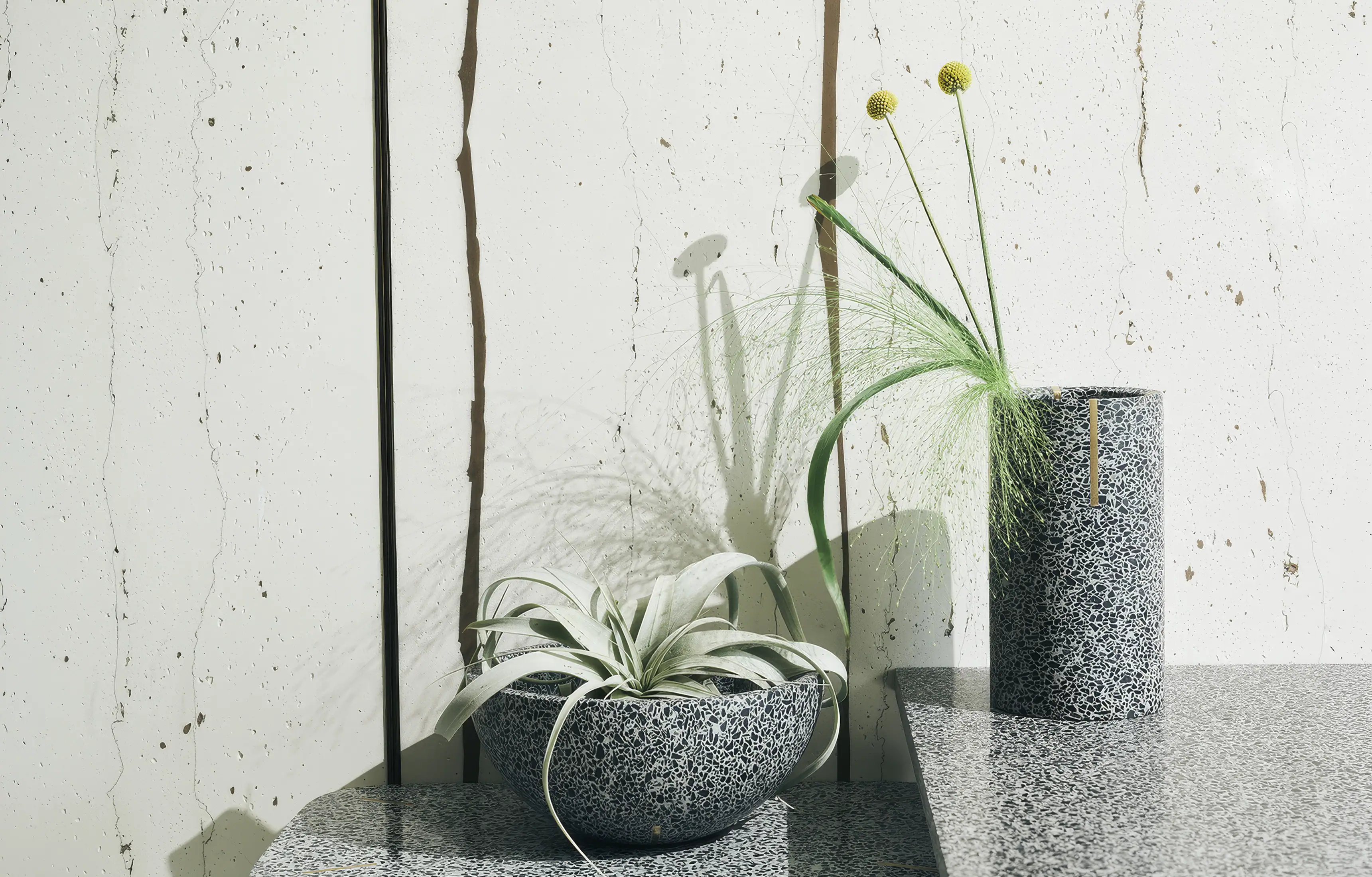
Before Joyce Wang designed a single hotel lobby, she studied architecture alongside materials science at MIT. Flint, the terrazzo object collection her studio unveiled at London Design Festival in September 2018, is the clearest evidence of what that combination produces: a material normally poured into floors and worktops, cut and polished instead into a vase, a paperweight, a set of tables a reader can actually pick up.
Joyce Wang and the terrazzo collection that started as an object study
Joyce Wang had already spent seven years designing some of Hong Kong’s most talked-about interiors before she gave a single material top billing in a collection of its own. Terrazzo had appeared throughout her studio’s hospitality projects since its founding in 2011, always as a surface: a floor, a bar front, a backdrop for something else. In September 2018, at London Design Festival, Joyce Wang Studio unveiled Flint, nine limited-edition terrazzo objects, made with Italian artisans, that treated the material as the subject rather than the setting.
The distinction matters more than it sounds. Wang’s academic training was not purely in design. She studied architecture and materials science together at MIT before a master’s at the Royal College of Art, and Flint reads like the direct output of that dual education: a designer who thinks about a material’s internal structure with the same seriousness most designers reserve for a floor plan.

The architect who trained as a materials scientist first
Wang grew up in a traditionally-minded Hong Kong family and has said her ambition to become an architect took hold after encountering Norman Foster’s HSBC building, an experience of the city’s built environment specific enough to shape a career. She went on to study architecture and materials science at MIT, followed by a master’s degree at the Royal College of Art and a year at Delft University of Technology. She founded Joyce Wang Studio in 2011, working across London and Hong Kong from the start.
Her early commissions established the register the studio has kept since. The Hollywood Roosevelt Hotel in Los Angeles, completed in 2011 after two years of work, was covered by the South China Morning Post as evidence she belonged on a list of rising designers. AMMO, a restaurant in Hong Kong, was her first major project in the city. Mott 32, also in Hong Kong, was named World’s Best Interior of 2014 at the INSIDE World Festival of Interiors. In 2015 she designed a crystal chandelier for Swarovski that debuted at Art Basel Hong Kong, and her practice has since extended into residential work for the Mandarin Oriental Hotel Group and the club and spa at the Equinox Hotel in New York. By 2018, the year Flint launched, she was shortlisted for Emerging Interior Designer of the Year at the Dezeen Awards.

Seven years of using terrazzo before finally naming it
Terrazzo had been a working material in Wang’s studio since it opened. She has described the appeal of the material in terms that read as much like a thesis as a design brief: terrazzo represents luxury moving, in her words, from the aspirational to the fathomable, from hierarchical to democratic. It is a material built from fragments rather than a single precious block, and rewards close attention rather than distant admiration.
That is also, in Wang’s own account, the difference between terrazzo and the homogeneous finishes that dominate contemporary interiors. She has compared encountering terrazzo up close to archaeology: a surface that reveals more the closer a viewer gets to it, in contrast to a plastic finish that looks identical from every distance. Flint is the first collection in which that observation became the entire premise, rather than a description of a floor a guest might walk across without noticing.

A material that began as an economy measure
Wang’s description of terrazzo as democratic rather than hierarchical is not just a personal reading of the material. It is close to how terrazzo actually began. The technique traces to sixteenth-century Venice, where mosaic and stoneworkers found themselves with piles of leftover marble chips, offcuts too small to use in the palazzi and churches they were paving. Rather than discard them, they set the fragments in mortar to floor terraces around their own modest living quarters, a frugal solution that gave the material its name. The craft became formal enough that in 1583 the Venetian Council of Ten granted its practitioners, the arte dei terazzeri, the right to establish their own professional school. What later became a byword for grand hotel lobbies and civic buildings started as a way of not wasting stone.
That backstory sharpens what Flint is actually doing. Wang has not taken a luxury material down a notch by casting it as objects; she has taken a material invented specifically to make use of what a quarry would otherwise throw away and put it, five centuries on, into a context where each fragment is visible enough to be appreciated on its own terms.

Nine objects, three colours
Flint comprises nine limited-edition pieces: three tables, a vase, two bowls, a small dish, an hourglass and a sphere. The core range is finished in charcoal, with a smaller set of vessels, including an ice-cream bowl, produced in limited-edition rose and sage colourways. Every piece uses domed forms, tapered silhouettes and bevelled edges rather than the rectilinear blocks terrazzo is usually cut into, and several pieces in the range are designed to stack or interchange with one another.
The studio’s signature brass detailing runs through the collection at every joint, appearing, in the studio’s own description, almost stapled into the terrazzo, in stroke, cross and ring motifs. It is a small piece of engineering doing double duty: brass reinforces a joint in a brittle material and reads, at the same time, as jewellery on an object that is otherwise entirely stone.

How a floor material becomes a paperweight
Flint was made in partnership with an established Italian terrazzo manufacturer, working from custom-mixed terrazzo blocks. Wang’s studio prototyped the forms in Hong Kong first, testing tools and techniques before the designs went to Italy for production. Each finished block is cut into slabs, shaped using stencils, bevelled and hand polished. A piece such as the Flint sphere, a 14 centimetre terrazzo paperweight sold with a matching dish or a brass ring, takes ten to twelve weeks to produce, and because the process is done by hand, no two pieces come out identical. The studio’s own account of the collection describes the manufacturer as fourth-generation; press coverage from the 2018 launch described it as third-generation. Either way, the collection was built on an existing, specialist Italian workshop rather than a factory contracted for the occasion.

The five ideas the studio designs against
Wang has organised her studio’s approach around five stated values, and Flint reads as a direct expression of at least two of them. The first, which she calls Learning and Discovery, is stated as a working rule rather than an aspiration: the studio begins every project believing it will be the best it has done, which for an object collection meant treating a familiar material as if it had not been fully explored yet. The second, Craft and Industry, is closer to a personal fascination than a slogan. Wang has said she finds “the possibilities for materials, and the hands and machines that manipulate them, endlessly compelling,” a description that applies as directly to a terrazzo sphere polished by hand in Italy as to a hotel lobby.
The remaining three values, Time and Place, Energy and Intimacy, and Care and Courage, describe how the studio researches a project’s cultural context, designs the emotional pace of a space, and holds itself accountable to the people it works with. They govern hotels and restaurants more visibly than a tabletop object, but they explain why a designer whose day job is choreographing entire buildings chose to spend part of 2018 on a paperweight. The scale changed. The standard did not.

Ice cream from a terrazzo bowl
Flint launched at Joyce Wang’s own London office, open to visitors for the duration of the festival rather than shown at a separate stand. On two afternoons that week, the studio ran what it called a Travelling Terrazzo cart, serving ice cream in the collection’s rose and sage bowls. It is a detail easy to miss in a list of materials and dimensions, and it makes the point better than a press description could: a material normally associated with hotel bathroom floors was, for two afternoons in September 2018, something visitors ate ice cream out of. Pieces from the finished collection are now sold through Artemest and The Artling.

Frequently asked questions
What is the Flint collection by Joyce Wang Studio?
Flint is a collection of nine limited-edition terrazzo objects, including tables, a vase, bowls, a small dish, an hourglass and a sphere, made by Joyce Wang Studio with an Italian terrazzo manufacturer and unveiled at London Design Festival in September 2018.
Who is Joyce Wang?
Joyce Wang is an interior designer who studied architecture and materials science at MIT and holds a master’s degree from the Royal College of Art. She founded Joyce Wang Studio in 2011, working across London and Hong Kong, and has designed hospitality projects including Mott 32 and AMMO in Hong Kong, the Hollywood Roosevelt Hotel, and the club and spa at the Equinox Hotel in New York.
What colours is Flint available in?
The core collection is finished in charcoal. A smaller set of vessels, including an ice-cream bowl, was produced in limited-edition rose and sage colourways.
Is the Flint collection still available to buy?
Yes. Pieces from the collection, including the Flint sphere, are sold through Artemest and The Artling.
Why did Joyce Wang Studio choose terrazzo for its first object collection?
The studio had used terrazzo throughout its hospitality interiors since 2011. Joyce Wang has described the material as rewarding close inspection in a way that resembles archaeology, unlike the homogeneous, distance-flattering finishes common in contemporary interiors, which made it a natural candidate for objects designed to be handled rather than simply viewed.
How is each Flint piece made?
Custom terrazzo blocks are cut into slabs, shaped using stencils, bevelled and hand polished by an Italian terrazzo manufacturer, after prototyping in Hong Kong. Because the process is done by hand, each finished piece has slight natural variation.

Final thoughts
Most designers who work with terrazzo treat it as a background decision: a floor chosen to sit quietly under furniture that is meant to be noticed. Flint is what happens when the background gets studied by someone trained to look at a material’s structure before its surface. Nine objects and three colourways is a modest catalogue by the standards of a major furniture launch, and that restraint is the point. Joyce Wang Studio did not need to reinvent terrazzo to make Flint interesting. It needed only to look at a material it had already been specifying for seven years and ask what happened if someone finally held it in their hands.


Leave a Reply