ART & CULTURE · SYDNEY
Reading time: 9 minLee Broom took a working underground car park beneath Space Furniture’s Sydney showroom and built an 18th-century pleasure garden inside it, complete with gravel paths, a maze of hidden rooms and a human-scale chess set staged with his own lighting. Park Life ran for the British designer’s largest presentation to that point, and it belongs to a pattern in his work that nobody had previously joined up: a habit of staging his most theatrical shows in spaces that were never meant to hold one.
Park Life opened beneath Space Furniture’s flagship showroom in Alexandria, Sydney, on 14 March 2019 and ran until 22 March, occupying 4,000 square feet of the building’s underground car park. Lee Broom, the British lighting and furniture designer, built the installation in collaboration with Space Furniture as the centrepiece of an Asia and Australia tour that also took him to Singapore, Melbourne and Brisbane that same month, timed around Singapore Design Week and Melbourne Design Week.
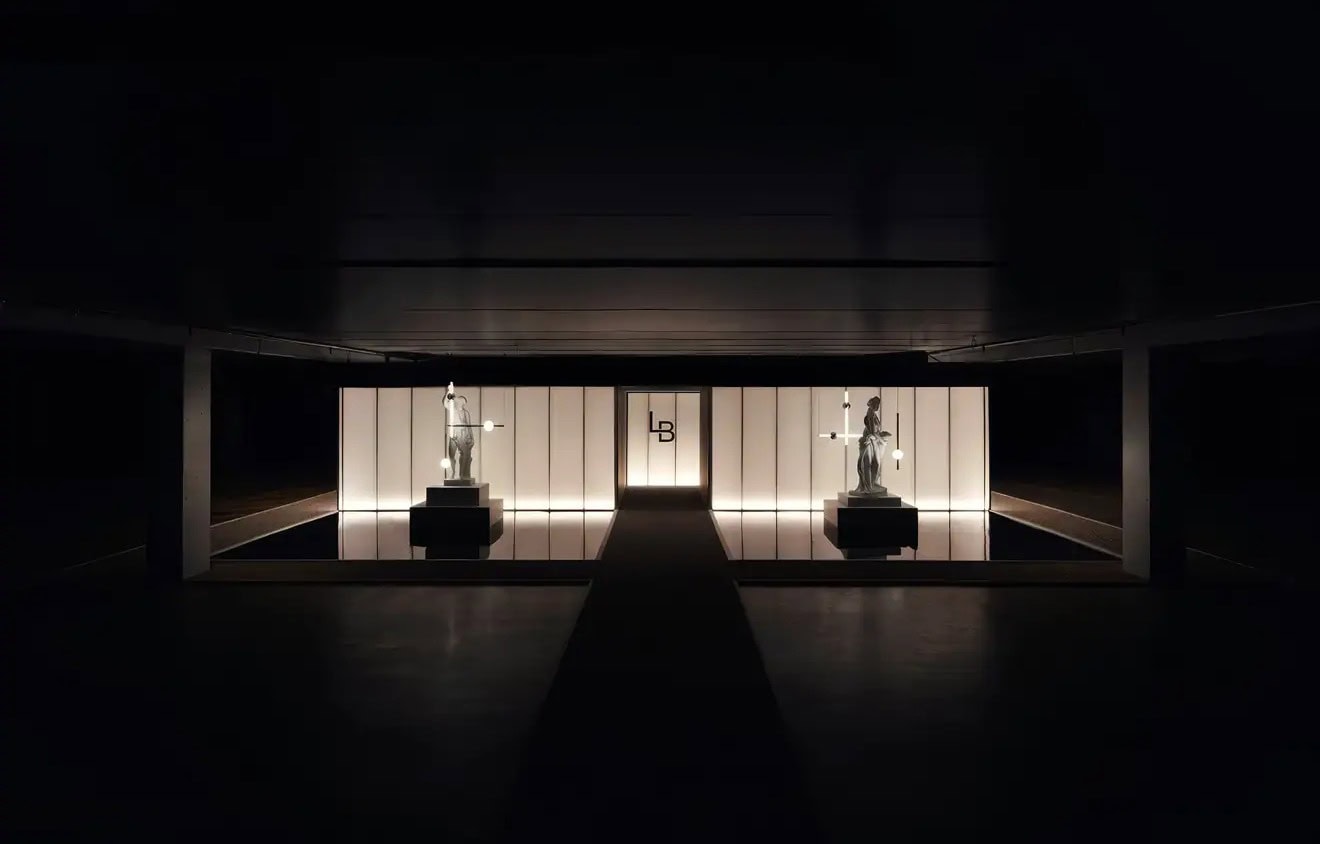
The idea was simple to state and considerably harder to build: take a car park and put an 18th-century pleasure garden inside it. Visitors descended from the showroom above into raw concrete, then walked into a white-walled maze of interlinked rooms, each one staged as a tableau for a different part of Broom’s collection. Sixteen separate vignettes ran off the central path, connected by hidden doors, so that the experience of moving through the show was itself part of the design.
Broom described the reasoning directly: “I took the urban surroundings of the car park and created a contemporary interpretation of a traditional 18th-century British pleasure garden instead.” That is the whole argument in one sentence, and the rest of Park Life is what it looks like to take it seriously rather than treat it as a curatorial wall text.
A maze built for getting lost, four floors under Alexandria
The transformation worked by contrast rather than concealment. Broom did not disguise the car park; he built a separate white structure inside it and let the raw concrete shell stay visible around the edges, so the artificial garden read as something inserted into an industrial space rather than a space made to look like something else. A white polycarbonate box, lit from within, formed the maze’s outer walls. Inside it, a floor of pale gravel led visitors along a winding path, flanked at the entrance by classical statues set on squares of polished black acrylic, which behaved like still water and doubled every figure standing on them.

The maze’s central chamber was staged as an oversized chess set: a chequered floor of black and white pavers scaled up to human size, with giant spherical pendant lights standing in for the pieces, half in polished gold and half in black. Elsewhere, a stretched white fabric ceiling diffused the light overhead, plinths and urns marked turning points in the route, and a light mist drifted through parts of the maze while a contemporary arrangement of Vivaldi’s Four Seasons played, timing the show to a score rather than leaving it silent. None of this needed to be there for the lighting to be seen. All of it was there because Broom was staging an experience, not a product display.

The route from theatre school to a car park garden
Broom’s own background explains why a lighting show comes with a score and a maze rather than a plinth and a price list. He worked as a child actor between the ages of six and seventeen, trained at theatre school, and spent time with the Royal Shakespeare Company before he ever designed an object. At seventeen he won a fashion competition judged by Vivienne Westwood, who invited him to her studio for what was meant to be a couple of days and became a ten-month apprenticeship. He went on to study fashion at Central Saint Martins, the London art school that has produced a disproportionate share of Britain’s best-known designers, before moving into interiors and then into furniture and lighting.

He founded his own studio in London in 2007, starting with interior schemes for bars and restaurants before developing the production pieces that built his reputation. That route, through theatre and fashion rather than industrial design, is the reason his shows behave like performances with a running time rather than static showroom sets. Park Life is a lighting exhibition with a plot: an entrance, a route that deliberately disorientates, a series of set-piece rooms, and a resolution. It is staged the way a costume designer might stage a scene change, which is a different discipline from the one most lighting brands bring to a trade presentation.
The same narrative instinct outlasted the show itself. Broom’s later work has continued to build collections around a story rather than a material or a finish, from the mythological references running through his Alchemist collection to the site-specific installations that followed it. Park Life is best read as an early, large-scale demonstration of a method Broom has kept using ever since: give the lighting a world to belong to, and the world does half the selling.

A collection cast as pleasure-garden furniture
Every product in Park Life was given a role in the garden rather than simply displayed. Lens Flair, the pendant Broom designed around telescopic lenses and the way they bend light through horizontal and vertical refraction, became the chess pieces standing on the chequered floor, clustered into what Broom has called a “celestial installation” when grouped rather than hung singly. Fulcrum, the pendant built around an off-centre spherical joint that divides an otherwise cylindrical body of steel and glass, was staged around the garden’s fountain tableau, its cascading, uneven arrangement doing the work that falling water does in an actual pleasure garden. Orion’s tube and globe lights ran through other rooms as glittering, star-field clusters, and pieces including the Drunken side table, Podium vases and split mirrors filled out the vignettes as garden furniture rather than showroom stock.
The most significant debut belonged to Eclipse, the light built around mirror-polished discs and opal acrylic that interact, dissect and partly obscure one another, described by Broom as celestial in both name and inspiration. Park Life marked the first time Eclipse appeared in polished gold, across its full range of pendant, chandelier and table lamp, having previously only been available in polished chrome. Broom had introduced Eclipse a year earlier, in that original chrome finish, at Observatory, his celestial-themed lighting show staged inside a Grade II listed gallery in Milan’s Brera district during Milan Design Week 2018.

What “pleasure garden” actually meant in the 18th century
Broom’s reference point was real rather than decorative. London’s 18th-century pleasure gardens, chiefly Vauxhall Gardens and its rival Ranelagh, were the era’s equivalent of a season-long design and entertainment festival, and the comparison holds up better than a passing mood-board credit usually does. Vauxhall, leased and developed by the entrepreneur Jonathan Tyers from the late 1720s, covered twelve acres in Lambeth and was lit at dusk by thousands of glass oil lamps hung through the trees, lit in a synchronised operation fast enough that a visiting Prussian observer wrote the gardens went from dark to “as light as a noon day” in under two minutes. Orchestras played new work by Handel from an elaborate bandstand, supper boxes were decorated with large-scale paintings, and masquerade balls drew a paying public that ranged from minor royalty to city merchants.

Ranelagh, which opened in the 1740s as Vauxhall’s more expensive, more exclusive rival, built its identity around a single enormous rotunda for music and promenading rather than Vauxhall’s spread of walks and follies; an eight-year-old Mozart performed there in 1764. Both gardens depended on the same mechanics Broom borrowed for Sydney: a route that visitors were meant to walk and discover rather than survey from one vantage point, illumination used as spectacle rather than utility, and a deliberate mixing of formal garden structure with theatrical incident. A hedge maze at either garden was not a horticultural feature so much as a piece of stagecraft, built to produce the sensation of being lost inside a controlled, decorated space. That is precisely the mechanism Broom rebuilt in a Sydney car park two and a half centuries later, with polycarbonate and LED in place of clipped yew and oil lamps.

A designer who keeps choosing the space nobody else would
Park Life was widely reported as Broom’s largest installation to date, and most coverage stopped at that superlative. Read alongside the rest of his exhibition history, the car park is not an isolated stunt but the latest entry in a consistent pattern: Broom repeatedly chooses working infrastructure over conventional gallery or showroom space for his most ambitious shows, and builds each concept around what that specific infrastructure already is.
In 2016, to mark his studio’s showing of the Optical collection during Milan Design Week, he fitted out the cargo hold of a delivery van as a miniature grey-toned palazzo and drove it between the week’s design districts, from Zona Tortona to Ventura Lambrate, rather than renting a single fixed stand. In April 2017, to mark his studio’s tenth anniversary, he took over a former goods warehouse platform inside Milan’s Central Station, Ventura Centrale, and installed a slow-revolving white carousel beneath its original vaulted brick, with a Carrara marble grandfather clock as the show’s still centre. Two years later in Sydney, the found space was a car park rather than a railway platform or a delivery van, but the method was identical: locate a piece of infrastructure that was never designed to hold an audience, and build a complete, theatrical world inside its existing shell rather than erasing it. Space Furniture’s own Sydney building supports the same instinct at a smaller scale. The showroom above the car park, designed by the architecture practice Woods Bagot, opened in 2004 and is credited locally with beginning the conversion of Alexandria from an industrial district into the design and hospitality precinct it is today. Broom’s garden, one floor further down, repeated that same industrial-to-cultural conversion in miniature, and in a fortnight rather than a decade and a half.

Final thoughts
Park Life reads, at first, like a straightforward piece of spectacle: a designer known for theatre builds a garden where nobody expects one, and the photographs do the rest. Looked at against the whole of Broom’s exhibition history, it is something more specific. He has now built major presentations inside a delivery van, a disused railway platform and a working car park, choosing infrastructure that already has a function and asking what happens when a pleasure garden is dropped inside it rather than built from scratch. Sydney’s car park did not need to become a garden. Broom simply proved that it could, using the same mechanics Vauxhall and Ranelagh used two hundred and fifty years earlier: a route, a maze, and light used to turn a familiar structure into somewhere worth getting lost in.
What was Lee Broom’s Park Life?
Park Life was a lighting and furniture exhibition designed by British designer Lee Broom, staged as an 18th-century pleasure garden built inside the underground car park beneath Space Furniture’s Sydney showroom.
Where and when did Park Life take place?
It ran from 14 to 22 March 2019 in the car park beneath Space Furniture’s flagship showroom at 84 O’Riordan Street, Alexandria, Sydney, occupying 4,000 square feet.
Who designed Park Life?
Lee Broom designed the installation in collaboration with Space Furniture, the Australian furniture retailer that hosted the show in its Sydney building.
What inspired the pleasure garden concept?
Broom drew on 18th-century British pleasure gardens such as Vauxhall Gardens and Ranelagh Gardens, historic venues known for mazes, illuminated walks and staged spectacle, describing his aim as a sense of “escapism, amusement and drama.”
Which collections were shown at Park Life?
The exhibition featured Broom’s Lens Flair pendants, Fulcrum pendants, Orion lights, and the debut of the Eclipse pendant, chandelier and table lamp in a new polished gold finish, alongside furniture and accessory pieces staged throughout the maze.
Was Park Life part of a wider tour?
Yes. It was the centrepiece of Broom’s Asia and Australia tour that month, which also included design talks in Singapore, Melbourne and Brisbane, timed around Singapore Design Week and Melbourne Design Week.
Has Lee Broom staged shows in unconventional spaces before?
Yes. He fitted a delivery van as a mobile showroom for Milan Design Week in 2016 and took over a former railway goods platform at Milan’s Ventura Centrale for his studio’s tenth-anniversary show in 2017, before building Park Life inside a working car park in 2019.

Project Credits
Read next
NOMAD Abu Dhabi returns to Paul Andreu's Terminal 1 from 18 to 22 November 2026, handing four private departure gates to A2Z, Nilufar, Gallery FUMI and Galerie Gastou, and extending…
Abu Dhabi


