
ART & CULTURE · MILAN
Reading time: 10 minLee Broom named four lighting collections after a solar eclipse, a constellation, the aurora borealis and the pull of the moon, then built each one so the physics of the phenomenon was legible in the object. Observatory opened in a Grade II listed gallery in Milan’s Brera district in April 2018, the first of three staged unveilings that carried the collection to New York and London before the year was out. One of its four families, Eclipse, went on to become one of Broom’s longest-running designs.
Four lighting collections, one governing idea, and a building old enough to have Grade II listing of its own. That was Lee Broom’s Observatory, unveiled in a 250 square metre gallery at Via Lovanio 6 in Milan’s Brera Design District during Milan Design Week 2018, held from 17 to 22 April that year. The British designer used the show to introduce Eclipse, Orion, Aurora and Tidal, four families of pendant lights, chandeliers, table lamps and surface lights, each one taking its form and its name from a real astronomical event rather than a decorative motif borrowed from the night sky.
The distinction matters, because it is the argument the whole collection makes. Eclipse works because two discs actually overlap and occlude each other, the way the moon occludes the sun. Tidal works because two hemispheres are pulled apart to expose the light between them, the way gravity pulls a tide. Broom had spent two years developing the custom LED systems that let each piece behave this way, and Observatory was where that two-year programme became visible. It was also the first of three staged unveilings across the year, and the point at which Eclipse, in particular, began a run that would carry it far beyond Milan.

Four collections, four astronomical events
Eclipse takes the form of mirror-polished stainless steel discs intersecting with illuminated opal acrylic discs, offered as a pendant, a chandelier, a table lamp and a surface light. The steel disc sits fractionally off the acrylic one, so that from most angles it appears to be sliding across the lit surface behind it, exactly as the moon appears to slide across the sun during an eclipse. The light itself is soft and diffused rather than a hard point source, produced by the acrylic disc rather than a visible bulb.
Orion is built from two complementary units rather than one fixed form. One pairs a polished tube with an opaque sphere; the other reverses the arrangement, pairing an opaque tube with an illuminated sphere. Both suspend horizontally or vertically, and because the two units are designed to be mixed and multiplied, a cluster of them reads as a field of points at different heights and angles, the way stars in a constellation sit at different distances from an observer on the ground while appearing to share a single plane. Broom’s own language for the effect, a “constellation” built from the units, is precise rather than decorative.

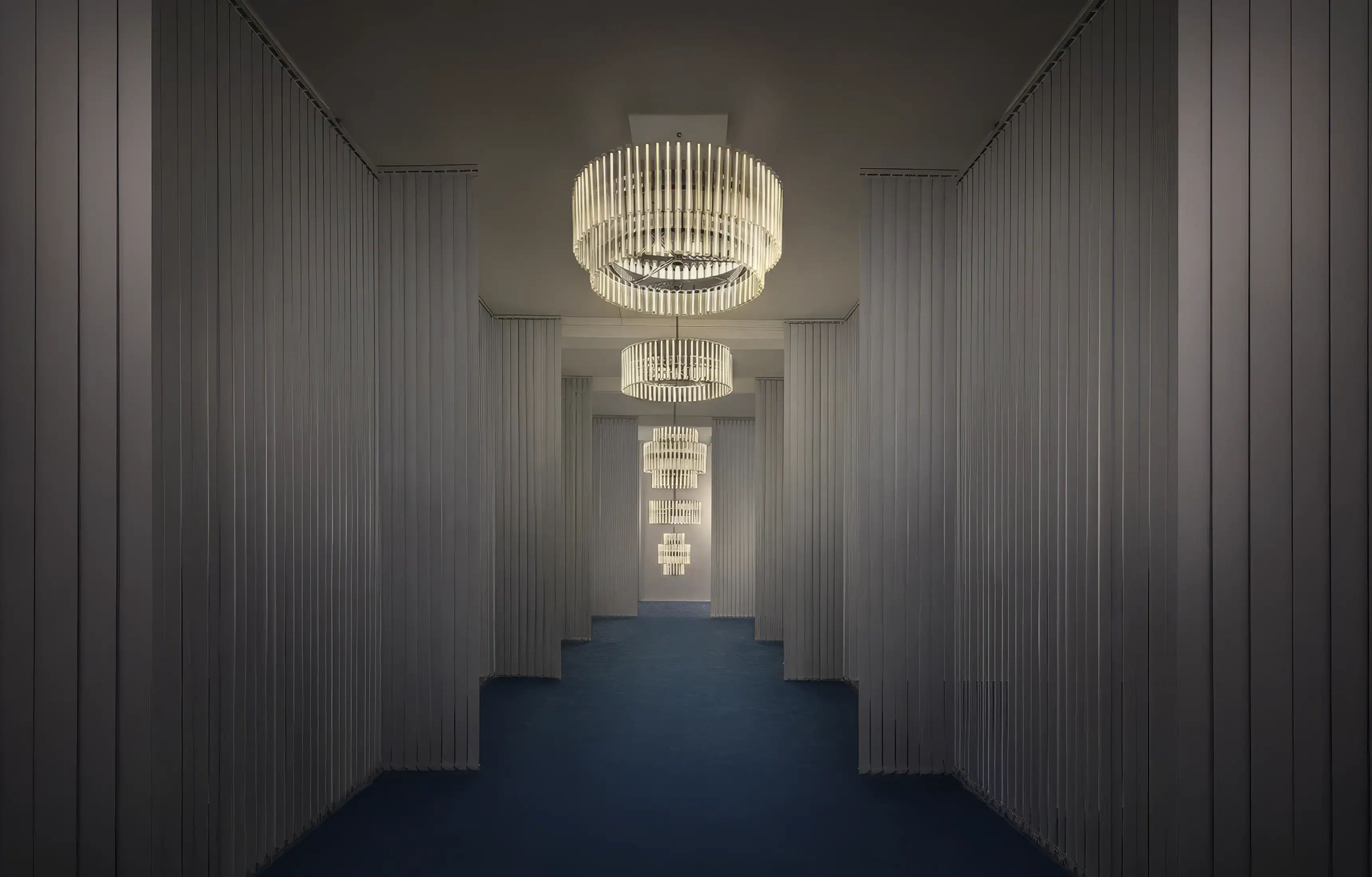
Aurora is a scalable chandelier available from 40 centimetres up to 1.5 metres in diameter, built from concentric rings of hand-blown reeded, or fluted, glass with custom linear LED lighting run through each ring. The reeding catches and scatters the light along the length of the glass rather than letting it sit as a single glow, which is what gives the finished piece its layered, shifting quality, the closest a static object gets to the aurora borealis’s moving curtains of colour.
Tidal is a table lamp built from a polished chrome sphere split into two hemispheres, balanced on top of one another rather than fused, with light emerging from the narrow gap between them and reflecting off the surrounding chrome. The two halves read as though an unseen force has prised them apart just far enough to let light through, which is the same mechanism, however different the scale, by which the moon’s gravity pulls the sea into a high and a low tide.
None of the four collections relies on a visible bulb to carry its effect. Orion’s tube and sphere units, for example, are built from opal acrylic and steel finished in polished gold or gunmetal, run on a 16.8 watt LED at a warm 2700 kelvin, and are supplied on a five metre adjustable cable so a single pair can be hung at markedly different heights within the same room. Broom’s studio spent two years developing the bespoke LED systems shared across all four collections before Observatory opened, which is why the light in each piece behaves the way its name promises rather than simply illuminating a sculptural shell.

A Grade II listed gallery in Brera
Milan’s Brera Design District has hosted Broom’s showings before, and Observatory’s setting was itself part of the argument. The gallery at Via Lovanio 6 is a Grade II listed building, meaning its structure and character are protected under Italian heritage law, and Broom filled its 250 square metres with contemporary, technically engineered lighting rather than adapting the collection to suit a period interior. The contrast, historic fabric against custom LED systems developed over two years, is consistent with how Broom has staged shows before and since: he tends to choose spaces with an existing identity and let the collection argue against it rather than defer to it.
Milan Design Week itself ran across the same dates, 17 to 22 April 2018, drawing the trade and press audience that made Observatory’s timing deliberate. Salone del Mobile is where a European lighting brand makes its year’s first and largest statement, and Broom used the platform accordingly, describing the resulting body of work as his most progressive to date.
Brera has been Milan’s gallery and antiques quarter since long before Fuorisalone events made design week an annual fixture there, and its narrow streets are lined with exactly the kind of protected historic buildings that Via Lovanio 6 belongs to. Showing a technically driven, LED-engineered collection inside that setting is a choice rather than a default. Amid a design week offering hundreds of exhibition halls to rent, Broom chose four centuries of Milanese building fabric as the backdrop for four collections built on twenty-first century light sources.

The designer behind the telescope
Lee Broom’s route into lighting did not start in a workshop. He worked as a child actor between the ages of six and seventeen and trained at theatre school, then won a fashion design competition at seventeen that was judged by Vivienne Westwood, who invited him into her studio for what became a ten month apprenticeship. He went on to study fashion design at Central Saint Martins before moving into interiors and, eventually, into the furniture and lighting that built his reputation. He founded his own studio in London in 2007, and by the time Observatory opened in April 2018 that studio was eleven years old, entering what Broom’s own team described as its second decade. The year before, in April 2017, Broom marked the studio’s actual tenth anniversary with Time Machine, a carousel retrospective staged inside a vault sealed for three decades at Milan’s Ventura Centrale, built around an exclusive handcrafted Carrara marble grandfather clock. Read the full story of Time Machine.
That background explains a habit that recurs across his exhibitions: a preference for staging lighting as though it were a collection with a season, rather than a product line with a catalogue number. Observatory’s structure, four named collections unveiled together under one conceptual umbrella, has more in common with a fashion show’s line-up than with a typical lighting brand’s product launch, and that is not incidental.
Broom has described his own process as starting with sketching and a personal library of reference images built up with his studio over years, and a preference for materials with what he calls “an essence of classicism” reinterpreted through new technology. Observatory is that philosophy applied literally: mirror-polished steel, hand-blown glass and chrome, the sort of materials a nineteenth-century instrument maker might have reached for, carrying LED systems that did not exist when those materials were first put to decorative use.

Immediate purchase, borrowed from the runway
Observatory’s pieces were available to buy, in store and online, from the moment the Milan presentation opened, rather than following the months-long gap between a design week unveiling and a retail release that is standard practice in the lighting industry. Coverage at the time noted this as a break from typical design week timing, borrowed from the fashion industry’s practice of selling a look the moment it leaves the runway.
That borrowing reads differently once Broom’s own career is taken into account. He is one of the few lighting designers working at this level who actually trained inside the fashion system, through a competition judged by Vivienne Westwood, an apprenticeship in her studio and a degree from Central Saint Martins, rather than picking up the industry’s see-now-buy-now model as an outside observer. Applying it to Observatory was not a marketing tactic imported from an adjacent business. It was Broom returning to the retail rhythm he had trained in before he ever designed a light.

A collection launched in three cities, not one showroom
Observatory was conceived from the outset as a staged rollout rather than a single unveiling. Milan, in April 2018, was the first of three planned appearances. The collection then travelled to New York for NYCxDesign in May 2018, and closed the year at London Design Festival, which that September ran from the 19th to the 23rd, each stop adding to what had been shown before. London’s leg introduced a new black finish for Orion and added a fifth collection, Lens Flair, built around telescopic lenses, to the celestial family Observatory had opened with. Reading Observatory only as a Milan story misses that structure: it was designed to unfold across a calendar year and three continents, with each city’s audience seeing a slightly larger version of the same idea, and with the pieces sold at every stop rather than held back for a later retail date.

Where Eclipse went next
Of the four collections Broom introduced at Observatory, Eclipse has had the longest life. It launched at Via Lovanio in polished chrome, part of a family that also included gunmetal, and stayed in that palette for almost a year. In March 2019, Broom took Eclipse to Sydney for Park Life, a pleasure garden he built inside the working underground car park beneath Space Furniture’s showroom in Alexandria, and gave the collection its first outing in polished gold, across the full pendant, chandelier and table lamp range. In a show built explicitly around eighteenth century opulence, gold was the material the moment called for, and Sydney is where Broom made that call in public.
The two shows sit almost a year and two hemispheres apart, but they are the same collection at two points in its life: introduced in a Grade II listed Milan gallery in 2018, then reintroduced in a new finish inside an Australian car park turned pleasure garden in 2019. Of the four collections that opened at Via Lovanio, Eclipse is the one whose story did not stop when Observatory’s third and final leg closed in London in September 2018. Read the full story of Park Life, including how Broom built an eighteenth century maze underground and why Eclipse’s gold debut mattered inside it.

Final thoughts
It would be easy to read Observatory as a design week product launch with an attractive name, four new lights unveiled in a handsome Milan building and available to buy the same day. That description is accurate and it is also the smaller story. The larger one is that Broom built four objects whose mechanics genuinely correspond to the astronomical events they are named for, staged the unveiling as the first of three chapters rather than a single event, and did it inside a rhythm, immediate availability, a phased rollout across cities, borrowed from the discipline he trained in before he ever designed a light.
Observatory’s real achievement is that none of its four ideas needed the others to work. Eclipse, Orion, Aurora and Tidal could each have stood as a collection on their own terms, and Eclipse has since proved exactly that, carrying on for years and crossing hemispheres in a new finish while the other three stayed closer to home. A Grade II listed gallery in Brera was simply where that journey started.

What was Lee Broom’s Observatory?
Observatory was a lighting exhibition by British designer Lee Broom, unveiled during Milan Design Week 2018, introducing four celestial-inspired collections: Eclipse, Orion, Aurora and Tidal.
Where and when did Observatory take place?
It opened in a Grade II listed 250 square metre gallery at Via Lovanio 6 in Milan’s Brera Design District, during Milan Design Week, which ran from 17 to 22 April 2018.
What are the four Observatory collections?
Eclipse uses intersecting mirror-polished steel and illuminated acrylic discs. Orion pairs modular tube and sphere units that suspend horizontally or vertically. Aurora is a scalable chandelier of hand-blown reeded glass rings. Tidal is a table lamp of two balanced polished chrome hemispheres.
Was Observatory shown anywhere after Milan?
Yes. It was the first of three planned appearances, travelling to New York for NYCxDesign in May 2018 and closing at London Design Festival that September, where a black Orion finish and a fifth collection, Lens Flair, were added.
Why were the pieces available to buy immediately?
Broom made Observatory’s pieces purchasable in store and online from the moment the Milan presentation opened, a departure from the usual gap between a design week unveiling and retail release, and one drawn from the fashion industry’s see-now-buy-now model.
What happened to the Eclipse collection after 2018?
Eclipse continued as one of Broom’s most enduring designs and was shown for the first time in a polished gold finish at Park Life, his 2019 installation beneath Space Furniture’s Sydney showroom.
Who is Lee Broom?
Lee Broom is a British lighting and furniture designer who founded his London studio in 2007, after training in fashion design at Central Saint Martins and apprenticing with Vivienne Westwood.


Leave a Reply