
Collectible Design · Miami
Reading time: 6 minIn 1983 she built a Parthenon from 25,000 books banned by Argentina’s junta, then had cranes tip it over so the crowd could carry them home. Forty-two years later, Marta Minujín filled a plaza in Miami with two glowing inflatables and invited passers-by to whisper their wishes into the walls. It is, remarkably, the same gesture.
The phrase “immersive art installation” covers a great deal of ground now: ticketed rooms, projectors, painted sunflowers turning on a wall, a shop at the exit. At its most generous, it means a space anyone can walk straight into.
Which is why it is worth saying plainly: Marta Minujín was making immersive art sixty years ago, and she did it in a public square, for nothing.
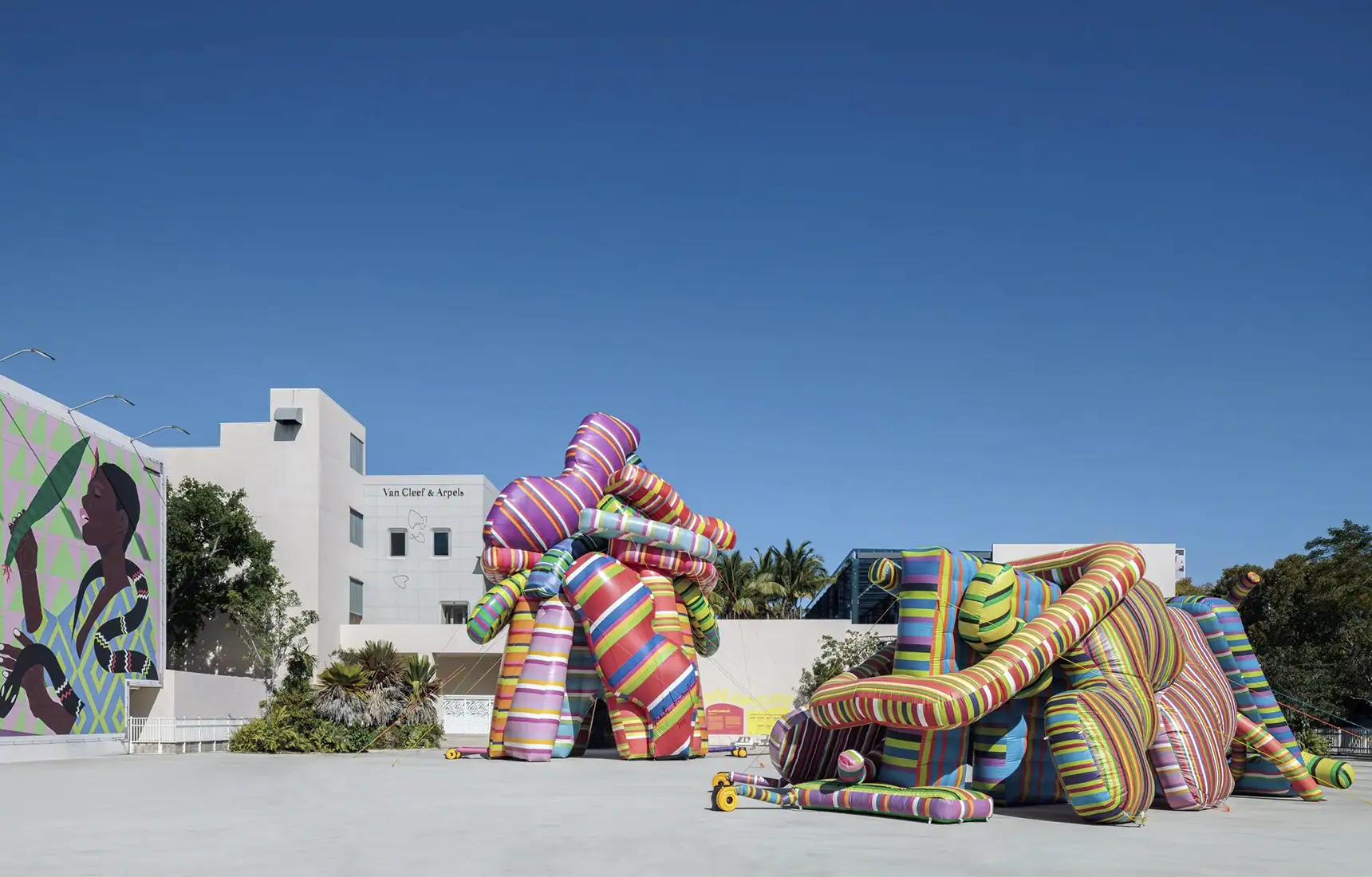
In March 2025, the Miami Design District, in collaboration with ICA Miami, presented Marta Minujín: Dreamscape at Jungle Plaza: two monumental inflatable sculptures, free and open to anyone who wandered past, on view from 18 to 31 March. It was the Argentine artist’s first large-scale public project in Miami, arriving in her eighty-second year and her seventh decade of work.
Two weeks in a plaza. The fortnight is part of the story. The sixty years behind it are the rest.

Who Marta Minujín is
Born in Buenos Aires in 1943, Minujín has spent her career doing something singular and daring: making monumental work that is designed to be taken apart by the public.
The essentials, briskly:
1963 — La Destrucción. In Paris, she gathered her own works, invited other artists to intervene in them, and burned the lot. Destruction as a beginning rather than an ending.
1964 — El Batacazo (“The Long Shot”). An early walk-through environment.
1965 — La Menesunda (“Mayhem”). Made with Rubén Santantonín at the Instituto Di Tella in Buenos Aires: a sequence of rooms you physically entered — neon corridors, a real couple in a bed, a dentist’s chair, a freezer. It is one of the first genuinely immersive artworks anywhere, and it predates the entire contemporary “experience” industry by half a century.
1983 — El Partenón de Libros (The Parthenon of Books). This is the one to hold onto.

The Parthenon, and the method
When Argentina’s military junta fell in 1983, Minujín built a full-scale replica of the Parthenon on a Buenos Aires avenue, clad in 25,000 books that the dictatorship had banned.
The choice of building is exact: the Parthenon is the architectural shorthand for Athens, and Athens is the shorthand for democracy. She wrapped that symbol in precisely the literature a dictatorship had tried to make disappear.
And then she did the thing that defines her.
After five days, two cranes tilted the structure, and the public were invited to take the books away. The monument was dismantled by the crowd, into thousands of hands, and carried home.
That is her method, and she has a name for the series it belongs to — La caída de los mitos universales, The Fall of Universal Myths: take a monumental icon, replicate it, break it up, and redistribute it into the public realm.
In 2017 she rebuilt the Parthenon for documenta 14 in Kassel, this time from 100,000 banned books — and sited it on Friedrichsplatz, the exact square where the Nazis burned books in 1933. Same gesture, aimed at a different wound.
Once you know this, everything about Dreamscape changes.

The two works at Jungle Plaza
Sculpture of Desires rose thirty feet above the plaza: intertwined, luminous inflatable arms forming a glowing portal. Bold, playful, symbolic — and, crucially, a threshold. Something you walk through rather than look at.
Emotional Candy was a labyrinth of merging hallways, its fluid, undulating neon forms recalling the mattress sculptures— the colchones — with which Minujín made her name in the 1960s: soft, striped, bodily, resolutely un-monumental. Ambient birdsong played through the corridors. And visitors were invited to whisper their wishes into the luminous walls.
That last detail is the whole thing.
A monument you enter. A wish you give away into it. The work is not complete until a stranger has put something of themselves inside it — which is, in a gentler key, precisely what the crowd did to the Parthenon when they carried the banned books out of it.

The setting, and why it suits her
The Miami Design District is a luxury retail development. Among Dreamscape‘s named supporters is Craig Robins, the developer behind the district itself. An artist of Minujín’s political history inflating sculptures between the boutiques turns out to be exactly right.
Her actual practice explains exactly why.
Minujín has never been precious about context. She has worked on motorways and in public plazas. She built a giant obelisk out of pan dulce and let people eat it. She has always co-opted the popular, the commercial, the mass-produced and the disposable, and turned them back on the crowd. Her instinct is not to withdraw art into a protected space but to push it into the street where the people already are.
Set against that, a free installation in an open plaza that anyone can walk into, no ticket and no queue, sits right at the heart of her sixty-year project. The setting is commercial. The gesture is a gift.
And there is something quietly generous about placing this artist, whose most famous work is about giving things away, in a district where so many people are already out walking.

Why it mattered
Minujín’s Miami installation was a glorious reminder of what the immersive form is for, and of how much it can give when it is opened up to everyone.
She has spent her life making work that only completes itself when a crowd arrives: burning her own paintings, filling rooms you have to walk through, building temples out of forbidden books and then handing them out. The participation is the heart of the design. It is the work.
That Dreamscape was her first major public project in Miami, at eighty-two, is wonderful. That it was free, in a plaza, and asked nothing of you but a whispered wish, is entirely in character.

Frequently asked questions
What was Marta Minujín: Dreamscape?
A free public installation of two monumental inflatable sculptures — Sculpture of Desires and Emotional Candy — at Jungle Plaza in the Miami Design District, presented with ICA Miami and on view from 18 to 31 March 2025. It was Minujín’s first large-scale public project in Miami.
Who is Marta Minujín?
An Argentine artist born in Buenos Aires in 1943 and a leading figure of the international avant-garde for six decades, working across happenings, performance, immersive environments and monumental public sculpture.
What is the Parthenon of Books?
Minujín’s best-known work. First built in 1983 in Buenos Aires from 25,000 books banned by the military junta, and dismantled after five days so the public could take the books home. Rebuilt at documenta 14 in Kassel in 2017 from 100,000 banned books, on the square where the Nazis burned books in 1933.
What is La Menesunda?
A 1965 walk-through environment made with Rubén Santantonín at the Instituto Di Tella, Buenos Aires — one of the earliest immersive artworks, predating the contemporary “immersive experience” by decades.
Who produced Dreamscape?
Conceived and co-produced by Meet People Meet Places, with support from Fundación Ama Amoedo, Craig Robins and Clarice O. Tavares, in collaboration with ICA Miami and the Miami Design District.

Final thoughts
She burned her own paintings. She built rooms you had to walk into before anyone called it immersive. She made a temple out of books a dictatorship had banned, and then let the crowd pull it down and take them.
At eighty-two, in a plaza in Miami, she built a glowing portal and asked people to whisper their wishes into the wall.
It is the same artist, doing the same thing she has always done: making something large, and then giving it to whoever turns up.


Leave a Reply