
ART & CULTURE · LONDON
Reading time: 11 minMasterpiece London’s ninth edition brought a Korean sculptor who wraps paper aggregations by hand, a Japanese painter working in a thousand-year-old technique, and a Madrid studio built to scan a pharaoh’s tomb turning its tools toward a bird driven to extinction by war. At Royal Hospital Chelsea in the summer of 2018, three stands made the case that a single fair tent could hold all of it at once.
Masterpiece London opened its ninth edition at the Royal Hospital Chelsea from 28 June to 4 July 2018, filling the grounds beside the Thames with a single marquee that has, since its founding in 2010 by Harry van der Hoorn and Thomas Woodham-Smith, made a habit of putting a Georgian bureau within sight of a piece cast the same year. Around 150 galleries and dealers took part, spanning antiquities to work still wet from the studio.

Three stands from that edition reward a longer look than a walk-through gives them. Sundaram Tagore Gallery, the New York gallery built on a founder’s own cross-cultural biography, brought four artists working in Korean paper, Japanese mineral pigment, Chinese calligraphy and Canadian industrial photography. Sarah Myerscough Gallery, London’s clearest advocate for material-led craft, showed furniture and sculpture built from reclaimed British timber and Irish steam-bent ash. And Factum Arte, the Madrid studio that has spent two decades scanning and recasting the world’s most fragile heritage, brought three works that turned that same technology toward a satirist, a Roman goddess and an extinct bird.
What connects them is not a shared subject. It is a shared argument about what a fair like Masterpiece is actually for: not a marketplace for finished objects so much as a place where the process behind an object gets to stand in the open, next to the thing it produced.

Sundaram Tagore Gallery and the case for East-West dialogue
Sundaram Tagore founded his eponymous gallery in SoHo, New York, in 2000, and by 2018 had opened further spaces in Hong Kong and Singapore. Tagore was born in Calcutta in 1961 into a family with a direct line to Rabindranath Tagore, the Nobel laureate poet; his own father, Subho Tagore, was raised by Rabindranath and became one of India’s first modernist painters. Sundaram Tagore studied in the United States before completing a doctorate in modern history at Oxford, focused on cross-cultural artistic movements, and built his gallery on the same premise: that the most interesting work of the past two decades has come from artists translating between Western visual language and the artistic traditions of Asia, the subcontinent and the Middle East.


That premise was visible across the four artists the gallery brought to Chelsea, each working in a technique with centuries of history behind it and none of them treating that history as decoration.

Chun Kwang Young’s aggregations, wrapped by hand
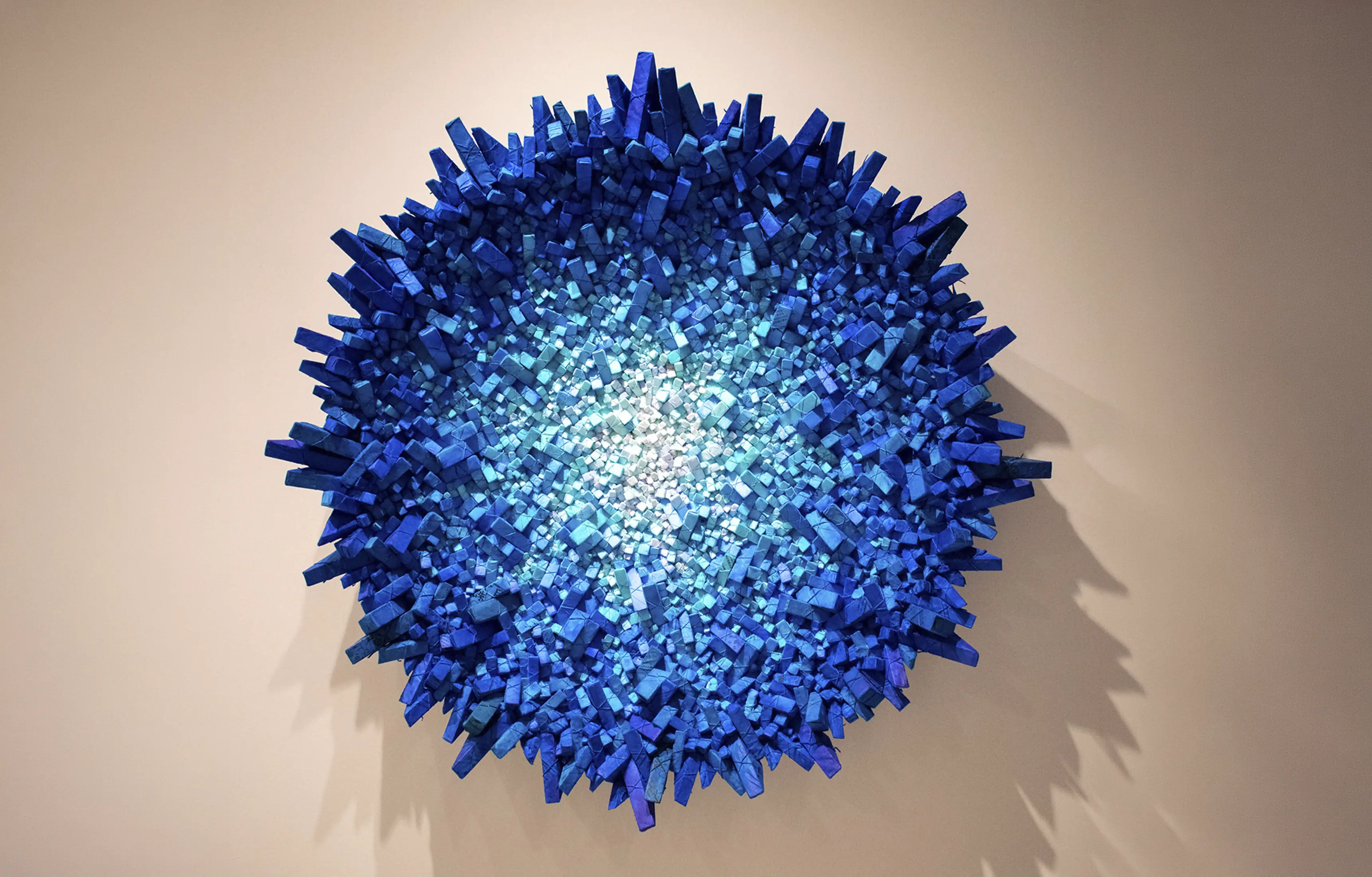
Chun Kwang Young, born in Korea in 1944, trained at Hongik University in Seoul before completing an MFA at the Philadelphia College of Art. The works he showed at Masterpiece belong to his ongoing Aggregations series: thousands of small triangular forms, each individually wrapped in mulberry paper, or hanji, and tied with string, then assembled into dense wall-mounted compositions with the visual charge of shattering rock or coral. Much of the paper he uses carries printed text from its previous life as pages of used books and documents, so a viewer standing close to one of his blue-toned works finds fragments of language surfacing through the wrapping rather than a blank surface.

Chun has traced the technique to a specific childhood memory: medicinal herbs, wrapped in mulberry paper and tied into small parcels, hanging from the ceiling of his local doctor’s office in Korea. The Aggregations carry that memory of care and containment into abstract sculpture, built entirely by hand, one wrapped triangle at a time, across surfaces that can run to several metres.

Hiroshi Senju and a thousand years of pigment
Hiroshi Senju, born in Tokyo in 1958, completed his undergraduate, graduate and doctoral training at Tokyo University of the Arts, finishing in 1987. He works in nihonga, the Japanese painting technique developed over roughly a thousand years, in which finely ground mineral pigments are suspended in animal-hide glue and applied to mulberry paper rather than canvas. Senju uses the technique almost exclusively to paint water: waterfalls and cliff faces rendered at a scale and resolution that make the pigment read as mist and spray rather than paint.

The technique earned Senju international recognition early. At the 1995 Venice Biennale, his waterfall installation The Fall, a work measuring 3.4 metres high and 14 metres wide, received an Honourable Mention, the first such award given to an Asian artist at the Biennale. He has gone on to install large-scale waterfall works at sites including Tokyo’s Haneda Airport, and the paintings shown at Masterpiece extended the same practice: pigment and glue, built up in layers, describing water in a technique developed for describing exactly that.

Zheng Lu’s characters in freefall
Zheng Lu, born in China in 1978, trained at the Lu Xun Fine Arts Academy in Shenyang and the Central Academy of Fine Arts in Beijing before an LVMH Prize sent him to study at the École nationale supérieure des Beaux-Arts in Paris. His sculptures at Masterpiece continued a practice built on a single, exacting technique: surfaces composed of thousands of individual Chinese characters, laser-cut from stainless steel and drawn from historical texts and classical poems, then linked together using a heat-based joining method closely related to the construction of chainmail.

The result is a body built from language rather than solid form, assembled into shapes that appear to defy gravity: splashes and drips frozen mid-motion, their chrome surfaces reflecting whatever stands in front of them. Zheng has said the characters he chooses often come from early Chinese philosophers who wrote about the physical principles of water and motion, which makes the material and the subject the same argument, made twice: language, built into the shape of the thing it once tried to describe.

Edward Burtynsky and the landscapes industry leaves behind
Edward Burtynsky, born in St Catharines, Ontario, in 1955, trained in photography and media studies before building a four-decade career photographing the surface of the planet as industry has reshaped it: quarries, mines, farmland engineered to an unnatural scale, and land cleared by deforestation. His large-format photographs at Masterpiece sat within the body of work that, in 2018, was culminating in the Anthropocene project, a multi-year collaboration examining humanity’s geological-scale impact on Earth.

Burtynsky’s photographs withhold judgement in a way his subject matter rarely gets credited for. A quarry face, photographed from directly above, resolves into a pattern that could as easily be a wound or a monument, and Burtynsky leaves that ambiguity in the frame rather than resolving it for the viewer. He has been made an Officer of the Order of Canada and was the inaugural recipient of the TED Prize, recognition that has followed a body of work built on looking directly at what extraction produces.

Sarah Myerscough Gallery and the argument for material
Sarah Myerscough Gallery has built its reputation as one of London’s most consistent advocates for craft treated as fine art: work made from wood, in particular, by makers who let the material’s own history and behaviour shape the final form rather than disguising it. That argument was on full display at the gallery’s 2018 stand, and it is one the gallery has returned to at Masterpiece more than once. A later edition of the fair, marking Masterpiece’s tenth year, saw the gallery bring an entirely different set of makers working the same material argument in wood.

Maisie Broadhead showed the work that has defined her practice: staged, theatrically directed photographs that reinterpret compositions from historical portraiture, then extend physically beyond the edge of the frame, with jewellery and suspended figures built out into real space rather than staying flat on the print. A gilt edge, in Broadhead’s work, stops functioning as a boundary and becomes another material in the sculpture.
Wycliffe Stutchbury, who spent 25 years as a furniture maker before turning to fine art and completed a degree in 3D craft at the University of Brighton in 2003, showed three-piece oak screens built entirely from reclaimed material: Victorian floorboards, excavated bog oak, and timber salvaged from specific British landscapes. Each screen is assembled by hand, tile by tile, from wood whose grain, colour and history vary piece to piece, so that no two screens can ever repeat, and each carries the identity of the exact place its material came from.

Joseph Walsh, working from his studio on his family’s farm in West Cork with a team of around twenty craftspeople, showed the Cleft Cabinet, a piece built in the vocabulary of his long-running Enignum series, in which thin strips of wood, typically olive ash, are laminated and shaped into sinuous, freeform curves. The cabinet kept the raw, split character of its exterior intact, a surface that reads as freshly cleft timber rather than finished furniture, and opened to reveal an interior fitted and finished to cabinetmaking tolerances, the two halves of the same object making two entirely different arguments about what wood can be asked to do.

Factum Arte, and the tools built for a tomb
Factum Arte was founded in Madrid in 2001 by the artist Adam Lowe together with the engineer Manuel Franquelo and the technologist Fernando Garcia-Guereta, with a specific first task: developing the scanning technology needed to record the Tomb of Seti I in Egypt’s Valley of the Kings. The studio has since built two instruments that define its practice, the Lucida 3D laser scanner, which records surface relief at 100-micron resolution without ever touching the object, and the Selene photometric system, developed with researchers at Oxford, which captures texture at sub-millimetre detail invisible to the naked eye.

That technology produced a full-scale facsimile of Tutankhamun’s tomb, installed near the original in the Valley of the Kings in 2014, and a 1:1 recreation of Veronese’s Wedding Feast at Cana, returned to the Venetian refectory the original was removed from in 1797. Since 2009, the Factum Foundation for Digital Technology in Preservation has extended that same work into a standing collaboration with institutions including the British Museum, the Louvre and the Prado, built around a single conviction that Adam Lowe has stated plainly: a tomb built to last for eternity was not built to be visited, and scanning it precisely enough to make an exact copy is the only way to let people see it without wearing it away.


Three works, one Palmyra thread
Factum Arte’s stand at Masterpiece carried three works that, read together, trace that mission somewhere the studio’s usual antiquities projects rarely go.
Shezad Dawood showed Where do we go now?, a sculpture cast in resin and finished in a polychromatic paint that shifts, depending on the angle it is viewed from, between metallic pink and green. The piece was 3D printed before being cast in composite resin, and its title draws on Jonathan Swift’s 1704 satire A Tale of a Tub, a work built around misreading, credulity and the gap between what a text claims and what it actually says, themes Dawood’s colour-shifting surface makes literal: the work tells a different story depending on where the viewer stands.

Alongside it, the Venetian designer Giberto Arrivabene showed the result of a project begun with Factum Arte in 2013: a life-sized glass recreation of Antonio Canova’s Pauline Bonaparte as Venus Victrix, the marble sculpted between 1805 and 1808 for Napoleon’s sister on her marriage into the Borghese family. Factum Arte scanned the marble at the Galleria Borghese, produced a stereolithographic print, then a mould and a wax positive, before casting the final piece in glass, a process that took over ten weeks to cool and set. Three editions eventually resulted, in glass, painted plaster and resin, and the set was acquired by the V&A. Five months after its Masterpiece preview, the glass Paolina Borghese was installed as part of the reopening of the V&A’s Cast Courts on 1 December 2018, taking a Regency neoclassical sculpture, by way of a laser scanner, into one of the world’s most significant collections of plaster and glass reproductions.

The third work sat furthest from marble and closest to the studio’s founding purpose. Hrair Sarkissian’s piece, drawn from his wider project Final Flight, presented seven resin and bone-cast skulls, recreated from real specimens, of the Northern Bald Ibis, a bird depicted in some of the oldest surviving hieroglyphs and once regarded as a guide for pilgrims travelling to Mecca. The species was declared extinct in the wild across the Middle East in 1989, until a small colony of seven birds was rediscovered in the Syrian desert near Palmyra in 2002. That colony was lost around 2014, as the conflict that reached Palmyra also destroyed part of the ancient city Factum Arte’s own foundation has separately worked to document. The same non-contact scanning technology built to copy a pharaoh’s tomb rather than let it be worn away by visitors had, in Sarkissian’s hands, been turned toward a species that vanished from the same stretch of desert, for related reasons, in the same decade. It is not a connection either the fair or the artist’s own materials draw out directly, but it is there in the geography: two kinds of loss, recorded by the same tools, from the same corner of Syria.

Final thoughts
None of these three stands needed to share a subject to make the same point. A Korean artist wrapping paper by hand, a British craftsman splitting oak from a specific field, and a Madrid studio built to save a pharaoh’s tomb are not obviously in conversation with each other. What put them in the same tent was a shared refusal to let technique disappear behind the finished object.
Chun Kwang Young’s wrapped triangles, Wycliffe Stutchbury’s reclaimed screens and Factum Arte’s scanned facsimiles all make the process visible rather than polished away, so that looking at the work means looking at how it was made almost as much as what it depicts. That is not a coincidence of one fair’s exhibitor list. It is what a fair built around putting radically different kinds of making in the same room is for.
The Northern Bald Ibis skulls make the argument most starkly, because the technology behind them was built for permanence, for outlasting the thing it copies. Turned toward a bird that did not survive, it becomes a record of exactly the opposite: proof that a species existed, made with the same precision as proof that a tomb still does.
When did Masterpiece London 2018 take place?
Masterpiece London’s ninth edition ran from 28 June to 4 July 2018 at the Royal Hospital Chelsea in London.
Who founded Masterpiece London?
The fair was founded in 2010 by Harry van der Hoorn and Thomas Woodham-Smith.
What did Sundaram Tagore Gallery show at Masterpiece 2018?
Sundaram Tagore Gallery showed Chun Kwang Young’s hand-wrapped paper Aggregations, Hiroshi Senju’s nihonga waterfall paintings, Zheng Lu’s laser-cut steel character sculptures, and Edward Burtynsky’s large-format industrial landscape photography.
What is Chun Kwang Young’s Aggregations technique?
Chun Kwang Young wraps thousands of small triangular forms individually in mulberry paper, often bearing printed text from used books, tying each in string before assembling them into dense abstract wall compositions by hand.
What is Factum Arte known for?
Factum Arte is a Madrid studio, founded in 2001 by Adam Lowe, that uses high-resolution non-contact 3D scanning to create facsimiles of endangered cultural heritage, including a full-scale replica of Tutankhamun’s tomb.
What did Factum Arte show at Masterpiece London 2018?
Factum Arte showed Shezad Dawood’s colour-shifting sculpture Where do we go now?, a glass recreation of Canova’s Paolina Borghese made with designer Giberto Arrivabene, and Hrair Sarkissian’s cast skulls of the extinct Northern Bald Ibis.
Who is Joseph Walsh and what did he show with Sarah Myerscough Gallery?
Joseph Walsh is an Irish furniture designer working from a studio in West Cork. At Masterpiece 2018 he showed the Cleft Cabinet, built in his Enignum technique of laminated, curved wood strips, with a raw exterior opening to a finished interior.
Is Masterpiece London still running?
Masterpiece London’s 2018 edition, its ninth, is the subject of this piece. Readers wanting current fair dates should check the fair’s own listings, and a later edition of the fair, its tenth in 2019, is covered separately on this site.


Leave a Reply