
ART & CULTURE · LONDON
Reading time: 8 minMasterpiece London marked its tenth edition in 2019 with a run of galleries that treated the fair’s cross-category format as an argument rather than a convenience. Wood carvers sat close to bronze casters, and a gallery built around a single Alex Katz canvas sat close to one built around colour-changing mirrors. The result was a week at the Royal Hospital Chelsea that made the case for looking at art, design and craft in the same room.
Masterpiece London returned to the grounds of the Royal Hospital Chelsea from 27 June to 3 July 2019, marking ten years since the fair’s launch in 2010. Founded by Harry van der Hoorn and Thomas Woodham-Smith, with Philip Hewat-Jaboor joining as chairman in 2012, Masterpiece built its identity on a single premise: that a fine Georgian bureau, a contemporary bronze and a piece of ancient jewellery could be judged by the same eye, in the same tent, in the same afternoon. By its tenth year, that premise had drawn around 160 exhibitors to a single marquee on the Chelsea Embankment, spanning antiquity to work made that same year.

What distinguished the 2019 edition was not scale but conversation. Sarah Myerscough Gallery, Pangolin London, Opera Gallery and Patrick Heide Contemporary Art each brought a distinct discipline, and each made its case through specific, well-chosen pieces rather than a broad survey. Read together, they trace a fair-wide argument about materials, technique and the value of putting radically different kinds of making in close proximity.
Sarah Myerscough Gallery and the case for craft
Sarah Myerscough Gallery returned to Masterpiece in 2019 after a strong showing the year before, bringing a stand built entirely around applied arts and craft-led sculpture, the specialism that has defined the gallery since its founding and that later saw it move into a converted Victorian schoolhouse in Mayfair. That 2018 showing is covered separately as Masterpiece London’s ninth edition, an earlier example of the fair putting applied arts and craft-led sculpture in the same tent as painting and antiquities. The stand’s strength was its refusal to treat wood, in particular, as a single material with a single outcome.

Maisie Broadhead’s work extended the argument furthest. Her pieces begin as constructed images, often referencing the composition and dress of historical portraiture, before pushing physically beyond their frames into the surrounding space, so that a gilt edge stops being a boundary and becomes part of the sculpture. The frame, in Broadhead’s hands, is not a device that contains the work. It is one of the work’s own materials.
Alison Crowther’s sculptures took a different route to the same territory. Crowther carves entirely in English oak sourced sustainably from UK woodland, working the wood by hand into forms with the rounded, layered geometry of spheres and shells. The material’s origin is not incidental: sourcing from British woodland ties each piece to a specific place and a specific supply chain, which matters in sculpture built from a material that took decades to grow.


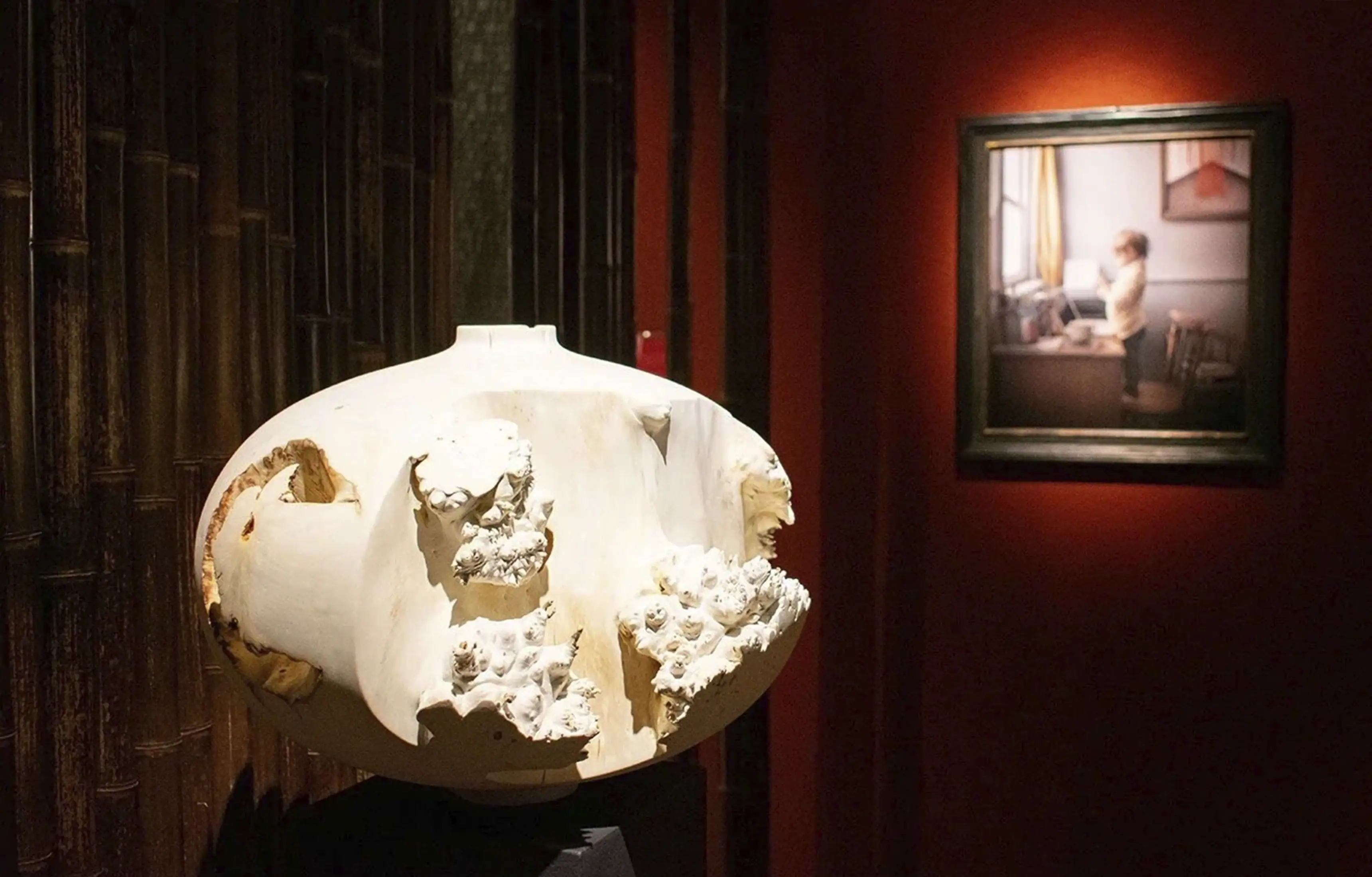
Ernst Gamperl’s wooden vessels approached the same question of material honesty from the opposite direction. Gamperl turns his vessels while the wood is still green, meaning freshly felled and full of moisture, rather than waiting for it to season and stabilise first. Turning green wood means working in dialogue with a material that is still moving: as the vessel dries after turning, it warps, cracks and settles into an asymmetric final form that Gamperl anticipates rather than fights. He reads how a particular log will behave as it dries and lets that prediction shape the initial cut, so the finished vessel’s curves and irregularities are a record of the drying process itself, not a design applied afterwards. The technique, developed over decades working largely in oak salvaged from storm-damaged or fallen trees, won Gamperl the Loewe Craft Prize in 2017, a recognition that placed a wood turner’s studio process on the same stage as the world’s most closely watched design award.

Eleanor Lakelin’s objects sit at the furthest end of that same conversation about material honesty. Her sculptures work back through a piece of wood’s own history, cutting into and pulling back its layers to expose the marks of growth, decay and erosion that the tree itself recorded over its lifetime. Where Gamperl reads the wood’s future movement, Lakelin reads its past.

Pangolin London and sculpture in the round
Pangolin London describes itself as one of the very few London galleries dedicated exclusively to sculpture, a specialism that runs in the same family as Pangolin Editions, the foundry that has cast bronze work for British sculptors for decades. That foundry connection matters more at Masterpiece than a catalogue note might suggest. Charlotte Mayer, whose bronze Solar appeared on the stand, has worked with Pangolin Editions since the early 1980s, casting her sculptures in bronze, silver and steel there across a career that began at Goldsmiths and the Royal College of Art. Mayer arrived in Britain from Prague as a child in 1939, and returned to sculpture in the mid-1960s after raising a family, going on to win the Royal Society of British Sculptors’ Silver Medal for her 1991 Barbican commission Ascent. Solar, made in 2009, belongs to the later, more experimental phase of that long practice, and its presence on Pangolin’s stand is a reminder that a gallery and its foundry can share a sculptor’s entire career, not just a single show.

David Mach brought two very different demonstrations of scale to the stand. His portrait of Van Gogh, built from thousands of coloured pins pushed into the surface by hand, applies the same logic Mach has used across a career built on mass-produced, readily available units: coat hangers assembled into a gorilla, matchsticks arranged and coloured into a portrait head, magazines stacked into the suggestion of an explosion. In each case, a single humble object, repeated at enormous scale, resolves from a distance into a recognisable image while remaining, up close, an accumulation of thousands of identical small things. The Van Gogh portrait sits in that lineage: pointillism made literal, built from pins rather than paint. Alongside it, Mach’s Deep-Sea World installation pushed the same appetite for scale and immersion into three dimensions, filling the stand rather than a single wall.


Susie MacMurray’s Strange Fruit, begun in 2017, brought a sharper material contrast to the same stand: reclaimed military barbed wire threaded through with red silk velvet, a pairing that sets an industrial, defensive material against one associated with luxury and the body. MacMurray has built a practice around exactly this kind of material collision, and the piece’s title, borrowed from a phrase with its own difficult history, adds a further layer without requiring the sculpture to explain itself.

Opera Gallery’s international stage
Opera Gallery brought a stand with the scale and confidence of an international operation, which is precisely what it is. Gilles Dyan founded the gallery in 1994, opening two spaces simultaneously in Paris and Singapore rather than starting in a single city and expanding outward, a decision that set the gallery’s international character from its very first day. It has since grown to sixteen locations, including New York, Miami, London, Paris, Monaco and Hong Kong.

The stand’s centrepiece was Alex Katz’s oil painting Corinne, a work whose flat planes of colour and confident, economical brushwork are instantly recognisable as Katz’s, an artist who has spent seven decades refining a visual language built on reduction rather than addition. Around it, Manolo Valdés showed his bronze Reina Mariana, a sculpture that reworks the language of Spanish court portraiture, particularly Velázquez, into monumental three-dimensional form, alongside head sculptures fitted with brutalist, architectural headpieces that place historical reference and contemporary structure in direct contact. Anthony James’s 50 Icosahedron, a geometric form built from LED and mixed media, closed the stand with something closer to pure structure: a shape defined by mathematics rather than a period, made luminous.


Patrick Heide Contemporary Art and the language of light
Patrick Heide Contemporary Art built its stand around works that treat colour and light as active, changeable materials rather than fixed properties. Hans Kotter’s Twin used colour-changing LED mirrors to make the viewer’s own reflection part of a shifting composition, so that the work is never quite finished and never looks the same twice.

Andy Harper’s contribution took the same instinct in a more physical direction. An Orrery for Other Worlds took a canvas off the wall entirely and suspended it as a three-dimensional illuminated globe, turning painting into something closer to a planetary model, an orrery being a mechanical device built to demonstrate the movement of celestial bodies. Alongside it, Harper’s oil painting Mont Royal stayed on the wall but pursued the same interest in density and colour through dense, layered foliage, a study in how much visual information a single canvas can hold before it stops reading as landscape and starts reading as pure pattern.


The fair’s front door
Every year, Masterpiece stages a major installation at the entrance to the fair itself, in partnership with a leading artist or gallery, and the commission is treated inside the trade as one of the most coveted projects in the fair’s calendar. In 2019, that installation came from Phyllida Barlow, working with her gallery Hauser & Wirth, who filled the entrance with an array of vividly coloured, oversized pom-pom sculptures built from hundreds of pieces of discarded fabric and suspended from wooden beams. It set the tone for everything that followed inside the marquee before a single stand had been reached. The full story of that commission, Barlow’s career and the thinking behind it is told in a companion piece on Phyllida Barlow’s Masterpiece Presents installation.
Final thoughts
A fair built around putting antiquity next to contemporary work, and painting next to wood turning, only succeeds if the individual stands hold up to that comparison on their own terms. At its tenth edition, Masterpiece London’s galleries did exactly that. Sarah Myerscough’s craft argument, built on green wood and layered material, sat comfortably alongside Pangolin’s sculpture in the round, Opera Gallery’s international scale and Patrick Heide’s work in light and colour, each making its own case rather than deferring to the others.

What ties the stands together is not a shared subject but a shared seriousness about process: Gamperl reading a log’s future movement, Mayer’s decades at the same foundry, Mach’s thousands of individual pins resolving into a single face, Kotter’s mirrors changing with every viewer who stands in front of them. Ten years in, that was the argument Masterpiece London had built its reputation on, and 2019 made it in full.
When did Masterpiece London 2019 take place?
Masterpiece London 2019 ran from 27 June to 3 July 2019 at the Royal Hospital Chelsea, marking the fair’s tenth edition since it launched in 2010.
Who founded Masterpiece London?
Masterpiece London was founded by Harry van der Hoorn and Thomas Woodham-Smith, with Philip Hewat-Jaboor joining as chairman in 2012.
How many exhibitors showed at Masterpiece London 2019?
Around 160 international galleries and dealers exhibited at the 2019 edition, spanning fine art, design, furniture, jewellery and antiques.
What kind of work did Sarah Myerscough Gallery show at Masterpiece 2019?
Sarah Myerscough Gallery showed applied arts and craft-led sculpture, including Maisie Broadhead’s frame-extending works, Alison Crowther’s hand-carved English oak sculptures, Ernst Gamperl’s green-wood turned vessels and Eleanor Lakelin’s layered wooden objects.
What was David Mach’s Van Gogh portrait made from?
David Mach’s portrait of Van Gogh was built from thousands of coloured pins pushed into the surface by hand, a technique that resolves into a recognisable image from a distance while remaining an accumulation of individual pins up close.
What was Opera Gallery’s centrepiece at Masterpiece 2019?
Opera Gallery’s stand was centred on Alex Katz’s oil painting Corinne, alongside Manolo Valdés’ bronze Reina Mariana and Anthony James’s LED sculpture 50 Icosahedron.
Is Masterpiece London still running?
Masterpiece London’s 2019 edition, its tenth, is the subject of this piece. Readers wanting current fair dates and exhibitor lists should check the fair’s own listings directly.


Leave a Reply