
ART & CULTURE · NEW YORK
Reading time: 10 minIn a converted NoHo storefront, more than forty independent designers agreed to give up their own booths and share one darkened room instead. Next Level’s second edition, staged during NYCxDesign 2019, replaced the usual trade show grid with black-painted walls, a floor of recycled tyre mulch, and a curatorial argument that the work would look stronger in conversation than in isolation. It did, and the room’s two most instructive relationships, one in lighting and one in charity, were not the ones anyone expected.
NYCxDesign fills New York with trade fairs built on the booth: a grid of rented squares, each designer fenced off from the next by drywall and carpet tile. Next Level, staged for its second edition in May 2019, took the opposite position. Inside a 9,000 square foot storefront at 718 Broadway in NoHo, more than forty independent designers and artists showed their work in a single continuous space, its walls painted black and its floor laid with recycled tyre mulch, with nothing to mark where one designer’s territory ended and another’s began.

The show had started the year before as a scrappy answer to a real problem. Three couples working across New York’s independent design scene, Asher and Jamie Israelow of Asher Israelow Studio, Patrick Weder and Tamika Rivera, and Shanan Campanaro and Nick Chacona of the textile studio Eskayel, built the first edition themselves in 2018, improvising display plinths out of cinder blocks when the budget for proper fixtures ran out. Here Projects, the events studio that has curated Next Level’s programming since, joined as a founding partner. By 2019 the improvisation had become a method, not a limitation, and the group used it deliberately.
The result was less a trade show than a single collective installation, and the pieces inside it repay looking at closely: a dining table with a fabricated night sky inlaid into its surface, a wall of hand cast glass that changes colour as it warms, a horn speaker built from the staves of a whiskey barrel, and a wall of paper lanterns painted by seventy New York artists to raise money for the city’s largest anti-poverty foundation. What held the room together was not a shared material or a house style. It was a decision about how independent designers should be allowed to show their work, and why that decision mattered as much as anything on the plinths.

A showroom with no booths, and the economics behind it
The founders’ central idea was structural before it was aesthetic. Trade show booths are sold by the square foot, which means the loudest, best-funded stand usually wins the room regardless of what is actually on it. Next Level’s organisers charged participants only enough to cover the cost of the space itself, which meant they could invite designers on the strength of the work rather than the size of a marketing budget, and stage that work as one continuous environment rather than forty competing footprints.
The black walls and tyre mulch flooring were part of the same logic. A neutral, unbranded backdrop puts every material on equal footing: a cast glass panel and a poured concrete cube read against the same dark ground, so the differences between them become the point rather than a distraction. Visitors moved through the space the way they would move through a single exhibition rather than a fair, discovering relationships between pieces that a conventional booth layout would have kept apart.

Lighting that set the tone at the entrance
Tala staged the show’s most dramatic first impression. The British lighting brand, founded in 2015 by three university friends who set out to prove that good design was the fastest route to a low carbon world, filled Next Level’s entrance with its Voronoi range: LED fixtures built around organic, cell-like forms, shown across a run of sizes and finishes so the installation read as a single sculptural cloud rather than a product display. Tala’s bulbs are engineered for high colour rendering and a warm, low-flicker output that mimics daylight, which is precisely why designers keep specifying them as visible elements rather than hiding them behind a shade.

L’aviva Home carried the same instinct into its own corner of the room with the Agave collection, a set of glass pendants named for the piña, the dense, layered heart of the agave plant that is also the raw material for mezcal. Founder Laura Aviva, whose practice is built on working directly with artisan makers, produced the pendants in three sizes and two distinct glass finishes, engineered so that individual fixtures could be clustered into a single dramatic installation rather than hung as isolated points of light. Kin & Company closed the lighting story with Remains Light, a hand cast glass semicircle developed with the Brooklyn lighting studio Bianco Light & Space, which shifts from deep purple to soft pink as it warms, a slow colour change that rewarded anyone who stayed in the room rather than walking straight through it.

The connection between two of the room’s exhibitors
The relationship between Tala and L’aviva Home did not start at Next Level, and that is what makes it worth pointing out. Laura Aviva had already worked with Tala on the Piedra collection, a line of wall sconces inspired by carved stone masks from Teotihuacán, choosing Tala’s bulbs specifically because the fixture left the light source fully exposed and needed to hold its own as a sculptural detail rather than disappear behind glass or stone. That is the same design conviction both brands brought to Next Level in 2019: Tala’s Voronoi installation at the entrance and L’aviva’s Agave pendants across the room were, in effect, two expressions of a shared position that a bulb is a material choice, not an afterthought.
It is a connection that only shows up if you look at how the two brands work together outside the show itself, and it says something about how Next Level built its guest list. The founders were not simply filling booths with whoever applied. They were assembling a room of designers who already shared a design language, whether or not they had shown alongside each other before.

Furniture built on process
Fort Standard brought the show’s clearest argument for material honesty. The Brooklyn studio, run by Gregory Buntain and Ian Collings out of a shared workshop in Red Hook, showed Cooperage Round, a dining table and matching stools that pair natural white oak with roasted oak in a banded, striped pattern drawn directly from the cooper’s craft of building a barrel stave by stave. Fort Standard’s practice has always treated the honesty of a material and the process that shapes it as the actual subject of the work rather than a footnote to it, and Cooperage Round makes that argument in a single, legible gesture.

Kate Duncan’s Writing Desk pursued the same discipline in a different register: North American hardwoods, a leather veneer top, and ribbed joinery supports that leave the desk’s structural logic visible rather than concealed inside a solid case. Oso Industries took material honesty somewhere more textural with the Crinkle Cube, a storage unit finished in concrete panels cast to mimic the surface of crumpled paper, turning a famously rigid material into something that reads, at a glance, as soft.

Furniture that behaves like sculpture
Several pieces in the room made their case through form rather than process. De La Vega Designs showed the Giac Settee, a sculpted seat named directly for the Swiss sculptor Alberto Giacometti, its attenuated silhouette borrowing the same reduction of mass to line that defines Giacometti’s own figures. Volk Furniture’s Sebastian Etagere took the opposite approach to colour: solid white oak shelving finished in bold, colour-blocked lacquer, treating a piece of storage furniture as a study in how far pigment can carry a form before the wood underneath stops mattering.

Kin & Company’s Wave Table II, shown alongside the studio’s Remains Light, extended rolled steel into a curved, undulating base beneath a glass top, using a heat treatment process on the metal that produces a naturally occurring range of colour across the surface rather than an applied finish. Noble Goods closed this thread with Le Chain, a system of suspended chain designs in customisable lengths, with individual links cast in wood, concrete or resin, so that a single design vocabulary produced pieces that read as jewellery at one scale and as architecture at another.

Where furniture design tips into art
A handful of pieces sat closer to the gallery wall than the showroom floor. Asher Israelow, one of Next Level’s own founders, showed a dining table built around a custom Starmap inlay, a galactic composition mapping constellations across the surface in a way that turns a functional table into a record of a specific moment in the sky. A Space presented Found II, a set of fourteen one-of-a-kind abstract objects cut from stone ten inches thick, each piece polished to a high finish on one face while the other kept its raw, unworked surface, a direct confrontation between what stone looks like before and after a maker’s hand touches it.

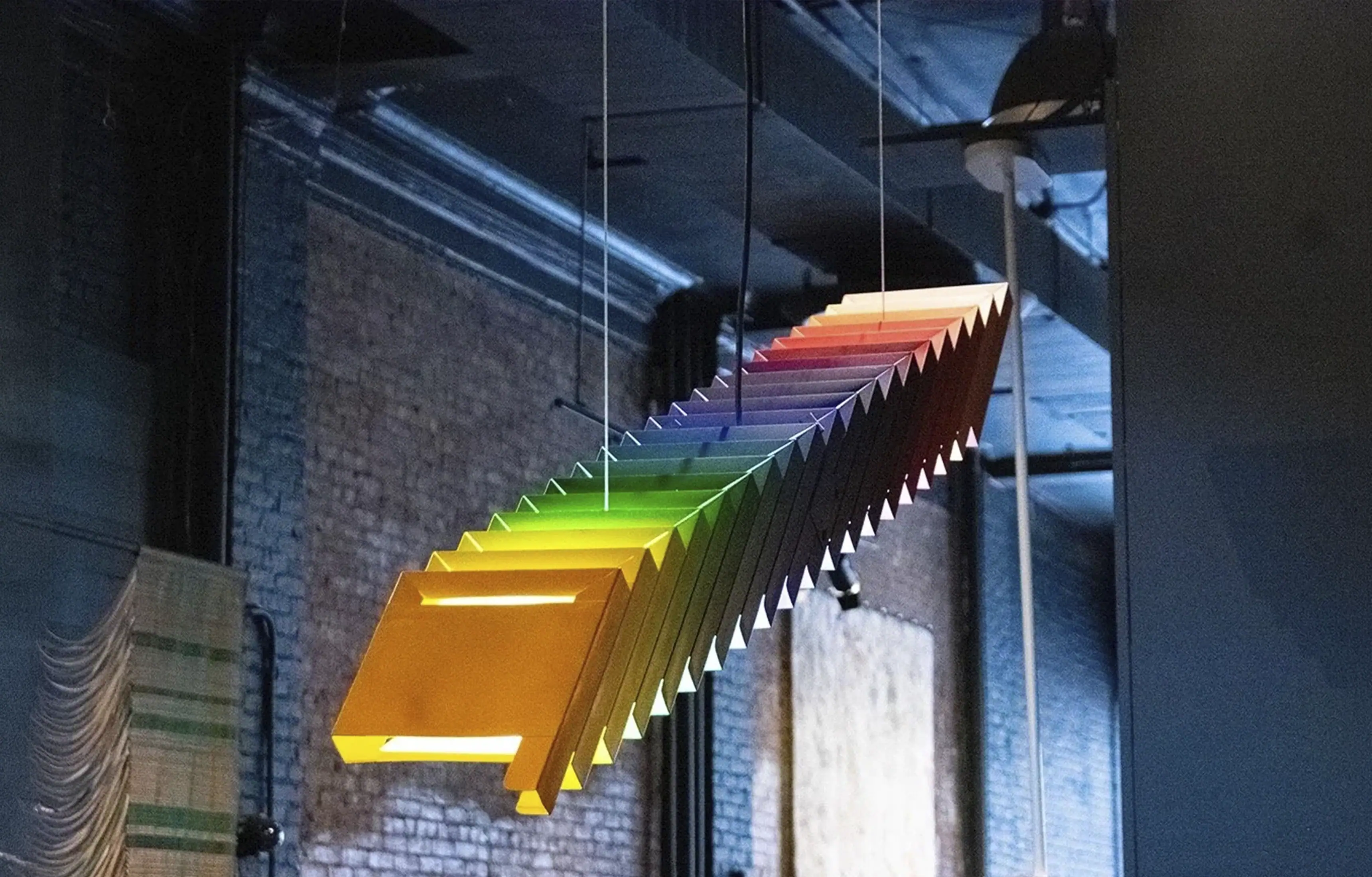
Erickson Aesthetics pushed the same idea into light with Spectrum, an LED piece built from twenty individually coloured metal cuboids stacked in a stepped, gradient formation that reads as a physical colour chart. Fiddle Hammer took the show’s most unexpected material journey with the Bellaphone, a wooden horn speaker crafted from the reclaimed staves of whiskey barrels, its form borrowed from early acoustic gramophones and its material taken from an entirely different American craft tradition.

Seventy lanterns and the Robin Hood Foundation
The show’s most quietly ambitious project sat on Next Level’s lower level: an installation of more than seventy rice paper lanterns, donated by the New York retailer Pearl River Mart and individually customised by seventy different New York artists, each one hand-painted or otherwise transformed into a one-off piece. Tala supplied the bulbs that lit them, extending the same brand into the room’s charitable wing that had staged its dramatic entrance installation upstairs. Proceeds from the lantern sales went to the Robin Hood Foundation, the New York organisation founded in 1988 by the hedge fund manager Paul Tudor Jones alongside Peter Borish and Glenn Dubin, which has since directed more than three billion dollars into programmes addressing poverty across the city, funding several hundred nonprofit partners working from early childhood through to adult and household support.

The lantern wall was not an add-on to the main exhibition. It ran on the same logic as everything else in the room: take a shared, unbranded material, in this case a plain paper lantern, and let seventy different hands make seventy different arguments with it, exactly as the show’s forty-plus designers had done with furniture, lighting and stone. A showcase built on the idea that independent work looks stronger shared than siloed found, in the lanterns, its most direct and most generous expression of that same principle.

Final thoughts
It would be easy to read Next Level as a story about a good idea for booth design: skip the trade show grid, paint the walls black, let the work speak. That is true as far as it goes, but it understates what the founders actually built. By pricing participation at cost rather than at market rate for exhibition real estate, they made the guest list a curatorial decision rather than a financial one, which is the reason the room held together as a single argument instead of forty separate sales pitches.

That argument showed up in details a visitor could easily miss: a lighting brand’s bulbs turning up twice in the same room, once in its own dramatic entrance installation and once lighting seventy lanterns for charity on the floor below; a founder showing his own table alongside the work of the designers he had invited; a stone sculptor and a furniture maker treating the same idea, material honesty, from opposite directions. None of it was accidental. It was the result of a group of makers who already trusted each other’s judgement being given a room large enough to prove it.
Next Level’s second edition ran for a single week in May 2019, but the model it tested, unified curation over rented square footage, is the more durable export. NYCxDesign continues to grow every year, and the showcases that have staying power tend to be the ones built on a genuine curatorial position rather than a floor plan. Next Level had one, and the room made it visible.

What was Next Level at NYCxDesign 2019?
Next Level was a collaborative design showcase staged during NYCxDesign 2019 in a 9,000 square foot NoHo storefront, bringing together more than forty independent furniture, lighting and object designers in a single unified space rather than individual trade show booths.
Who founded Next Level?
Next Level was founded in 2018 by three New York design couples, Asher and Jamie Israelow, Patrick Weder and Tamika Rivera, and Shanan Campanaro and Nick Chacona of the textile studio Eskayel, with the events studio Here Projects curating its public programme.
Where was Next Level 2019 held?
The second edition took place at 718 Broadway in the NoHo neighbourhood of Manhattan, occupying a 9,000 square foot storefront for the run of NYCxDesign in May 2019.
What made Next Level different from a typical trade show?
Rather than renting individual booths, Next Level’s organisers charged only cost-covering fees and staged every designer’s work inside one continuous, black-walled room floored in recycled tyre mulch, so pieces were viewed in relation to each other rather than in separate stands.
Which designers and studios showed work at Next Level 2019?
Exhibitors included L’aviva Home, Fort Standard, Kin & Company, Tala, Asher Israelow Studio, Fiddle Hammer, Volk Furniture, A Space, Kate Duncan, Oso Industries, De La Vega Designs, Erickson Aesthetics and Noble Goods, among more than forty designers and artists in total.
What was the charitable component of the show?
Pearl River Mart donated rice paper lanterns that were individually customised by seventy New York artists, with Tala supplying the bulbs to light them, and proceeds from the lantern sales benefited the Robin Hood Foundation, which funds anti-poverty programmes across New York City.


Leave a Reply