
Fourteen years ago, Nina Yashar started testing her gallery’s furniture inside real rooms instead of a white cube, calling the idea Squat and moving it between borrowed buildings in Milan, Paris, Beirut and London. For Milan Design Week 2026, she brought the idea home. Le Pied-à-terre Cosmopolite staged seventy years of design inside Nilufar’s own Via della Spiga gallery, turned for six days into the compact apartment of an imagined collector passing through the city.
Introduction
Le Pied-à-terre Cosmopolite, curated by Nina Yashar, occupied Nilufar Gallery’s showroom on Via della Spiga in Milan from 21 to 26 April 2026, during Milan Design Week. Across roughly seventy square metres, Yashar staged a sequence of rooms, an entrance, a living area, a bar corner, a dining area and a master bedroom, built around the conceit of a cosmopolitan collector’s brief, elegant stay in the city, mixing vintage design icons with new work by contemporary makers.

That description alone places the piece inside a familiar Milan Design Week category: the immersive apartment installation, a format several galleries and studios used across the city that week. What it misses is the fourteen years of curatorial practice sitting behind this specific version of it. Yashar has been staging her gallery’s collection inside lived-in rooms rather than plinths since 2012, under a project she calls Squat, and this is the first time she has done it inside her own gallery rather than a borrowed building somewhere else.
That is the argument worth making about Le Pied-à-terre Cosmopolite: not that it was another well-dressed apartment, but that it is the latest, most self-referential chapter of an idea Yashar has now been refining for well over a decade.

What the space actually looked like, room by room
Visitors entered past Robinson Ferreux Maeght’s Yoko bench, positioned as a threshold piece before the apartment proper began. The living area built its case around Willy Rizzo’s Super C sofa, paired with Roberto Sironi Studio’s Aphènès low tables, Jorge Zalszupin’s Capri tables, Gabriella Crespi’s Fungo lamps and a Pneu Giga carpet by Caturegli & Formica, a room deliberately mixing a 1970s Italian glamour piece, a Brazilian modernist table and a contemporary rug into one legible sitting room rather than a period set.

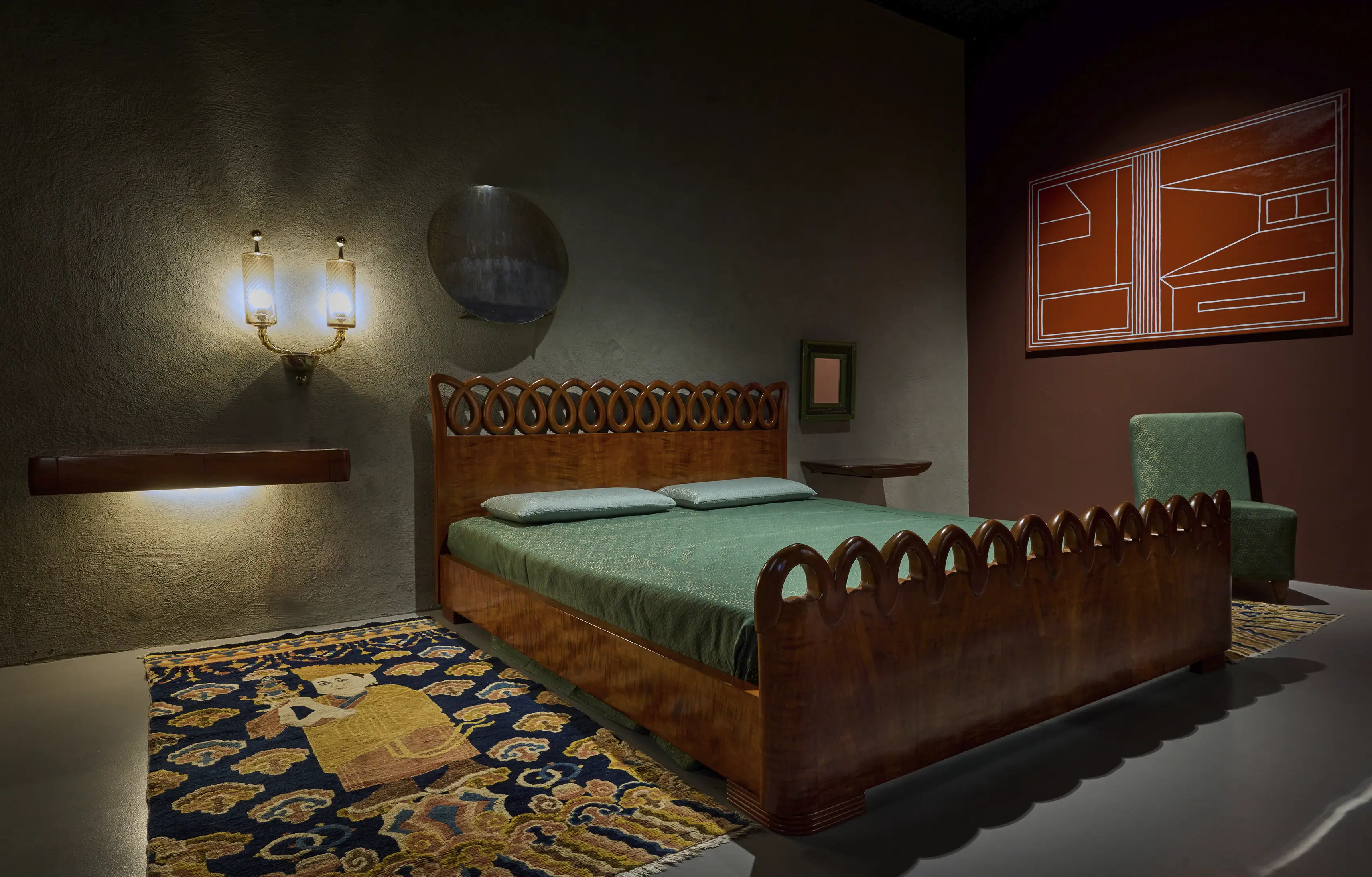
A dedicated bar corner introduced the newest work in the space, pieces by StudioDanielK shown alongside Murano Borealis glassware by NasonMoretti. The dining area carried the heaviest concentration of named mid-century design: Marco Lavit’s Hexa table, made with Azimut Design, surrounded by Axel Einar Hjorth’s Futurum chairs, lit by a chandelier from Napoleone Martinuzzi, with a copper shelf by Carlo Lorenzetti and a CC03 console by Johan Viladrich completing the room. The master bedroom closed the sequence around Osvaldo Borsani’s 1939 bed, produced by Arredi Borsani Varedo, his own L78 floor lamp for Tecno, and a Venini Murano glass mirror.
Materials ran as a deliberate thread through all five rooms: honeycomb aluminium, amber epoxy resin, parchment, minerals, metal and Murano glass, chosen to read as a coherent domestic palette rather than five unrelated showroom vignettes.

Nina Yashar: forty-seven years from an antique carpet trade to a gallery that redefined the category
The apartment format only works as well as the eye choosing what goes in each room, and Yashar’s eye has forty-seven years of practice behind it. She grew up in Milan in a family of Persian carpet and textile merchants, began working alongside her father in the trade, and struck out on her own at twenty-one, dealing first in antique and nineteenth-century French carpets before moving toward the vintage design and contemporary work that would define her career.

She founded Nilufar in 1979, and the gallery has spent the decades since building a reputation for identifying design history’s overlooked or undervalued figures, several of the names in this apartment among them, and putting them in front of a market that had not always known to look for them. In 2015 she opened Nilufar Depot, a 1,500 square metre exhibition space in a former industrial building on Viale Lancetti, deliberately modelled in spirit on an opera house, alongside the original Via della Spiga gallery where Le Pied-à-terre Cosmopolite was staged. A gallerist with a showroom that large did not need to build a temporary apartment to have somewhere to show seventy years of design. She built one anyway, because the format itself, not just the objects inside it, is part of what she has spent the last decade and a half developing.

The idea that started with Squat, fourteen years ago
In 2012, Yashar began Squat, a project that moved her gallery’s pieces out of a conventional white-cube setting and into real rooms inside borrowed buildings, testing furniture and objects against actual domestic architecture rather than a plinth. The project travelled: Milan, Paris and Beirut each hosted an edition before it reached Mayfair in the summer of 2016, where interior architect Shalini Misra completed a genuine renovation of a 230 square metre apartment at 70 South Audley Street, finished it to a livable standard, and Yashar filled it with pieces spanning nearly seventy years of design and art, a 1939 Matisse drawing among them, with the flat and its entire contents offered for sale together.

Le Pied-à-terre Cosmopolite is a smaller, more compressed descendant of that same idea, and the detail that separates it from every prior Squat edition is where it happened. The earlier stagings all used borrowed architecture, spaces Yashar and her collaborators had to win the use of and adapt. This time the apartment was built inside Nilufar’s own long-standing Milan address, the gallery she has run from Via della Spiga for decades, temporarily converted from a showroom into a home. Fourteen years into refining the format, she no longer needed someone else’s building to prove the idea. Her own gallery could become the room.

Fifty years of design in five rooms
The apartment’s real discipline is in what it declines to do with that range of material. A room containing a 1939 Borsani bed, a 1970s Crespi lamp, a Brazilian modernist table from the same decade and new pieces by a contemporary jewellery designer working in furniture could easily read as a showroom clearance dressed up as a living room. Le Pied-à-terre Cosmopolite avoided that by organising everything around function rather than period: a bar corner is a bar corner whether the glassware beside it is from a historic Murano house or a debut furniture collection, and a dining table reads as a dining table whether the chairs around it were designed in Stockholm in the 1930s or Milan the same year as the exhibition.

That is the same instinct Yashar applied to Squat London, where Shalini Misra’s brief was to make seventy years of design and art read as a considered collection inside working bedrooms and bathrooms rather than a temporary set. Le Pied-à-terre Cosmopolite compresses the same idea into a single gallery floor: design spanning nearly a century, organised by how a room is actually used rather than by when each piece was made.

The vintage names carrying the weight of the room
Two figures in the dining and living areas do more work than a single credit line suggests. Napoleone Martinuzzi, whose chandelier lit the dining table, trained as a sculptor at Venice’s Accademia di Belle Arti before becoming a favourite of the writer Gabriele D’Annunzio and, from 1922, director of Murano’s Glassmaking Museum. In 1921 he co-founded what became Venini with Paolo Venini and Francesco Zecchin, serving as artistic director until 1932, and it was Martinuzzi who moved Venetian glass away from purely decorative hand-blown tradition toward genuine sculptural form, developing the matt, bubbled pulegoso glass that gave his pieces a plastic, almost solid weight unusual for the medium. A chandelier by him is not simply an old light fixture. It is an object made by the person who redirected an entire regional craft toward sculpture.

Jorge Zalszupin, whose Capri tables anchored the living area, tells a different kind of design story. Born in Warsaw in 1922, he relocated to Brazil and founded the furniture manufacturer L’Atelier in São Paulo during the 1950s, becoming one of the defining names of Brazilian modernism. His furniture was chosen by the architect Oscar Niemeyer for two of the country’s most significant government buildings, the Palácio da Alvorada and the Palácio do Planalto, putting Zalszupin’s work inside the physical seat of Brazil’s federal government at the moment the country was building an entirely new capital. He died in 2020, at ninety-eight. A table from that body of work, placed in a Milan living room built to look like a passing collector’s temporary home, carries a design history that runs through Brasília’s founding architecture.

The materials doing the work
StudioDanielK’s contribution, shown in the bar corner, is worth singling out for what it says about where Yashar’s eye currently sits. The studio’s founder built his early career in jewellery design before moving into furniture, and the pieces shown here carried that background directly into the material list: parchment set against mineral and metallic finishes, treating each object as closer to a sculptural artefact than a conventional furnishing. Placed a few steps from Napoleone Martinuzzi’s Murano chandelier and Osvaldo Borsani’s 1939 bed, StudioDanielK’s newest work was not positioned as a contrast to the historic pieces around it but as evidence that the same instinct for material specificity, precious surfaces used with intent rather than for show, runs from a 1939 bed frame through to a debut collection eighty-seven years later.

Frequently asked questions
What was Le Pied-à-terre Cosmopolite?
An exhibition curated by Nina Yashar at Nilufar Gallery in Milan, staging around seventy square metres of the gallery as a sequence of apartment rooms mixing vintage design icons with contemporary work.
Where and when did it take place?
At Nilufar Gallery, Via della Spiga, Milan, from 21 to 26 April 2026, during Milan Design Week.
Who curated Le Pied-à-terre Cosmopolite?
Nina Yashar, founder of Nilufar Gallery, who has run the gallery since 1979.
Which designers featured in the exhibition?
Willy Rizzo, Gabriella Crespi, Jorge Zalszupin, Osvaldo Borsani, Napoleone Martinuzzi, Axel Einar Hjorth, Marco Lavit with Azimut Design, Carlo Lorenzetti, Johan Viladrich, Robinson Ferreux Maeght and Roberto Sironi Studio among the vintage and gallery pieces, alongside new work by StudioDanielK, Caturegli & Formica, NasonMoretti and Venini.
Is this Nina Yashar’s first apartment-format exhibition?
No. Yashar began staging her gallery’s collection inside real rooms in 2012 under the project Squat, with editions in Milan, Paris, Beirut and a fully renovated Mayfair apartment in London in 2016. Le Pied-à-terre Cosmopolite is the first version staged inside her own gallery rather than a borrowed building.
Can Le Pied-à-terre Cosmopolite still be visited?
No. The exhibition ran for six days, from 21 to 26 April 2026, and has since closed.
What is Nilufar Gallery?
A Milan gallery founded by Nina Yashar in 1979, now operating from its original Via della Spiga address and the larger Nilufar Depot on Viale Lancetti, known for collectible and vintage design.

Final thoughts
Nina Yashar could have filled Le Pied-à-terre Cosmopolite with any seventy years of design she has handled since 1979 and let the pieces carry the week on their own. Plenty of galleries do exactly that every April. What makes this particular apartment worth the closer look is the fourteen years of curatorial thinking underneath it, a project that started in 2012 as a way of testing furniture against real rooms rather than plinths, travelled through Milan, Paris, Beirut and a fully renovated Mayfair flat, and has now arrived back inside the gallery where it began.
A bar corner that treats a debut furniture collection and a historic Murano chandelier as the same kind of object, a dining room where a 1930s Swedish chair and a piece made the same year as the show sit at the same table, only works if the person choosing the pieces has spent decades building the judgement to make it look inevitable rather than assembled. Yashar has had that practice since she was twenty-one. Le Pied-à-terre Cosmopolite is what it looks like when she turns it on her own address.

Leave a Reply