
ART & CULTURE · LONDON
Reading time: 9 minWilliam Kent laid out Berkeley Square in the 1730s, then went upstairs and designed the furniture too, treating a room and everything standing in it as one unbroken decision. PAD London has returned to the same square for its eighteenth year, deliberately capped at a few dozen galleries so that almost everything on almost every stand can still be traced back to a named workshop or a named hand. This year that meant an archive kept since 2006, a Delhi studio’s third appearance, and eleven new dealers who had to wait their turn to get in.
PAD London 2025 ran from 14 to 19 October in Berkeley Square, Mayfair, the seventeenth edition of a fair that has spent eighteen years arguing that twentieth and twenty-first century design belongs in the same conversation as fine art. Sixty-seven galleries from twenty countries filled a tented structure across the square’s private garden, eleven of them exhibiting at PAD London for the first time, including the fair’s first gallery from the Middle East.
The fair was founded by Patrick Perrin, a fourth-generation Parisian antique dealer whose PAD Paris launched in 1998 at the Jardin des Tuileries before the London edition followed in 2007. Perrin has never let either fair grow much past its original scale. Where Art Basel accommodates some 300 exhibitors, PAD caps itself at around 70, a decision Perrin has described as keeping the fair “an intimist side, a cosy affair, rather than a big event.”
That restraint is the more interesting story than the guest list. A fair this size cannot rely on scale to impress anyone, so it survives on the strength of its provenance: whether the desk on a given stand can be traced to the workshop that made it, the archive that recorded it, or the hand that carved it. Berkeley Square, as it turns out, has been making exactly that argument about design and architecture since long before the first PAD tent went up.


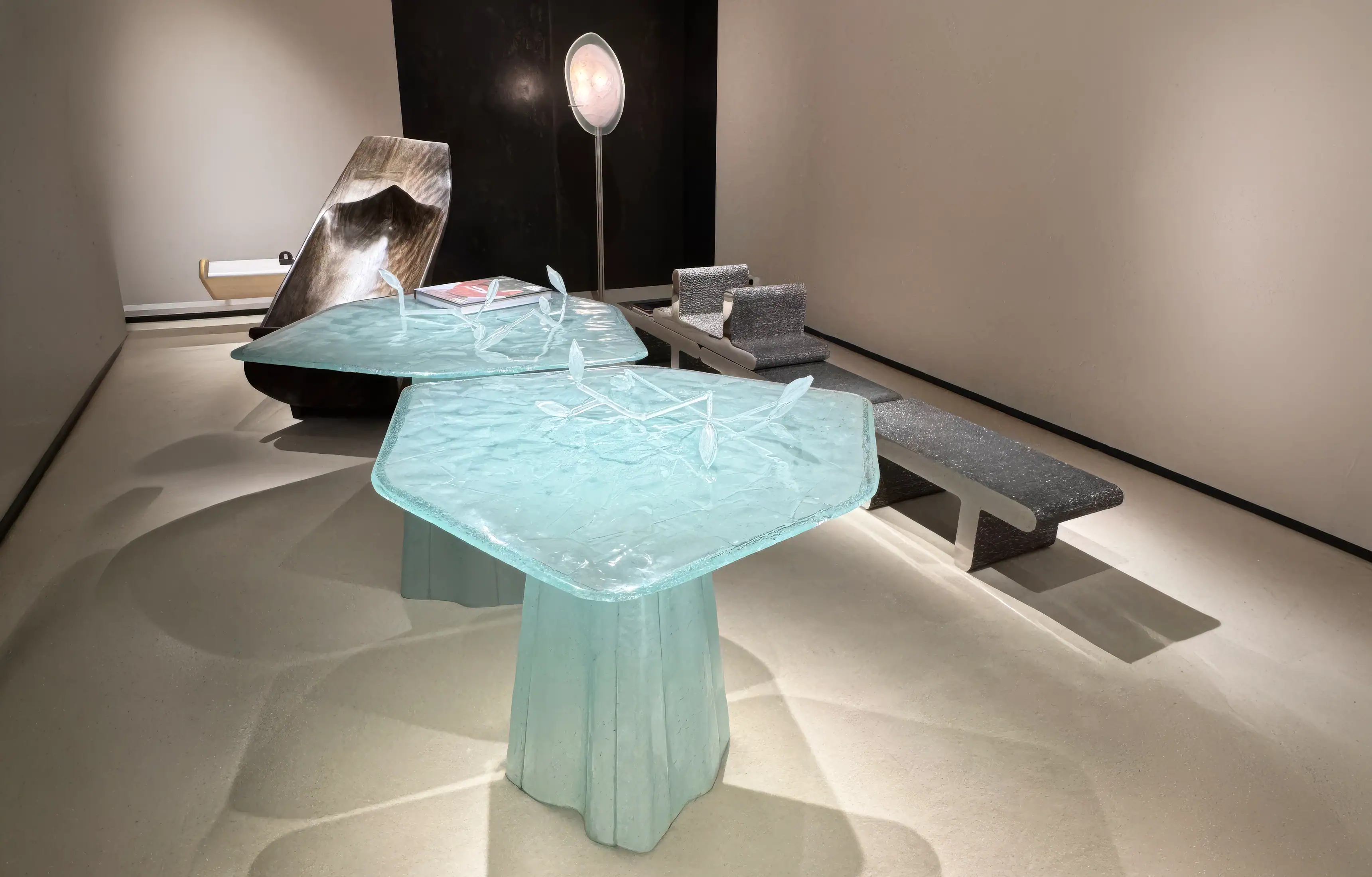
Friedman Benda
A fair that has always refused to grow
Perrin’s discipline about size is unusual in an industry that treats expansion as proof of relevance. PAD London 2025 brought together 67 galleries from 20 countries, a number barely changed from previous editions and well short of the ceiling Perrin has publicly set for himself. He personally knows each exhibitor, a claim that becomes credible once the guest list is this short, and the fair’s selection committee turns away far more galleries each year than it admits.
The result is a fair organised around depth rather than footfall. PAD Paris, the elder of the two events, opened in 1998 to cover ground that Art Basel and the young Frieze had left alone: decorative arts, design and jewellery treated with the same seriousness as painting and sculpture. PAD London followed nine years later, in 2007, at Hanover Square, before the fair relocated to Berkeley Square in 2016, trading a smaller Georgian square for one with a more generous private garden and, as it turned out, a design history of its own worth pitching a tent inside.
Perrin’s model has since become a small franchise rather than a chain: PAD Paris every April, PAD London every October during Frieze week, and a Geneva edition that now runs alongside Artgenève. None of them has grown to Art Basel’s scale, which appears to be the point rather than a limitation.


Æquo
From Hanover Square to a garden Kent designed twice over
Berkeley Square was laid out in the 1730s under the direction of William Kent, the architect who is generally credited with turning English interior design into a single, coordinated discipline rather than a sequence of separate trades. Kent designed the furniture at Chiswick House, Houghton Hall and Hampton Court Palace as part of the same commission that gave him the architecture, on the reasoning that a room’s proportions and the objects standing in it were one decision, not two. Horace Walpole called him “a painter, an architect, the father of modern gardening,” which understates the point: Kent is really the father of the idea that a building’s furniture is not decoration applied afterwards but part of what the building is.
That is precisely the argument PAD London spends six days making on his square. The fair does not separate architect-designed furniture from decorative art or from jewellery, and its strongest stands are the ones that can show a piece’s whole route from a named designer’s hand to a documented sale. Kent rehearsed that argument two centuries before Perrin arrived to pitch a tent on top of it.
The square itself still carries the evidence. Its London plane trees, planted in 1789, are among the oldest in central London, and the tree in the square’s southwest corner has been named a Great Tree of London and once assessed as the most valuable street tree in Britain. Most of the Georgian townhouses around the garden, once grand private addresses for figures including Robert Clive and a young Winston Churchill, have since become offices for the finance and consultancy firms typical of contemporary Mayfair. The design fair that appears there every October is now one of the few things left in the square still making Kent’s original argument in Kent’s original terms.


Galerie Meubles et Lumières
The archive that authenticates a chair
Few stands demonstrated the provenance argument more directly than Laffanour / Galerie Downtown, founded in Paris in 1982 by François Laffanour and Mara Cremniter, with Laffanour taking sole ownership a decade later. Laffanour built his reputation buying modernist furniture that other dealers overlooked, and in 2006 he acquired the archives of the Steph Simon gallery, which had published and sold designs by Jean Prouvé, Charlotte Perriand and their contemporaries between 1956 and 1974. Those archives let Laffanour authenticate pieces against original documentation rather than against a dealer’s word, which is precisely the difference between a design market built on connoisseurship and one built on attribution alone. At PAD London 2025 his stand carried work by Prouvé, Perriand, Le Corbusier, Serge Mouille and Isamu Noguchi, each traceable through the paperwork he has spent two decades assembling.
Rose Uniacke’s stand made a comparable case with a different generation of material, bringing an Alvar Aalto dining ensemble to the market for what dealers described as the first time, while Gallery B.R showed Jean Prouvé’s rare Aile d’Avion desk. In a fair this small, a single documented rarity does more work than an entire stand of decorative pieces without a paper trail behind them.


BOOROOM Gallery
Craft that crosses continents to get here
Not every stand at PAD London was trading in twentieth-century archives. Æquō, exhibiting from Mumbai, was founded by Tarini Jindal Handa and creative director Florence Louisy, who met in Paris in 2019 and identified a gap: nowhere was treating Indian craft traditions as collectible design in their own right. The gallery’s name, drawn from the Latin for equal, is meant literally. Æquō pairs international designers with Indian artisans on equal terms, crediting both the designer’s concept and the workshop’s technique rather than folding the craft into an anonymous “handmade” label.
Nilufar Gallery, founded by Nina Yashar and based in Milan, took two booths at PAD London 2025 rather than one. Its second stand was given entirely to Delhi-based designer Vikram Goyal, making his third appearance at the fair, showing a new body of work in patinated and nickel-finished brass built using repoussé and hollowed joinery, hand-cut and hammered by his Delhi studio. The collection ranged from the Bagh series of low tables and mirrors, drawing on the planting of historic Indian gardens, to a sixteen-foot run of Thar wall sconces whose rippled surface was built to evoke desert dunes. It is a body of work that names its own technique in its own vocabulary rather than reaching for a generic craft label, which is exactly what the provenance test asks for.


Laffanour Galerie Downtown
Design decades rediscovered, one dealer at a time
Galerie Meubles et Lumières was founded in 2014 by Guilhem Faget and Alexandre Goult, who met trading at the Paul-Bert Serpette flea market in Saint-Ouen and built a gallery devoted to rediscovering French and Italian design of the 1950s through the 1980s. At PAD London their stand centred on a fourteen-cushioned sofa designed by Maurice Marty in 1972, shown alongside work by Xavier Féal, a designer the gallery has championed through dedicated exhibitions of his stainless steel furniture and lighting.
Dumonteil, founded in Paris in 1982 and now operating twin spaces in Paris and Shanghai as Dumonteil Contemporary and Dumonteil Design, brought bronze, brass and lacquer pieces by Jean-Marie Fiori and Daniel Daviau, continuing more than four decades of the same specialism. BOOROOM, founded in Dubai’s Business Bay in 2014 by Irina Budtseva-Vinitskaya and joined two years later by her husband Maxim Vinitsky, showed work that sits deliberately between sculpture and furniture, part of a wider push at PAD London this year to treat twenty-first-century collectible design with the same seriousness usually reserved for the historical stands.


Charles Burnand Gallery
Eleven new names, and the first from the Middle East
Eleven galleries exhibited at PAD London for the first time in 2025, the largest single intake of new exhibitors in the fair’s history at Berkeley Square. PIK’D, based in Beirut, became the fair’s first gallery from the Middle East, showing ceramics and glass. Friedman Benda, the New York gallery founded in 2007 that has since built a roster spanning five continents, brought new work by Faye Toogood and Najla El Zein. NM Art & Design arrived from Cyprus, and Charles Burnand Gallery, founded in London in 2009 by Simon Stewart and now a regular at Design Miami, Collect and PAD, showed pieces exploring monumentality in hand-silvered glass and charred wood.
The scale of that intake matters more at a fair capped at 70 exhibitors than it would at a larger one. Eleven new galleries out of 67 is a meaningful reshuffling of a guest list Perrin keeps deliberately short, and it suggests the fair is still actively rotating in new specialisms rather than settling into a fixed roster of the same dealers each October.


Dumonteil Design
The same week as Frieze Masters, a short walk from the tents
PAD London deliberately schedules itself during Frieze week, and in 2025 its run from 14 to 19 October overlapped almost exactly with Frieze Masters, which opened in The Regent’s Park on 15 October and closed on the same day as PAD. The two fairs sit roughly two and a half miles apart, one in a Mayfair square and one under a tented structure in a royal park, and between them they gave London’s collectors a single continuous week of historical and collectible material to move between.
Gallery FUMI, which returned to PAD London 2025 to premiere sculptural woodwork by Jesse Schlesinger, is a useful thread between the two. The same Mayfair gallery filled its Hay Hill townhouse for Casa al Mare, its third summer exhibition, turning the space into an Aeolian-inspired “house by the sea” earlier in 2025. A gallery capable of running both a townhouse exhibition and a fair stand in the same year, within walking distance of each other, is a fair description of how concentrated Mayfair’s collectible design district has become.
Entry to PAD London 2025 cost £30 for adults and £15 for students with valid identification, with children under 15 admitted free, a pricing structure that keeps the fair accessible to the design-literate public it says it wants, rather than restricting the garden entirely to trade visitors and existing collectors.


Nilufar Gallery
What is PAD London?
PAD London is an annual fair for twentieth and twenty-first century collectible design and jewellery, held in a tented structure in Berkeley Square, Mayfair. It was founded in 2007 by Patrick Perrin as the London edition of PAD Paris.
When did PAD London 2025 take place?
PAD London 2025 ran from 14 to 19 October 2025 in Berkeley Square, London W1J 5AS, during the same week as Frieze London and Frieze Masters.
How many galleries exhibited at PAD London 2025?
Sixty-seven galleries from 20 countries took part, including 11 first-time exhibitors, among them PIK’D from Beirut, the fair’s first Middle Eastern gallery.
Who founded PAD London?
Patrick Perrin, a fourth-generation Parisian antique dealer, founded PAD Paris in 1998 and launched the London edition in 2007, initially at Hanover Square before the fair moved to Berkeley Square in 2016.
What makes PAD different from a general art fair?
PAD is dedicated exclusively to twentieth and twenty-first century design, decorative arts and jewellery, deliberately capped at around 70 galleries so that the fair stays smaller and more curated than fairs such as Art Basel.
What did tickets to PAD London 2025 cost?
Adult tickets were £30, student tickets with valid identification were £15, and children under 15 were admitted free.
Is PAD held anywhere else?
Yes. PAD Paris runs every April at the Jardin des Tuileries, and PAD has also run editions in Geneva alongside Artgenève.
Final thoughts
The easy way to write up a fair this size is by its numbers: 67 galleries, 20 countries, 11 debuts, a fourth-generation antique dealer at the centre of it. All of that is true, and none of it explains why PAD London is worth returning to every October rather than treating it as one stop among many during Frieze week.
The real case is the one Berkeley Square has been making since William Kent designed it: that a room and the objects inside it are a single decision, not two, and that the value of a piece of furniture is inseparable from who made it and how the making can be proven. Laffanour’s Steph Simon archive, Æquō’s insistence on crediting the artisan alongside the designer, Vikram Goyal’s studio-specific vocabulary of repoussé brass, all make the same argument from different directions. A fair that capped itself at 70 galleries never had the option of hiding a weak stand behind scale, so it built its reputation on paperwork and named hands instead.
Perrin has kept PAD at roughly the same size for eighteen years, which in an industry built on expansion is itself a kind of argument. The square he chose to make it in was designed by a man who thought exactly the same way about the objects inside a room. PAD London did not need to say so out loud in 2025. The trees, the townhouses and the paperwork on every serious stand were already making the point.


Leave a Reply