
ART & CULTURE · LONDON
Reading time: 7 minAdrian Berg painted Regent’s Park from his own doorstep for two decades. In October 2025, Frestonian Gallery hung those paintings inside a tent pitched in the same park, a few hundred metres from where he worked. It was the clearest example of what Frieze Masters’ fourth section, Reflections, and its new director were both arguing all week: that historical art gets its charge from a named person and a specific room, not from an era.
Frieze Masters returned to The Regent’s Park, London, from 15 to 19 October 2025, for its fourteenth edition. More than 120 galleries from 26 countries filled the fair’s tents with material ranging from Roman Imperial portraiture to paintings finished within living memory, run alongside Frieze London a short walk across the park.
It was also the first edition under a new director. Emanuela Tarizzo, previously an independent art adviser and a director at the Old Masters and sculpture gallery Tomasso, took over from Nathan Clements-Gillespie, who had led the fair for four years and announced his departure in January 2025.
The scale and the leadership change are the headline facts. The more interesting story is what the fair chose to argue with them. Across a new curated section, a returning one, and a single gallery stand a short walk from Gloucester Gate, Frieze Masters 2025 kept making the same case: that the past is most alive when it is tied to a name, a workshop, or a room, rather than sold as a period.


Tenzing Asian Art
What Frieze Masters is, and why it exists alongside Frieze London
Frieze London launched first, in 2003, founded by Matthew Slotover and Amanda Sharp as a fair for contemporary art. Frieze Masters followed nine years later, in 2012, under founding director Victoria Siddall, built specifically to cover everything the contemporary fair does not: antiquities, Old Masters, twentieth-century painting and sculpture, and historical work from beyond Europe. Siddall went on to run Frieze’s fairs globally for eighteen years before leaving in 2022; she is now director of the National Portrait Gallery.
The two fairs share a park and a week but not a remit. Frieze London is where a gallery shows what an artist is making now, and its own 2025 edition made that case with a floor plan built to put its newest galleries at the entrance. Frieze Masters is where a gallery makes the case for what has already been made, and for the specific expertise, provenance and connoisseurship that separates a genuine rediscovery from a decorative object with an old story attached. That distinction is what the 2025 edition spent five days demonstrating.


Tomasso
A new director’s first edition
Emanuela Tarizzo was appointed in March 2025 and started that April, giving her roughly six months to shape an edition she had not built from scratch. Her background suited the brief: at Tomasso, the Leeds and London gallery founded by brothers Dino and Raffaello Tomasso in 1993, she worked inside exactly the kind of connoisseur-led trade in European sculpture and Old Masters that Frieze Masters exists to showcase. Tomasso itself returned to the fair in 2025 after several years’ absence.
“I am honoured to join Frieze Masters at such a pivotal time,” Tarizzo said on her appointment. “From its inception, the fair has stood out for its innovative narrative.” Kristell Chadé, Frieze’s executive director of fairs, said Tarizzo would focus on “deepening relationships with leading museums and collectors whose insight and ambition shape the field.”
By the numbers, the edition she delivered was substantial: 120-plus galleries from 26 countries, five new exhibitors including Vito Schnabel Gallery, Champ Lacombe and Luisa Strina, and, across the shared Frieze week, 90,000 visitors from 108 countries, including more than 400 museum patron groups from over 47 countries.
The park hangs its own portrait
The fair’s most specific piece of storytelling had nothing to do with scale. Between 1969 and 1988, the painter Adrian Berg lived in St Katharine’s Precinct, on Gloucester Gate, at the northern edge of Regent’s Park, and made the park his subject for two decades: its seasonal light, its formal planting, its water. He painted it with a precision that owed as much to music and colour theory as to observation.
At Frieze Masters 2025, Frestonian Gallery, the west London gallery founded in 2017 and based at The People’s Hall, brought a group of those paintings back to the park itself: two large canvases the gallery describes as the peak of Berg’s engagement with the site, alongside watercolours, earlier smaller works and paintings from his St Katharine’s Precinct series. The gallery calls the presentation “a fragment of a love letter that Berg spent twenty years crafting, rediscovered some forty years later, on his own doorstep.” It is a rare instance of a Frieze Masters stand and its subject occupying, quite literally, the same address.


Offer Waterman
Three sections, argued through people rather than periods
Three curated sections carried the same idea into different corners of the fair, each organised around a named curator rather than a chronological sweep.
Studio, curated by Sheena Wagstaff, chair emerita of modern and contemporary art at the Metropolitan Museum of Art, with Margrethe Troensegaard, presented solo work by six artists: Dorothy Cross with Frith Street Gallery, Anju Dodiya with Vadehra Art Gallery, Samia Halaby with Sfeir-Semler Gallery, R. H. Quaytman with Miguel Abreu Gallery, Anne Rothenstein with Stephen Friedman Gallery, and Glenn Brown with Gagosian. The section framed the artist’s studio as, in the fair’s own phrase for the idea, a place where historical memory sparks new invention.
Spotlight, curated by Valerie Cassel Oliver, the Sydney and Frances Lewis Family Curator of Modern and Contemporary Art at the Virginia Museum of Fine Arts, gathered 26 galleries around under-recognised twentieth-century figures, concentrated in the 1950s to 1970s. It included Bertina Lopes, the Mozambican-Italian painter and activist, in her first London survey, alongside Cildo Meireles’s works on paper, Sonja Sekula’s scratch paintings, and presentations of Sonja Ferlov Mancoba, Helena Almeida, Novera Ahmed and Nalini Malani, among others.
Reflections, a new section curated by Abby Bangser across six galleries (AGO Projects, Brun Fine Art, Ippodo Gallery, Elliot Davies Fine Art, Erskine, Hall & Coe, and Vagabond), took its cue from two house-museum collections: Sir John Soane’s Museum in London, with its dense, architectural arrangement of antiquities and fragments, and Kettle’s Yard in Cambridge, whose founder Jim Ede lived among the ceramics and paintings he collected. The section included studio ceramics by Hans Coper, Lucie Rie and Jennifer Lee, shown in the domestic, lived-in spirit of both collections rather than as a survey. It is the same collector’s instinct behind the maker’s library built for Collect 2026’s Collectors’ Lounge, turned here toward antiquities and fragments rather than contemporary craft.


Frestonian Gallery
The specialist trade doing the quiet work
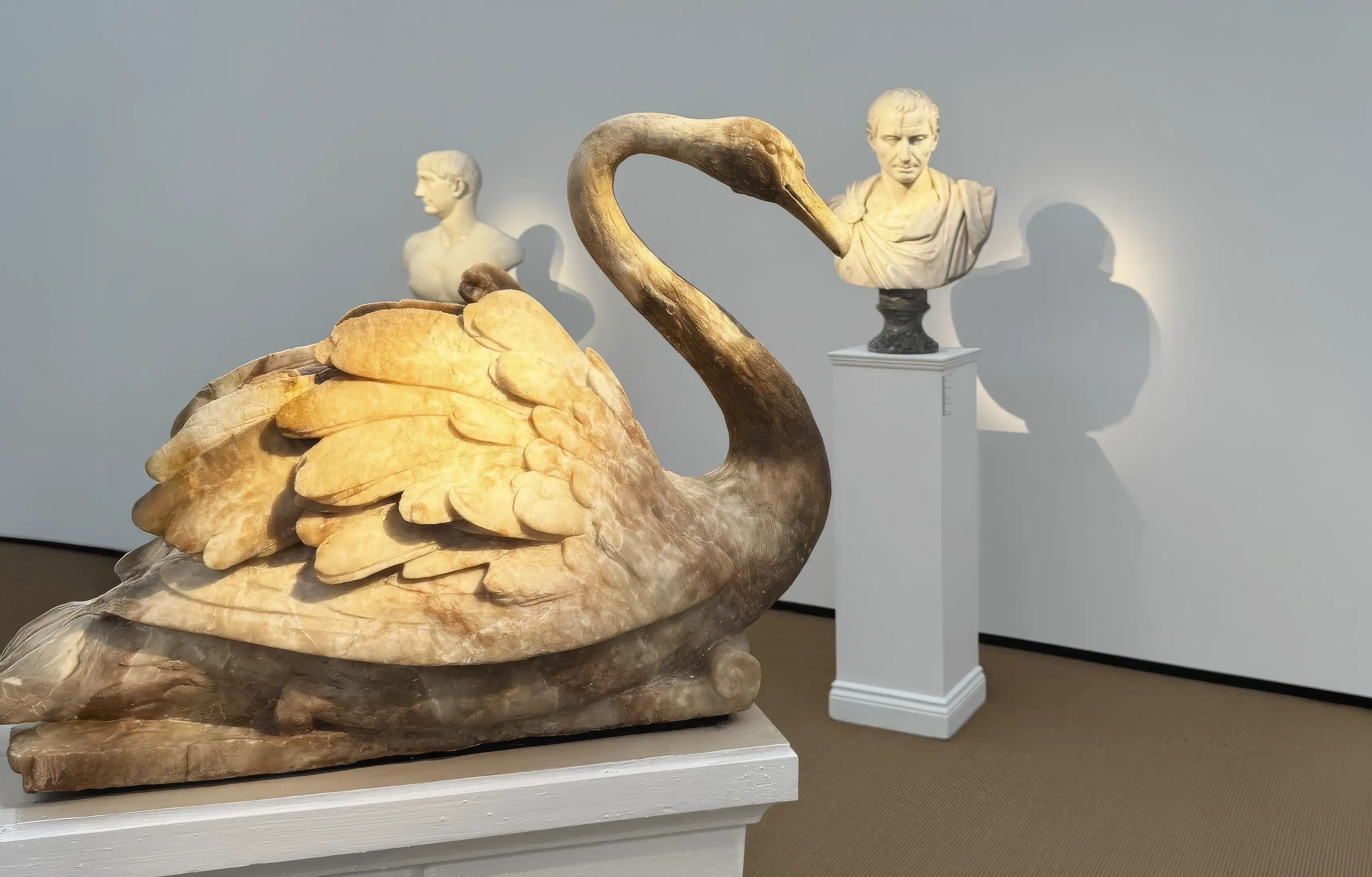
Away from the curated sections, the fair’s older business, connoisseurship and rediscovery, was on full display. Tenzing Asian Art, founded in 2006 by Iwona Tenzing and joined in 2015 by Chino Roncoroni (a contributor to the Art Institute of Chicago’s 2003 exhibition “Himalayas: An Aesthetic Adventure”), showed Himalayan objects from the early Kashmiri Buddhist, Pala Indian and Licchavi Nepali periods. Offer Waterman, founded in Chelsea in 1996 and now based in a five-storey Georgian townhouse on St George Street, Mayfair, that once housed a William Morris & Co. showroom, brought its expertise in twentieth-century British art, built over exhibitions including a Frank Auerbach centenary show in 2024 that drew more than 5,000 visitors.
Rediscoveries anchored several stands: David Aaron Ltd showed a Late Period Egyptian statue newly attributed to the so-called Greywacke Master, working around 570 to 526 BC. Bowman Sculpture exhibited a rediscovered Edgar Degas bronze, Danseuse Saluant, alongside works by Rodin and Zadkine. At Hauser & Wirth’s stand, the artist Nicolas Party curated a selection of nineteenth and twentieth-century paintings, setting Louise Bourgeois’s Lair (1962) and Marcel Duchamp’s Jaquette (1956) against artists who have shaped his own practice, including Félix Vallotton and Hans Emmenegger.
What sold, and what it says about the market for historical work
Sales confirmed the market’s appetite for material with a documented history. Gabriele Münter’s Der blaue Garten (Mein Gartentor) (1909) sold through Hauser & Wirth for close to $3 million, and a René Magritte, Le domaine enchanté, went for $1.6 million from the same stand. Robilant+Voena placed three Lucio Fontana works from its Concetto Spaziale series, ranging from roughly $230,000 to $1.86 million, evidence of sustained demand across a single artist’s output rather than one headline lot. D’Lan Contemporary set record prices for the Aboriginal Australian artists Makinti Napanangka and Naata Nungurrayi, part of a broader push at the fair to give Indigenous Australian and Mexican traditions their own dedicated space rather than folding them into a general historical survey.


Axel Vervoordt
The wider week
Frieze Masters shares its dates with Frieze Sculpture, which opened earlier, on 17 September, and runs until 2 November 2025 across the park’s English Gardens, curated in 2025 by Fatoş Üstek with digital access provided through Bloomberg Connects. Deutsche Bank marked its 22nd consecutive year as Frieze’s global lead partner, presenting new work by the French artist Noémie Goudal alongside its long-running collecting programme. Neither is Frieze Masters itself, but both frame the same week and the same park, and both point the same way: toward named artists and specific commissions rather than a generic art-fair backdrop, the same argument this site has traced through Design Miami’s twentieth-anniversary edition and the Gulf’s own three-fair expansion of Design Miami, NOMAD and Frieze. A short walk south in Berkeley Square, PAD London ran the same week, making a parallel case for named makers and documented provenance across a much smaller, deliberately capped guest list of design and decorative art galleries.
What is Frieze Masters?
Frieze Masters is an art fair in The Regent’s Park, London, dedicated to historical work, from antiquity to the late twentieth century, run alongside the contemporary-focused Frieze London.
How is Frieze Masters different from Frieze London?
Frieze London, founded in 2003, shows work by living artists made in the present. Frieze Masters, launched in 2012, is dedicated to historical and twentieth-century material and the connoisseurship behind it.
When did Frieze Masters 2025 take place?
Frieze Masters 2025 ran from 15 to 19 October 2025 at The Regent’s Park, London.
How many galleries exhibited at Frieze Masters 2025?
More than 120 galleries from 26 countries took part, including five new exhibitors: Vito Schnabel Gallery, Champ Lacombe, Galerie Mueller, Joost van den Bergh and Luisa Strina.
Who directed Frieze Masters 2025?
Emanuela Tarizzo directed the 2025 edition, her first since being appointed in March 2025. She succeeded Nathan Clements-Gillespie, who had led the fair for four years.
What were the curated sections at Frieze Masters 2025?
Three sections: Studio, curated by Sheena Wagstaff and Margrethe Troensegaard around six solo artist presentations; Spotlight, curated by Valerie Cassel Oliver around 26 galleries showing under-recognised twentieth-century figures; and Reflections, a new section curated by Abby Bangser and inspired by Sir John Soane’s Museum and Kettle’s Yard.
Final thoughts
The easy way to cover an art fair of this size is by the numbers: 120-plus galleries, 26 countries, 90,000 visitors across the week, a headline sale near $3 million. All of that happened, and none of it is the reason the 2025 edition is worth remembering.
What made this edition distinct was its insistence on the specific over the general. Reflections built an entire new section on the collecting habits of two individuals, Sir John Soane and Jim Ede, rather than a period or a movement. Spotlight gave Bertina Lopes a first London survey rather than a place in a group hang. And Frestonian Gallery, without any curatorial brief at all, brought Adrian Berg’s paintings of Regent’s Park back into Regent’s Park, closing a forty-year gap between where the work was made and where it was finally shown.
That is the argument a new director made in her first edition, whether or not it was stated as one: that a fair built on history earns its authority one named person, one documented object and one specific room at a time. The scale is what gets reported. The specificity is what gets remembered.


Leave a Reply