
Design Travel · Palm Springs
Reading time: 8 minBehind a wall of palms on thirteen acres of Californian garden, the Parker is a 144-room love letter to hedonism — a former Holiday Inn turned Gene Autry ranch turned Givenchy spa, reborn by Jonathan Adler as the most joyfully maximalist hotel in the desert.
Some hotels whisper their luxury; the Parker Palm Springs positively cackles with it. Hidden behind a tall screen of palms, lush foliage and riotous blooms on the edge of one of California’s most design-obsessed towns, it is the kind of place you could drive straight past without ever suspecting the thirteen acres of gardens and the five-star pleasure palace concealed just out of sight. Those who do turn in, though, are delivered into a world of quirky glamour, cheeky indulgence and mid-century abandon that has few equals anywhere. This is not a hotel that trades in restraint. It is a hotel that trades in delight.

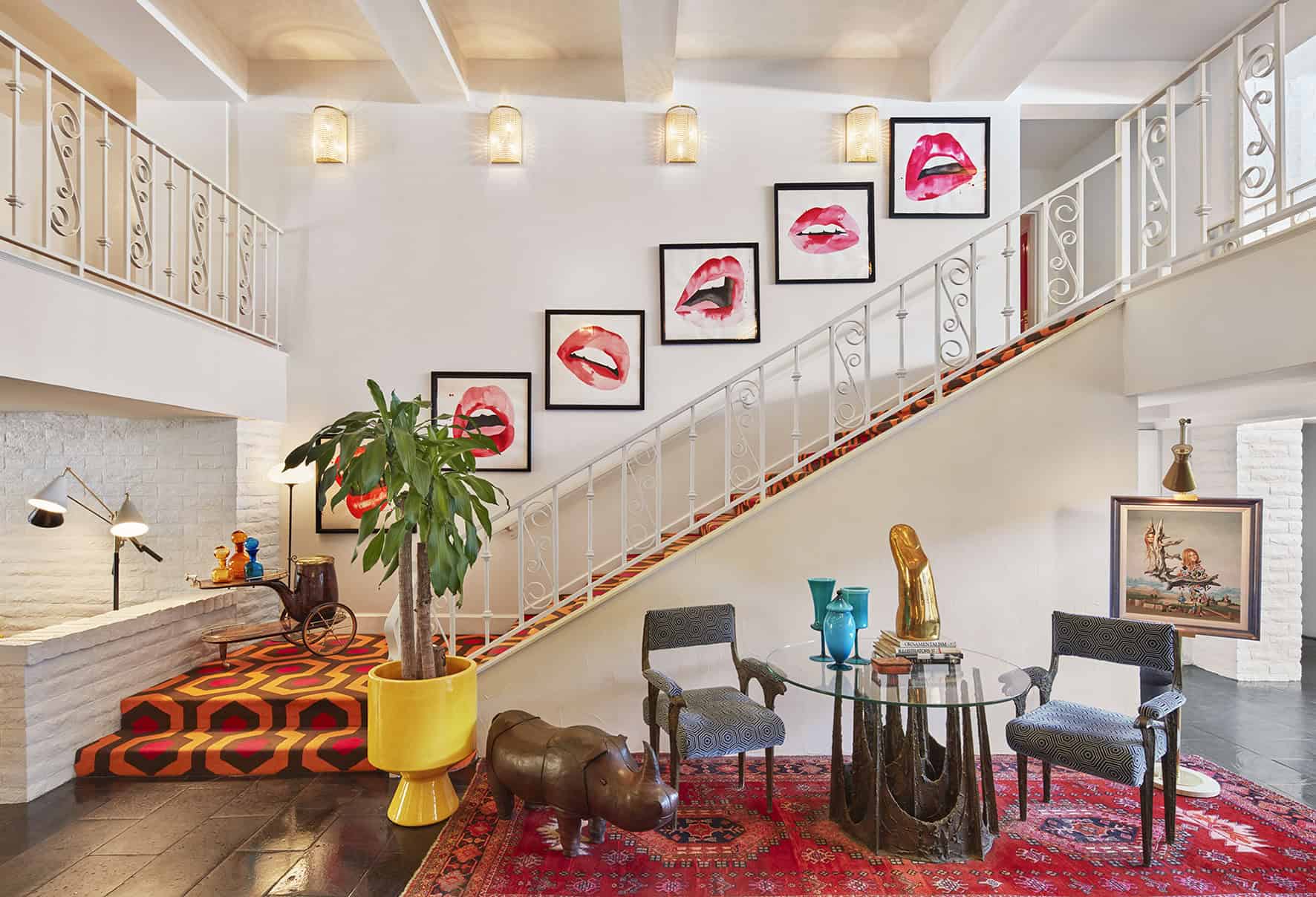
Much of that delight is the work of one man. When the New York designer Jonathan Adler was handed the keys to the property in the early 2000s, he did not so much decorate it as choreograph it, turning the resort into a technicolour stage set for the good life. More than two decades on, the Parker remains the fullest, most confident expression of his happy-hedonism philosophy: a place where nothing is beige, nothing is timid, and everything, from the orange front doors to the golden Art Deco bar stools, is designed to make you smile.
A building with several past lives
To understand the Parker, it helps to know how many hotels it has already been. The property first opened in 1959 as California’s first Holiday Inn, a crisp piece of roadside modernism in a town that was fast becoming the weekend playground of Hollywood. In 1961 it was bought by the singing cowboy Gene Autry, who renamed it after his radio show and used it, rather wonderfully, to house his baseball team, the California Angels, during their spring training. For a while, the desert resort doubled as a locker room for major-league ballplayers.

Its next incarnation was grander and more Gallic. Under later ownership the resort was reimagined by the designer Hubert de Givenchy and the hotelier Rose Narva as a Versailles-inspired French fantasy, and in 1998 it was acquired by the television mogul Merv Griffin, who ran it as Merv Griffin’s Resort Hotel and Givenchy Spa and drew a steady stream of celebrity guests. Powdered, gilded and gloriously theatrical, it gave the property a romantic French register all of its own, a spirited counterpoint to the breezy modernism of its origins.
The version we know today arrived in 2003, when the New York developer Jack Parker bought the property and commissioned Jonathan Adler, together with a team of landscape architects, to deliver a comprehensive twenty-seven-million-dollar overhaul. Reopening as the Parker Palm Springs in 2004, it took on a new register, loose, witty and unmistakably American: a mid-century desert idyll seen through Adler’s irreverent, colour-drunk eye. He returned in 2017 to refresh the interiors, dialling up the cheeky, hedonistic Californian glamour. Few hotels have worn so many faces; fewer still have found one that fits so perfectly.

The Adler effect
Every corner of the Parker has a personality, and most have several. Adler’s approach was not to impose a single scheme but to curate a magpie’s hoard of antiques, art and mid-century treasures, then let those pieces dictate the colours, patterns and materials around them, so that each object feels as though it has always belonged. The result is an interior that reads like a lived-in, slightly eccentric private estate that happens to have 144 bedrooms.
The tone is set before you are even indoors. Guests arrive through a twenty-three-foot breeze-block brise-soleil and a pair of now-iconic orange front doors — a jolt of citrus against the desert light that functions as a kind of design manifesto. Step through them, and the ordinary world is left firmly outside.
“As soon as guests pass through the breeze-block screen and the iconic orange doors, they are delivered into an extraordinary world that brings an involuntary smile.”

A lobby made for lingering
Beyond the doors, the lobby unspools along the main building as a series of loosely defined rooms, each an invitation to sit down and stay a while. The reception desk is tucked discreetly to one side, a deliberate move that keeps the decor, rather than the check-in ritual, as the centre of attention. Plush rugs in a clash of colours, shapes and styles anchor an assortment of sofas, armchairs and coffee tables, arranging the space into intimate conversational islands.

At its heart, beside the jewel-box Mini Bar, a double-height seating area rises beneath a spectacular mid-century gold chandelier. Here hangs the much-photographed “Drugs” artwork, presiding over an alcove studded with thirty decorative lanterns in vivid, sweet-shop colours. Towards the back, a cosy winter lounge borrows the language of a log cabin — swing chairs, buttery leather seating and a crackling open fire pit — proof that even in the desert, the Parker understands the appeal of somewhere to hunker down.

Five ways to eat, drink and misbehave
A hotel this theatrical needs somewhere to perform, and the Parker obliges with five distinct food and drink venues, each with its own mood. Norma’s is the sunny extrovert: a vibrantly dressed outdoor terrace where a celebrated all-day breakfast is served against the greens of the garden and the blue of the sky, its booths upholstered in burnt orange and dotted with bright button cushions. Mister Parker’s, by contrast, is the seductive one — a jewel of formal dining where mirrored ceilings bounce light across a bold geometric carpet, and dark wood-panelled walls hung with an eclectic array of artwork lend the low-lit room an intimate, faintly wicked glamour, ideal for a long and romantic evening.

Then come the bars, and this is where Adler’s imagination really lets loose. Counter Reformation, a tiny wine bar hailed as a “shrine”, is staged with glossy black running-bond tiles, an ornate black tin ceiling and eye-catching red cement floor tiles; it has no tables and no chairs, only a bar and a ledge to lean on, a design decision that all but forces guests to mingle. The Mini Bar, reached straight from the lobby, opens like a jewellery box: gold-studded blue velvet doors part to reveal dark emerald stone across the ceilings, walls and floors, inset with mirrored detailing and crowned by a row of gleaming golden Art Deco bar stools. It is Hollywood glamour compressed into a few square metres. Out in the sunshine, the Lemonade Stand — set beside the pétanque court, wrapped in a classic yellow-and-white striped awning and furnished with colourful Bertoia stools — pours lemonade and cocktails to registered guests alone, a nostalgic little full stop to the property’s roster of watering holes.

The Palm Springs Yacht Club
If the bars are the Parker at its most extrovert, the spa is the Parker at its most tongue-in-cheek. Named, with a straight face, the Palm Springs Yacht Club, it carries the hotel’s eclectic mid-century spirit into distinctly nautical territory, pared back to a crisp palette of red, white and blue. A serene calm settles the moment you enter; expansive double-height ceilings and metallic wallpaper conjure a sense of space and indulgence, while decorative wall mouldings play up the yacht-club conceit. At its centre lies an indoor saltwater pool trimmed with uniform nautical stripes, and the bold graphic outlines on the awnings, textiles and draperies give the whole space a comic-book crispness — a witty, restorative sanctuary several hundred miles from the nearest ocean.


Thirteen acres of play
For all its interior fireworks, the Parker is also a garden hotel, and its thirteen acres of grounds are as much a part of the experience as any bar or bedroom. Framed by the desert and the San Jacinto mountains beyond, the gardens thread lawns, citrus and blooms between the buildings, dotted with the props of a grown-up playground: pétanque and croquet, hammocks strung between the trees, and two swimming pools, including an adults-only retreat for those in search of quieter sunbathing. It is a landscape designed, like everything here, for lingering and for play.

Rooms that feel like private galleries
That same collector’s sensibility shapes the accommodation. Across eight distinct categories of villa, suite and room, the Parker’s spaces read almost like gallery interiors, layered with mid-century antiques and art that make each one a home away from home and unmistakably part of the Parker world. At the top sits the grand, gated Gene Autry Residence, a two-bedroom, two-bathroom retreat with its own private treatment room, sauna and generous terrace. The Hammock Rooms offer a gentler kind of exclusivity, with a private outdoor space to laze away an afternoon among the blooms and manicured planting. Whichever you choose, it is the meticulous detail — the curated objects, the confident colour, the sense of narrative — that lingers longest.


More than twenty years after Adler first threw open those orange doors, the Parker Palm Springs remains gloriously, defiantly itself: a hotel that refuses to grow up, and is all the more seductive for it. It makes a persuasive case that true luxury lies in personality, in the confidence to be joyful, eccentric and entirely, unmistakably one of a kind. Two decades on, that conviction still feels as fresh as a jolt of citrus against the desert light.




Leave a Reply