Design Travel · New York
Reading time: 8 minIn partnership with Marriott, Ian Schrager dropped a hushed, monochrome design hotel into the neon heart of Times Square — a “decompression chamber” of Venetian plaster, a Michelin-starred restaurant, a cabaret theatre and a hanging garden in the sky, all a floor or two above the chaos.
Times Square is New York City’s most recognisable crossroads, a place synonymous with towering screens, blinding light and the ceaseless churn of visitors from every corner of the globe. It has not always worn this face; the district has cycled through glamour, grit, decline, and reinvention many times over the past century, and it is still changing. Into this most improbable of settings, the hotelier Ian Schrager, working in partnership with Marriott International, introduced the neighbourhood’s first true design hotel: The Times Square EDITION, a property that sets out not to compete with the spectacle outside but to offer sanctuary from it.

That is the great, counter-intuitive idea at the centre of the building. Rather than amplify Times Square, the EDITION mutes it. In a location engineered to overstimulate, Schrager and his team have created something calm, considered and quietly luxurious; a hotel that treats serenity as the ultimate urban indulgence. It is a bold gesture, and a characteristically clever one from the man who effectively invented the boutique hotel, and who has spent a career understanding that the most desirable thing in a crowded city is somewhere to breathe.

Few people in hospitality carry a pedigree quite like Schrager’s. The co-founder of Studio 54, he went on to reshape the very idea of the hotel in the 1980s and 1990s with Morgans, the Royalton and a string of properties that fused nightlife energy, cutting-edge design and a sense of theatre into something entirely new. EDITION is the brand through which he has translated that instinct for a broader, global audience, developed in partnership with Marriott: a collection of individually conceived hotels that pair Schrager’s design sensibility with the reach and operational muscle of the world’s largest hotel company. The Times Square outpost is arguably the most audacious expression of the formula, proof that carefully calibrated cool can flourish when planted in the most commercial square mile in America.

The decompression chamber
The sense of retreat begins before you have properly arrived. Schrager sets aside the convention of the grand hotel entrance and its oversized lobby in favour of something more intimate. Guests are led through a corridor towards a sculptural, green mirrored sphere, the walls and ceiling around them wrapped in beautiful ivory-coloured Venetian plaster. The hotel itself describes this hushed threshold as a “decompression chamber”: a deliberate buffer between the energy of the street and the tranquillity waiting upstairs.

It is a piece of theatre, and a subtle one; an architectural exhale. By the time you emerge from it, the volume of the city has been turned down, and the mind has begun to settle. The hotel understands the psychology of arrival exceptionally well, and has the confidence to make its opening move a moment of near-silence in the middle of Times Square.

A monochrome respite
That restraint carries through into the lobby and lobby bar, which unfold as a series of black-and-white spaces, almost monochromatic in feel, lifted by carefully chosen notes of brass and evergreen. The muted palette is the whole point: in a location defined by the vivid electric glow of the billboards outside, a limited, near-colourless interior becomes a genuine relief, a cool grey-scale room in which the eye can finally rest.

The Lobby Bar extends the mood outward onto a wraparound terrace with views over the square, so that guests can survey the famous chaos from a position of studied calm, in it, but pointedly not of it. It is the essence of Schrager’s approach: the glamour of the location without its exhaustion.

701 West and a Michelin first
If the lobby is about withdrawal, the dining is where the EDITION allows itself a flourish. The property’s culinary programme was placed in the hands of the chef John Fraser, notably the first Michelin-starred chef ever to set up in the neighbourhood, a small but telling marker of the hotel’s ambition to change what Times Square could mean. His fine-dining restaurant, 701 West, sits on the eleventh floor and went on to earn a Michelin star of its own, its menu drawing confidently across French, Asian and Latin influences.

The room is a beauty. Walls and ceiling are lined with warm wood grid panelling, matched by floor-to-ceiling Venetian blinds at the windows, while the floor is laid with elegant ivory mosaic tiles in a traditional fan pattern borrowed from the classic French brasserie. Then comes the twist: the diamond-tufted booth seating erupts in vivid blues and greens, a jolt of colour and eccentricity against the calm of the panelling. It is a room that knows exactly when to whisper and when to raise its voice.

Cabaret, and the reinvention of the billboard
For all its serenity, the EDITION does not forget where it is. Schrager leaned into the district’s theatrical heritage in two very different ways. The first is the Paradise Club, a high-production cabaret and nightlife venue that revives the spirit of old Times Square glamour with a contemporary, boundary-pushing edge: a supper-club spectacle for a modern crowd. The second is subtler and wittier: a complete reinvention of billboard art, turning the very medium that makes Times Square so overwhelming into a curated canvas, and reclaiming the neighbourhood’s defining visual language as something closer to installation than advertising.

Together, they signal a hotel entirely fluent in its surroundings. The EDITION shows that elegance belongs here, on the hotel’s own terms. It is an accomplished piece of work: to sit at the centre of the world’s most energetic piece of commercial theatre and remain the coolest, most composed presence in the room, and the ease with which the hotel does it says a great deal about the precision of the thinking behind it.

In a location engineered to overstimulate, Schrager treats serenity as the ultimate urban indulgence — a hotel that turns the volume of Times Square down rather than up.
A garden in the sky
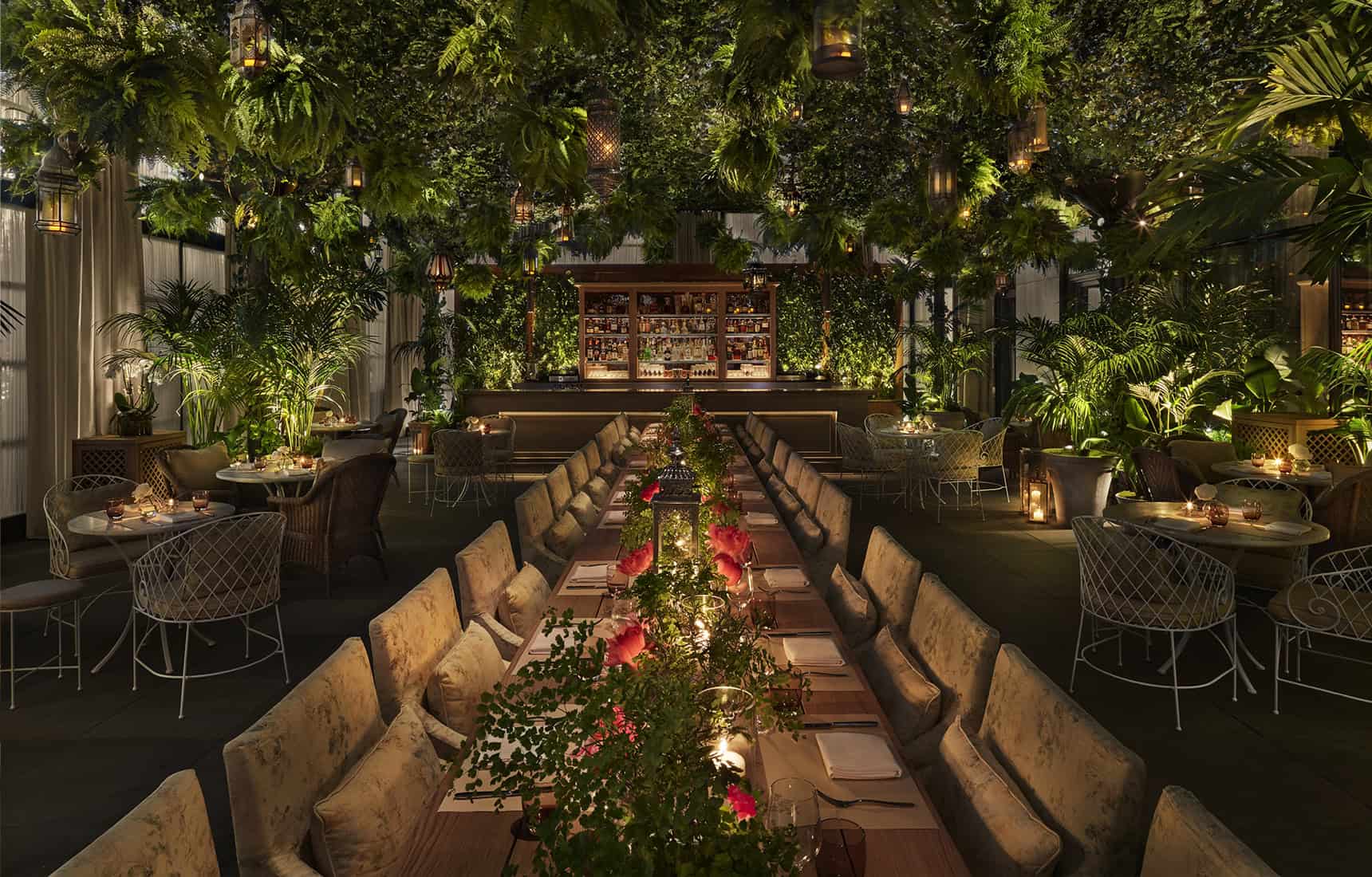
Perhaps the most surprising space of all is outdoors. The terrace and gardens take their cue from the Orangerie at the Jardin des Tuileries in Paris, and were designed by the celebrated landscape designer Madison Cox. Thousands of plants and trees, decorative palms, hanging ferns, and trailing English ivy climb across multiple levels to create a green oasis in the sky, high above one of the most famous crossroads on earth.

Wicker and wrought-iron garden furniture lend the space an easy, European elegance, while collections of Moroccan lanterns bring a flicker of romance as the sun goes down. Best of all are the glimpses: through small gaps in the dense foliage, the twinkling lights of the Manhattan skyline appear, a gentle reminder of exactly where you are and of the extraordinary views the hotel commands. It is a masterful piece of contrast; a soft, planted, candle-lit refuge suspended directly above the hardest-edged corner of New York.

Rooms shaped for calm
That same philosophy of quiet luxury runs through the accommodation. Across its 452 rooms, the hotel offers five variations of guest rooms alongside three types of suites, rising to an ultra-luxurious Penthouse with views over both Times Square and, beyond it, the Hudson River. Whatever the category, the language is consistent and deliberately soothing: light natural woods, soft leather, fresh white linens and the brand’s now-signature restraint, finished with considered touches such as Le Labo bathroom amenities.

There is nothing shouty here, no attempt to recreate the drama of the street indoors. The rooms are, in the best sense, a place to switch off; the private counterpart to the public decompression chamber below.

The hotel that came back
The Times Square EDITION has also proved unexpectedly resilient. Opened in 2019 to considerable acclaim, it became an early and high-profile casualty of the pandemic, announcing a permanent closure in 2020, barely a year into its life. That it subsequently reopened, and continues to operate today, feels entirely in keeping with the neighbourhood it inhabits; a district that has itself been written off and reborn more times than anyone can count.

After decades of transformation, affection, and reinvention, Times Square retains a cherished place in the city’s heart, and the EDITION adds a welcome edge of sophistication. By introducing art, glamour and a new level of fine dining to a corner celebrated for its exuberance, the hotel gives something back to the neighbourhood, drawing not only visitors to the city but New Yorkers themselves back to a place they can once again call their own. In doing so, it makes the most persuasive case imaginable for Schrager’s founding conviction: that even in the loudest place on earth, the greatest luxury of all is a little peace and quiet.

Project Credits
Go further from here
Read next
Aman Miami Beach pairs the restored 1940 Versailles Hotel with a new eighteen-storey residential tower designed by Kengo Kuma at 3425 Collins Avenue in the Faena District — bringing Aman's…
Miami


