
Art & Culture · Miami Beach
Reading time: 7 minTwenty-two concrete cars now sit in a traffic jam on the seabed off South Beach. They are art, they are habitat, and they are the opening move in a seven-mile underwater park that TIME has already named one of the World’s Greatest Places. Martyn White on the ReefLine.
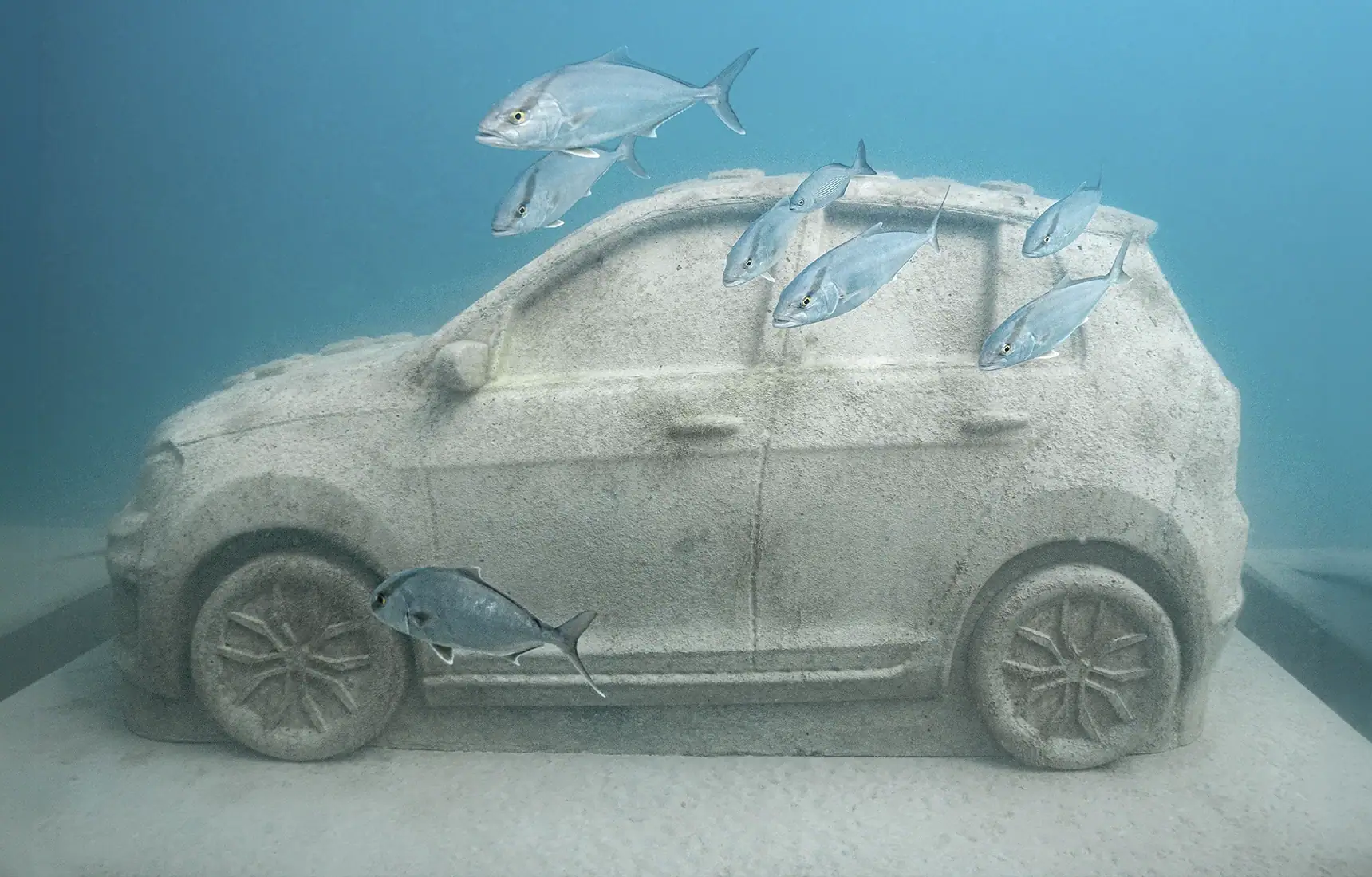
In late October 2025, a 159-foot construction barge spent four days lowering cars into the Atlantic off Miami Beach. Twenty-two of them — life-sized, cast in marine-grade concrete — settled onto the seabed roughly 780 feet offshore of 4th and 5th Streets, in 15 to 20 feet of water, arranged in the unmistakable configuration of a traffic jam.
That was the public debut of The ReefLine: a seven-mile underwater sculpture park, snorkel trail and hybrid artificial reef running parallel to the Miami Beach shoreline, and one of the most ambitious public art projects the United States has produced this decade. It is now open, permanently, and free to access.
The ReefLine had been in development for five years before those cars went in. What makes it worth paying attention to is the seriousness with which it treats the second job each sculpture has to do. These works are engineered to grow coral, and that ecological performance is held to the same standard as the art.

What is The ReefLine?
The ReefLine is the work of Ximena Caminos, the cultural placemaker and curator who conceived the project and serves as its Artistic Director. Its masterplan — including the barrier module that forms the structural backbone of the whole thing — was designed by OMA New York, led by partner Shohei Shigematsu, working alongside marine biologists, coastal engineers and researchers.
Completed, it will run seven miles: beginning at 4th Street in South Beach and tracking north along the coastline through Surfside and Bal Harbour, sitting a few hundred feet offshore in water shallow enough to snorkel. Installations are deployed in phases; the trail grows outward from its southern anchor.
Three things define the ambition of the project:
It is infrastructure as well as art. The modules are engineered to dissipate wave energy and reduce shoreline erosion. Miami Beach is among the most climate-exposed cities on earth; the ReefLine is a coastal defence project that happens to be beautiful, with ecology engineered into every element.
It is designed for coral, specifically. The sculptures are not simply “reef-friendly.” They are seeded.
It is free, permanent and public. No ticket, no season, open to everyone.


Concrete Coral: Leandro Erlich’s traffic jam on the seabed
The inaugural work is Concrete Coral by the Argentinian conceptual artist Leandro Erlich, and it is a genuinely excellent piece of thinking.
Erlich is best known for optical and spatial illusions — swimming pools you can stand beneath, buildings that appear to defy gravity. In 2019, during Miami Art Week, he staged Order of Importance: a traffic jam of more than sixty life-sized cars and trucks, sculpted from sand, marooned on Miami Beach and left to erode. It was a memento mori about emissions and the sea, and the sand was the point — the work was designed to disappear.
Concrete Coral is that idea taken to its logical conclusion, and then inverted. Twenty-two vehicles, this time cast to last, submerged in the very ocean the originals warned about. The symbol of carbon emissions is placed on the seabed and made to serve the reef that emissions are killing.
The mechanism is not metaphorical. Live corals are attached to the cars using Coral Lok, a patented fixing system designed to accelerate reef establishment, converting each vehicle into a substrate for growth. Over the coming years the cars will disappear — not by eroding, as the sand ones did, but by being colonised. The traffic jam will vanish under coral.
It is rare for a work of public art to have a punchline that takes a decade to land.


The artists still to come
The first phase established the trail. The works announced to follow tell you what kind of project this intends to be.
Petroc Sesti — Heart of Okeanos. The British artist’s monumental sculpture takes the form of the heart of a stranded blue whale. As habitat, its chambers and cavities are precisely the kind of complex structure reef fish shelter in; as an image, a whale’s heart resting on the ocean floor needs no explaining.
Carlos Betancourt and Alberto Latorre — Miami Reef Star. A trail of large-scale starfish distributed along the length of the ReefLine, threading the seven miles together into a single legible route rather than a series of isolated stops.
Shohei Shigematsu / OMA. Beyond the masterplan, OMA contributes to the first phase directly, with the modular barrier structures that are simultaneously artwork, breakwater and reef.
Further installations are scheduled to extend the trail through 2026.


Art that has to work
The most interesting thing about the ReefLine is the constraint it accepts.
Public art is judged on what it means. The ReefLine’s works are judged on that and on whether coral attaches to them, whether fish colonise them, whether they measurably reduce wave energy at the shoreline. The project runs alongside marine biologists and academic institutions monitoring coral growth, biodiversity and coastal protection outcomes over time, feeding into wider research on reef restoration and climate adaptation.
That is a genuinely unusual bargain for an artist to strike. It means the material palette is guided by biology: every surface has to be something coral will consent to grow on. It means scale, texture and void are functional decisions before they are aesthetic ones. And it means the work keeps developing long after it is installed. It reaches completion when it is no longer recognisable as sculpture.
There is a double achievement here worth naming. The ReefLine adds real habitat where there was bare seabed, and it does so in the ocean that Erlich’s cars are about. It is doing two things at once, buying genuine ecological function and making the climate story visible to anyone who will happily swim over a submerged traffic jam and surface thinking about coral. That public understanding may matter as much as the biology, and the project delivers both.


Visiting the ReefLine: what you need to know
Accessibility was designed in, and it is the quiet triumph of the project.
The ReefLine sits, deliberately, at snorkel depth, and Concrete Coral is in 15 to 20 feet of water. A reasonably confident swimmer with a mask can see it. Deeper sections will reward experienced divers, and the trail’s centre of gravity is the surface, which opens it to almost anyone.
- Where: Off 4th Street, South Beach, extending north. Concrete Coral sits roughly 780 feet offshore between 4th and 5th Streets.
- Depth: 15–20 feet at the inaugural installation — snorkel-accessible.
- Cost: Free. Permanently open.
- Access: Swim, snorkel, dive or boat. Guided snorkel tours operate locally.
- Best conditions: Calm, clear days. Visibility is everything.
The experience is entirely its own. You float above it, breathing through a tube, moving with the swell, while fish work their way through a Ford. It collapses the distance between viewer and work in a way that stays with you.
For Miami Beach, this is also a strategic repositioning: culture that exists year-round, open in every month of the calendar, and rewards slowness as generously as spectacle.


Frequently asked questions
Is the ReefLine open?
Yes. The first installation was deployed in October 2025 and the site is permanently open and free to access. Further works are scheduled through 2026.
What is the first artwork?
Concrete Coral by Leandro Erlich — 22 life-sized marine-grade concrete cars arranged as a traffic jam on the seabed, seeded with live coral via the Coral Lok attachment system.
Where exactly is it?
Roughly 780 feet offshore between 4th and 5th Streets, South Beach, in 15–20 feet of water. The full seven-mile trail will run north through Surfside and Bal Harbour.
Do I need to scuba dive?
No. The inaugural installation sits at snorkel depth. Deeper sections will suit certified divers, but the trail is designed to be snorkel-accessible.
How much does it cost?
Nothing. It is free and permanently open.
Who created the ReefLine?
Conceived by Artistic Director Ximena Caminos, with the masterplan designed by OMA New York under Shohei Shigematsu, in collaboration with marine biologists and coastal engineers.
Which artists are involved?
Leandro Erlich (Concrete Coral), Petroc Sesti (Heart of Okeanos), Carlos Betancourt and Alberto Latorre (Miami Reef Star), and Shohei Shigematsu / OMA.


Final thoughts
TIME named the ReefLine one of the World’s Greatest Places of 2026, and the project earns the billing. This is a piece of coastal infrastructure that a city commissioned artists to design, and its success will be measured in the life that grows on it.
The cars will go first. Give it a decade and Erlich’s traffic jam will be a coral reef with a strange silhouette, and the joke — that we sank the thing that was sinking us, and it turned into life — will have completed itself without anyone needing to explain it.


Leave a Reply