

ART & CULTURE · DUBAI
Reading time: 4 minDubai is a city you usually experience at speed. Roots, a new sculpture by the Emirati artist Azza Al Qubaisi installed on Mercato Beach, asks you to do the opposite. Part of the emirate’s growing Public Art Strategy, it is a quiet, deliberate pause on the shoreline, a work that turns the palm tree, the fabric of Emirati life, into a shield between the sea and the skyline. It is a small thing, and that is exactly the point.
Art that meets you where you already are
Along the Jumeirah shoreline, where the Arabian Gulf meets one of the fastest-changing skylines on Earth, a new sculptural presence has quietly settled into the landscape. Installed at Mercato Beach, Roots by Azza Al Qubaisi is the latest work unveiled by the Dubai Culture and Arts Authority as part of the emirate’s wider Public Art Strategy, and it belongs to an idea I find genuinely compelling: the city itself as an open-air gallery.
This is the part of Dubai’s cultural growth that interests me most. The public art programme feels increasingly visible and increasingly intentional, and there is something refreshing about meeting art outside the hush of a gallery, woven instead into ordinary life, along a beachfront, beside a road, framed against the towers. Art in this form stops being a destination you set out for and becomes a companion you happen upon. In a city defined by momentum, that unplanned pause, however brief, feels essential.

The palm, reimagined
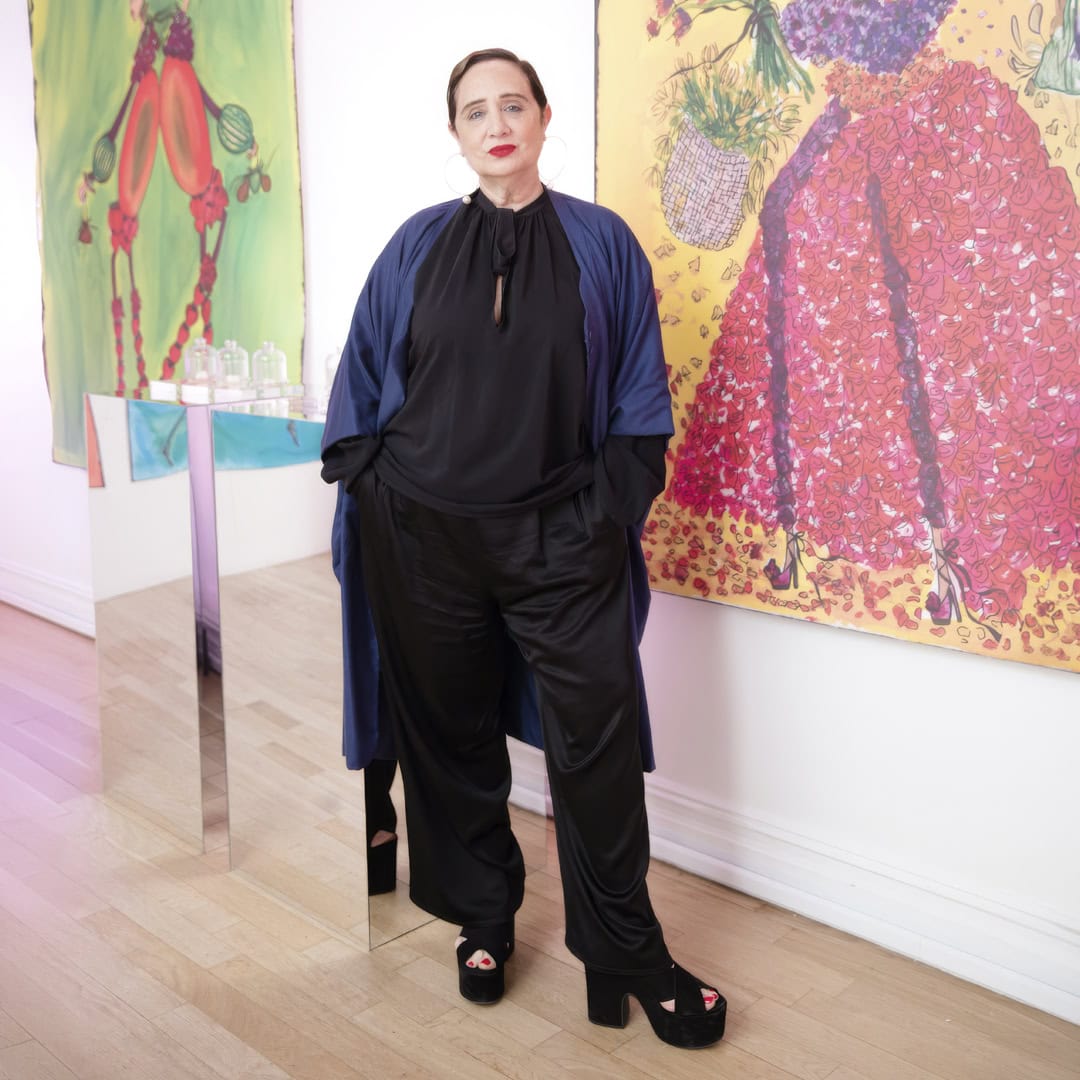
At its core, Roots draws on one of the UAE’s most enduring symbols: the palm tree. Long described as the “fabric of life,” the palm stands for nourishment, shelter and resilience, qualities woven deep into the country’s sense of itself. That reference is far from incidental to the artist. Azza Al Qubaisi is widely regarded as the UAE’s first Emirati jewellery artist, and across her work as a sculptor and designer she returns again and again to the essential materials of pre-oil Emirati life, palm and traditional Sadu weaving among them, reworked through techniques she has developed herself. Heritage, in her hands, is never nostalgia. It is raw material.
In Roots she translates the palm into a sculptural language that reads as both tactile and fluid, echoing the texture and pattern of a palm trunk while abstracting it into something unmistakably contemporary. The form does not sit still. There is movement built into it, gestures that recall wind sweeping across the dunes, waves folding onto the shore, and birds tracing brief paths across the sky. Those natural rhythms are distilled into a single, unified shape, so the sculpture resonates less as an object dropped into a setting than as a distillation of the environment around it.
A shield, and a frame
Positioned almost architecturally, Roots takes on the form of a shield. It offers shade, invites you to step in and under it, and gently slows you down. That choreography is the cleverest thing about it. As you pass beneath the work, the experience turns: the sea opens up ahead of you, and when you look back the city reveals itself in layers, rising all the way to the distant point of the Burj Khalifa. For a moment the sculpture becomes a frame, holding nature and urbanity together in a single composed view. For anyone who photographs, it is an unusually generous piece of public art, a made object that quietly organises everything around it.
Materiality carries the same conversation. Al Qubaisi works the piece in stainless and mild steel, a reflective, future-facing surface that mirrors its surroundings and answers Dubai’s forward drive, while every curve of it points back to the palm and the older, handmade traditions that shape her practice. The result holds two timeframes at once, what has been and what is still to come, without letting either win. That doubleness is why Roots resonates. It is not simply a sculpture in a landscape; it is a work actively connecting past and present, land and city, tradition and innovation, which is precisely the cultural identity Dubai Culture keeps reaching for: deeply rooted and globally relevant in the same breath.

The bigger picture
Step back, and Roots says something about how Dubai is choosing to grow. As the city expands both physically and culturally, works like this suggest a more nuanced ambition, one that values not only scale and spectacle but meaning, memory and human experience. The Public Art Strategy is explicitly meant to strengthen the city’s visual identity and its standing as a hub for the creative economy, but on the ground, at beach level, it does something simpler and more human. It gives you a reason to stop.
That, in the end, is why the piece stays with me. It is a reminder that public art does not have to be monumental to matter. Sometimes it is enough for a work to exist quietly along the paths we already walk, offering a moment to pause, reflect and reconnect. In a city that rarely stands still, that is something worth holding on to.

Leave a Reply