
Art & Culture · Miami
Reading time: 6 minIn July 2025, a Dubai artist cast bronze ashtrays embedded with four elemental stones and asked whether the Earth’s electromagnetic field might resonate with the human heart. Five months later, that question would fill a room at Design Miami. This is where it started.
There is a particular kind of pleasure in watching an artist’s idea arrive before they know what it is.
In July 2025, Roham Shamekh showed a small body of work at a newly opened gallery on Beverly Boulevard: Earth Magma, a limited-edition series of bronze ashtrays, each embedded with four stones standing for earth, air, fire and water. The accompanying text posed a question that read, at the time, as an elegant metaphysical invitation:
“Could the Earth’s electromagnetic frequencies be in resonance with the human heart?”
Five months later, at Design Miami, Shamekh would build an entire Curio installation around exactly that proposition — R O O T S, a room of hand-carved ceramic furniture wired to a soundscape tuned toward the Schumann resonance, the 7.83 Hz pulse of the Earth’s own electromagnetic cavity.
The ashtrays were the sketch. Seen now, with the benefit of a year’s hindsight, Earth Magma is not a minor commission in a group show. It is the moment the central preoccupation of Shamekh’s recent work first became visible — worked out, quietly, at the scale of an object you could hold.

The exhibition: SMOKESHOW at So-Too
SMOKESHOW was the inaugural group exhibition at So-Too, a gallery that opened in West Hollywood at 8271 Beverly Boulevard in summer 2025. It ran from 10 to 17 July 2025 — a short, sharp opening statement rather than a season.
The premise came from So-Too’s founder, Lauren Thompson, who invited artists and designers to make one-of-a-kind ashtrays. Alongside Shamekh, the show included Alex Proba, Jonathan Cross, Matt Gagnon, Lucas Zito and Marquel Williams, among a wider roster.
Thompson’s framing was the interesting part. She proposed the ashtray as an altar for gathering — an everyday object with an unusual power to hold people in one place. Smoking, she noted, is culturally coded as a gesture of disconnection, and yet in practice it does the opposite: it pulls people outside together, it enforces a pause, it manufactures the small unstructured intervals in which conversation actually happens.
That is a good curatorial premise because it is true, and because it is uncomfortable.
Why the ashtray, and why now
It is worth being direct about the thing the exhibition is circling.
The ashtray is available as an art object precisely because it is disappearing, and it is disappearing because smoking kills people. Nostalgia for the mid-century glass ashtray on the desk, the cafe table in a European city, the cigarette as punctuation in a hundred films, is nostalgia for a period when the harm was not yet fully reckoned with. Nobody making a sculptural ashtray in 2025 is unaware of this, and Shamekh works with that tension rather than around it.
What makes the object compelling is not the cigarette. It is the ritual scaffolding the cigarette used to carry, and which we have not replaced: the sanctioned interruption, the shared silence, the reason to step outside and stand next to someone.
Shamekh’s contribution takes that logic and pushes it as far as it will go. If the ashtray was always a small altar, then make it one properly.

Earth Magma: the objects
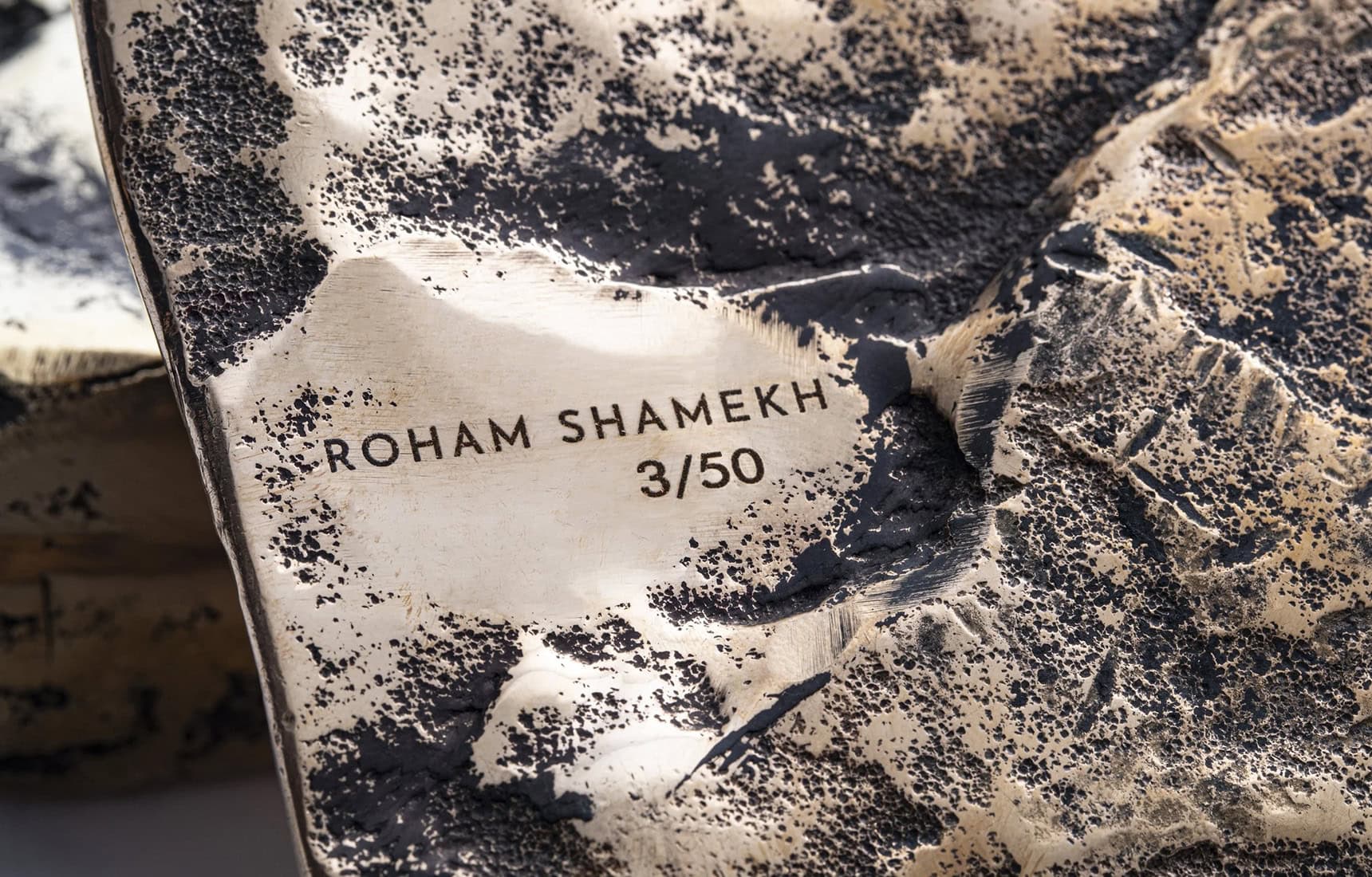
Each piece is cast in bronze — a decision that carries more freight than it might appear.
Bronze is the material of votive objects, of temple vessels, of things intended to outlast the person who commissioned them. It has been the material of ceremony for roughly five thousand years, and it comes with an implicit claim to permanence. To cast a disposable object — a receptacle for ash, for the residue of something already burnt away — in the metal of monuments is a genuinely well-judged joke, and it is not only a joke.
Embedded into each work are four stones, standing for the four cardinal elements: earth, air, fire, water. Shamekh is explicit that these are not decorative inlays. They are markers of elemental presence, and they turn each object into a compressed cosmology: a small, dense system in which the four forces are held together around a hollow where fire goes out.
An ashtray, after all, is where fire ends. Earth Magma places that ending inside a diagram of the elements and asks you to think about it while you use it.
The objects read as simultaneously ancient and futuristic, and the phrase earns itself here, because Shamekh is genuinely working in two registers at once. The bronze and the stones are archaic. The proposition, that the planet’s electromagnetic field and the human cardiac rhythm might be in some kind of conversation, is science-adjacent, speculative, and very much of the present moment.
The question underneath
Shamekh does not claim the resonance proposition as fact, and that is to his credit. The original framing was explicit that it “doesn’t demand scientific proof” — it is offered as a meditative lens, not a finding.
That distinction is worth holding onto, because it is exactly what gives the work its poise. Claims about the Earth’s electromagnetic frequencies and human physiology circulate widely, and Shamekh handles his with unusual care. The Schumann resonance is real and measurable; its relationship to the human heart he treats as an open and generative question. An artist entertaining the idea as a poetic proposition is doing something rich and particular: holding it up to the light rather than closing it down.
Shamekh, on the evidence of Earth Magma and then R O O T S, uses the idea exactly as it wants to be used. He takes it as a structuring metaphor, a way of insisting that objects are not inert and that we are not separate from the ground we stand on. That is an old thought, and a resonant one, and it does not need a laboratory.
It turns out to bear the weight of an entire practice. On a bronze ashtray, held in the hand, it works beautifully. Scaled to a room full of furniture and headphones, as it later would be, it holds just as surely. Small objects can carry large ideas lightly. That is what small objects are for.

Where this sits in Shamekh’s work
For context: Shamekh was born in Tehran, left Iran at eighteen, and established his Dubai studio in 2016. His practice moves across collectible design, sculpture, painting and generative AI, and he is conspicuously uninterested in the borders between those categories. His signature form is the Ovo Man Chair; earlier collections include Pharrell’s Echoes and Terminator.
The through-line in all of it is the conviction that an object can carry and transmit an intention, that design is a channel rather than a container. It is a large claim to make, and Earth Magma substantiates it with real conviction, because the object is small enough that the idea does not have to shout.
Frequently asked questions
What is Earth Magma?
A limited-edition collection of sculptural bronze ashtrays by Roham Shamekh, each embedded with four stones representing earth, air, fire and water. It debuted at SMOKESHOW in Los Angeles in July 2025.
What was SMOKESHOW?
A group exhibition and the inaugural show at So-Too gallery, 8271 Beverly Boulevard, West Hollywood, running 10–17 July 2025. Founder Lauren Thompson invited artists and designers to make one-of-a-kind ashtrays, reframing the object as an altar for gathering.
Who else was in the exhibition?
Alex Proba, Jonathan Cross, Matt Gagnon, Lucas Zito and Marquel Williams, among others.
Why bronze?
Bronze has been the material of votive and ceremonial objects for millennia. Casting a disposable object in the metal of monuments is central to the work’s argument.
How does Earth Magma relate to R O O T S?
Earth Magma asks whether the Earth’s electromagnetic frequencies might resonate with the human heart. Five months later, Shamekh’s R O O T S installation at Design Miami 2025 built a soundscape tuned toward the Schumann resonance — the Earth’s 7.83 Hz electromagnetic pulse — around the same idea.

Final thoughts
Earth Magma is a small work in the sense that it fits in the hand, and a major one in the sense that everything Shamekh did next came out of it.
Cast the ending of fire in the metal of permanence. Set four elements around the hollow. Ask whether the ground and the heart keep time together. Then go and build a room around the answer.
Quite something, for an ashtray!


Leave a Reply