
Art & Culture · Miami
Reading time: 7 minA hand-carved ceramic sofa that looks grown rather than made. A soundscape tuned to the frequency of the Earth. At Design Miami’s 20th edition, the Tehran-born, Dubai-based designer Roham Shamekh made the case that furniture’s next frontier is not form but feeling.
Of the eighty-plus exhibitors at Design Miami 2025, few asked as much of the visitor as Roham Shamekh. Most collectible design presentations want to be looked at. R O O T S, the Tehran-born, Dubai-based designer’s debut in the fair’s Curio programme, wanted to be listened to — and, more unusually still, felt.
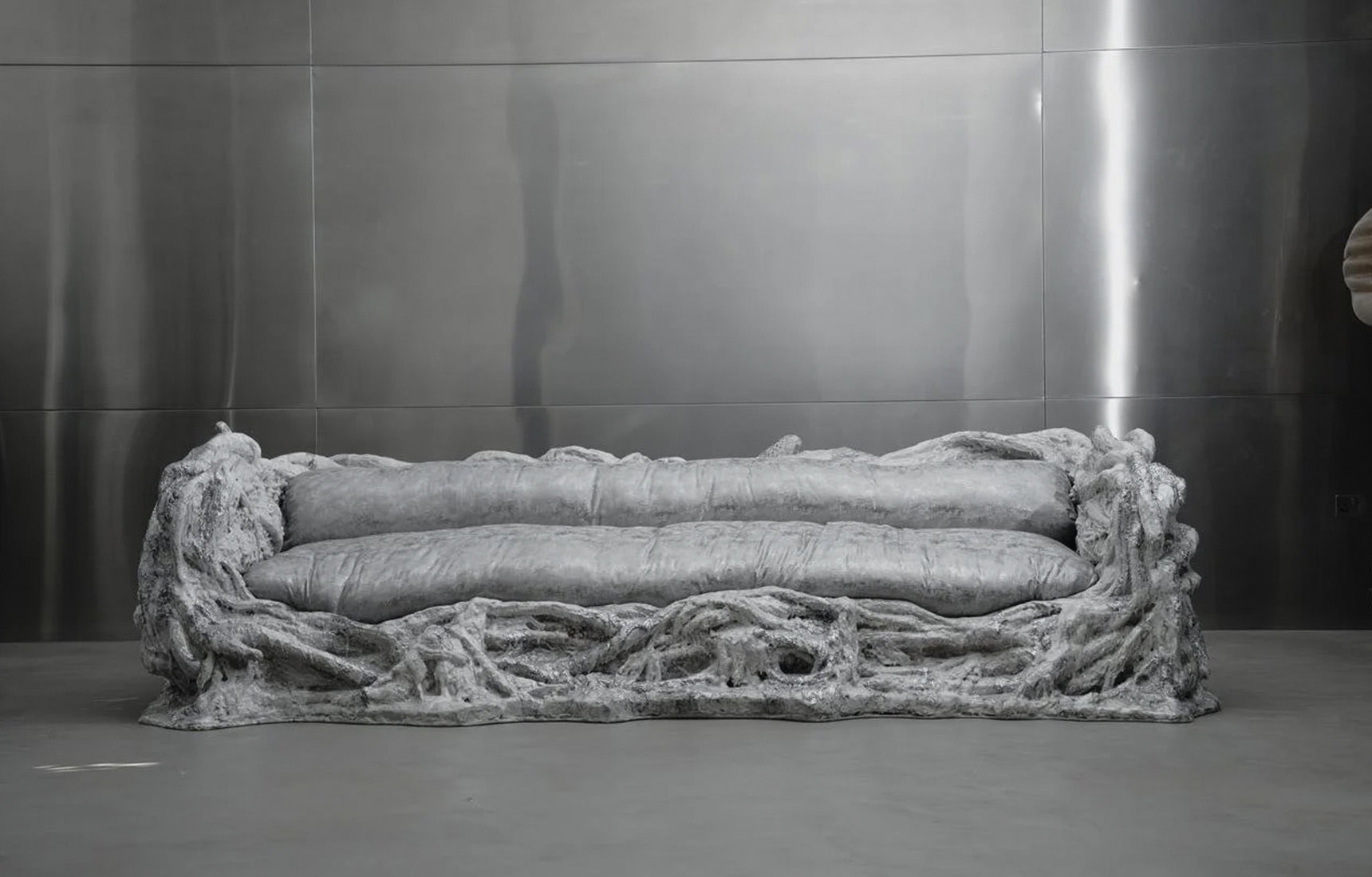
Staged during Miami Art Week as Design Miami marked its twentieth anniversary under the theme “Make. Believe.”, R O O T S comprised four works: a hand-carved sofa in ceramic and epoxy resin, two fluid organic side tables, and a painting anchoring the whole. But the objects were only half of it. Visitors were handed headphones and an iPad, and the composition that played through them was as much the work as the furniture was.
It was, by some distance, the quietest thing in Miami that week. That was the point.

What is Design Miami Curio?
For readers arriving without the context: Curio is Design Miami’s platform for immersive, narrative-driven installations — a deliberate counterweight to the gallery booths that make up the bulk of the fair. Where a gallery presents objects for sale, a Curio presents an argument. Designers, architects, curators and emerging galleries are invited to build a focused environment: a cabinet of curiosities, a thesis, a room with a thought in it.
The 2025 edition, curated by returning Curatorial Director Glenn Adamson, ran at the Miami Beach Convention Center from 2–7 December 2025, alongside Art Basel Miami Beach. Superhouse took Best Curio Presentation for American Art Furniture: 1980–1990; Paris debutant Galerie Signé won Best New Voice.
Into that context — a twentieth-anniversary fair, a curatorial theme about belief and making — Shamekh brought a sofa you were meant to sit on with your eyes closed.

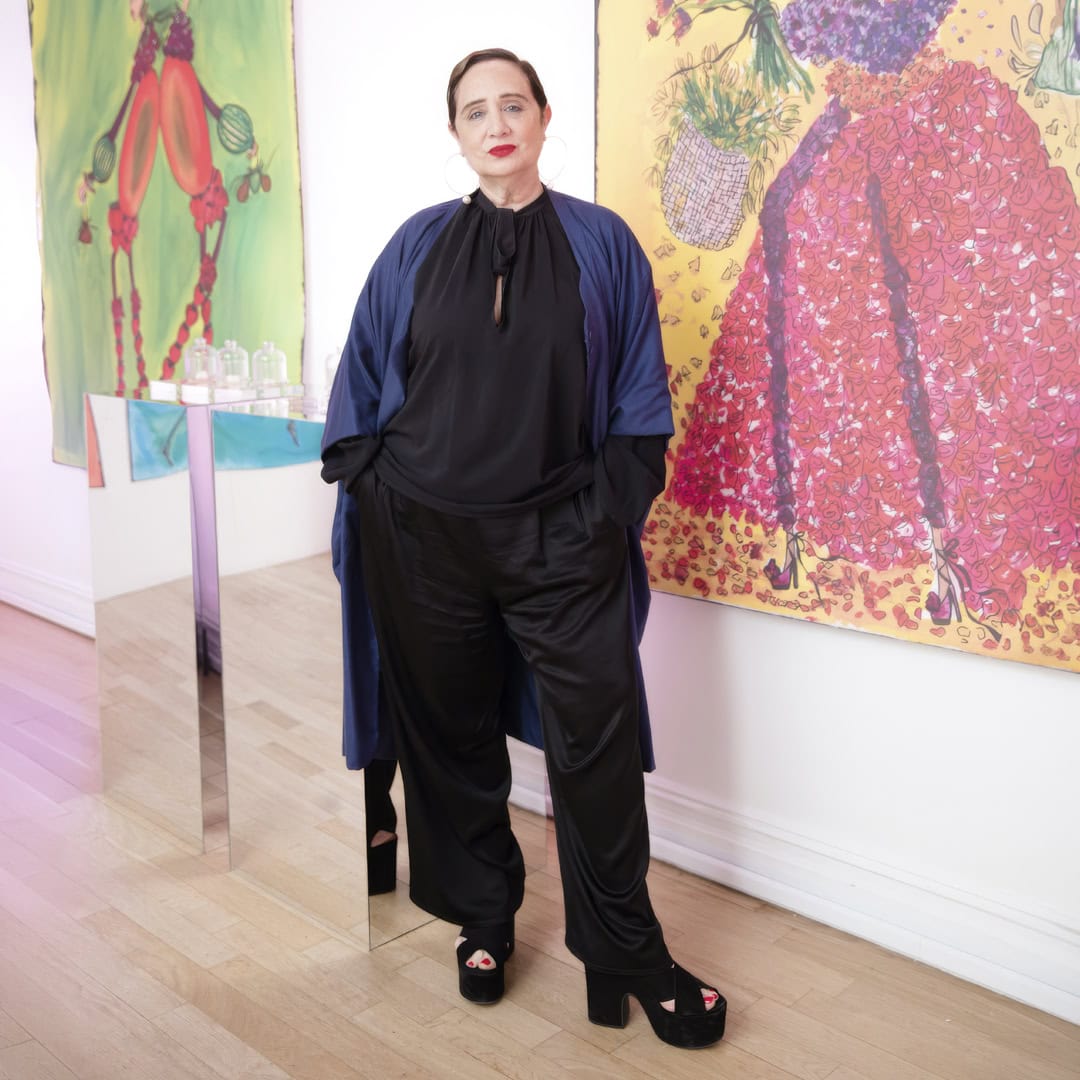
Roham Shamekh – Courtesy of Nikita Berenzhoy
Who is Roham Shamekh?
Understanding R O O T S requires understanding the path that produced it, because Shamekh’s work is unusually autobiographical for a furniture designer.
Born in Tehran, he was working across photography, painting and sculpture by the age of fifteen. At eighteen he left his family behind; he arrived in Dubai in his early twenties, and in 2016 established the eponymous studio he still runs there — a practice he describes as anti-conformist, sitting at the intersection of collectible design, experimental art and what he calls soulful living.
His signature piece to date is the Ovo Man Chair, a form he has returned to and reworked in numerous variations. Recent collections — Pharrell’s Echoes, Terminator — established the preoccupation that R O O T S now pushes furthest: the idea that a physical object can carry, and transmit, an intention. Shamekh works across tattoo painting, floral motifs, generative AI and spatial design, and he is markedly uninterested in the borders between art, design and architecture.
That biography matters here. A body of work about roots, displacement and belonging reads differently coming from someone who left one country at eighteen and built a practice in another.

Inside the installation: a room built for slowing down
The booth was conceived less as an exhibition than as an environment — reflective, hushed, closer to a sanctuary than a sales floor. Visitors were invited to slow down, breathe, listen.
At its centre sat the headphones and iPad, delivering a bespoke composition that formed the emotional spine of the piece. Drawing on forest ecosystems and elemental patterns, the soundscape layered low, mid and high frequencies to mirror the vibrational qualities of the natural world.
The low end is where Shamekh’s thinking becomes most specific. The composition tunes toward the Schumann resonance — the roughly 7.83 Hz electromagnetic pulse in the cavity between the Earth’s surface and the ionosphere, long associated in wellness discourse with grounding and stability. Mid- and high-frequency harmonics were layered above it, intended to stimulate creativity and emotional openness.
(A note in fairness: the Schumann resonance is a genuine, measurable geophysical phenomenon. Claims about its direct effects on human physiology are considerably more contested than the wellness literature tends to admit. Shamekh is working with it as a compositional and conceptual device — a way of tuning an artwork to the planet — rather than making a clinical claim, and it is more interesting read that way.)
The effect was disorienting in the best sense: an environment at once ancient and futuristic, and genuinely difficult to leave.

The collection: four works, one organism
Made in Shamekh’s Dubai studio, R O O T S comprised four pieces.
The hand-carved sofa — ceramic and epoxy resin, finished in white — was the anchor and the argument. It does not read as manufactured. It reads as excavated: a form that appears to have surfaced from the ground rather than arrived from a workshop, its silhouette echoing root systems that twist and thicken and push outward beneath the soil. The whiteness is doing real work, stripping out any distraction of colour or grain and leaving only the movement of the form itself.
Two side tables continued the same grammar — surfaces that ripple and reach, tendril-like, searching for purchase.
A painting completed the narrative, extending the collection from three dimensions into two and restating its themes: belonging, origin, memory.
Shamekh’s framing is that these are not four objects but one organism. Design, in his account, is a living system rather than a static output, and each piece is a limb of something larger — a network in which human experience, environmental memory and sculptural form cannot be cleanly separated.
The metaphor holds because roots are a genuinely good metaphor. They never stop extending. They interlace with the roots of other organisms. They constitute a communication network we cannot see and only recently learned to read. Drawing the parallel to human ancestry — the invisible ties, emotional, historical and cultural, that bind us to people we will never meet — is not subtle, but it is earned.

Design as activation
“After R O O T S, sitting will never feel the same. It is soulful design as activation, art as alignment, and wellness as awareness — a new frontier where the senses become gateways to the soul. My work invites us to ground, to listen, and to remember that the future of design is not what we build, but what we awaken.”
— Roham Shamekh
It is a large claim, and worth taking seriously rather than either swallowing or dismissing.
What R O O T S is really testing is whether collectible design can be experiential without ceasing to be design. That’s a live question. The sector has spent a decade drifting toward the sculptural — objects that function, technically, but justify their price through presence rather than use. Shamekh goes a step further: he adds a temporal, sensory layer that only exists while you are inside it. The sofa remains after the headphones come off. The work, arguably, does not.
Whether that constitutes a new frontier or an elaborate framing device is a fair thing to argue about. The counter-case is straightforward — that wellness language has become a convenient premium wrapper across the design industry, and that a soundscape is an easier way to manufacture significance than a difficult form is. Some of the vocabulary here (“activation”, “alignment”) does sit close to that line.
But the objects hold up without the audio, which is the test that matters. Take the headphones away and the ceramic sofa is still one of the more arresting things anyone made in 2025. The sound deepens it; it isn’t propping it up.

Why R O O T S mattered at Miami Art Week
Miami Art Week in December is a week of volume. Fairs, activations, parties, queues — a great deal of shouting. What made Shamekh’s Curio work land was that it did the opposite. It was a room you entered to stop.
That is not merely a mood observation; it’s a strategic one. As sensory design, environmental consciousness and emotional resonance increasingly shape what collectors want, presentations that offer depth rather than impact are becoming the ones people remember. R O O T S was the quiet antidote at the loudest week in the design calendar, and it was better for it.
Frequently asked questions
What is R O O T S? A four-part collection by Iranian designer Roham Shamekh, shown in the Curio programme at Design Miami 2025: a hand-carved ceramic and epoxy-resin sofa, two organic side tables, a painting, and an accompanying soundscape delivered via headphones.
Who is Roham Shamekh? A Tehran-born, Dubai-based multidisciplinary artist and designer. He founded his studio in Dubai in 2016 and works across collectible design, sculpture, painting and generative AI. His best-known piece is the Ovo Man Chair.
What is the Schumann resonance, and why does it appear in the work? It is the roughly 7.83 Hz electromagnetic resonance of the cavity between the Earth’s surface and the ionosphere. Shamekh tunes the low-frequency layer of the R O O T S soundscape toward it, using it as a conceptual and compositional link between the work and the planet.
When and where was Design Miami 2025? 2–7 December 2025 at the Miami Beach Convention Center, concurrent with Art Basel Miami Beach. It marked the fair’s 20th anniversary, curated by Glenn Adamson under the theme “Make. Believe.”, with over 80 exhibitors.
What is the Curio programme? Design Miami’s platform for immersive, narrative installations — as distinct from conventional gallery booths — open to designers, architects, curators and emerging galleries.
Final thoughts
Design Miami’s twentieth edition asked its exhibitors to make believe. Most answered with objects. Shamekh answered with a room, a frequency, and an instruction to sit down and close your eyes.
Whether the future of design really is “not what we build, but what we awaken” remains to be seen — that is a thesis, not a fact, and the industry will spend the next few years arguing about it. But R O O T S made the argument with more conviction, and better objects, than most.

Leave a Reply