
Art & Culture · Milan
Reading Time: 8 minutes
Press coverage of the Manifestation Chair describes its gold finish and cherub figures as symbols of protection and unseen guidance, in the general, spiritual register collectible design usually reaches for. The symbolism is not general. In 2014, Roham Shamekh was arrested in Iran for appearing in a dance video set to Pharrell Williams’s song “Happy,” and Williams’s own public response was part of what got him released. The gold and the cherubs are about that, specifically.
Introduction
Roham Shamekh, the Tehran born, Dubai based designer, showed the Manifestation Chair, cast in bronze and finished in gold, at Milan Design Week 2025, as part of Deoron: Elevating Objects, a group exhibition of more than forty designers at Via Paolo Frisi 3 in the Porta Venezia district, running from 7 to 13 April 2025. The chair belongs to Pharrell’s Echoes, a collection Shamekh designed and produced entirely himself, which had debuted four months earlier at Design Miami’s Curio programme in December 2024, where it was reported as one of the most interacted with pieces at the fair.
Most coverage of the piece stayed at the level of the press materials: gold evokes beauty and timelessness, cherubim represent unseen guiding forces, the chair invites contemplation on manifestation. All of that is true as far as it goes, and none of it explains why Shamekh is using this specific vocabulary rather than any other. The explanation is a decade-old, well documented event in his own life, and once it is on the table, the chair stops reading as a mood board exercise and starts reading as a piece with an actual subject.

What happened in Tehran in 2014
In May 2014, a group of young Iranians filmed themselves dancing to Pharrell Williams’s song Happy and posted the video, titled Happy We Are From Tehran, online. Iranian authorities objected to the women in the video appearing without headscarves and in trousers rather than traditional dress. Six people who appeared in the video and its director were arrested, and in September 2014 an Iranian court handed down suspended sentences of six months in prison and ninety one lashes for “ignoring Islamic norms,” with one defendant receiving a further six months for alcohol possession. The case drew international attention. Amnesty International condemned the arrests, a #freehappyiranians campaign spread online, and Pharrell Williams spoke out publicly against the sentencing, alongside voices including then Iranian president Hassan Rouhani, who tweeted that “happiness is our people’s right.”

Roham Shamekh, then nineteen, has said he was one of the six people in that video. He describes the ordeal, and Williams’s public response to it, as the reason he was eventually released, and calls it his first experience of manifestation: proof, in his own account, that speaking a hope aloud and repeating it can bring about a real, external outcome. He has described Williams since as a guardian angel, a word he uses carefully rather than casually, given that Williams did not know him personally at the time and was responding to a case rather than to an individual. A decade later, Shamekh built an entire design collection around that experience.

Pharrell’s Echoes, correctly attributed
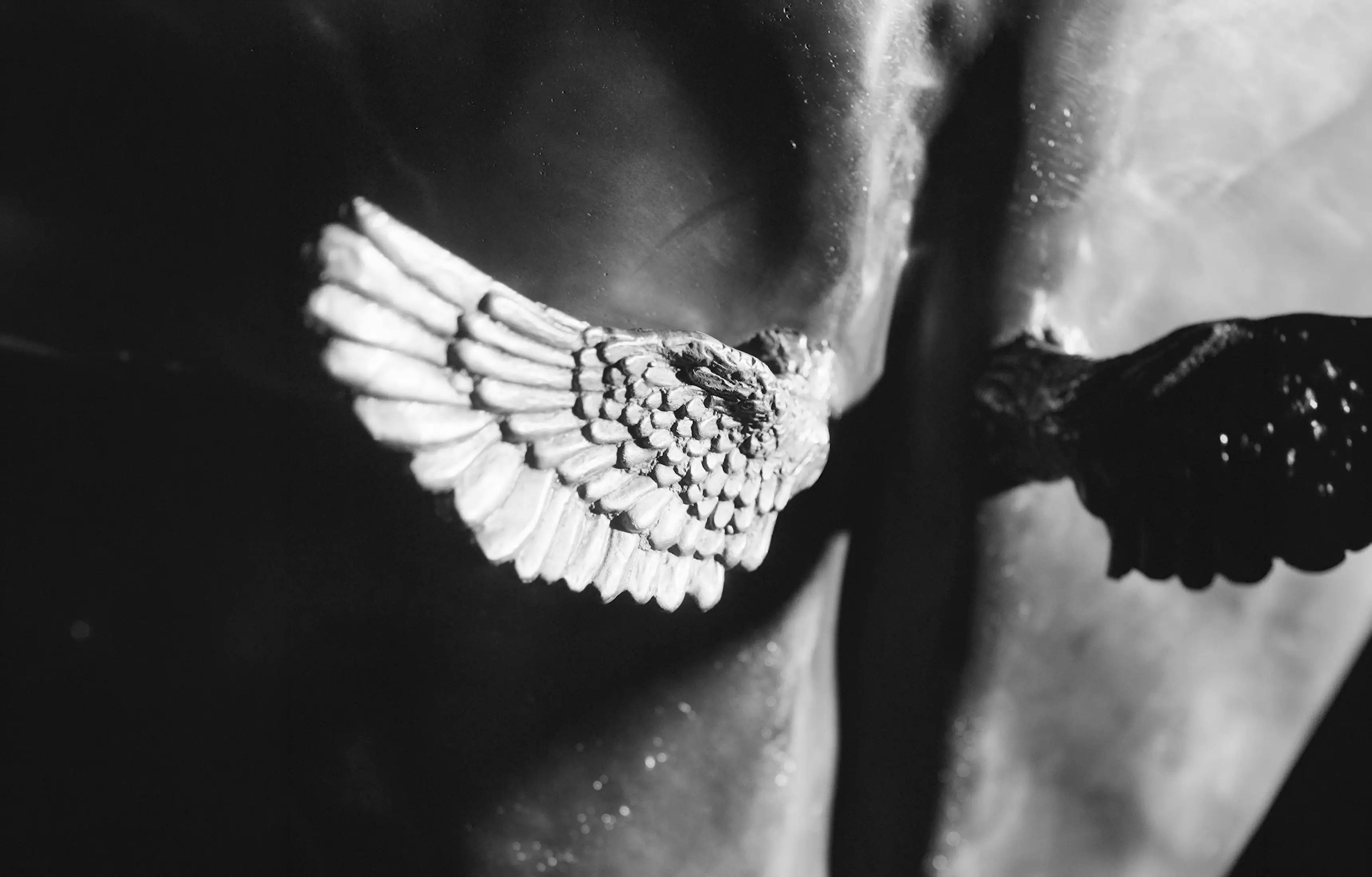
Pharrell’s Echoes is Shamekh’s own collection, designed and produced by his studio rather than in collaboration with Williams, and the title names its subject rather than its author. The pieces are cast in bronze and shown in different finishes: a version finished in silver formed the centrepiece of the Design Miami debut in December 2024, and the Manifestation Chair shown in Milan four months later carries the same underlying form in gold. Sculptural cherub figures, reworked through Shamekh’s own hand rather than as literal portraiture, sit across the pieces as recurring guardian motifs, and other works in the collection extend the same language: a white resin chair modelled on a torso with wing forms, exploring transcendence, and a further bronze piece exploring the same guardianship theme under a different name.
Read against the 2014 case, the material choices stop being generic. Gold, in Shamekh’s own description, stands for protection and timelessness, which is a specific claim about an intervention that protected him at nineteen, not a general claim about luxury. The cherubs, reinterpreted rather than copied from classical sculpture, stand for an unseen guiding force, which is a specific description of a public figure who spoke up for a stranger without being asked to and without knowing who that stranger was. Shamekh’s own account is that Williams’s music had guided him through the ordeal before Williams was aware of it, which is the sense in which the guidance in the work is genuinely unseen rather than a design metaphor borrowed for effect.

From a Design Miami centrepiece to a Milan group show
Pharrell’s Echoes debuted at Design Miami’s Curio programme in December 2024, at booth C08, the fair’s platform for narrative led installations shown alongside its main gallery booths, where it was reported as one of the most interacted with pieces on the floor. Four months later, the Manifestation Chair travelled to Milan Design Week for Deoron: Elevating Objects, running from 7 to 13 April 2025 at Via Paolo Frisi 3 in Porta Venezia. The show was Deoron’s first in person curatorial project, a design discovery platform previously known as an online shop directory and magazine, moving into physical exhibition making with a group presentation of more than forty designers built around a single brief: how an object functions, how it feels, and how it speaks within contemporary living.
That is a useful frame for the Manifestation Chair specifically, because the object is built to be sat in rather than only looked at. Coverage of the piece has consistently described it as interactive, inviting a visitor to sit, reflect, and hold a personal wish in mind while doing so, which only works as a design idea if the chair’s symbolism is actually specific enough to hold a visitor’s attention rather than dissolving into ambient gold. A guardian who intervened once, real and named, gives the gesture something to hold onto that a generic idea of protection does not.

What the Manifestation Chair’s design argument actually is
Strip away the exhibition context and the Manifestation Chair is making one claim: that an abstract symbol works better when the person using it can trace it back to something that actually happened. Shamekh had every option to make a chair about beauty and protection as ideas in general, the register most collectible design in this territory settles into. Instead he built the piece around a specific, checkable event in his own life, a 2014 arrest, a flogging sentence, and a public intervention that helped end it, and let the gold and the cherub figures carry that history rather than a mood. The chair asks a visitor to sit down and hold a wish in mind. Its maker is doing the same thing the piece asks of its audience, with a decade’s distance and a considerably better outcome to point to.

A decade of practice, from Ovo Man Chair to now
The Manifestation Chair is not an isolated gesture prompted by an anniversary. It sits inside a design practice Shamekh has been building since he opened his Dubai studio in 2016, having trained as an interior designer and worked for a period as a photographer beforehand. His recurring subject, across pieces that look very different from one another, is the same one the Milan chair works through: an idea made specific enough to hold weight rather than left as a general mood. His signature work, the Ovo Man Chair, cast in stainless steel with a wood lacquer finish, is built around duality rather than symbolism in the abstract: masculine read against feminine, order against chaos, tradition against innovation, worked out through mathematical precision rather than expressive chaos. Shamekh has described his approach as functional art, made, in his own words, wholeheartedly, on the belief that genuine beauty is whatever is made that way rather than whatever simply looks a certain way.
That same instinct runs through the Terminator collection, shown at Frieze New York and NYC x Design in 2024, where silver toned floral candelabras named Earth Monsters and chairs named Scavengers addressed climate change directly rather than through a decorative reference to nature. It runs through Earth Magma, a bronze ashtray series from July 2025, through Self Love, the quieter collection he showed between Miami and Paris that same year, and through R O O T S, an installation shown at Design Miami later that year, all of which the site has told in earlier pieces. The Manifestation Chair belongs to the same pattern: an internal conviction, arrived at through a specific personal history, given a physical form precise enough that a stranger encountering the object can trace the idea back to something that actually happened, rather than take it on faith.

Frequently asked questions
What is the Manifestation Chair?
A bronze chair finished in gold by the designer Roham Shamekh, part of his collection Pharrell’s Echoes, shown at Milan Design Week 2025 as part of the group exhibition Deoron: Elevating Objects.
Who is Roham Shamekh?
A Tehran born, Dubai based multidisciplinary designer who founded his studio in Dubai in 2016. His other work includes the Ovo Man Chair, the bronze Earth Magma ashtray series, and the R O O T S installation shown at Design Miami 2025.
What is Pharrell’s Echoes?
A collection designed and produced entirely by Roham Shamekh, exploring themes of protection, guardianship and manifestation through cast bronze sculptural furniture in different finishes, including gold and silver.
Why does the collection reference Pharrell Williams?
In 2014, Shamekh was arrested in Iran alongside five others for appearing in a video set to Williams’s song Happy, and was sentenced to a flogging and a suspended jail term. Williams publicly condemned the sentencing, which Shamekh credits as part of why he was released, and has described as his first experience of manifestation.
Where and when was the Manifestation Chair shown at Milan Design Week?
At Deoron: Elevating Objects, Via Paolo Frisi 3 in Milan’s Porta Venezia district, from 7 to 13 April 2025.
Had the piece been shown before Milan?
Yes. A version of the same collection, finished in silver, debuted at Design Miami’s Curio programme in December 2024, where it was reported as one of the fair’s most interacted with pieces.

Final thoughts
Most collectible design that reaches for gold and guardian imagery is reaching for a feeling rather than a fact. The Manifestation Chair is unusual because the feeling is downstream of an actual, documented event: a nineteen year old was arrested and sentenced to a flogging for dancing on camera, and a stranger’s public objection was part of what got him out. Roham Shamekh has spent a decade turning that into a design practice rather than a private story, first as a collection at Design Miami and now as a chair in Milan built to be sat in rather than admired from a distance. The symbolism holds up under questioning, which is the test most work in this register never has to pass, because the person who built it can answer, specifically, what the gold is for.
Leave a Reply