
ART & CULTURE · LONDON
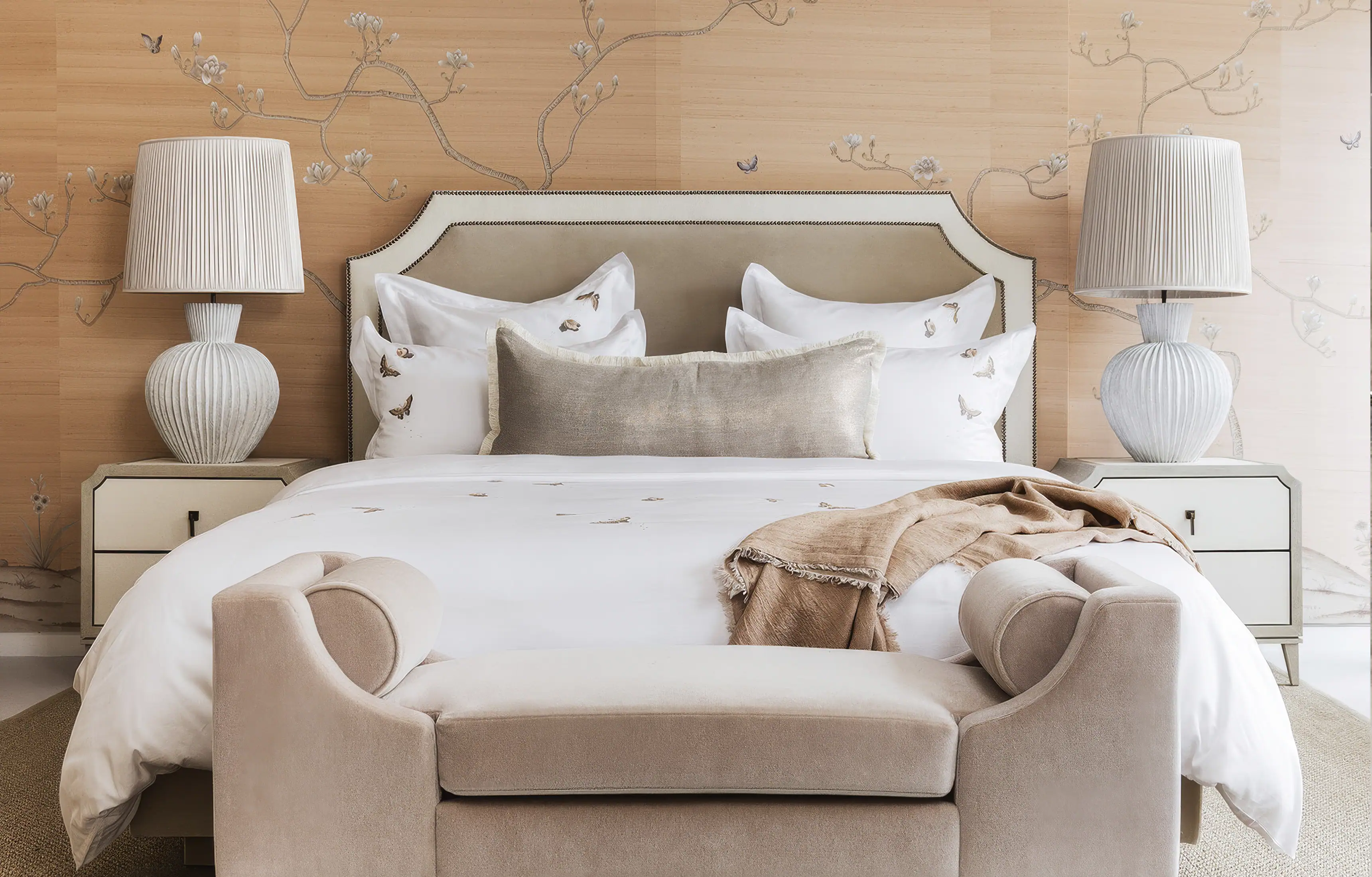
Reading time: 7 minVis-à-Vis Paris has spent thirty-five years building a reputation on hand-guided embroidery, the kind of technique that can render a single wing vein in thread. For its London showroom on Motcomb Street, the house handed that technique to Sophie Paterson and asked her to choose a subject worth it. She chose butterflies, twice over, once as a Chinoiserie-inspired print and once as an extreme close-up rendered entirely in stitched white cotton sateen.
Introduction
Vis-à-Vis Paris has been hand-embroidering household linen since 1989, working from its own Paris workshop rather than outsourcing the stitching, and it has built its London presence at 8 Motcomb Street in Belgravia around the same conviction that has carried the house for thirty-five years: that hand-guided embroidery can do things to fabric that printing and machine work cannot. For a house built on that premise, the choice of who gets to design a new collection matters more than it would for a printer that can simply run off whatever pattern arrives. Vis-à-Vis names its collections after the person who drew them, a practice closer to a couture atelier crediting a guest designer than a standard linen catalogue, and its most recent London collaborator is the interior designer Sophie Paterson.
Paterson, who founded her eponymous studio in 2008 and now works from bases in Surrey and London, is not primarily a textile designer. Her practice is high-end residential interiors, taken on a deliberately limited number of projects a year so that each one gets her direct attention. But she has spent the past several years building a parallel body of work designing collections for the makers she specifies into her own projects, brass mirrors, upholstery, wallpaper, cushions, and now, for Vis-à-Vis, two collections built around a single motif she chose herself: the butterfly.

The house that builds around its collaborators
Vis-à-Vis’s own account of its craft is specific rather than decorative. The house describes its hand-guided embroidery as work carried out in its own workshop, with fabric, thread and colour selected through a consultative process for each design, and it frames the result plainly: “each piece of embroidery tells a story. A story of your own.” That is not a generic maker’s slogan so much as a description of how the house actually operates, since its collections are consistently attributed to named collaborators rather than issued anonymously under the Vis-à-Vis name alone. A design credited to the French embroiderer and colourist Jérôme Faillant-Dumas sits in the same catalogue structure as one credited to Paterson, each one a discrete, authored collection rather than a seasonal update to a house pattern book.

That structure only works if the technique underneath it can actually deliver on a collaborator’s specific idea, and hand-guided embroidery is a slower, more exacting process than printing a repeat pattern onto cotton. A printed motif can be reproduced instantly and identically across any length of fabric. An embroidered one is worked by hand, piece by piece, which is slower and more expensive but capable of a level of dimensional detail, raised thread, shifting density, a sense of an image built up rather than laid down, that a flat print cannot match. Choosing to work with a house built on that difference is itself a design decision, not just a supplier choice, and it shapes what kind of motif is worth bringing to it in the first place.
The Motcomb Street showroom is where that decision becomes visible rather than theoretical. Vis-à-Vis’s London presence serves residential clients alongside hospitality projects and private commissions for yachts and aircraft interiors, settings where a printed textile and a hand-embroidered one read as genuinely different tiers of finish rather than interchangeable options at different price points. A house whose client base already understands that distinction is exactly the kind of collaborator worth bringing a considered, technically demanding motif to, rather than a safer, more generic pattern that would have worked just as well printed.

Why a butterfly, and why by hand
Paterson’s two collections for Vis-à-Vis approach that question from opposite directions. The first scatters butterflies across the fabric as a print-like repeat, its composition drawing on the tradition of Chinoiserie wallpaper, where birds, insects and branches are arranged loosely across a plain ground rather than locked into a strict grid, a convention originally developed to suggest a garden glimpsed in passing rather than catalogued specimen by specimen. Working within that tradition rather than a stricter, more symmetrical repeat gives the print collection room to feel observed instead of engineered, which matters for a motif as small and specific as a butterfly. The second collection abandons the repeat altogether and moves in close: a single butterfly wing, rendered in hand-guided embroidery on white cotton sateen, worked at a scale and level of detail that treats the wing itself as the entire composition rather than one element within a wider scene.

That second collection is the one that actually tests what hand embroidery is for. A butterfly wing is not a flat shape. It has veining, a graduated density of scale that reads as shading rather than line, and an almost translucent quality at its edges that a printed motif renders as a hard boundary between pattern and ground. Hand-guided stitching can vary its density and direction across a single small area in a way a print cannot, which is what allows the wing to hold its own as a standalone image rather than needing a busier composition around it to justify the technique. Paterson has described the collections as drawing on her own longstanding interest in butterflies, aiming for “a calm and natural interior feel,” and the close-up embroidery is where that intention and the house’s technical strength actually meet: a quiet, single-subject piece that only works because the stitching can carry that much detail on its own.

A collector of collaborations
The Vis-à-Vis collections are not an isolated venture into product design for Paterson. Over roughly the same period she has designed a brass dressing-table mirror collection with the Birmingham manufacturer Armac Martin, named the Claremont Mirror Collection; a throw collection with Andrew Martin woven in Italy from ninety per cent merino wool and ten per cent cashmere, alongside a thirty-four-piece cushion collection for the same house named Brindisi after the Adriatic coast that inspired it; wallpaper and decorative artwork with Fromental; bathroom vanity units and mirrors with Parker Howley & Co; internal doors and decorative screens with SWD Bespoke; and a furniture collection called Loom, launched at Decorex in 2024, built from textural pieces that draw on both classic British and contemporary reference points.
Taken together, that list reads less like a series of one-off licensing deals and more like a designer treating a network of British and European makers as an extended studio, each one brought in for a specific material skill her own residential projects already depend on. The Vis-à-Vis collaboration fits that pattern precisely: a London-based interior designer with a decade and a half of client work behind her, choosing a French embroidery house for a motif that specifically needs what hand embroidery, and only hand embroidery, can do.

The designer behind the collections
Paterson founded her studio in 2008 and has grown it over the years since into what is now described as one of the more established names in British luxury interior design, working from Surrey and London on high-end residential projects for private clients and developers in the UK and internationally. The studio takes on a limited number of projects each year by design, a decision framed around giving each one sustained, personal attention rather than scaling the practice into a larger volume operation. Paterson leads a team of interior and architectural designers and project coordinators, supported by a curated network of contractors and artisans she has worked with over time, the same network that has evidently grown to include mirror makers, upholsterers, wallpaper houses and, now, a Parisian embroidery atelier.
She has also built a second strand to her practice in design education, founding the Sophie Paterson Academy to teach interior design skills beyond her own client roster. Between the studio, the academy and the steadily lengthening list of maker collaborations, the throughline is consistent: Paterson treats specification, choosing exactly the right hand for a given material, as a design skill in its own right, not a step that happens after the design is already settled.

Frequently asked questions
What is Vis-à-Vis Paris?
A hand-embroidery house founded in 1989, working from its own Paris workshop on bespoke bed, bath and table linen, with a London showroom at 8 Motcomb Street, Belgravia.
What did Sophie Paterson design for Vis-à-Vis?
Two collections built around a butterfly motif: a Chinoiserie-inspired scattered butterfly print, and a close-up butterfly wing rendered in hand-guided embroidery on white cotton sateen.
Who is Sophie Paterson?
A British interior designer who founded her eponymous studio in 2008, working on high-end residential projects from bases in Surrey and London, and the founder of the Sophie Paterson Academy.
Why does the embroidery technique matter for this collection?
Hand-guided embroidery can vary density and direction across small areas of fabric, which lets it render the veining and graduated shading of a butterfly wing in a way a flat printed pattern cannot.
Has Sophie Paterson designed other product collections?
Yes. Alongside the Vis-à-Vis collections, she has designed a mirror collection with Armac Martin, cushions and throws with Andrew Martin, wallpaper with Fromental, and a furniture collection called Loom, among others.
Final thoughts
A butterfly wing is an easy thing to render badly and a hard thing to render well, and the difference between the two comes down almost entirely to whether the technique doing the rendering can handle graduated detail at a small scale. Vis-à-Vis built its reputation over thirty-five years on a technique that can, and Sophie Paterson’s close-up embroidery is what happens when a designer brings that house exactly the kind of subject it exists to prove itself on. Read against the rest of her collaborations, the mirrors, the throws, the wallpaper, the choice looks less like a one-off and more like a working method: find the maker whose particular skill a subject actually needs, and let that pairing do the talking rather than the motif alone.




Leave a Reply