
ART & CULTURE · MIAMI
Reading time: 11 minSuperblue Miami turned a 50,000 square foot former food distribution warehouse in Allapattah into a venue built entirely around art that cannot be bought, hung or taken home. Its opening exhibition paired soap-bubble sculpture and real-time flower animation from teamLab with Studio Drift’s kinetic Meadow and Es Devlin’s mirrored labyrinth, and its founders built a business model to match: one that pays artists directly from ticket sales rather than through a sale to a collector or a museum.
Miami’s Allapattah neighbourhood, just north of the Design District and Wynwood, is better known for produce warehouses and light industry than for art. That changed when the Rubell family relocated its collection there in 2019, and it changed again on 20 May 2021, when a 50,000 square foot building directly across the street opened as Superblue Miami.
The venue does not sell paintings or sculpture. It sells tickets to rooms built by artists specifically because the work inside them cannot be owned in any conventional sense: a floating mass of bubbles that repairs itself when disturbed, a field of flowers rendered fresh in real time for every visitor, motorised blooms that open and close on their own schedule, a mirrored maze shaped like the inside of a lung. Four commissions, all made for the space, opened the building together and set the template for everything that has followed.
Superblue’s founders describe what they built as infrastructure for artists working outside the object, and the physical building was engineered specifically to carry that argument. What follows is a look at what is actually in the rooms, who made each piece, and the model that lets it all keep running.

teamLab – Massless Clouds Between Sculpture and Life
Two teamLab works that never look the same way twice
teamLab, the Tokyo-based collective of artists, engineers, animators and mathematicians founded in 2001, contributed two works to Superblue Miami’s opening, and both are built to resist repetition by design.
Massless Clouds Between Sculpture and Life is a suspended, cloud-like mass built from soap bubbles infused with airflow, floating in the gallery without a visible structure holding it up. Visitors can walk into it without collapsing it: the surface yields, then reforms. If a section is disturbed beyond what the piece can regenerate on its own, that section collapses and rebuilds itself over time rather than staying broken, which means the sculpture on view during any single visit is, in a literal sense, unrepeatable elsewhere and unreachable by hand.

teamLab – Massless Clouds Between Sculpture and Life
Flowers and People, Cannot be Controlled but Live Together takes the same logic and applies it to a field of computer-rendered blooms. The flowers move through birth, bloom and scattering across a cycle compressed to roughly an hour standing in for a full year, rendered fresh in real time rather than played back from a fixed animation loop. Stillness lets flowers gather and grow; movement scatters petals underfoot. Because the rendering responds live to however many people are in the room and where they stand, no two passes through the space produce the same arrangement of flowers, and teamLab has been explicit that a previous visual state can never be reconstructed exactly.
Both pieces are drawn from the same underlying software system, an approach teamLab calls ultrasubjective space, which treats the boundary of a wall or the edge of the room as something the artwork can flow past rather than a hard limit. It is also worth noting that Superblue’s own ticketed, experience-first format takes a direct cue from teamLab’s own permanent venue in Tokyo, which was already proving that audiences would pay to walk through art built with exactly this kind of technology.

teamLab – Flowers and People, Cannot be Controlled but Live Together – Transcending Boundaries, A Whole Year per Hour
Studio Drift’s flowers that close for the night
Meadow, by the Amsterdam studio Drift, was the largest work in the practice’s Suspension Programme at the time it opened in Miami. Drift, founded by Lonneke Gordijn and Ralph Nauta, builds mechanical sculpture that borrows its logic directly from plant biology rather than from decorative botanical form.

DRIFT – MEADOW
The flowers in Meadow are motorised and fitted with sensors below the installation that register a visitor’s presence and translate it into movement. The blooms open and close in response, choreographed rather than random, in a pattern that echoes nyctinasty, the real biological process by which certain plants open during daylight and close at night. Drift has described the aim as making an ordinary environmental process, one that happens constantly in nature without anyone watching, suddenly visible and collective, so that a room full of strangers ends up moving through the same choreography together.
The mechanism matters because it is the argument. A cut flower in a vase is already dying by the time it is arranged. Meadow keeps its blooms in permanent motion instead, tying their apparent life not to a growing season but to whoever happens to be standing beneath them, which is Drift’s own way of making seasonal impermanence a felt, physical experience rather than a metaphor read off a wall label.

DRIFT – MEADOW
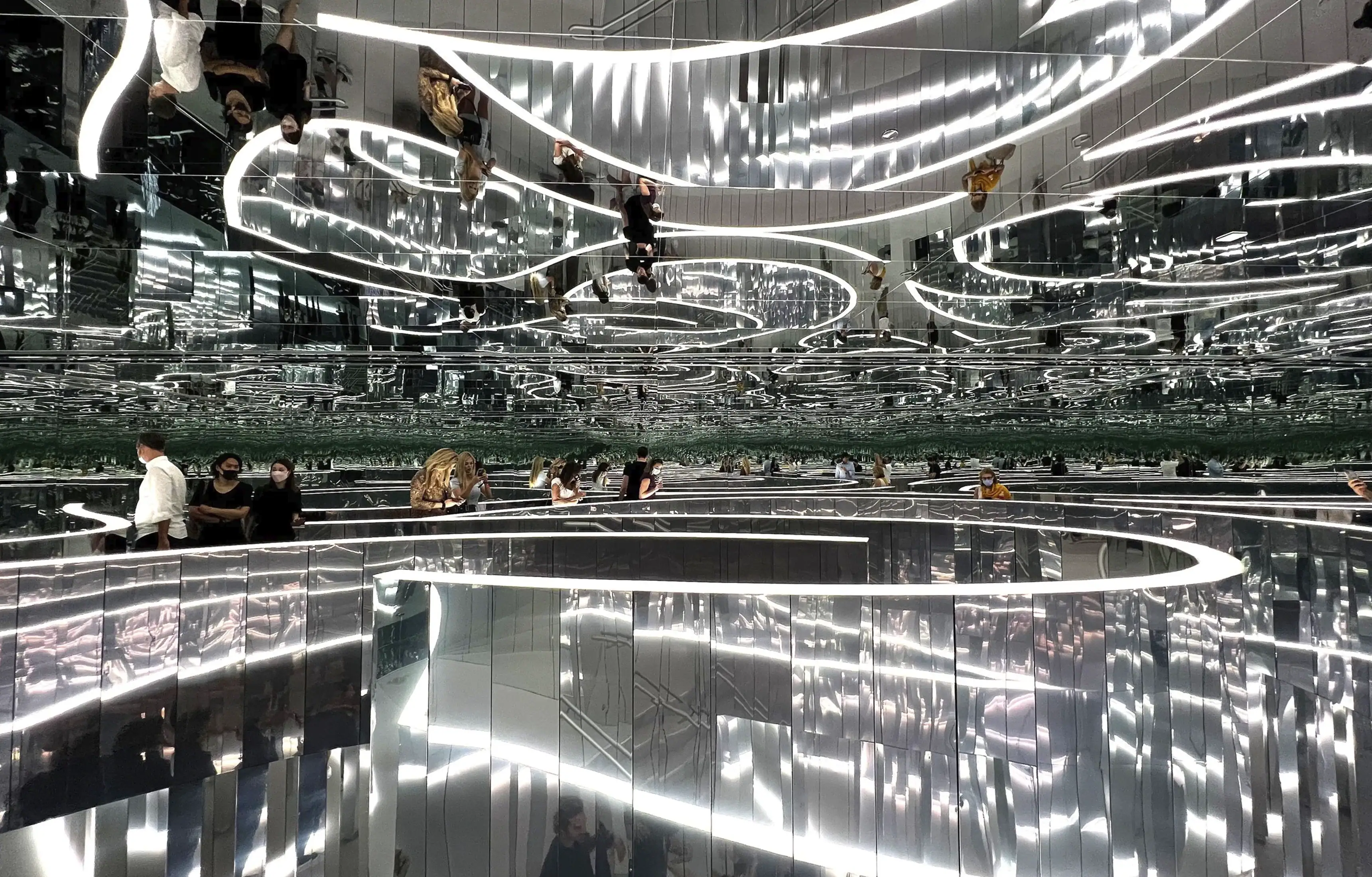
Es Devlin’s mirrored labyrinth, built on the shape of a lung
Es Devlin, the British stage designer known for large-scale work with Beyoncé, Kanye West, Adele and the Royal Opera House, brought a different discipline entirely to Superblue’s opening: Forest of Us, a two-storey mirrored labyrinth built from optical glass and polished aluminium.

Es Devlin – Move through a mirrored labyrinth
The piece opens with a short film that sets out its premise directly: the branching structure of the bronchial tubes inside a human lung and the branching structure of a tree are, geometrically, close to identical. Visitors then walk into a maze built on that same bifurcating pattern, its surfaces mirrored so thoroughly that the boundary between one person and the reflected crowd around them becomes genuinely hard to read. Devlin has pointed to the labyrinth built into the floor of Chartres Cathedral, walked by medieval pilgrims reciting prayers as they traced its turns, as a historical precedent for using a maze as a device for reflection rather than simple navigation.

Es Devlin – Move through a mirrored labyrinth
The design argument is direct rather than decorative. A tree and a pair of lungs perform the same function, exchanging gas with the air around them, and Devlin’s maze makes a visitor physically retrace that shared structure rather than simply being told about it. It is the one work of the four built primarily from architecture and optics rather than software, and it is the clearest demonstration that Superblue’s opening exhibition was never conceived as a single medium wearing four names.
Devlin’s practice usually plays out on stages built for a single night, from stadium tours to opera houses, where the set disappears once the run ends. Forest of Us is built to be walked through slowly and repeatedly over years rather than watched once from a seat, and that shift, from a temporary set for an audience to a permanent structure for individual visitors, is its own kind of design decision, distinct from the film and the maze geometry themselves.

Es Devlin – Move through a mirrored labyrinth
The model built to pay for all of it
None of the four pieces above can be bought, hung in a private house or resold at auction, which is precisely the problem Superblue was built to solve. Its co-founder, Mollie Dent-Brocklehurst, has described the gap plainly: artists working in this kind of large-scale, technology-driven, non-object practice had no reliable way to be paid for the work once a museum acquisition was off the table, because there was nothing physical left to sell.

teamLab – Flowers and People, Cannot be Controlled but Live Together – Transcending Boundaries, A Whole Year per Hour
Dent-Brocklehurst’s own career runs through the commercial side of the art world she then set out to change. She started at Sotheby’s in London in the mid-1990s, moved to Gagosian Gallery in New York and became a director there in 1997, then returned to London in 1999 to found and run Gagosian’s first London gallery until 2008. In 2010 she was appointed to open Pace Gallery’s first London space and served as its president until 2017, going on to run the two-year public art initiative Future/Pace with Mark Davy. Superblue grew out of PaceX, a research and development unit Pace Gallery set up in 2019, and was announced publicly on 4 August 2020 with Dent-Brocklehurst as chief executive, backed by Pace’s president Marc Glimcher and by Laurene Powell Jobs’s Emerson Collective.

teamLab – Flowers and People, Cannot be Controlled but Live Together – Transcending Boundaries, A Whole Year per Hour
The model Dent-Brocklehurst built pays artists a direct share of ticket revenue rather than routing money through a single sale. As she has put it, a conventional museum acquisition puts a patron or an institution in the position of deciding which work gets shown at all; Superblue instead lets the public do that job with their own ticket purchases; if visitors keep coming back, the work keeps earning for the artist who made it. It is a genuinely different mechanism from a gallery commission or a museum fee, and it is the reason a piece as technically demanding as Massless Clouds or Meadow can stay open, staffed and maintained for years rather than for the length of a single exhibition.

teamLab – Massless Clouds Between Sculpture and Life
A building shared with its neighbour
The building itself carries a detail that rarely makes it into coverage of the venue. Superblue Miami occupies 1101 NW 23rd Street, a former food distribution warehouse converted through major work to its electrical, HVAC and life-safety systems so that it could support installations built to hold thousands of visitors a month. Directly opposite, at 1100 NW 23rd Street, sits the Rubell Museum, which moved its collection to Allapattah from Wynwood in 2019, and the project’s own construction managers have confirmed that Superblue’s building was leased from the Rubell family itself.

DRIFT – MEADOW
That single fact reframes the whole block. Two of Allapattah’s founding cultural anchors, opened within two years of each other and sitting on opposite sides of the same street, exist inside a landlord and tenant relationship rather than a coincidence of geography. The Rubells went on to buy two further industrial buildings on the same block in 2021 and 2022, which suggests the arrangement with Superblue was less a one-off lease and more the opening move in a deliberate plan to turn a stretch of Allapattah’s produce and garment warehouses into a single walkable art campus.

DRIFT – MEADOW
A programme that has kept moving since opening day
Superblue Miami’s opening exhibition, titled Every Wall Is A Door, was never intended as a fixed collection. The venue has continued to rotate and add work since 2021, including touring pieces developed elsewhere and brought to Miami to run alongside the original four commissions. Rafael Lozano-Hemmer’s Pulse Topology, a canopy of thousands of bulbs that light in time with visitors’ heartbeats, is one of them, arriving at Superblue in November 2022 paired with BMW’s i7 after runs in Toronto, Kansas City and Basel.
That kind of movement between venues is only possible because Superblue was built as a rotating platform from the outset rather than a single fixed installation with a run date. The building’s infrastructure, reinforced specifically to support large kinetic and light-based work, is what allows one generation of commissions to make way for the next without the venue itself needing to be rebuilt each time.
It is a working demonstration of the same principle behind the revenue model. Just as artists are paid for as long as visitors keep buying tickets, the building itself is designed to keep earning its place by hosting whatever comes next, rather than being built around one exhibition and then standing still.

Es Devlin – Move through a mirrored labyrinth
Final thoughts
It would be easy to describe Superblue Miami as a photogenic warehouse full of technology, and stop there. That version is not wrong, but it misses the two decisions that actually make the place work. The first is curatorial: four artists working in entirely different media, software animation, kinetic mechanics and mirrored architecture, were asked to build around a single idea, that the work inside the building should be impossible to own in the way a painting is owned. The second is structural: a payment model built specifically to make that kind of unownable work financially viable for the artists making it, tested against a converted warehouse engineered to carry the load.

teamLab – Massless Clouds Between Sculpture and Life
Put those two decisions together and the venue reads less like an attraction and more like infrastructure, purpose-built for a category of art that genuinely did not have anywhere else to go. The building’s own address, leased from the family running Allapattah’s other major collection across the street, is a small but telling sign of how deliberately that infrastructure was assembled. Superblue Miami is what happens when a converted food warehouse, a revenue model built from ticket sales, and four artists asked to make something no one could take home are put in the same room.

teamLab – Flowers and People, Cannot be Controlled but Live Together – Transcending Boundaries, A Whole Year per Hour
What is Superblue Miami?
Superblue Miami is a 50,000 square foot experiential art venue in the Allapattah neighbourhood of Miami, built inside a converted former food distribution warehouse and dedicated to large-scale, technology-driven installations rather than paintings or sculpture for sale.
When did Superblue Miami open?
It opened on 20 May 2021 with the exhibition Every Wall Is A Door, featuring commissions by teamLab, Studio Drift and Es Devlin, alongside a fourth by James Turrell.
Who founded Superblue?
Superblue was co-founded by Mollie Dent-Brocklehurst, formerly president of Pace Gallery’s London space, together with Pace’s president Marc Glimcher and backing from Laurene Powell Jobs’s Emerson Collective. It grew out of Pace’s in-house research unit PaceX and was announced publicly on 4 August 2020.
How does Superblue pay its artists?
Superblue shares ticket revenue directly with the artists whose work it presents, rather than relying on a single sale to a collector or museum, which allows it to keep commissioning large-scale, non-object work that has no conventional resale market.
What installations opened Superblue Miami?
teamLab’s Massless Clouds Between Sculpture and Life and Flowers and People, Cannot be Controlled but Live Together, Studio Drift’s Meadow, and Es Devlin’s Forest of Us opened the venue together.
Where is Superblue Miami located?
It is at 1101 NW 23rd Street in Allapattah, directly across the street from the Rubell Museum, which relocated to the same neighbourhood in 2019.
Is the Superblue Miami building connected to the Rubell Museum?
The building Superblue occupies was leased from the Rubell family, whose collection sits directly opposite, making the two venues part of the same landlord and tenant relationship rather than simple neighbours.
Has Superblue Miami’s programme changed since it opened?
Yes. Alongside its four original commissions, the venue has hosted touring works including Rafael Lozano-Hemmer’s Pulse Topology, which arrived in November 2022 after showings in Toronto, Kansas City and Basel.
Leave a Reply