
ART & CULTURE · MILAN
Reading time: 13 minCrystal has one obvious job: to be the star. Six designers at Atelier Swarovski Home spent the collection’s second edition proving otherwise, treating it instead as a foil for metal, marble, brass and, in one case, turned oak. What each of them chose to put crystal against says more about the material than the crystal itself ever could.
In April 2017, Swarovski opened the doors of Palazzo Crespi, Piero Portaluppi’s 1930s office palazzo on Piazza Meda in central Milan, for the second edition of Atelier Swarovski Home. The collection had launched the year before with two names, the London studio Raw Edges and the late Zaha Hadid, working crystal into bowls and a centrepiece. For its second outing, Swarovski widened the invitation considerably: six designers, none of them primarily known as jewellers or glassmakers, each given the same material and asked to decide what to do with it.

Andre Kikoski
The results shared almost nothing formally. Andre Kikoski, a Manhattan architect, set crystal against blackened copper and bronze. Barbara Barry, the Los Angeles interior designer, paired it with brass and gunmetal in deep blue and amber. Studio Brynjar & Veronika built pure polygonal paperweights that let the crystal answer entirely for itself. Aldo Bakker, working in the material-first tradition his own family helped establish in Dutch design, distilled it into stoppers and lenses. Tomás Alonso set it into marble. And Greg Lynn, an architect who had built his reputation on computer-generated form, turned it on a lathe, in oak.
That range is the actual subject here, more than any single piece in it. A material usually reads as itself: crystal photographs as crystal, whatever it is set beside. What Atelier Swarovski Home’s second collection demonstrated, across six unrelated design practices working independently of one another, is that crystal is more accurately described as a variable, one that changes meaning according to what it is asked to sit against.

Studio Brynjar & Veronika
Palazzo Crespi, and why the setting matters
Palazzo Crespi was built between 1928 and 1932 by Piero Portaluppi, the Milanese architect responsible for some of the city’s most distinctive interwar buildings, for the Crespi family, textile and electrical industrialists who also held a stake in Corriere della Sera. It sits on Piazza Meda, at the junction of Corso Matteotti and Corso Venezia, part of the wave of construction that opened Corso Matteotti as a new route between Piazza della Scala and Piazza San Babila during Milan’s late-1920s urban renewal.

Aldo Bakker
Portaluppi’s design is a study in the same tension the Atelier Home collection would later stage inside it: monumental classical elements, a serliana at the base, a broken pediment at the top, set against contemporary details including Greek key motifs cut into the stonework, and a material palette that runs from dark granite at street level to pale marble above. Two angled wings meet at the hexagonal staircase that anchors the whole plan. It is, in short, a building built to hold two registers at once without letting either dominate, which makes it a considered choice for a collection built on exactly that principle in miniature.

Tomás Alonso
What Atelier Swarovski Home is, and who built it
Atelier Swarovski itself dates to 2007, when Nadja Swarovski, the company’s first female executive board member and the figure who had already spent a decade pushing Swarovski crystal into fashion, architecture and design through the Swarovski Crystal Palace platform she launched in 2002, established it as a jewellery, accessories and home décor line built on collaboration with named designers rather than an in-house house style. Atelier Swarovski Home, the interiors-focused strand within it, launched in 2016. Its debut collection paired Raw Edges’ colour-hatched bowls with a crystal-and-metal centrepiece by Zaha Hadid, one of her final pieces of work.

Studio Brynjar & Veronika
The second collection, shown at Palazzo Crespi in 2017, was built around continuity as much as expansion. Aldo Bakker returned to develop the modular vase he had shown in the debut year into a fuller range. Alongside him, Swarovski brought in five designers who had not worked with the brand’s home décor line before: Barbara Barry, Andre Kikoski, Greg Lynn, Tomás Alonso and Studio Brynjar & Veronika, the last of whom arrived via an existing relationship with Swarovski’s design programme, having won the 2016 Swarovski Designers of the Future Award at Design Miami/Basel. The brief given to all six was, in effect, the same one Nadja Swarovski had set for the platform a decade earlier: bring your own practice to the material, rather than adapting the material to fit a house style.

Barbara Barry
Andre Kikoski’s Lustra, and an architect’s approach to a small object
Andre Kikoski runs a Manhattan-based architecture practice, working from Varick Street, that has built a reputation across three decades on cultural and residential commissions and picked up more than thirty design awards along the way. His firm describes its own position as “grounded by enduring architectural principles, driven by innovation,” and that description holds up unusually well when applied to a candle holder rather than a building, because it explains why Lustra reads as an object built by someone used to thinking in structural terms rather than decorative ones.

Andre Kikoski
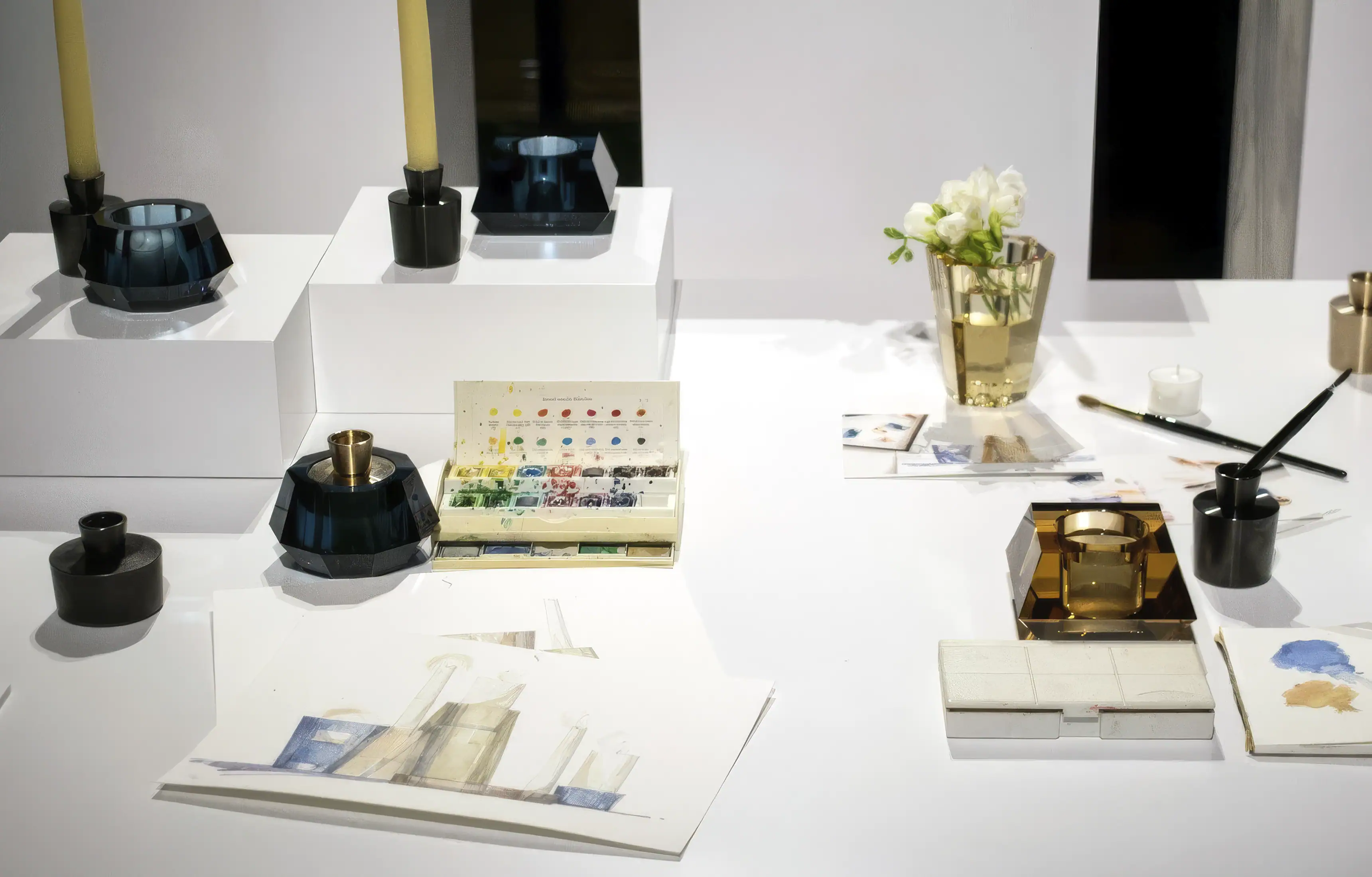
The collection, trays, boxes and candle holders, sets crystal against copper, nickel and bronze, materials with an explicitly industrial and masculine register rather than the soft metals more typical of tabletop design. The crystal is smooth and unfaceted where the metalwork is textured, so the contrast is less about colour than about surface: a hard, worked metal edge against a material that offers no resistance to light at all. It is the kind of decision an architect makes almost by instinct, treating the object the way a facade treats a material junction, rather than the way a jeweller treats a setting.

Andre Kikoski
Barbara Barry’s Aura, and warmth as a design decision
Barbara Barry has spent more than two decades building an interior design practice out of Los Angeles defined, by her own account and by the design press that inducted her into Interior Design’s Hall of Fame in 2000, by restraint: clean line, warm materials, nothing overstated. Her furnishings and home collections are licensed and sold through galleries as far afield as Bangkok, Singapore, Kuala Lumpur and Moscow, and her 2012 book Around Beauty set out the design philosophy behind them directly.

Barbara Barry
Aura, her contribution to Atelier Swarovski Home, applied that philosophy to candle holders and vases in deep blue and amber crystal, set into brass and gunmetal. Where Kikoski used contrast to sharpen crystal’s presence, Barry used colour to soften it, choosing tones that read as warm rather than sparkling and pairing them with metals that carry their own patina rather than a hard shine. The effect is a set of objects that behave more like ceramics or blown glass in a room than like cut crystal, which is precisely the register her interiors work has always aimed for.


Barbara Barry
Studio Brynjar & Veronika’s Currents, and crystal asked to do all the work
Studio Brynjar & Veronika is the partnership of Brynjar Sigurðarson, an Icelandic designer who founded his studio in 2011, and Veronika Sedlmair, a German interior designer from the Allgäu region of Bavaria who joined him in 2014, the studio now based in Immenstadt, in southern Germany. The pairing is worth stating precisely: the studio is Icelandic in origin and German in its current base, run by one designer of each nationality, rather than a single-nationality practice. Sigurðarson has described their working method as one that resists a fixed brief from the outset: “We allow ourselves to be guided by the process rather than by a prefabricated idea.”

Studio Brynjar & Veronika
Currents, the trio of polygonal crystal paperweights the studio built for Palazzo Crespi, grew directly out of that method and out of a specific piece of prior recognition: the studio had won the 2016 Swarovski Designers of the Future Award at Design Miami/Basel, and the paperweights extend the thinking behind that commission into a domestic object. Each piece is faceted crystal alone, no metal, no wood, no contrasting material at all, cut so that the polygon chambers inside catch and disperse light differently depending on the angle it is viewed from. Of the six collections, it is the only one that treats crystal as sufficient by itself, which makes it the control case against which the other five design decisions can be read.

Studio Brynjar & Veronika
Aldo Bakker’s Facet, and a family’s approach to material
Aldo Bakker was born in 1971 in Amersfoort into Dutch design’s most consequential family. His father, Gijs Bakker, co-founded Droog, the collective that reshaped Dutch conceptual design from the late 1980s onward; his mother, Emmy van Leersum, was a jewellery designer whose own work helped define the same movement’s early years. Aldo trained initially as a jeweller himself before moving into the industrial design practice he now runs from Amsterdam, one built, in his own description, around the interaction between materials and the bodies and objects that use them. A 2011 retrospective at the Zuiderzeemuseum, staged under the title Emmy+Gijs+Aldo, was in part an exercise in establishing him as a designer in his own right rather than only as an inheritor.

Aldo Bakker
Facet, his contribution to the second Atelier Home collection, extended the modular vase he had shown in 2016 into bottle stoppers and paperweight lenses, objects reduced to almost nothing beyond pure form. Bakker’s practice generally works porcelain, metal and wood into shapes drawn less from function than from what he has called the unexpected forms he notices in passing, refining a shape first and adjusting it for use only afterwards. Applied to crystal, that method produces objects that read as studies in optical purity rather than as tableware: a stopper is a stopper, but it is also, first, a lens.


Aldo Bakker
Tomás Alonso’s Prism, and crystal folded into stone
Tomás Alonso was born in Spain and spent a decade working across the United States, Australia and Italy before completing a master’s degree at London’s Royal College of Art and settling in the city, where his studio now shares a workshop with the OKAY Studio collective. His design language has been described, accurately, as an inversion of expected material behaviour: wood reduced to slender, squared, almost linear forms, while iron is allowed to curve and warm in ways timber usually would.

Tomás Alonso
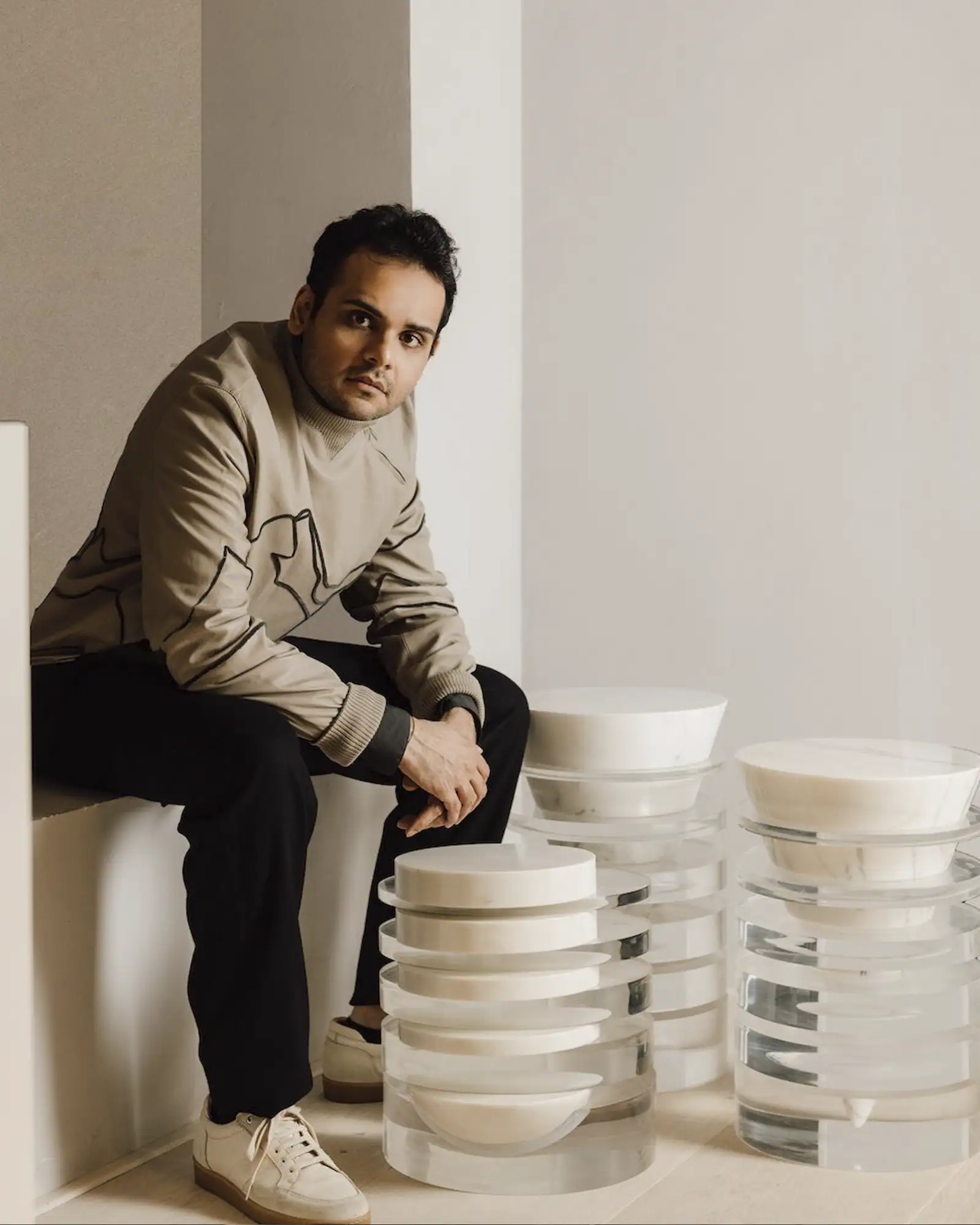
Prism, his Atelier Swarovski Home collection, applies a version of the same inversion to crystal and stone. Circular and square marble trays are inset with chips of coloured crystal, arranged either as clustered patterns or as stripes cutting across the trays in contrasting hues. Marble is the material usually expected to dominate a tabletop object; here it becomes the ground, and the crystal, ordinarily the material asked to command attention, becomes the accent set into it. It is a quieter reversal than Bakker’s or Kikoski’s, but it is a reversal of the same kind: crystal made to behave against type.

Tomás Alonso
Greg Lynn’s Coronel, and the departure that makes the whole collection make sense
Greg Lynn is an American architect, born in 1964 in North Olmsted, Ohio, educated at Miami University and Princeton, who built his career pioneering computer-aided architectural design in the 1990s. His 1993 essay “Folding in Architecture” and his 1999 book Animate Form argued for a calculus-based, animation-software approach to architectural form that produced the curved, biomorphic buildings the press later nicknamed “blobitecture,” a term Lynn himself did not coin but which stuck to his work regardless. He has taught the approach at Columbia, ETH Zurich, Yale, UCLA and the University of Applied Arts Vienna, and won a Golden Lion at the 2008 Venice Biennale for it. His best-known objects, the Alessi Tea and Coffee Towers in superformed titanium, the Vitra Ravioli Chair, the Blobwall system, are computational forms realised in fabricated, often synthetic, materials.

Greg Lynn
Coronel, his contribution to Atelier Swarovski Home, is a set of pieces for an at-home bar, integrating turned oak, stainless steel and cut crystal, texture and tone playing off against the natural grain of the wood. It marked the first time wood had appeared in the Atelier Home collection at all. Set beside Lynn’s usual register, it reads less as a stylistic choice than as a genuine departure, and the departure is sharper than it first appears once one piece of prior history is accounted for: Lynn had already worked with Swarovski once before, in 2009, at Design Miami, on an installation for the Swarovski Crystal Palace called Carbon Crystal Sails. That piece, suspended sails of carbon and aramid fibre laminated between sheets of mylar and embedded with over 1.5 million crystals, was built by computer-guided robots at a sailmaker’s factory, its components formed in moulds and its final panels, more than fifty square metres of them, weighing under 350 kilograms. Lynn described the intent at the time as getting “the crystals suspended in the air, not as an object but as a sheet or surface through which light could pass and be reflected,” a piece of pure digital fabrication from an architect who had spent two decades arguing that software, not the hand, was where architectural form should be found.

Greg Lynn
Coronel, eight years later, is a lathe-turned object. It is difficult to find two more opposite approaches to putting crystal into a room than a robotically laminated carbon-fibre sail and a hand-finished oak bar tray, and the fact that the same architect made both, for the same client, is a more interesting fact about crystal’s range than any single material choice in the rest of the 2017 collection. If a designer whose entire public identity was built on computation would turn to a lathe for this material, the reason is worth taking seriously: crystal’s optical behaviour, its refraction and its edge, reads differently against organic material than it does against anything synthetic, and Lynn’s own career gave him an unusually direct way of testing that difference against himself.

Greg Lynn
What six approaches to one material actually prove
Taken individually, none of the six collections argues very much. Taken together, they argue something specific: that crystal does not have a fixed visual identity, only a set of relationships. Set against blackened metal, it reads as hard and architectural. Set against brass and warm colour, it reads as soft. Left entirely alone, it reads as pure optics. Set into marble, it becomes an accent rather than a subject. Set against oak, cut by the same hands that once built its forms from carbon fibre and code, it becomes something closer to a material argument about craft itself. None of these readings is wrong, and none of them is the definitive one, which is the actual point: a material this widely used usually gets treated as settled, and Atelier Swarovski Home’s second collection is a rare case of six practitioners, working independently, proving in six different directions that it was never settled at all.
Swarovski kept returning to Milan on the strength of that idea. Two years later, at Euroluce 2019, the company built an entire stand around crystal’s behaviour in light rather than in domestic objects, organised around the four elements of crystal manufacturing itself. The register had shifted from tableware to lighting, but the underlying question, what a single material does when handed to different designers working in different disciplines, was the same one Palazzo Crespi had already answered in 2017.

Tomás Alonso
Final thoughts
It would be easy to read Atelier Swarovski Home’s second collection as six good ideas that happened to share a supplier. That undersells what actually happened at Palazzo Crespi. Six designers working in six unconnected disciplines, an architect, an interior designer, a jewellery-trained material specialist, a design duo, a product designer and a computational architect, were each handed the same material and left to decide, entirely on their own terms, what it should be set against. None of them produced the same answer, and the range of answers is the real subject of the collection: crystal read as hard architecture in Kikoski’s metalwork, as warmth in Barry’s brass, as pure optics in Brynjar & Veronika’s paperweights, as distilled form in Bakker’s lenses, as accent in Alonso’s marble, and, in Lynn’s turned oak, as the material an architect chose specifically because it was the opposite of everything he had built his name on.
That last choice does more work than any single object in the collection. A designer’s material choices usually confirm what is already known about their practice. Lynn’s oak did the opposite, and the fact that Swarovski gave him the room to make that choice, rather than commissioning the crystal-and-carbon-fibre spectacle he had already built for them once before, says as much about the collection’s premise as any of the pieces themselves. Crystal, it turns out, is not a material with one true register. It is a material that reveals whoever is asked to use it.
What is Atelier Swarovski Home?
Atelier Swarovski Home is the interiors-focused strand of Atelier Swarovski, Swarovski’s collaborative design line, launched in 2016 to apply crystal to domestic objects through partnerships with named designers and architects rather than an in-house style.
When and where was the second Atelier Swarovski Home collection shown?
It was presented at Palazzo Crespi in Milan during Milan Design Week, 4 to 9 April 2017, as part of that year’s Salone del Mobile.
Who designed the 2017 collection?
Six designers contributed: Andre Kikoski, Barbara Barry, Studio Brynjar & Veronika, Aldo Bakker, Tomás Alonso and Greg Lynn, each working independently on their own named collection within the wider presentation.
What is Palazzo Crespi?
Palazzo Crespi is an office palazzo on Piazza Meda in central Milan, built between 1928 and 1932 by the architect Piero Portaluppi for the Crespi family, and now used periodically as an exhibition venue during Milan Design Week.
What materials did the designers use alongside the crystal?
The materials varied by collection: copper, nickel and bronze for Andre Kikoski’s Lustra; brass and gunmetal for Barbara Barry’s Aura; pure faceted crystal for Studio Brynjar & Veronika’s Currents; marble for Tomás Alonso’s Prism; and turned oak and stainless steel for Greg Lynn’s Coronel, the first time wood had featured in the collection.
Why is Greg Lynn’s use of oak in Coronel notable?
Lynn built his career on computer-generated, digitally fabricated architectural form and had previously worked with Swarovski in 2009 on a robotically laminated carbon-fibre installation. Turning oak on a lathe for Coronel represents a marked departure from that computational register, made more striking because it was the same architect and the same client both times.
Who leads Swarovski’s design collaboration programme?
Nadja Swarovski, the company’s first female executive board member, has led Swarovski’s design collaboration work since launching the Swarovski Crystal Palace platform in 2002 and Atelier Swarovski in 2007, building the model of pairing crystal with independent, named designers that Atelier Swarovski Home continued.
Did Swarovski return to Milan Design Week after 2017?
Yes. Swarovski has treated Milan Design Week as a recurring platform for its Crystal Palace concept for well over a decade, including at Euroluce 2019, where crystal’s behaviour in lighting was explored across a stand built around the four elements of crystal manufacturing.



Leave a Reply