
INTERIORS · LONDON
Reading time: 10 minIndia Mahdavi has now designed the Gallery at Sketch twice. The first room, in pink, became one of the most photographed interiors in the world. The second, in copper and yellow, is the more sophisticated piece of work, because it was built as a container rather than a picture. It has already carried two entirely different art commissions, and it looks better for both.
Sketch occupies 9 Conduit Street, a stuccoed Mayfair town house of 1779 by James Wyatt, Grade II star listed since 1958, with a giant order of Ionic pilasters running up the front. Before it was a restaurant it housed the Royal Institute of British Architects, a headquarters of the suffragette movement, and Christian Dior’s London atelier.
Mourad Mazouz opened it with the chef Pierre Gagnaire in 2002, after four years working out what the building wanted to be. His own account of the process is a good description of the whole place: “There was never a mission for Sketch. The ideas started to emerge as I walked through the building.”
Of Sketch’s rooms, the Gallery is the one that changes. It began in 2002 as a white cube with video screens by Noé Duchaufour-Lawrance, took decorative screens in 2005, went to Martin Creed in 2012, and in 2014 became the pink room that made it globally famous.
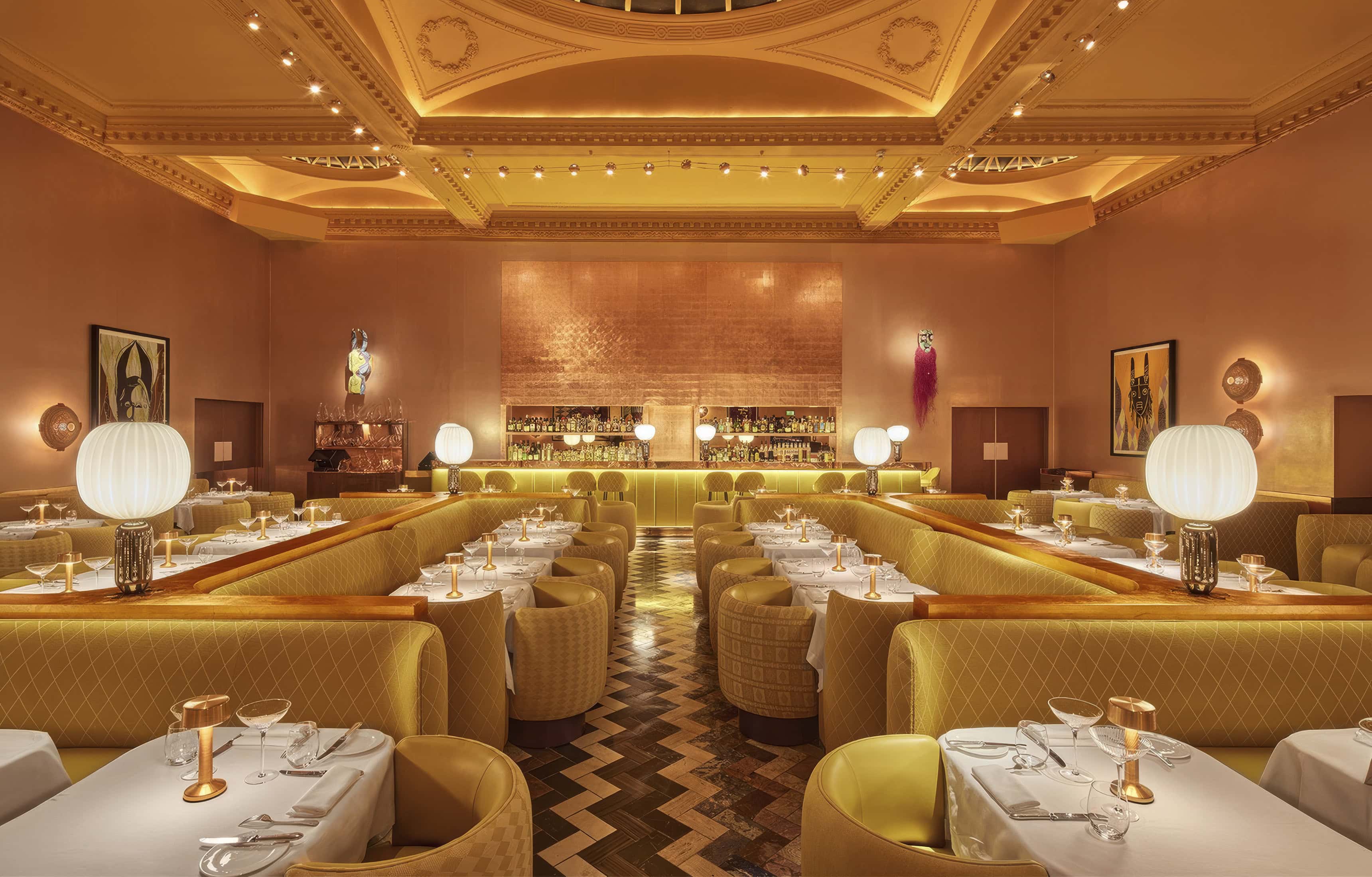
Then in March 2022, for Sketch’s twentieth anniversary, India Mahdavi designed it again, this time in copper and yellow, to hold a commission by Yinka Shonibare CBE RA.
That second room is the interesting one, and four years on it is possible to see why.

The pink room deserves its reputation
Before anything else, the pink.
Mahdavi’s 2014 Gallery opened on 9 June 2014, in what her studio calls Hollywood pink, hung with 239 black and white drawings by David Shrigley, rehung in January 2018 with 91 new colour works. The seating was her own Charlotte armchair, barrel-backed, upholstered in rose Pierre Frey velvet and named after the dessert that is ringed with sponge fingers. She kept Martin Creed’s floor from the previous scheme. Shrigley made a 22 piece dinner service with Caverswall in Stoke-on-Trent.
It became, by common consent, one of the most photographed restaurant interiors in the world, and it defined a decade of how interiors were shared.
Her account of the intent is characteristically direct. “My first desire was to paint it all pink and to stage the customer as if he were part of a film,” she has said. “The pink contrasted with the monumentality of the room.” It was conceived on Sketch’s usual two year rotation. It ran for eight, because nobody could bear to take it down.
When it finally came out, the Charlotte armchairs were sold at auction rather than skipped, and Sketch kept a scale model of the pink Gallery on permanent display in the building. That is the correct way to retire a room.
Mahdavi has been candid about what came next. “The Gallery at Sketch has been linked to the colour pink for such a long time that it was very challenging for me to overcome this success.” She has also called the pink room “the Scheherazade of interiors, which survived year after year thanks to its success”, which is the best line anyone has written about it.

Warmth is the new colour
The 2022 room replaced pink with metal and sunlight.
The walls are a metallic copper wallcovering by de Gournay, a house Mahdavi has collaborated with since 2020, and the effect is closer to a skin than a decoration. The ceiling is Mandarine au Lait, a shade from Mahdavi’s own 56 colour paint range developed with Meriguet-Carrère. Upholstery runs to solar yellow. The floor is chevron ceramic tile. Lighting is warm and low.
Her summary of it was four words: “Warmth is the new colour at Sketch.”
The intelligence of the scheme is in the banquettes. They are custom, quilted in a diamond pattern, and finished in leather carrying woven raffia patterning specially made in Senegal by the textile designer Aïssa Dione. On the walls, hand-woven wicker light fittings by Inès Bressand were made in collaboration with Ghanaian weavers.
So the room is not simply coloured warm. Its two most tactile elements were made by named makers in West Africa, which means the material and the art are arguing the same case rather than the interior providing a backdrop for someone else’s idea.
Mahdavi has said as much. “Yinka’s artwork was a real inspiration and enticed me to work differently in this new version of the Gallery.”

Shonibare’s four years on these walls
The commission Mahdavi built the room for was Modern Magic, an extension of Shonibare’s series Modern Magic (Studies of African Art from Picasso’s Collection).
The premise is elegant. Picasso took African masks into European modernism. Shonibare takes them back, remaking them as framed quilts in appliqué and embroidery on Dutch wax batik, alongside hand-carved and hand-painted wooden masks. Around a dozen and a half pieces in total, hung salon style against the copper.
“Picasso was interested in appropriating from another culture, and I also appropriate from European ethnic art,” he said at the time. “Cultural appropriation can be a two-way street.”
The material carries the argument by itself. Dutch wax print is a wax-resist cotton whose technique is Indonesian batik, industrialised by Dutch manufacturers in the colonial period, taken up in West Africa where it became a marker of African identity, and still made in the Netherlands and in Manchester. Shonibare has used it since 1994 and buys his in Brixton Market. “It’s the fallacy of that signification that I like,” he has said. “It’s the way I view culture. It’s an artificial construct.”
He also designed ceramic tableware, again made by Caverswall, the same Stoke-on-Trent maker who produced the Shrigley service eight years earlier. Gagnaire put a West African jollof on the menu. The uniforms were by Sonia Taouhid.
Mazouz’s account of commissioning it is worth having. “I was very afraid to change the pink room as David Shrigley is a part of Sketch,” he said. “Then I was introduced to Yinka Shonibare, and I thought, my God, the master himself wants to work with Sketch.”
Those works hung for roughly four years. In January 2026 the Gallery was rehung again, with a new commission by the British artist Jonathan Baldock, who like Shonibare is represented by Stephen Friedman Gallery: eighty-odd coloured clay masks running in a staggered line around the walls, flower sculptures around the bar and reception, and wool cocoons suspended in the domed skylight.
Mahdavi’s room did not change. The copper walls, the Mandarine au Lait ceiling, the raffia leather and the wicker lights are all still there, holding a completely different body of work.

Why the container matters more than the picture
This is the argument the room makes, and it took four years to become visible.
The pink Gallery was a total work. Colour, furniture, drawings and crockery arrived together and read as one object, which is exactly why it was so photographable and why it was so difficult to change. Its identity and its art were the same thing.
The 2022 room is built the other way round. Mahdavi gave it a strong material character, copper, yellow, raffia, wicker, and then left the walls to somebody else. The colour is warm enough to flatter almost anything hung on it. The metallic ground reflects rather than competes. The craft is concentrated in the seating and the light fittings, at the edges of the room, where art does not go.
It is a room designed with the knowledge that it will be rehung, by a designer who had already learned what happens when a room becomes too closely identified with one artist to be changed. That is a more difficult brief than making something memorable, and a more generous one.
The proof is that Shonibare’s quilts and Baldock’s clay masks are almost nothing alike, and the room has carried both.

India Mahdavi
Mahdavi was born in Tehran in 1962 to an Iranian father and an Egyptian mother, and had a childhood of near constant movement, through Cambridge Massachusetts, Heidelberg and the south of France. She describes herself as “polyglot and polychrome”, which covers it.
She trained in architecture at the École des Beaux-Arts in Paris from 1980 to 1986, then studied furniture design at Parsons and graphic design at the School of Visual Arts, both in New York. She spent seven years as artistic director for Christian Liaigre before founding her own studio around the turn of the millennium, on rue Las Cases in the seventh arrondissement of Paris.
Her furniture line launched in 2003, and the Bishop, a glazed ceramic stool shaped like a chess piece, is the piece most people can picture. The projects run from the Coburg Bar at the Connaught to Monte-Carlo Beach, the Hôtel du Cloître in Arles, Ladurée in Los Angeles, Tokyo and Geneva, and the Villa Medici in Rome. She was Maison&Objet Designer of the Year in 2004 and made Officier des Arts et des Lettres in 2015.
Her most significant recent work is PoMo in Trondheim, her first museum, a modern and contemporary art gallery inside a converted art nouveau post office, which opened in February 2025. It is a useful corrective to anyone who files her as a colourist for hire, and it is also, again, a building made to hold other people’s work.
On colour she is worth quoting at length. “Colour is a consequence,” she has said. “I never begin with a palette.” And: “I like to mix and let them insult each other, have an argument. When they’re too perfect, it’s boring.”

Yinka Shonibare
Shonibare was born in London in 1962 and moved to Lagos at three, returning to England at seventeen. He studied at Byam Shaw and took his MFA at Goldsmiths in the late 1980s, alongside the generation that became the YBAs. At eighteen he contracted transverse myelitis, which left him permanently paralysed down one side, and he has worked since by directing a studio of assistants.
The public will know Nelson’s Ship in a Bottle, made for the Fourth Plinth in Trafalgar Square in 2010 and now at the National Maritime Museum, and the Wind Sculpture series. The works that matter most to his argument are the libraries: The British Library of 2014, The African Library of 2018 with six thousand volumes bound in Dutch wax, each carrying the name of a figure from African independence, and The War Library of 2024.
He was elected a Royal Academician in 2013 and made CBE in 2019. He runs Guest Projects, a free space for emerging artists, and the Guest Artists Space Foundation in Nigeria, which since November 2022 has run a residency in Lagos and a 54 acre ecology farm at Ijebu, the latter built from 40,000 bricks made from soil excavated on site. His position is straightforward: artists should have some impact socially.
His work is currently on show at the Rose Art Museum at Brandeis, where Sanctuary runs until January 2027.
Frequently asked questions
Who designed the Gallery at Sketch?
India Mahdavi has designed it twice, in 2014 and again in 2022. The current copper and yellow scheme is hers.
Is the Gallery still pink?
No. The pink room ran from June 2014 to early 2022. Mahdavi replaced it with copper walls, a Mandarine au Lait ceiling and yellow upholstery.
What was the pink room?
Hollywood pink walls, Mahdavi’s Charlotte armchairs in rose Pierre Frey velvet, and 239 David Shrigley drawings, rehung with 91 new colour works in 2018.
What did Yinka Shonibare make for Sketch?
A group of site-specific works titled Modern Magic: framed quilts in appliqué and embroidery on Dutch wax batik, replicating African masks from Picasso’s collection, together with hand-carved painted wooden masks. He also designed ceramic tableware made by Caverswall.
Is the Shonibare work still there?
No. The Gallery was rehung in January 2026 with a commission by Jonathan Baldock, made up of coloured clay masks, flower sculptures and wool cocoons suspended in the dome. India Mahdavi’s interior remains in place.
Who made the textiles?
The leather banquettes carry woven raffia patterning made in Senegal by the textile designer Aïssa Dione. The wicker wall lights were designed by Inès Bressand and made with Ghanaian weavers.
What is Dutch wax print?
A wax-resist printed cotton whose technique came from Indonesian batik, was industrialised by Dutch manufacturers, and was adopted in West Africa as a marker of identity. Much of it is still made in the Netherlands and in Manchester.
What is the building?
9 Conduit Street, a town house of 1779 by James Wyatt, Grade II star listed, which has previously housed the Royal Institute of British Architects and Christian Dior’s London atelier.
Who founded Sketch?
Mourad Mazouz, with the chef Pierre Gagnaire, in 2002.
What are the other rooms?
The Lecture Room and Library, which holds three Michelin stars, the Glade, the Parlour, the East Bar and the egg-shaped pod lavatories by Noé Duchaufour-Lawrance.

Final thoughts
Sketch has now given the Gallery to Mahdavi twice, and the two rooms are doing quite different jobs. The last four years have made that clear in a way it could not have been in 2022.
The pink Gallery was a brilliant single object. It was so complete that changing it took eight years and a certain amount of nerve, and Sketch keeps a model of it in the building because a room like that deserves a memorial.
The room Mahdavi made to replace it is quieter and cleverer. Copper on the walls, a milky orange ceiling, raffia woven in Senegal into the leather you sit on, wicker woven in Ghana into the lights above your head. It was designed to be the constant while the art on the walls comes and goes, and it has now done that twice with work as different as Dutch wax quilts and clay masks.
Making a room nobody can bear to change is one kind of achievement. Making one that can hold anything, and still be unmistakably yours, is the harder one.


Leave a Reply