
ART & CULTURE · MILAN
Reading time: 6 minTokujin Yoshioka‘s Frozen ran at Palazzo Landriani in Milan’s Brera Design District from 8 to 13 April 2025. Its centrepiece, the Aqua Chair, weighed 850 kilograms and was engineered to gradually dissolve across the week. It was not Yoshioka’s first attempt at building a chair through a natural physical process rather than a conventional one. It was closer to his second.
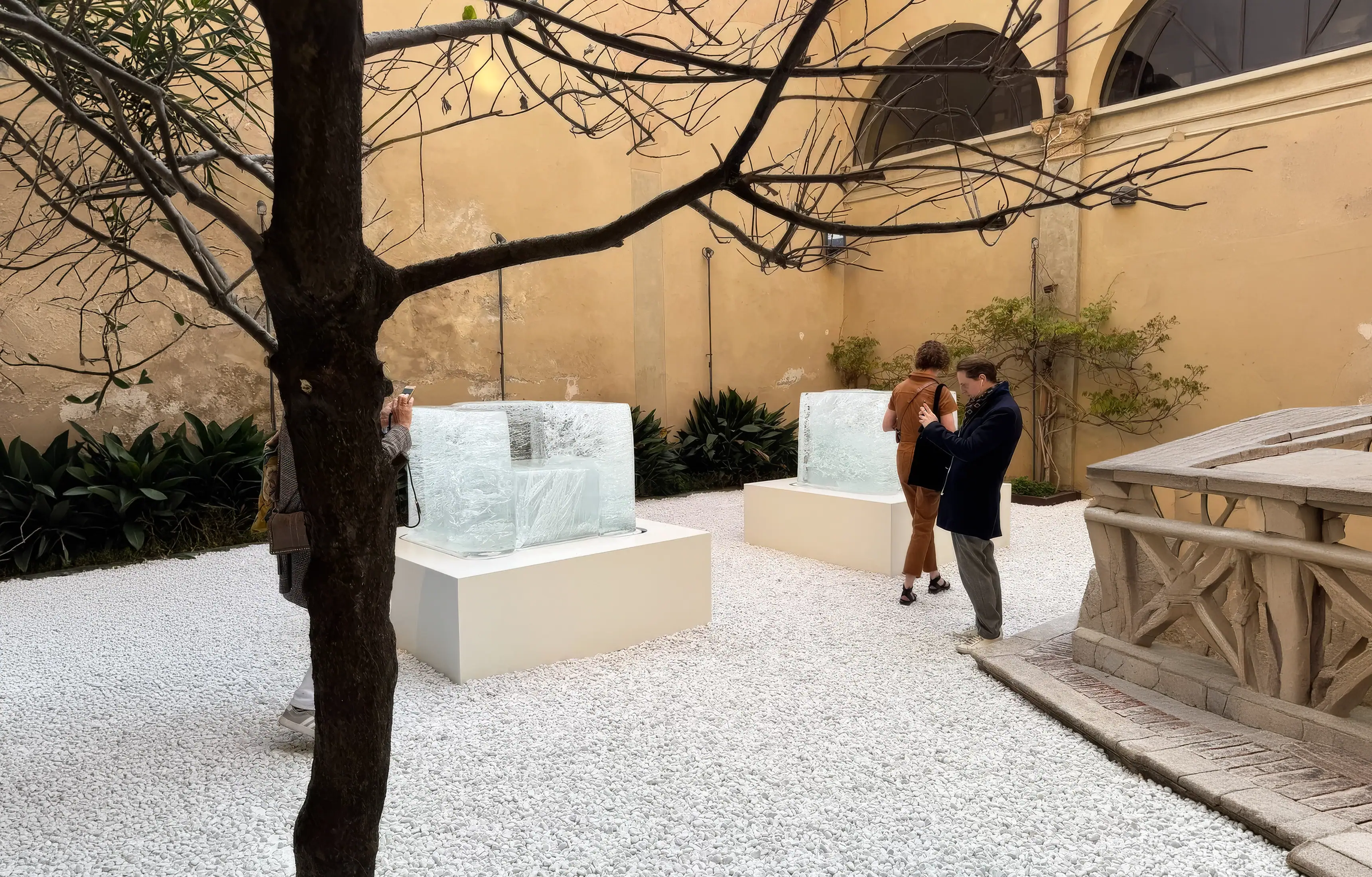
Frozen ran at Palazzo Landriani, on Via Borgonuovo in Milan’s Brera Design District, from 8 to 13 April 2025, staged as part of Fuorisalone’s Connected Worlds theme and presented in partnership with Grand Seiko, official timekeeper of both Fuorisalone and the Brera Design District that year. Its centrepiece was the Aqua Chair, a sculptural form built from ultra-transparent ice through a specialised slow-freezing process, weighing 850 kilograms and measuring 120 by 100 centimetres, standing 89 centimetres tall. It was never intended to be sat on. It was built to be watched, and specifically to be watched changing, as light, temperature and air gradually broke its transparent mass down over the course of the week until it dissolved into a shallow pool.
The exhibition has since closed, and the chair itself no longer exists in any form. What remains worth examining is the idea behind it, because Frozen was not an isolated stunt built for one Milan Design Week. It was the most recent instance of a working method Yoshioka has been developing for close to two decades, in which the designer’s role shifts from shaping a material directly to setting the conditions under which a material shapes itself.


What Aqua Chair actually was, and how it disappeared
The chair was made using a gradual-freezing technique that began with a single block of ultra-transparent ice, built up slowly enough that the resulting mass stayed largely free of the cloudy internal fractures that form when water freezes quickly. That clarity mattered directly to how the piece read: light passed through and refracted across its faceted surfaces rather than being absorbed by an opaque block, which is why Yoshioka has described these pieces as Sculptures of Light rather than simply as ice sculptures. Over the course of the exhibition, the chair’s surface responded continuously to the room’s temperature and to changing light, its edges softening and its clarity diminishing day by day, before it eventually melted into the shallow catchment pool built beneath it.
The process inverted the usual relationship between a designer and a finished object. Yoshioka did not carve or mould the chair into a fixed final form. He set a starting shape and then handed control of everything that happened next to water, temperature and time, treating the object less as a piece of furniture and more as what he has called a viewing instrument, a device built specifically to make an otherwise invisible natural process, water losing its solid form, visible and slow enough to actually watch happen.


A chair grown from water is not new territory for Yoshioka
Aqua Chair’s method has a direct precedent in Yoshioka’s own back catalogue, and the precedent runs in the opposite physical direction. In 2008, Yoshioka presented Venus, a chair grown rather than carved: a wire armature suspended in a tank of mineral-saturated water, left for weeks while natural crystal formations built up along the wires until the accumulated crystal growth itself became the seat’s visible structure. Where Venus let a natural process add material until a chair emerged, Aqua Chair let a natural process remove material until the chair disappeared. The two pieces, made seventeen years apart, are effectively mirror images of the same design method: build the conditions, then let water do the actual forming or unforming.
That method runs through much of Yoshioka’s wider practice. His Water Block, a glass bench first shown in 2002, now has ten permanent examples installed at the Musée d’Orsay in Paris. His Rainbow Church installation used more than five hundred crystal prisms to turn ordinary daylight into a shifting field of coloured light rather than treating light as a fixed backdrop. His Glass Tea House, KOU-AN, designed in 2011 and permanently built in Kyoto in 2015, applies the same underlying interest, materials and light treated as active, changing participants in a space rather than as static building elements, to an architectural scale. Frozen and Aqua Chair belong to that same continuous line of work rather than standing apart from it.
A courtyard built to outlast everything, hosting something built not to
Palazzo Landriani, where Frozen was staged, predates the sixteenth century. Originally built by the Bossi family and later sold to the Landriani family, the building was largely destroyed by fire in the early 1500s and rebuilt to designs by the Renaissance architect Cesare Cesariano, best known as the first translator of Vitruvius’s treatise on architecture into Italian. Its facade still shows two distinct periods of construction side by side, a sixteenth-century section with Doric pilasters and terracotta window surrounds beside a more austere seventeenth-century wing distinguished mainly by a wrought-iron balcony. The building once held frescoes by Bernardino Luini, a painter closely associated with Leonardo da Vinci’s Milanese circle; those frescoes have since been moved to the Pinacoteca di Brera nearby. Today the palazzo serves as the headquarters of the Istituto Lombardo Accademia di Scienze e Lettere, an academy of sciences and letters with roots reaching back into the nineteenth century.
None of that history makes Aqua Chair’s presence there a coincidence exactly, Brera Design District programmes installations across the whole neighbourhood’s historic courtyards each year, but the pairing is still worth noticing. A five-hundred-year-old building, rebuilt once already after near-total destruction, that now exists specifically to preserve scientific and literary knowledge across generations, spent a week in April 2025 hosting an object engineered to do the opposite of everything the building stands for: something built to last six days and then vanish completely, on schedule, by design.


Trained under two of Japan’s most demanding designers
Yoshioka was born on 20 January 1967 in Saga Prefecture, Japan, and graduated from the Kuwasawa Design School in Tokyo in 1988. He then trained directly under two of the most significant figures in postwar Japanese design: the furniture designer Shiro Kuramata, known for work that treated glass, acrylic and steel mesh as if they were weightless, and the fashion designer Issey Miyake, whose own practice was built around finding new physical behaviours in familiar materials, pleating being the best known example. Yoshioka founded his own studio, Tokujin Yoshioka Inc., in 2000, and has since worked for Cartier, Swarovski, Louis Vuitton, Hermès, Toyota and Lexus, alongside a long list of Italian furniture manufacturers at Milan’s fairs.
The training shows directly in Frozen’s underlying logic. Kuramata’s furniture asked what a chair could be if it stopped behaving like solid matter. Miyake’s clothing asked what fabric could do if a designer worked with a material’s own physical tendencies rather than against them. Aqua Chair does both at once: a solid object that behaves, quite literally, like it barely qualifies as solid matter at all, built by working with water’s own tendency to melt rather than fighting to preserve a fixed shape against it.
Why a watch brand was the right partner for a melting chair
Grand Seiko’s involvement was not simple sponsorship. The brand served as Fuorisalone’s official timekeeper for 2025 and used the partnership to present its Spring Drive watch movements alongside the installation, and the pairing holds up mechanically rather than just thematically. Spring Drive is powered by a conventional unwinding mainspring, with no battery, but instead of the ticking escapement found in ordinary mechanical watches, it uses an electromagnetic brake, regulated against a quartz crystal’s vibration, to produce a seconds hand that glides continuously rather than jumping from second to second. The technology makes an otherwise abrupt, discrete process, mechanical timekeeping, appear smooth and continuous instead, to an accuracy of around half a second a day.
That is the same trick Aqua Chair performs with a different physical process. Ice melting is, at a molecular level, a continuous process happening constantly rather than in visible steps, but it is rarely experienced that way; a melting ice cube reads as a series of discrete states, solid, then slush, then water, rather than as one smooth transition. Aqua Chair’s slow-freeze construction and its week-long dissolution were engineered specifically to make that underlying continuity visible, in exactly the way Spring Drive’s glide-motion hand makes a mechanical process read as continuous rather than stepped. Displaying the two side by side was less a sponsorship arrangement than a genuine pairing of two objects solving the same representational problem in two different materials.


Final thoughts
Frozen closed on 13 April 2025, and Aqua Chair no longer exists in any recoverable form; it finished the week as a shallow pool of water where an 850-kilogram sculpture had stood. That was always the intended outcome rather than a failure of preservation. What the piece leaves behind is a continuation of an idea Yoshioka first tested with a chair built the opposite way, growing rather than dissolving, seventeen years earlier, and a reminder that the most literal way to make a design object about time is to give it a working lifespan measured in days rather than decades.
Can I still see Tokujin Yoshioka’s Aqua Chair?
No. Frozen ran at Palazzo Landriani, Milan, from 8 to 13 April 2025, and the Aqua Chair itself melted completely by the end of the exhibition, as intended. It cannot be viewed again in its original form.
How was the Aqua Chair made?
It was built using a specialised slow-freezing technique, forming a single 850-kilogram block of ultra-transparent ice measuring 120 by 100 centimetres and standing 89 centimetres tall, designed to gradually dissolve over the course of the exhibition.
Has Tokujin Yoshioka made a similar piece before?
Yes. His 2008 chair Venus used the opposite process, growing a seat from mineral crystals formed in a water tank over several weeks, rather than dissolving a finished form. The two works are effectively mirror versions of the same underlying method.
What was Grand Seiko’s role in the exhibition?
Grand Seiko served as the official timekeeper of Fuorisalone and the Brera Design District for 2025 and displayed its Spring Drive watch movements alongside Aqua Chair, drawing a direct parallel between the chair’s visible transformation and Spring Drive’s continuous, glide-motion seconds hand.
Who trained Tokujin Yoshioka?
Yoshioka trained under the furniture designer Shiro Kuramata and the fashion designer Issey Miyake before founding his own studio, Tokujin Yoshioka Inc., in 2000.


Leave a Reply