
Design Research Studio has spent nineteen years building installations for Milan Design Week that come down again a week later. This year it built one that does not. Tom Dixon’s AW26 collection and a new bed collaboration with Vispring have moved permanently into the Mua Mua Hotel, twelve rooms inside a 1929 flour mill whose current owner has already turned one family inheritance into a global fashion label.
Introduction
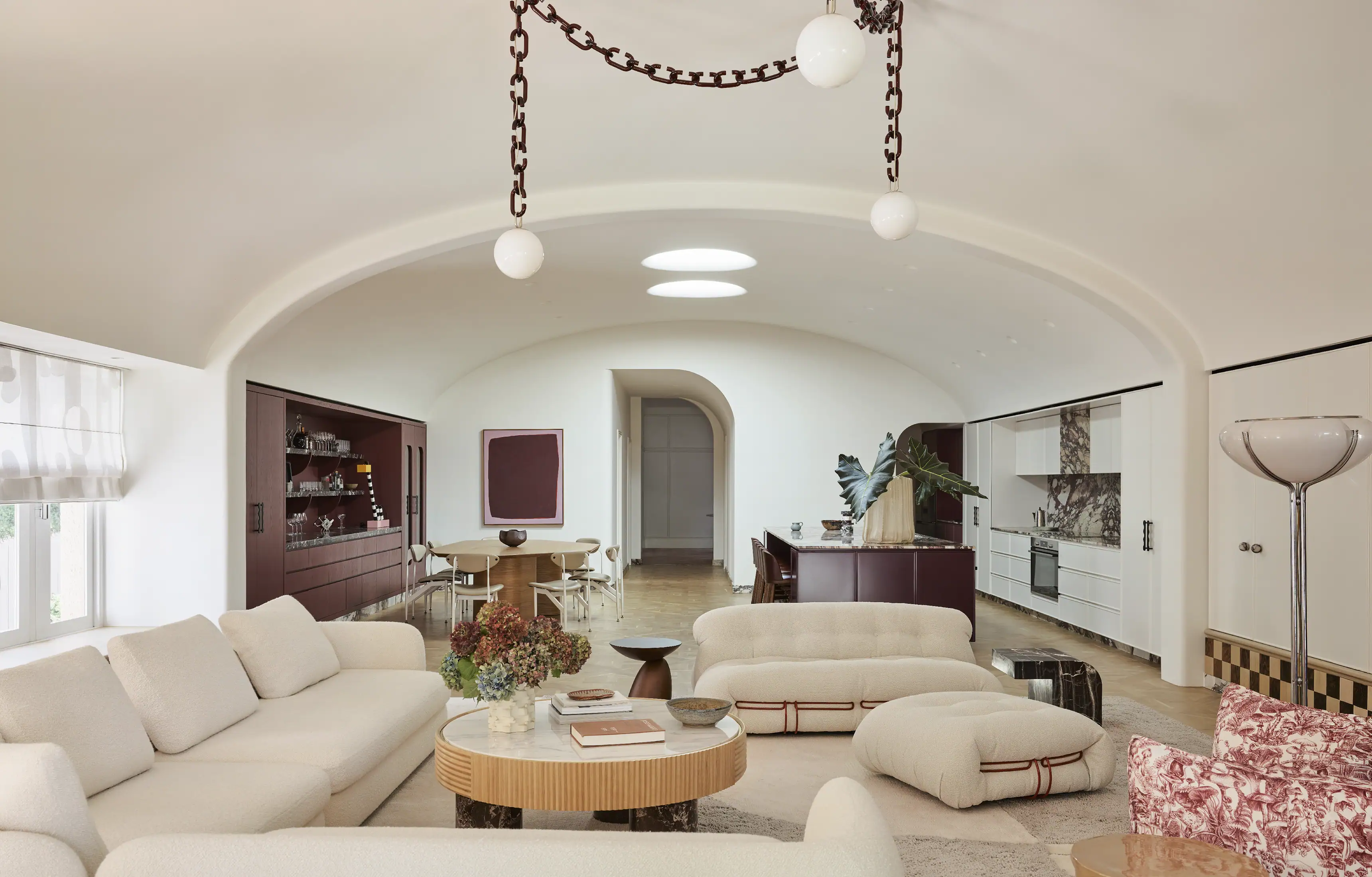
Tom Dixon’s Design Research Studio spent Milan Design Week 2026 converting a working hotel rather than dressing a stand. From 21 to 26 April, the studio staged the brand’s AW26 collection, alongside a new bed and headboard collaboration with the British bedmaker Vispring, inside the Mua Mua Hotel, a twelve-room micro-hotel built into the Mulino Estate at Via Aosta 2. The building is a 1929 flour mill, and the hotel opened fully to the public once the fair ended, which is the detail that separates this from almost everything else on the Milan Design Week calendar.

That distinction matters more than it might first appear. Design Research Studio built bedrooms, a garage-turned-workspace and a converted courtyard that all continued operating as a functioning hotel and creative campus the week after Salone closed. The furniture, lighting and beds on show were the actual fittings of rooms guests would sleep in a few days later.

A hotel built to outlast the fair by design
Design Research Studio has worked in Milan before, most notably at The Manzoni, the restaurant and showroom Tom Dixon opened in the city’s Brera district in 2019 and which still operates. Mua Mua Hotel is the studio’s second permanent Milan venture, following seven years after The Manzoni, and that gap says something about how selectively Dixon has used Milan Design Week as a platform for permanent projects.

The approach also changes what a visitor actually experiences. Visitors moved through bedrooms, a reception, a garage and a courtyard that had to work as real hospitality spaces first. Beds needed to be slept in. Lighting needed to survive daily use. A wardrobe needed to hold clothes. That constraint is what gives the AW26 collection a different kind of proof: the pieces are already living in the rooms they were designed for.

Design Research Studio’s other work explains why hospitality keeps recurring as the studio’s proving ground. Beyond The Manzoni, the studio has reworked interiors for Virgin Voyages’ cruise ships, another commission where furniture and lighting had to survive continuous, unglamorous daily use rather than a single week of scrutiny. Mua Mua Hotel sits in that same lineage: a studio that treats hospitality not as a marketing exercise but as the most honest test available for whether a piece of furniture actually works.

A 1929 flour mill, and the family that still owns it
The Mulino Estate was built in 1929, designed by the engineer and urban planner Cesare Chiodi with Gio Ponti, then early in the six-decade career that would make him one of Italian design’s defining figures. It was commissioned by the Sordelli family as a working flour mill and pasta production facility, and it operated as one for decades before the Sicilian entrepreneur Salvatore Virga bought the property in 1955.

What happened next is the part of the mill’s history that Milan Design Week coverage has largely skipped. Salvatore Virga’s son inherited the estate at twenty-five and struggled to hold it together, leaving ownership fragmented for years. It was his daughter, Ludovica Virga, who eventually took control and reimagined the mill as a working creative community rather than a static piece of industrial heritage, one she has described as combining the mill’s own history with something closer to Andy Warhol’s Factory: a working space that houses visual artists, architects, a gym and a handful of independent businesses under one roof, with Studio Uao handling the physical restructuring.

The hotel takes its name from her own fashion label
Ludovica Virga did not arrive at industrial heritage from architecture or hospitality. She is the founder of House of Mua Mua, the fashion label she started on a beach in Bali in 2006, originally making crocheted character dolls to support Balinese artisans whose work had collapsed with the local tourism industry after the 2004 tsunami. The brand found an unlikely second life in 2009, when Virga presented Karl Lagerfeld with a doll made in his own likeness at a Chanel show in Venice. Lagerfeld went on to commission more than 500 of the dolls for Chanel’s retail stores, and by 2016 House of Mua Mua had grown into a fashion label stocked in concept stores internationally, still built around the same whimsical, character-led sensibility and the same commitment to Balinese craft.

That is the name now attached to Tom Dixon’s twelve-room hotel, and it is not a coincidence or a licensing arrangement. It is Virga’s own brand, given to the building she inherited and is rebuilding around exactly the same instinct that built House of Mua Mua: take something with an unglamorous, overlooked origin and give it enough conviction that people take it seriously. A flour mill and a set of crocheted dolls are not obviously related projects, but the person who has run both of them is the same.

The wider estate Virga has built around the hotel makes the same point at a larger scale. Alongside Design Research Studio’s twelve rooms, the Mulino Estate now houses the artist Lola Montes Schnabel‘s studio, the architect Sofia Albrigo‘s practice, a branch of the fitness operator Tyger Gym, and the business Cashberry, curated by Virga herself into a working creative community rather than let out as conventional commercial space. Tom Dixon’s hotel is the newest and most visible part of that programme, but it did not create the mill’s second life. It moved into one Virga had already been building.

What moved into the twelve rooms
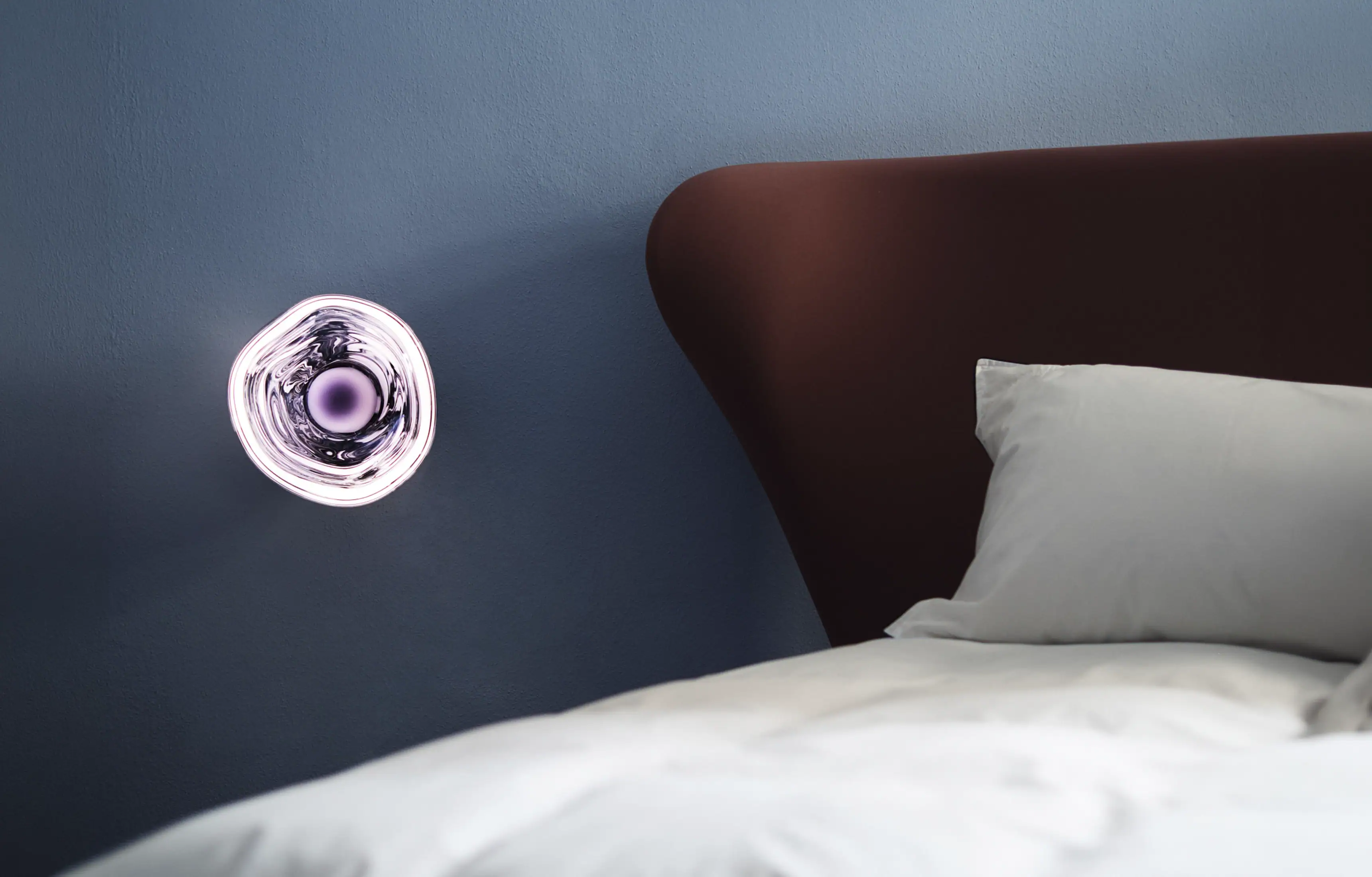
Dixon’s AW26 collection debuted across all twelve rooms, spread through bedrooms, the reception and the communal areas rather than gathered in one place. The headline launch was FLARE, a new lighting family made from borosilicate glass, shown alongside the Melt collection in a new polished nickel finish. Bell Portable and Mill lighting appeared in deep burgundy tones, Whirl Copper pendants and cast-iron Cast objects were placed throughout the rooms, and Smash occasional tables and Boulder marble vases furnished the communal spaces. Textiles and accessories were worked into the rooms as functioning objects rather than displayed as a separate product wall, in keeping with the studio’s insistence that the collection be seen doing its actual job.

The wider AW26 collection is scheduled to launch formally on 1 September 2026, which makes Mua Mua Hotel the collection’s first public appearance. Visitors who stayed in or toured the rooms during Milan Design Week saw the range roughly four months before most of the trade did.

Vispring’s beds, on their 125th anniversary
The bed collaboration carries its own weight. Vispring was founded in Plymouth in 1901 by the engineer James Marshall, on the invention of the pocket-sprung mattress, in which each spring compresses independently rather than in a single connected unit. The company still makes its own springs in-house, one of very few bedmakers left that does, and its beds are hand-built to order by a workforce of close to two hundred craftspeople using techniques including hand side-stitching and hand-nested springs. Vispring beds have furnished the Dorchester and the Beverly Hills Hotel, and the company has previously supplied bedding for the Titanic and the Queen Elizabeth II. 2026 marks the company’s 125th anniversary.

For that anniversary, Vispring chose Dixon specifically. Clare Schifano, the company’s global marketing director, has said it was important to work with a designer who carried both “a British connection and global resonance” for the milestone. The resulting collaboration produced four new headboards, developed from Dixon’s existing Fat, Groove and Wingback furniture series, and a bed built specifically for the partnership. A separate installation reworked the fairy tale of the Princess and the Pea as a stack of Vispring’s own mattress toppers, layering the fabrics from the company’s new Luxe Fabric Collection, developed with Dedar and Andrew Martin, to make the point about craft physically visible rather than simply stated. Dixon has said plainly that bedroom design has been overlooked: “there hasn’t been truly extravagant design since waterbeds in the 1970s,” and the collaboration is his answer to that gap, treating the bed as a piece of architecture rather than an accessory to the room around it.

A shared address for the rest of the fair
Mua Mua Hotel was not a single-brand takeover. Coalesse and the Spanish manufacturer Viccarbe converted the estate’s garage into a workspace installation built around the same blurred line between working and living that ran through the rest of the hotel, pairing Coalesse’s Ensemble Lounge and Jean Nouvel seating with Dixon’s Groove and Jack pieces, and extending into the courtyard under a “Work Hard, Play Hard” theme. VitrA, Ege Carpets, Prolicht, Monument gallery and Avalon & London each took further spaces across the site, turning the hotel into a shared address for the week.

The estate’s grain silo, itself part of Chiodi and Ponti’s original 1929 structure, hosted a separate exhibition of rare functional artworks from the 1970s to the 1990s, a piece of programming that used the mill’s own industrial architecture rather than working against it. Sited inside the same building Ponti helped design as a young engineer’s collaborator, the silo show gave the estate’s oldest and least converted space a purpose of its own, rather than leaving it as a backdrop to the hotel next door.
Between the silo, the garage and the twelve rooms, Milan Design Week 2026 turned nearly the entire Mulino Estate into functioning space. Visitors moving between them crossed nearly a century of the building’s own uses in a single afternoon, from grain storage to a design fair to a hotel that has no closing date.

Frequently asked questions
What is the Mua Mua Hotel?
A twelve-room micro-hotel in Milan, converted by Tom Dixon’s Design Research Studio inside a 1929 flour mill on the Mulino Estate at Via Aosta 2. It launched during Milan Design Week 2026 and has continued operating as a permanent hotel since the fair ended.
Where and when did the installation take place?
At the Mulino Estate, Via Aosta 2, Milan, from 21 to 26 April 2026, during Milan Design Week.
What is the history of the building?
The estate was built in 1929, designed by the engineer and urban planner Cesare Chiodi with Gio Ponti, and commissioned by the Sordelli family as a flour mill and pasta production facility. Salvatore Virga bought the property in 1955, and it passed through his family until his granddaughter, Ludovica Virga, reimagined it as a creative hub.
Who is Ludovica Virga?
The current custodian of the Mulino Estate and the founder of House of Mua Mua, a fashion label she started in Bali in 2006 making crocheted dolls to support local artisans, and which later collaborated with Karl Lagerfeld and Chanel.
What did Tom Dixon show for AW26?
FLARE, a new lighting family in borosilicate glass, alongside the Melt collection in a new polished nickel finish, Bell Portable and Mill lighting, Whirl Copper pendants, and Smash and Boulder tables, all shown inside the hotel’s working rooms rather than on a showroom floor.
What is the Vispring collaboration?
A partnership between Tom Dixon and the British bedmaker Vispring, marking Vispring’s 125th anniversary, producing four headboards developed from Dixon’s Fat, Groove and Wingback series and a bed built specifically for the collaboration.
Is the Mua Mua Hotel open to the public now?
Yes. The hotel was built to continue operating after Milan Design Week concluded, rather than as a temporary installation.

Final thoughts
Mua Mua Hotel is easy to describe as a Milan Design Week installation and much harder to describe as only that. Design Research Studio built a functioning twelve-room hotel inside a working flour mill that has already survived one industrial closure and one fractured inheritance, gave Tom Dixon’s AW26 collection and a Vispring collaboration built for the brand’s 125th anniversary somewhere real to live, and did it on a site whose current owner had already proved, with a fashion label built from Bali on crocheted dolls, that an unglamorous inheritance can become something durable if the right person takes it on. The fair moved on after 26 April. The hotel, the mill and the collection did not.

Leave a Reply