
ART & CULTURE · MILAN
Reading time: 9 minTom Dixon did not take a stand at Milan Design Week 2017. He took a theatre. For six days, Teatro Manzoni, a cinema on via Manzoni with its own history of technical spectacle, became Multiplex: five boutiques, an 840-seat screening programme with IKEA, a whisky lounge and a café, organised around the idea of Yesterday, Today and Tomorrow. It was Dixon’s second Multiplex in two years, and Milan asked more of the format than London had.
Tom Dixon returned to Milan Design Week in April 2017 with Multiplex, an installation that took over Teatro Manzoni, the cinema and galleria on via Manzoni in the heart of the city’s fashion and antiques district. From 4 to 9 April, the week Salone del Mobile ran across town in Rho, Dixon’s studio filled the theatre’s stalls, foyer and adjoining galleria with five themed boutiques, an 840-seat cinema programme run with IKEA, a Johnnie Walker lounge and a café by Arabeschi di Latte.
Multiplex was Dixon’s second attempt at the same idea. He had built the first version eighteen months earlier, in September 2015, inside the disused Old Selfridges Hotel on Oxford Street, for London Design Festival. Milan’s edition kept the name and the underlying argument, that a retail experience built around entertainment and culture can do something a normal showroom cannot, and pushed it into a working cinema instead of an empty one.
The result was organised around three time frames, Yesterday, Today and Tomorrow, and staged against what press coverage at the time called a retro Italian glamour backdrop, a description that undersells a building with a genuinely unusual technical history of its own. Dixon has described three months of studio work going into the final version, after an early plan to lay the whole collection out in a single white warehouse was set aside for something with more theatre to it.

A cinema built for spectacle before Dixon arrived
Teatro Manzoni’s own story is a large part of why it worked as a venue for this. The theatre traces back to 1850 on Piazza San Fedele, was renamed for the novelist Alessandro Manzoni after his death in 1873, and was destroyed by Allied bombing in August 1943. It reopened on via Manzoni in 1950, rebuilt to a design credited to the architect Alziro Bergonzo, with a lobby conceived as a covered square, sculptural detailing and a domed, muralled ceiling.
What makes the building relevant to Dixon’s brief specifically is what happened next. On 9 April 1955, the reopened theatre became the first cinema after New York and London to be fitted with three-projector Cinerama, then the most technically demanding widescreen format in commercial use. It went on to install 70mm projection in 1964, and in January 2005 it took Milan’s first digital cinema projector. This was, in other words, a venue whose whole identity was built on showing audiences the newest possible way to look at something. Multiplex, arriving in a theatre with that specific pedigree, was not simply borrowed grandeur. It was a spectacle format meeting a building that had spent sixty years in the same business.
The physical fabric backs this up. The 1950 rebuild gave the theatre a lobby treated as a covered public square, complete with sculpture, marble surfaces and a domed ceiling carrying its own mural, an unusually generous piece of architecture for a building whose primary job was getting an audience from the street to their seats. That is the kind of room a retail installation borrows atmosphere from without needing to add very much of its own.

Five boutiques, arranged as Yesterday, Today and Tomorrow
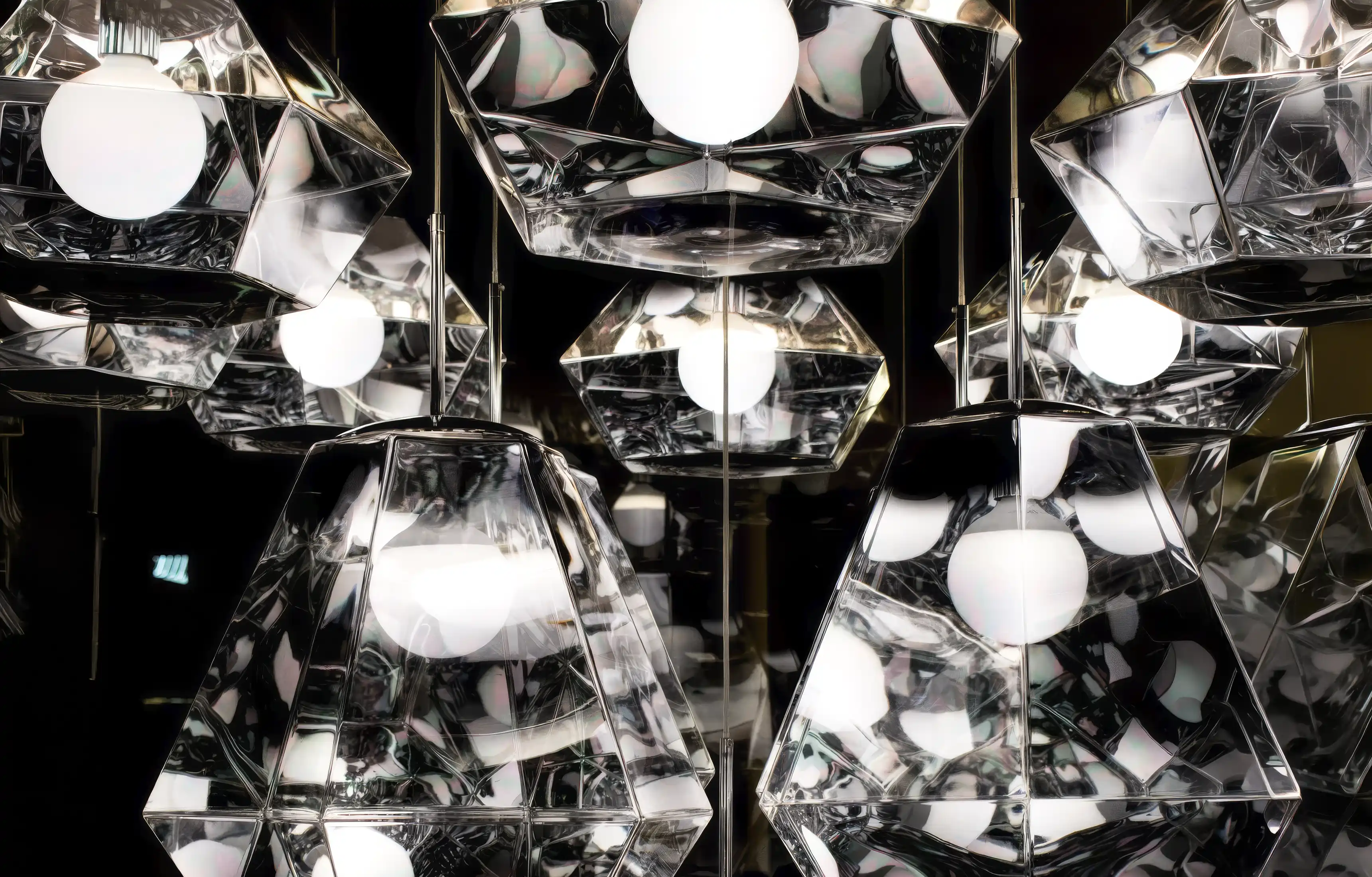
The Galleria section of the venue held five distinct boutiques, each doing a different piece of the Yesterday, Today, Tomorrow structure. The Chandelier Store carried Dixon’s newest lighting, including the faceted, mirror-finished Cut pendants, the laser-perforated Tube range and the metallised Melt collection, representing Today. The Antique Centre did the opposite job, gathering reissued pieces from earlier in Dixon’s career, among them the S Chair, the Bird chaise longue, the Pylon chair and the Jack lamp, standing in for Yesterday.
The Haberdashery introduced Supertexture, a new upholstery collection built around six distinct textures, including a soft, feather-and-hair-blend family and a hand-spun, hand-woven bouclé made from Rajasthani and New Zealand wool. It was the collection’s public debut. Dixon’s studio expanded it the following year at Maison et Objet with three further families, a hand-tufted wool range called Abstract, a digitally printed linen range called Paint and an embroidered range called Geo, which means the fabric family a visitor could touch for the first time inside Teatro Manzoni in April 2017 is the same one that, twelve months on, had grown into a full material system shown across a different fair in a different country entirely.
The Perfumery held Dixon’s fragrance work, and the Rubber Workshop was the boldest of the five, built around a limited-edition motorcycle developed with Pirelli and Moto Guzzi.

The bike, the tyres and the man who taught himself to weld by trying to fix one
The motorcycle, named Tomoto, was a customised Moto Guzzi, built with the Italian customiser Stefano Venier, with a raw aluminium tank hand-lettered in dripping pink paint, aluminium wheel rims punched with a star pattern, and Dixon’s own Fin pendant light repurposed as its headlamp. Pirelli, headquartered in Milan, built a set of prototype tyres for the project, with Dixon developing several original tread patterns for the manufacturer rather than simply specifying an existing one.
The bike was not incidental to Dixon’s own history. He has described learning to weld specifically in order to fix a motorbike as a young man, in the years before he became a designer, an attempt that never actually resulted in a working bike but did give him the skill that led to his earliest welded furniture and, from there, the rest of his career. Multiplex put the same interest back on public display, thirty years on and considerably better resourced: he had owned the same Moto Guzzi for 27 years by the time Tomoto was built, and the new bike was, by his own account, overdue.

IKEA takes the stalls
The cinema’s main auditorium was where IKEA made its Milan debut with Delaktig, a modular sofa and bed platform designed with Dixon and built on an aluminium extrusion frame rather than the timber-and-staple construction that has defined upholstered furniture for centuries. The stalls held two-seat, three-seat, armchair and chaise-longue configurations arranged across the theatre floor, including black and gold variants alongside the standard finishes, and the foyer displayed developmental concepts from seventy-five students across the Royal College of Art, Musashino Art University and Parsons School of Design, who had been briefed to imagine what an open, hackable furniture platform could become in other hands.
Delaktig would not go on sale until the following year, which made its Teatro Manzoni showing a genuine preview rather than a launch. Around it, the cinema ran a free film programme through the week, films chosen around themes of creativity and radical design, using the auditorium exactly as it had always been used, as a place where an audience sits down together to look at something new.

A whisky lounge and a café, either side of the retail floor
Two further spaces bracketed the boutiques. Johnnie Walker installed a Blue Label lounge inside the theatre, the second consecutive year the whisky brand had worked with Dixon in Milan, this time unveiling a bespoke capsule series of bottle, ice bucket, coaster and bottle cap, developed around the copper stills and oak barrels of the distilling process the brand itself is built on. And a café inside the venue, the Hack Bar, was run by Arabeschi di Latte, the food design studio whose past Milan work has included staged, performative approaches to serving and eating rather than conventional catering, extending Multiplex’s central idea, that a retail environment is stronger when it behaves like a piece of programming, into the one part of the building where visitors actually sat still.
Two Multiplexes, two buildings, two very different afterlives
Multiplex’s Milan edition shared its name and its basic proposition with the version Dixon built in September 2015 inside the Old Selfridges Hotel, the vacant Edwardian building above the Oxford Street department store. That first Multiplex gathered more than thirty independent brands under one roof, from Cubitts eyewear to Teenage Engineering synthesisers, hung with folded silver foil inspired equally by the International Space Station and Andy Warhol’s Factory, and built explicitly, in Dixon’s own words at the time, to stop smaller design labels being “ghettoised” in shops too small to give them a proper audience.
Milan changed what the format had to prove. London’s Multiplex occupied a building with no active use of its own, empty since the hotel closed and still, a decade on, awaiting the luxury hotel conversion its current owners have since announced. Teatro Manzoni was the opposite kind of building: a working theatre with its own nightly programme, which returned to hosting live performance and cinema the week after Dixon’s studio moved out. The Milan version had to be built, dressed and struck around a venue that had somewhere else to be, and the boutiques, the lounge and the café all had to work inside that constraint rather than around an empty shell.

What staging retail as a cinema takeover actually achieves
A conventional Milan showroom asks a visitor to walk past product on a schedule set by the exhibitor. Multiplex reversed that. By splitting the Teatro Manzoni site into five boutiques, a working cinema and two social spaces, Dixon gave each part of his output, new lighting, archive furniture, textiles, fragrance and a one-off motorcycle, its own room and its own pace, so a visitor moved through the collection the way they would move through an afternoon out, rather than the way they would move through a trade stand. Layering IKEA’s film programme and Johnnie Walker’s lounge into the same building did the same job at a larger scale: it gave people a reason to stay in the venue for longer than it takes to look at furniture, which is precisely the problem Dixon has said retail now has to solve.
That is also why the Yesterday, Today and Tomorrow structure mattered more than a simple curatorial label. Placing reissued furniture, current-season lighting and a not-yet-released IKEA platform inside the same building, in the same afternoon, let a visitor read Dixon’s own trajectory in one visit rather than piece it together across separate showrooms and seasons. Few Milan installations attempt to show a designer’s past, present and future in a single space; fewer still have a building on hand with the right kind of history to make that argument physically credible.

Final thoughts
It would be easy to read Multiplex as a product showcase with a good set, five shops built to hold a season’s worth of new furniture and lighting. What actually happened was more specific than that. Tom Dixon took a theatre with its own sixty-year record of showing Milan the newest possible way to watch something, and used it to ask what a retail space could do if it borrowed that same appetite for spectacle. The boutiques carried the collection. The cinema, the whisky lounge and the café carried the reason to stay. Two years after an empty hotel in London, Multiplex found a building that had never stopped being used for exactly this, and let that history do part of the work.
What was Tom Dixon’s Multiplex at Milan Design Week 2017?
Multiplex was an installation by Tom Dixon that took over Teatro Manzoni, a cinema and theatre on via Manzoni in Milan, from 4 to 9 April 2017 during Salone del Mobile. It combined five themed boutiques, an 840-seat cinema programme run with IKEA, a Johnnie Walker Blue Label lounge and a café by Arabeschi di Latte.
Where did Multiplex take place?
At Teatro Manzoni, the cinema and galleria on via Manzoni in central Milan, close to the city’s fashion and antiques district.
Was this the first Multiplex?
No. Tom Dixon first built Multiplex in September 2015 at the Old Selfridges Hotel in London, for London Design Festival, as a pop-up department store bringing together more than thirty independent design brands.
What was the Yesterday, Today and Tomorrow structure?
It organised the boutiques by era: The Antique Centre showed reissued earlier pieces such as the S Chair and the Bird chaise longue for Yesterday, The Chandelier Store showed new lighting including Cut and Melt for Today, and IKEA’s Delaktig platform, previewed in the main cinema, represented Tomorrow.
What was the Tomoto motorcycle?
A customised Moto Guzzi motorcycle built by Tom Dixon with the customiser Stefano Venier, fitted with prototype tyres and tread patterns developed with Pirelli and shown inside the Rubber Workshop boutique.
What is Supertexture?
Tom Dixon’s upholstery textile collection, which made its public debut inside The Haberdashery boutique at Multiplex in 2017, ahead of a wider expansion shown at Maison et Objet the following year.
Is Teatro Manzoni still an active venue?
Yes. It operates as a working theatre and cinema, and returned to its regular programme once Multiplex closed, having done so continuously since its post-war reconstruction opened in 1950.


Leave a Reply