
Collectible Design · Los Angeles
Reading time: 7 minA tar-covered teddy bear. A bronze screen that took four years to build. Rugs by Warhol and Nan Goldin that you were invited to walk on. During the LA Design Festival, Twentieth marked twenty years on Beverly Boulevard by doing what it had always done: arranging design as though it were already at home.
There is a particular building on Beverly Boulevard that you do not forget: clad in overlapping scales, reptilian, unmistakable at forty miles an hour, a facade pitched perfectly to the way Los Angeles is seen. Behind it, for two decades, was Twentieth, and during the Los Angeles Design Festival, it was celebrating its twentieth anniversary, which is where the name comes from.
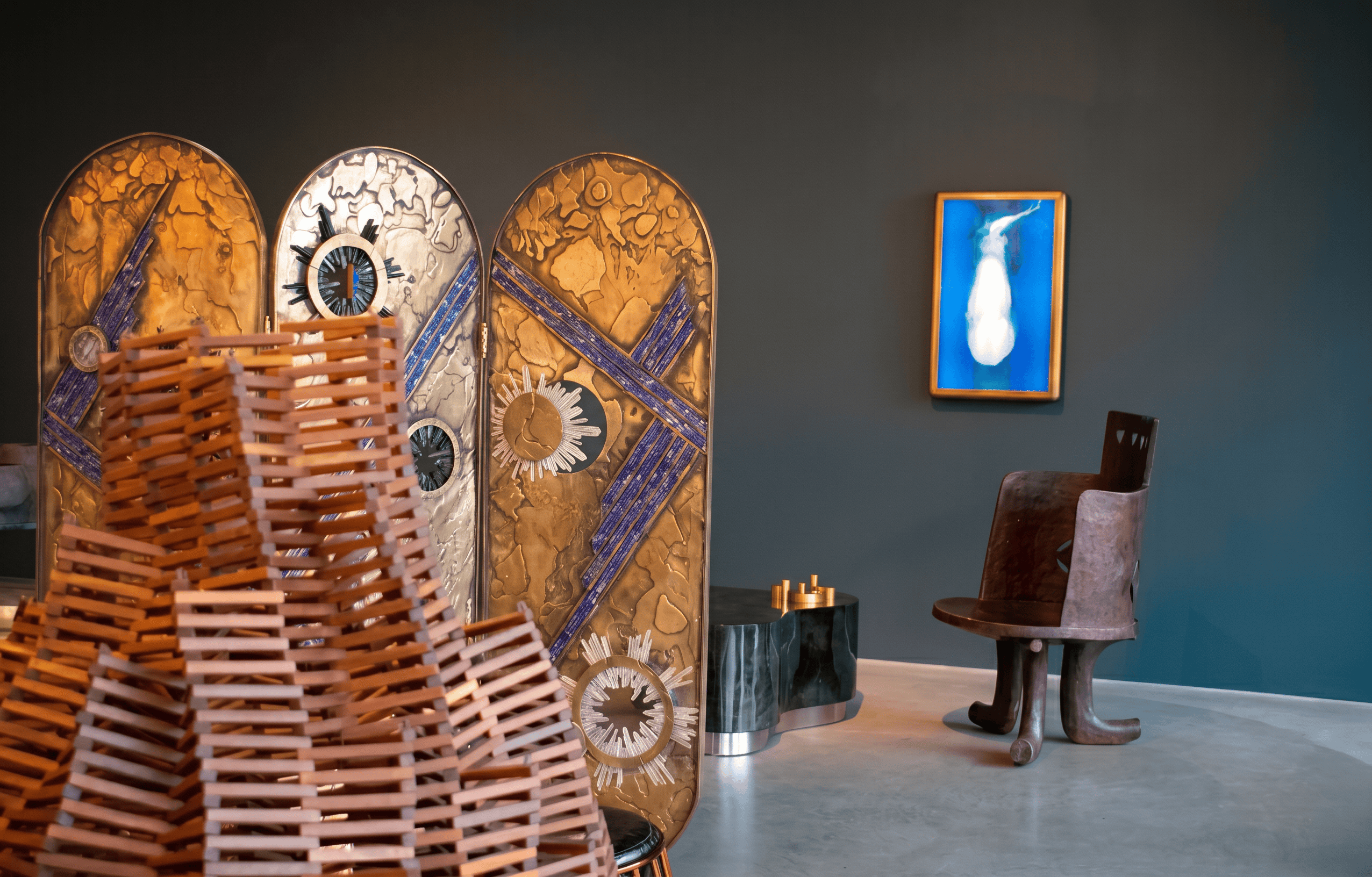
Inside, the space was memorable in its own right: 6,000 square feet under a vaulted ceiling, in which furniture, lighting and sculpture had been arranged roughly as they might sit in somebody’s home, mixed, adjacent, in conversation with one another.
Twentieth showed you objects and, in the same breath, a way of living with them. That distinction is a fine one. In practice it shapes everything about how the work reads.

The gallery that put design back in the room
Founded in 1999 by Stefan Lawrence, Twentieth spent twenty years establishing itself as the benchmark for contemporary collectible design in Los Angeles — sculptural lighting, one-off and limited-edition furniture, and objects that sit deliberately uneasily between art and use.
The conventional gallery grammar is one of separation. Work is isolated, plinthed, lit from above, and surrounded by enough empty air to signal that it is not to be touched. The white cube exists to abstract an object from ordinary life so that you look at it properly.
Twentieth worked to a grammar of its own, and did it on purpose. Pieces were integrated rather than segregated: a light beside a chair beside a sculpture, the way they would actually be encountered. The effect was a productive strangeness, the familiar arranged unfamiliarly, the domestic made slightly uncanny by the quality of what was in it.
This is a considered curatorial position. It is an argument about what collectible design is. If a chair is a sculpture you sit on, then presenting it as a sculpture you can sit on tells the truth about it. Twentieth took its own premise seriously, and the vaulted space, more hall than shop, gave it the room to.
The result was a place that functioned less as retail than as a hub: for events, for installations, for the slow accretion of a scene around it.

Mattia Biagi’s tar
Two works from that visit have stayed with me, and the first is the one that greets you and refuses to let go.
Mattia Biagi coats everyday objects in black tar. A bicycle. A teddy bear. It is a distilled gesture, and it produces something genuinely difficult to look at calmly.
Tar is a substance of two opposite meanings. It preserves: it is the material of the La Brea pits a few miles west of the gallery, in which everything that fell in is still there, forty thousand years later, perfectly kept and entirely dead. And it destroys: it is spill, contamination, the black slick.
A tarred teddy bear sits precisely on that contradiction. A childhood object rendered funereal and archaeological, extracted rather than made — something you might dig out of the ground rather than buy. It is preserved and ruined, and you cannot decide which, and that is the work.
It is also, in the best sense, an extremely Los Angeles piece of art: a city built on top of a tar pit, fascinated by preservation, alive to everything preservation holds.

Christopher Boots and the four-year screen
The second was Christopher Boots’ Vanity Screen, and its statistics do most of the arguing.
A room divider. Four years to complete. Clear and smoky quartz crystals set with lapis lazuli, arranged against a moon-like ground, the whole structure cast in solid bronze.
Four years for a screen is the entire point, and the Australian designer has built a practice on that conviction. A screen’s basic job is quickly solved: it divides a room. Everything beyond that is generosity, and Boots’ work is generous, extravagantly so. Quartz and lapis are chosen for the light they hold. The moon-like ground is chosen for its atmosphere. Bronze is a magnificent material for something whose job is to stand there.
Which is why it works. Vanity Screen is a functional object that has been pursued so far past its function that it arrives somewhere else entirely — closer to a reliquary than to furniture. Standing in front of it, the four years feel less like a production statistic than like the subject.
In a gallery arguing that design deserves the seriousness we extend to art, it was the most persuasive object in the room.

Henzel Studio Collaborations at THE NEW
In the adjacent gallery space, THE NEW, next door to the scale-clad building, Twentieth was showing Henzel Studio Collaborations, and it deserves a full account of its own.
Henzel Studio was founded in 1999 by the Swedish designer Calle Henzel — the same year as Twentieth, a coincidence that becomes quite satisfying once you notice it. Its Collaborations programme, curated by Joakim Andreasson, commissions limited-edition rugs from contemporary artists.
The roster is extraordinary. Across the programme’s life it has included Richard Prince, Lawrence Weiner, Nan Goldin, Marilyn Minter, Mickalene Thomas, Anselm Reyle, Jake & Dinos Chapman, Kim Gordon, Tim Noble & Sue Webster, Sanford Biggers, Ashley Bickerton and Andy Warhol. More than thirty artists in total, shown at the Goss-Michael Foundation in Dallas, Barneys Madison Avenue, Colette in Paris, Rossana Orlandi in Milan, and in museum exhibitions including MOCA Cleveland and the Boca Raton Museum of Art.
The premise is quietly subversive. Take work by artists whose output is handled with extreme reverence — Goldin, Warhol, Prince — and turn it into something you walk on in your socks.
It refuses the sanctity of the art object while depending on it completely. Nobody would want the rug if they did not revere the Goldin; the transgression only registers because the reverence is real. That is a genuinely sharp thought, and these rugs carry it.
And showing it here — inside a gallery that already insisted on arranging art as though it were furniture — was exactly right. Twentieth had spent twenty years dissolving the line between the work and the room. Henzel had spent the same twenty years dissolving the line between the work and the floor.

Why it mattered
Design festivals fill a city with things to see, and the best of them stay with you for years. What Twentieth offered, during a week of it, was a proposition rather than a display: that the ideal place to encounter a piece of collectible design is a room, ideally one that feels like it has been lived in.
Continuously evolving, restaged through the year, never quite the same twice — it remained the benchmark for contemporary furniture and design in the city, and the first place I intended to visit on any return to Los Angeles.
Postscript: Twentieth has since moved
Since this visit, Twentieth has left Beverly Boulevard.
In February 2023 the gallery relocated to a house in the Hollywood Hills, reopening with a group exhibition curated by Stefan Lawrence with Daniele Albright. The scale-clad building and the 6,000 square feet beneath the vaulted ceiling are now history — and the gallery’s long argument, that design belongs in a room rather than on a plinth, has arrived at its logical destination: an actual house.
Read our feature on Twentieth’s new Hollywood Hills space →

Frequently asked questions
What is Twentieth gallery?
A Los Angeles contemporary design gallery founded in 1999 by Stefan Lawrence, specialising in collectible furniture, sculptural lighting and objects that sit between art and use. The name marks its founding year.
Where was the original Twentieth gallery?
In a distinctive scale-clad building on Beverly Boulevard, Los Angeles — a 6,000 square foot space beneath a vaulted ceiling, with an adjacent gallery, THE NEW. The gallery relocated to the Hollywood Hills in February 2023.
Who is Christopher Boots?
An Australian lighting and object designer. His Vanity Screen — clear and smoky quartz, lapis lazuli and solid bronze — took four years to complete.
Who is Mattia Biagi?
An artist known for coating everyday objects, including bicycles and teddy bears, in black tar — transforming the familiar into something archaeological and funereal.
What is Henzel Studio Collaborations?
A programme by Swedish rug maker Henzel Studio, founded in 1999 by Calle Henzel and curated by Joakim Andreasson, producing limited-edition art rugs with over thirty artists, including Richard Prince, Nan Goldin, Marilyn Minter, Mickalene Thomas and Andy Warhol. It was shown at THE NEW during the LA Design Festival.


Leave a Reply