
Collectible Design · Los Angeles
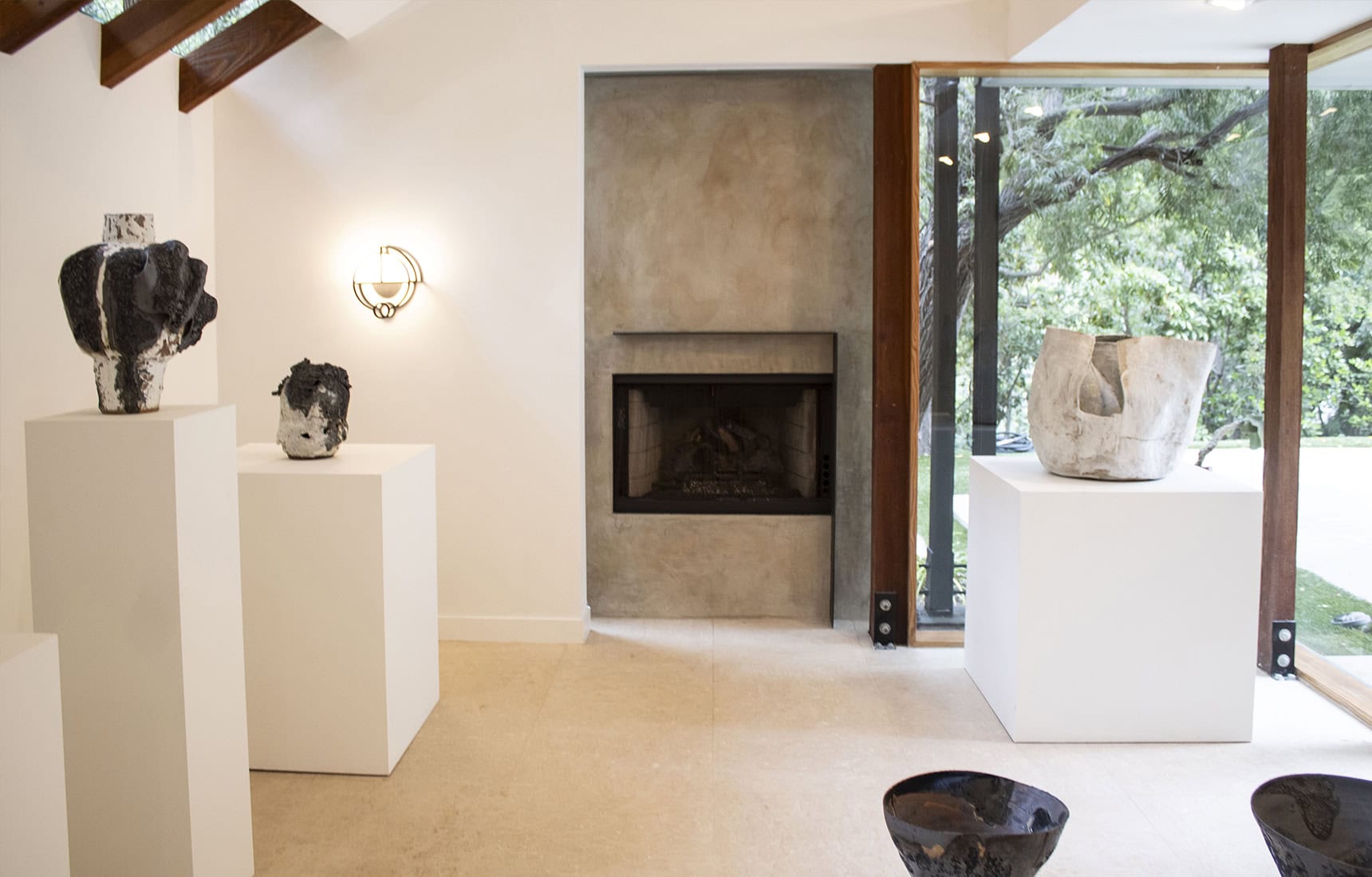
Reading time: 6 minClimb high enough into the Hollywood Hills and the city noise falls away, replaced by birdsong, dappled shade and the soft hush of an acre of woodland. It is here, behind a screen of trees, that Twentieth has staged its most ambitious act yet: a 5,000-square-foot gallery of collectable design set within a purpose-tuned residence, where glass walls dissolve into garden, and each room reads like a chapter. More than two decades after it helped put Los Angeles on the global design map, the gallery has built itself a home worthy of the work it shows.
Twentieth announces itself quietly, and all the more memorably for it. Its Hollywood Hills outpost, opened in February 2023, sits at the end of a quiet approach, cocooned by trees, revealing itself only once you are inside. The reward for the climb is a rare kind of encounter with contemporary design: unhurried, immersive and given all the room and time it deserves.


For a gallery that has spent much of its life championing the experimental and the handmade, the move feels less like an expansion than an arrival. Twentieth has always argued that design deserves to be lived with, seen in daylight, understood in space. In this house on the hill — part gallery, part garden, part total work of art — that argument finally has the setting it was waiting for. This is the story of how a Los Angeles institution grew from a mid-century dealer into one of the most compelling stages for collectible design anywhere in the world.


From Mid-Century Dealer to Design Pioneer
Twentieth was founded in 1999 by Stefan Lawrence, and even the name carries a clue to its origins: it began as a tribute to the twentieth-century modernism that first drew Lawrence’s eye. His route into design was itself circuitous. Trained in fine art photography, he had worked behind the camera in New York and on magazine shoots across Europe before relocating to Los Angeles in 1990, where a dealer’s instinct gradually eclipsed the photographer’s.
In its early years the gallery traded in the icons of mid-century modern design. But Lawrence’s curiosity pulled him forward rather than back. A pivotal moment came in 2014, when Twentieth moved into a striking new building conceived in collaboration with the acclaimed Los Angeles architect Neil Denari — a shift that coincided with a decisive turn away from vintage material and toward the contemporary and the commissioned. Two years later, in 2016, the gallery launched THE NEW, an adjacent exhibition space co-curated with the artist Daniele Albright, giving experimental and emerging work a platform of its own.


“More than twenty years on, Twentieth has arrived at something singular: not merely a place to buy design, but a place to understand it.”


Placing Los Angeles on the World Map
Across more than twenty years, Twentieth has done as much as any single gallery to build the international reputation of the Los Angeles design scene. It was an early conduit for major international names — introducing local audiences to the likes of Tom Dixon, Moooi, the Dutch provocateurs Droog and Established & Sons, whose roster included work by Zaha Hadid. Alongside these, the gallery has consistently backed the individual voice: the crystalline lighting of Christopher Boots, the architectural fixtures of Bec Brittain, the sculptural blackened wood of John Eric Byers and the poetic pieces of Larose Guyon, among many others.
What unites this eclectic roster is an appetite for work that pushes materials and processes somewhere new. Twentieth has always been a gallery of ambitious, adventurous objects. It deals in the boundary-testing and the hand-crafted: the limited edition and the one-off, made by people willing to experiment. That editorial conviction is precisely what makes the new Hollywood Hills setting feel so apt.


A House Conceived as a Total Work of Art
The gallery’s current home is a residence designed by the Los Angeles architect Jeff Mills, and it has been reimagined as an exhibition environment of unusual ambition. Spread across two levels, seven distinct gallery rooms unfold over more than 5,000 square feet of interior space, allowing Twentieth to run several exhibitions concurrently, a luxury written into the very plan of the house.
Mills’s architecture is defined by its relationship to light. His signature handling of glass and window openings turns the interior into what one account aptly called a reservoir of light, filtered and softened by the greenery pressing in from outside. Walls give way to garden; the boundary between inside and out is deliberately blurred. Working in concert with the landscape architect Lisa Gimmy, the team pursued the idea of a Gesamtkunstwerk — a German term, borrowed from the world of opera and architecture, meaning a total work of art in which every element is composed as part of a single, unified whole.


The Garden as Gallery
That ambition extends well beyond the walls. The house sits within an acre of lush, wooded grounds, and the landscape is treated as exhibition space in its own right. Large-scale sculpture and outdoor design pieces are sited among the planting, encountered as one moves through shade and clearing, so that the act of viewing becomes a slow walk rather than a static browse. In a city famous for its indoor-outdoor living, Twentieth has taken the idea to its logical, elevated conclusion, using the California light and the enveloping woodland as active collaborators in how the work is seen.
The effect is as much retreat as gallery. Removed from the density of the city below, the setting invites an unusually generous quality of attention. Visitors are encouraged to linger, to move between rooms and gardens, to experience design as atmosphere.


Collectible Design at the Centre
At the heart of Twentieth’s programme sits collectible design — the increasingly prominent field in which functional objects are conceived, made and collected with the seriousness once reserved for fine art. The gallery’s rotating exhibitions foreground unique and limited-edition works, spanning furniture, lighting, ceramics and sculpture, and drawing on both established international figures and rising avant-garde talent.
Crucially, Twentieth has never confined this activity to a single space. Its exhibitions travel — appearing not only at the gallery but across other physical locations and in the digital realm, a hybrid model that reflects how contemporary collectors now discover and acquire work. In more recent years the gallery has continued to expand its horizons, championing designers such as Mattia Biagi, Julian Mayor and Henzel Studio, and reinforcing its role as a bridge between the Los Angeles scene and the wider international design community.


Why Craft and Material Matter Here
What gives the work its charge is a shared devotion to material and making. This is design that reveals the hand: the controlled growth of a cast-crystal fixture, the depth of hand-carved and blackened timber, the tension of blown glass or the weight of worked bronze. Twentieth makes a quiet, persuasive case for objects that carry time and intention in their surfaces, and that reward close looking.
Seen within Mills’s light-washed rooms and Gimmy’s gardens, these pieces come fully alive. A sculptural chair angled toward a window, a chandelier suspended in a shaft of filtered daylight, a bronze form half-glimpsed among the trees: each is understood in relation to space, light and landscape, exactly as its maker intended.


Los Angeles and the Rise of Collectible Design
Twentieth’s evolution mirrors, and has helped drive, a larger story. Over the past two decades Los Angeles has emerged as one of the world’s most fertile grounds for collectible design, its abundance of space, light and skilled fabrication drawing makers and collectors who might once have looked only to New York or Milan. The city’s ceramicists, metalworkers and woodshops have made it a natural home for the studio-made object, and its galleries have grown in ambition to match.
By establishing itself in the Hollywood Hills, Twentieth both reflects and advances that momentum. The gallery functions as a cultural anchor — a destination that rewards the journey, hosting exhibitions and encounters that bring designers, collectors and the simply curious into the same rarefied setting. It is less a shop than an experience, and that distinction is precisely the point.


Why Twentieth Matters
To visit Twentieth is to be reminded that where and how we encounter design shapes what we are able to see in it. By dissolving the lines between architecture, landscape and object, the gallery gives every piece the sense of wonder that its making deserves.
There is a rare coherence to what Lawrence has built here — a gallery, an architect and a landscape designer all pulling toward a single vision, a house on the hill in which every element belongs to the same composition. More than twenty years after Twentieth first opened its doors, it has arrived at something genuinely singular: not merely a place to buy design, but a place to understand it. Long after the drive back down the hill, it is that feeling — of design as landscape, as light, as total experience — that stays with you. The gallery brings the same instinct off the hill each year for LA Design Festival.


Leave a Reply