
Xevi Solà’s first major Monaco exhibition takes its title directly from David Hockney, and its five new paintings answer him directly: the same swimming pool, stripped of status and refilled with a stillness that has nothing to do with the water.
Introduction
Thoughts of a Bigger Splash opens at Opera Gallery Monaco on 18 September 2026 and runs until 15 October, the Catalan painter Xevi Solà’s first major show in the principality. Five new paintings, all completed this year, return to the motif Solà has spent the better part of two years refining: the swimming pool, populated by groups of elongated, expressionless figures who share a frame without ever quite sharing a moment.
The title is not a passing nod. It borrows directly from Hockney’s 1967 painting A Bigger Splash, the picture that turned a Californian pool into shorthand for status, sunshine and suspended time. Solà keeps the water and empties out almost everything else Hockney put around it. Where Hockney’s pool was a stage for arrival, wealth and leisure earned, Solà’s is a stage for people who have arrived and now do not know quite what to do with each other.
That substitution, a symbol of status rebuilt as a study in social distance, is the argument the whole show is built on, and it is sharper for arriving in 2026 than it would have been at any point in the two decades Hockney’s splash paintings have been part of the culture’s shorthand for the good life.

What is actually on the walls
The show’s anchor piece is Coupe du Monde, a diptych in which two groups of women stand at the edge of a pool in front of a pale, shuttered villa, dressed in the flattened primary colours and stylised sport branding, a shirt lettered VENEZA, shorts numbered 23, that Solà borrows from fashion editorial rather than any real team kit. Nobody in either panel looks at anybody else. One woman crouches at the pool’s edge with her back half turned; another, in sunglasses, watches the group from several feet away. The composition reads like a lookbook that has forgotten what it was advertising.
Bamboo sets four women around a pool backed by a dense stand of bamboo and palm, one gripping a chrome ladder rail waist deep in the water, another perched on the coping in a wide-brimmed hat, a third seated fully dressed on a poolside chair as though she arrived at the wrong event. Party is the most populated canvas in the show, seven figures around a pool on a bright day, and the busiest composition, deliberately, is also the one where the least actual connection happens: glances cross without landing, a shirtless man wades past a seated woman in red without either registering the other.
Rendez-vous, painted on linen rather than canvas, isolates the same detachment into two figures, a man in a dinner jacket and a woman in a beaded burgundy gown, standing on a rooftop terrace against a dusk skyline the colour of a Cinzano advert. And Vestiaires, the one painting set away from the water entirely, moves the same choreography of averted eyes into a dressing room, proving the pool itself was never really the point.
A sixth work, Sunrise, is described in Opera Gallery’s own material as suspending the same anticipation above the sea rather than a pool, but no image of it was supplied for this piece, so it is described here at one remove from the rest.

The room itself: Palais de la Scala
The gallery hosting Solà sits inside a genuinely specific building rather than a generic white cube. Palais de la Scala, at 1 avenue Henri Dunant, is a Belle Époque block in the Carré d’Or, Monaco’s densest concentration of prestige retail and residential addresses, a few steps from the Casino de Monte-Carlo, built with the refined detailing and balanced proportions that define the style across the principality. Opera Gallery’s Monaco outpost operates there under the high patronage of Prince Albert II, and has previously staged its summer Masters exhibitions in the same rooms, shows that place historic and contemporary work side by side under one roof.
Federica Beretta and Damien Simonelli run the Monaco gallery day to day, and it is Beretta, as Opera Gallery’s global director, who has put the clearest statement on record about why this show matters to the wider programme: Solà’s work, she says, sits within a broader lineage of contemporary figurative painting while using colour, composition and cinematic framing to build something recognisably his own. Worth noting for the record: the standard “about Opera Gallery” boilerplate circulated with this show still lists the network’s cities as London, Paris, New York, Geneva, Madrid and Dubai, an outdated list that omits Miami, Monaco and Seoul, three cities where Solà himself has already shown with the gallery inside the past eighteen months. A small thing, but worth flagging to whoever maintains that copy.

A route into painting that started with comic strips
Solà’s biography gets condensed, in most coverage of this show, to a single line: born in Santa Coloma de Farners in 1969, working in Girona, a 2007 fine art degree from the University of Barcelona. What that line leaves out is where he actually started, and it changes how the flattened, cinematically framed compositions in this show should be read.
Before Barcelona, Solà trained at the School of Art and Design in Olot, graduating with distinction in 2003. Before that, as a teenager, he won prizes in three separate comic competitions, a second prize from the publisher Toutain in 1987 and two first prizes, in Cornellà de Llobregat and Calonge, in 1998. A painter whose current work is built on deliberately flattened perspective, cropped framing and figures arranged like a single panel from a longer sequence spent his formative years drawing exactly that, panel by panel, for competition judges rather than gallery walls.
None of the coverage of Thoughts of a Bigger Splash mentions this. It is worth mentioning, because it reframes what looks, at a glance, like a fashion-photography habit as something closer to a comic artist’s instinct for staging a scene so that a single frame carries a whole unstated story. The mugshots and film stills Solà cites as sources sit naturally alongside comic panels: all three are images built to be read in isolation, without the connecting tissue a narrative would normally supply.

How the paintings actually get made
Solà works fast and from found imagery rather than live sittings, building each composition from fashion photographs, film stills and mugshots layered together and reworked until the source material stops being recognisable as any one picture. He has placed himself, in interviews around the New York show, within a lineage of figurative painters working in the same territory of presence without full disclosure, Lucian Freud, Alex Katz, Elizabeth Peyton and Alice Neel among the names he cites, painters whose subjects are rendered with total technical confidence and withheld emotional access in more or less equal measure.
The speed is deliberate rather than a shortcut. Solà has described painting quickly “to regain freshness,” accepting the reworked passages and visible corrections that come with it rather than smoothing a canvas into something more polished and less alive. It is a working method suited to figures who are meant to look composed rather than natural, poised the way a fashion plate is poised, and the flattened, deliberately unglamorous colour blocking across all five paintings in Monaco reads as a direct product of that speed rather than a separate stylistic choice layered on top of it.

Four cities, two years, one motif
Thoughts of a Bigger Splash is not an isolated commission. It is the fifth stop in an arc that has taken Solà through four Opera Gallery cities in a little over two years, and each stop has stayed inside the same territory: leisure, distance and the gap between how a scene looks and what is actually happening inside it.
Opera Gallery Geneva gave him his first solo show with the gallery in March 2024, twenty-two new works shown as the second edition of its invited artists series. Miami followed in May 2025 with Social Landscape, a fourteen-painting show explicitly built around the photographer Lee Friedlander’s idea of the social landscape, people’s relationship to the spaces around them, and reportedly informed by time Solà spent working in a psychiatric hospital earlier in his life, a detail reported in coverage of that show rather than in his own public statements, and worth treating carefully rather than over-explaining. Opera Gallery announced Solà as a globally represented artist that October. Endless Sun-days opened at the gallery’s New York space in February 2026, the pool motif fully formed, and One Year, Scenes in Time, a related survey, is running concurrently with this Monaco show at the Seoul Calligraphy Art Museum through October.
Monaco is not a new direction. It is where two years of the same question, what happens to a person’s face when the setting around it is built for leisure but the leisure itself does not quite land, arrives at its most explicit reference point yet.

What he takes from Hockney, and what he changes
Hockney painted A Bigger Splash in California between April and June 1967, the last and largest of three related pictures, working from a photograph and his own memory rather than a live model, in acrylic Liquitex applied with rollers rather than brushes for the flat planes of lawn and sky. He later said the actual splash, the single event the whole picture organises itself around, took him two weeks to paint and lasted two seconds in life. Tate has held the picture since 1981.
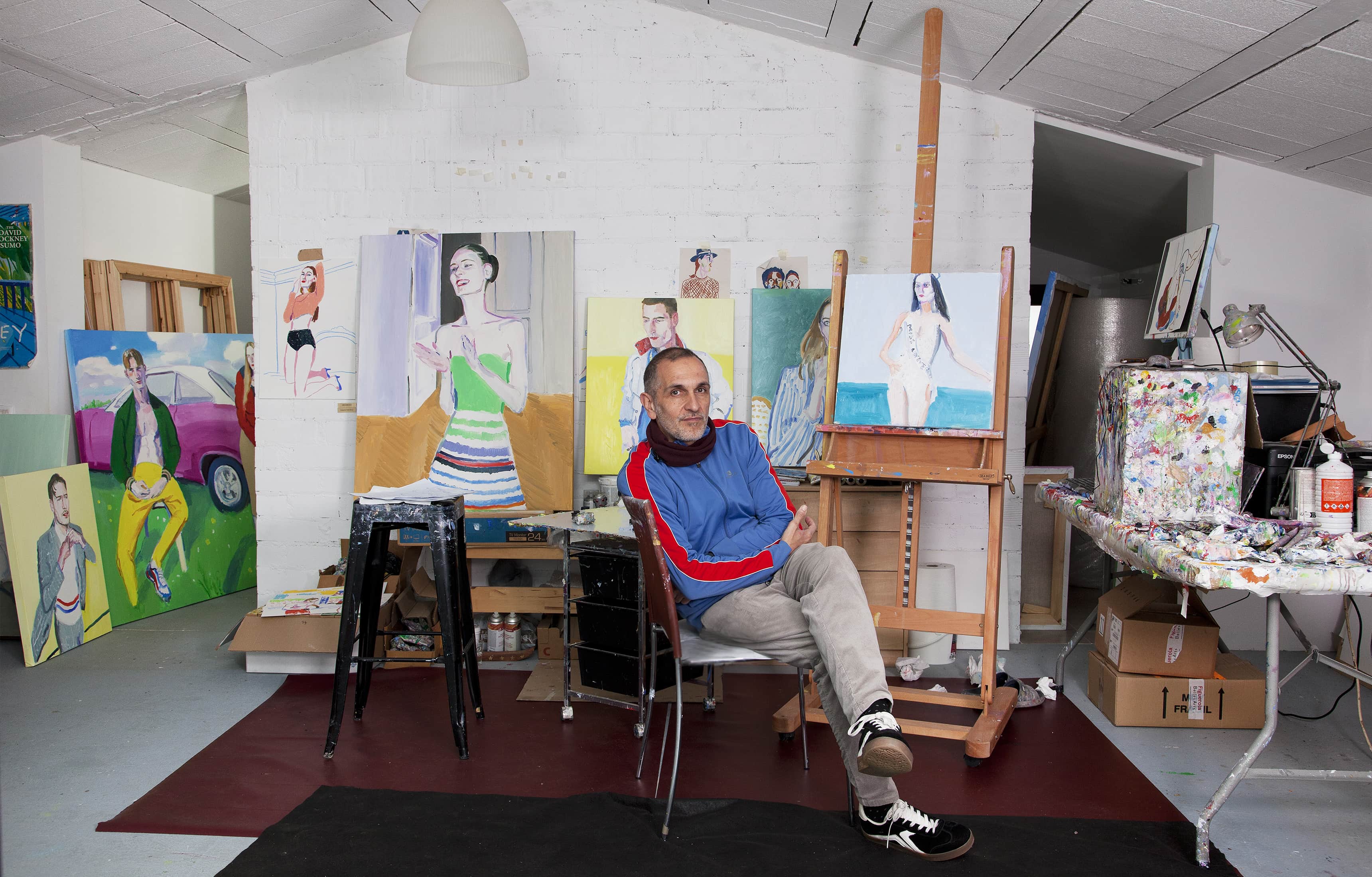
Solà’s own studio carries the reference plainly. A photograph of him at work, taken in 2025, shows a copy of Hockney’s SUMO-format monograph propped on a shelf behind his easel, alongside his own canvases in progress, not staged for the camera so much as simply part of the room. The debt in Thoughts of a Bigger Splash is not a marketing conceit invented for this show. It has been sitting on his shelf.
What he changes is the emotional register entirely. Hockney’s splash paintings are pictures of a moment, arrival, immersion, the single second a diver disappears beneath the surface, staged around an empty pool and an absent figure. Solà crowds his pools with people and empties out the moment instead: nobody arrives, nobody dives, nobody leaves. The tension in Coupe du Monde or Party is not what just happened but what is conspicuously not happening between the figures who share the frame. It borrows more from La Piscine, Jacques Deray’s 1969 film in which a pool becomes a pressure chamber for everything its cast will not say to each other, than from Hockney’s own emptied, sunlit calm.
The timing sharpens all of it. Hockney died in June 2026, three months before this show opened, and Opera Gallery has been explicit that the title is intended as tribute rather than trend-chasing. A painter who has spent two years quietly working the same motif Hockney made famous is now doing so in the first Monaco season after the reference himself is gone, which turns a stylistic homage into something closer to a handover.

Frequently asked questions
What is Thoughts of a Bigger Splash?
A solo exhibition of five new paintings by the Spanish artist Xevi Solà, on view at Opera Gallery Monaco from 18 September to 15 October 2026, his first major show in the principality.
Where is it being held?
At Opera Gallery Monaco, Palais de la Scala, 1 avenue Henri Dunant, Monaco.
Why is it called Thoughts of a Bigger Splash?
The title references David Hockney’s 1967 painting A Bigger Splash. Solà keeps Hockney’s swimming pool motif but replaces its association with status and leisure with a more psychological, unresolved reading of the same setting.
Who is Xevi Solà?
A Spanish painter, born in 1969 in Santa Coloma de Farners and based in Girona, globally represented by Opera Gallery since October 2025 following his first solo show with the gallery in Geneva in 2024.
What paintings are in the show?
Coupe du Monde, a diptych, Bamboo, Rendez-vous, Party and Vestiaires, all completed in 2026, alongside a sixth work, Sunrise, described in the gallery’s own material.
Is this connected to any other current Xevi Solà exhibition?
Yes. A related show, One Year, Scenes in Time, is running concurrently at the Seoul Calligraphy Art Museum through October 2026.
Did Xevi Solà know David Hockney?
There is no indication the two artists met. The reference in this show is to Hockney’s work and legacy rather than a personal connection, and the exhibition opens three months after Hockney’s death in June 2026.
Final thoughts
The easiest way to describe Thoughts of a Bigger Splash is as a tribute show, an homage timed to a famous painter’s death. That is true as far as it goes, but it treats the exhibition as a single gesture rather than the fifth stop on a route Solà has been walking since Geneva in 2024, through Miami, New York and now Monaco and Seoul at once, each show narrowing in on the same question about what a pool actually does to the people standing around it.
What makes the Monaco show worth the trip past the obvious Hockney comparison is the distance between where Solà started, drawing prize-winning comic panels as a teenager, and where two years of steady, unglamorous repetition of one motif have brought him: a room in the Palais de la Scala where five paintings ask what is left of a swimming pool once you take away everything Hockney once put in one.
Leave a Reply